




Why Cyber Security Is The Future Career ?
By Cyber Defentech Team | May 2026 | 10 Mins Read | Beginner to Advanced
Introduction
On a quiet Tuesday morning in November 2023, a ransomware gang locked down the systems of the Industrial and Commercial Bank of China’s US division — one of the world’s largest financial institutions — forcing Wall Street traders to reroute transactions manually using USB drives. The attack lasted days. The financial disruption was measured in billions. And the root cause? A single unpatched vulnerability and a critical shortage of trained cybersecurity professionals who could have caught it before it became a catastrophe.
That story did not make most people’s morning news. But for anyone paying attention to where the world is heading, it told a story that should stop you cold: we are living through the most dangerous era of digital vulnerability in human history — and the professionals capable of defending against it are in desperately short supply.
In 2026, cybercrime is projected to cost the global economy over $10.5 trillion USD annually — more than the GDP of every country except the United States and China. Every hospital, every bank, every government system, every startup, every e-commerce platform you have ever used is a target. And behind every successful defense of those systems is a trained cybersecurity professional.
If you are still wondering whether cyber security is the right career path — or searching for the best IT career in India that offers genuine long-term security — here is your answer: it is not just a good career. It is arguably the most important, most in-demand, and most financially rewarding professional discipline of the next decade. This complete cybersecurity career roadmap will show you exactly why cybersecurity demand in 2026 is at an all-time high — and exactly how to get there.
What Is a Cyber Security Career?
A career in cyber security means becoming a professional guardian of the digital world. It encompasses every role, discipline, and specialization involved in protecting computer systems, networks, data, applications, and digital infrastructure from unauthorized access, theft, disruption, and destruction.
Cyber security is not a single job title. It is an entire ecosystem of high-demand professional roles — from ethical hackers who attack systems to find weaknesses before criminals do, to incident responders who contain breaches in real time, to cloud security architects who design fortress-grade infrastructure, to GRC analysts who ensure organizations meet regulatory requirements.
What unites every cyber security career is purpose: protecting the systems that power modern civilization. And in 2026, with AI cybersecurity jobs multiplying across every sector as AI-powered threats escalate faster than defenses can keep pace, that purpose has never been more urgent or more valuable.
Why Is Cyber Security The Future Career?
Several converging forces make cyber security not just relevant but absolutely essential as a career path for the foreseeable future. Understanding the future of cybersecurity jobs and the scale of cybersecurity demand in 2026 makes the case impossible to ignore.
The Talent Gap Is Structural, Not Cyclical.
The global cybersecurity workforce gap stands at over 4 million unfilled positions as of 2026. This is not a temporary market fluctuation — it is a structural deficit years in the making, driven by the explosion of internet-connected systems, cloud migration, remote work infrastructure, and IoT device proliferation. Universities and traditional training pipelines have never produced enough graduates to fill this gap. Demand consistently and significantly outpaces supply.
AI Has Raised the Stakes Dramatically.
Artificial intelligence has transformed cyber threats from largely manual, human-paced operations into automated, machine-speed attacks that evolve in real time. AI-powered malware adapts to evade defenses. AI-generated phishing emails are indistinguishable from legitimate communications. Autonomous attack tools can compromise entire networks in hours. This escalation demands more cybersecurity professionals, with deeper skills, than ever before — and it is not slowing down.
Digital Transformation Is Non-Reversible.
Every industry on earth is becoming a technology industry. Healthcare runs on connected systems. Finance runs on digital infrastructure. Manufacturing runs on industrial IoT. Government services run on cloud platforms. Agriculture runs on connected sensors. The more digital our world becomes, the larger the attack surface — and the greater the need for professionals who can defend it.
Regulation Is Forcing Investment.
India’s Digital Personal Data Protection Act, the EU’s GDPR and NIS2 Directive, the United States’ cybersecurity executive orders, and sector-specific regulations across banking, healthcare, and critical infrastructure are legally mandating cybersecurity investments. Organizations that do not employ qualified professionals face massive fines and legal liability. Compliance requirements are generating demand entirely independent of actual threat levels.
Job Security Is Exceptional.
In an era of tech layoffs and AI-driven role displacement, cybersecurity stands out as a profession where human expertise is genuinely irreplaceable. The creative, adversarial thinking required to outmaneuver sophisticated attackers — and the judgment required to make high-stakes incident response decisions — cannot be automated away. Cybersecurity professionals are among the most recession-proof workers in the global economy.
Real-World Cyber Threats & Risks Driving Demand
The demand for cybersecurity careers is not theoretical. It is being driven by real, escalating attacks happening right now across every sector:
Healthcare Under Siege: The AIIMS Delhi ransomware attack in 2022 paralyzed one of India’s most critical hospital systems for two weeks, forcing doctors to revert to paper records and delaying critical patient care. Similar attacks have struck hospitals across the US, UK, and Europe — with patient outcomes directly impacted as a result.
Financial System Targeting: The ICBC US ransomware incident disrupted Treasury bond settlement across Wall Street. The Bangladesh Bank heist saw $81 million USD stolen through compromised SWIFT credentials. Indian banking institutions face hundreds of thousands of cyber attack attempts every single day.
Critical Infrastructure Vulnerability: Power grids, water treatment facilities, and transportation systems are increasingly connected and increasingly targeted. Ukraine’s power grid attacks in 2015 and 2016 — executed by nation-state hackers — demonstrated that cyber warfare can cause real-world physical consequences.
Supply Chain Attacks at Scale: The SolarWinds breach compromised 18,000 organizations including US government agencies through a single poisoned software update. The MOVEit zero-day exploitation of 2023 affected thousands of organizations globally through a single managed file transfer application vulnerability.
AI-Augmented Phishing and Fraud: Generative AI tools are enabling attackers to craft hyper-personalized deception campaigns at industrial scale. Deepfake video and voice cloning are being used to impersonate executives in real-time calls, bypassing human judgment entirely.
Every one of these incidents represents a failure that a qualified cybersecurity professional might have prevented — and a lesson that organizations are learning by paying devastating costs.
Why Companies Need Cyber Security Professionals?
The organizational demand for cybersecurity talent spans every industry and every company size:
Enterprise Organizations need Security Operations Centers staffed around the clock, cloud security architects, penetration testers, incident response teams, and GRC professionals to manage compliance across complex regulatory environments.
Financial Institutions — banks, insurance companies, fintech startups — face some of the most sophisticated and frequent attacks in any sector, and maintain some of the largest and most well-funded cybersecurity programs in the world.
Healthcare Organizations protect patient data that is worth ten times more on the dark web than financial data, making them prime targets and driving heavy investment in security talent.
Government and Defense agencies at every level require certified cybersecurity professionals for both offensive (cyber warfare, intelligence) and defensive (infrastructure protection, incident response) operations.
Technology Companies — from cloud providers to SaaS startups — embed security into every layer of their development and operations, creating enormous demand for DevSecOps professionals, application security engineers, and security architects.
Small and Medium Enterprises are the fastest-growing segment of cybersecurity demand, as they increasingly recognize their vulnerability and face regulatory pressure to demonstrate adequate security controls.
The result is a job market where qualified cybersecurity professionals receive multiple competing offers, companies actively recruit from competitors with significant salary premiums, and entry-level certified practitioners are treated as valuable strategic assets from Day 1.
Skills You Will Learn in a Cyber Security Career
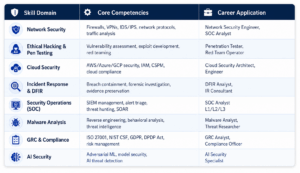
Career Opportunities in Cyber Security
A cyber security career is not a single track — it is a branching ecosystem of specializations that cater to different skill sets, personalities, and professional ambitions:
Offensive Security (Red Team): An ethical hacking career remains one of the most exciting and financially rewarding paths in the industry — encompassing penetration testers, red team operators, bug bounty hunters, and offensive security researchers who think like attackers to expose weaknesses before they are exploited maliciously.
Defensive Security (Blue Team): SOC analysts, threat hunters, incident responders, digital forensics investigators, and malware analysts — professionals who detect, investigate, and contain real attacks in real time.
Engineering & Architecture: Security architects, cloud security engineers, DevSecOps professionals, and application security engineers — the professionals who build security into systems from the ground up rather than bolting it on afterward.
Intelligence & Research: Threat intelligence analysts, vulnerability researchers, and security researchers — professionals who study the evolving threat landscape and develop the knowledge that keeps defenders ahead of attackers.
Governance & Compliance: GRC analysts, compliance officers, security auditors, and data protection officers — professionals who ensure organizations meet legal, regulatory, and contractual security obligations.
Leadership & Strategy: CISOs, security directors, and security program managers — senior professionals who lead organizational security strategy at the executive level.
Every one of these paths offers strong job security, compelling compensation, and the opportunity to do work that genuinely matters.
Salary & Industry Demand
Cyber security professionals are among the highest-compensated workers in the technology sector globally. Cybersecurity salary in India has seen consistent double-digit growth year over year — and the numbers below reflect the current market reality:
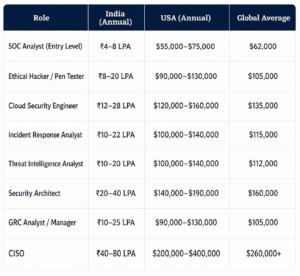
India’s cybersecurity market is expanding at a compounded annual growth rate of over 15%, driven by the DPDP Act’s compliance requirements, rapid digitization across BFSI and healthcare, and the growing maturity of India’s tech sector. The cyber security scope in India has never been broader — professionals are increasingly sought by global organizations through remote and hybrid arrangements, accessing international salary structures while working from India.
Real-World Importance of a Cyber Security Career
Let us be direct about what is at stake here — because this is not just about salary and job security.
When a hospital’s systems go down in a ransomware attack, surgeries get postponed. When a bank’s customer data is stolen, people lose their life savings. When a power grid gets compromised, entire cities lose electricity in winter. When government systems are breached, national security is threatened.
Behind every successful defense of these critical systems is a trained cybersecurity professional who chose this career, developed their skills, earned their certifications, and showed up to do work that matters.
Cyber security is not just a high-paying career. It is a vocation with genuine moral weight. The professionals who enter this field are not just building personal financial security — they are protecting the digital infrastructure that billions of people depend on every day.
That combination of financial reward and genuine societal impact is rare. Medicine offers it. Law enforcement offers it. And increasingly, cyber security offers it too — at compensation levels that few other professions can match.
Tools & Technologies Used in Cyber Security Careers
Building a cyber security career means becoming proficient with the industry’s most important platforms and tools:
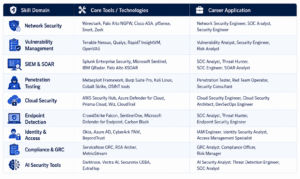
Cyber Defentech’s training programs provide direct, hands-on access to the majority of these industry-standard platforms — ensuring students develop genuine proficiency, not just conceptual familiarity.
Beginner Roadmap: Your Cybersecurity Career Roadmap from Zero to Hired
Starting from zero and reaching a hired cybersecurity professional is a realistic goal with the right structured approach:
Stage 1 — Technical Foundations (1–2 months) Build your base in Linux, basic networking (OSI model, TCP/IP, DNS, HTTP/S), and fundamental operating system knowledge. Free resources like TryHackMe’s pre-security path and Cisco’s Networking Academy are excellent starting points.
Stage 2 — First Certification: CompTIA Security+ (2–3 months) Security+ is the globally recognized entry-level credential that proves foundational cybersecurity knowledge. It is required for many entry-level government and enterprise roles and signals to employers that you are serious about the profession. Cyber Defentech’s Security+ preparation program combines structured curriculum with practice labs.
Stage 3 — Choose Your Initial Specialization (2–4 months) Based on your natural inclinations — offensive (hacking and testing) or defensive (monitoring and response) — choose your first specialization. CEH v13 for offensive, CySA+ for defensive, or CCSP for cloud security are all strong choices at this stage.
Stage 4 — Build Practical Experience (Ongoing) Create a home lab. Practice on Hack The Box, TryHackMe, and PentesterLab. Participate in Capture the Flag (CTF) competitions. Document your projects on GitHub. Contribute to bug bounty programs. Practical experience alongside certifications is what makes candidates genuinely compelling to employers.
Stage 5 — Enter the Job Market (Month 6–12) With Security+ and a specialized certification in hand, plus demonstrable hands-on experience from labs and CTFs, you are competitive for entry-level SOC analyst, junior penetration tester, or security operations roles. Cyber Defentech’s career support services help you translate your skills into your first professional position.
Stage 6 — Advance and Specialize (Year 2–5) OSCP for offensive practitioners, CISM for those moving toward management, CCSP for cloud security specialists, or advanced platform certifications for specific toolsets position you for mid-senior roles with dramatically higher compensation. The cybersecurity career ladder rewards continuous learning more than almost any other profession.
Why Choose Cyber Defentech?
The quality of your training foundation determines the trajectory of your entire career. Cyber Defentech training is built to give you the best possible start and the strongest possible progression — with a program structure that consistently produces job-ready professionals, not just exam passers.
Hands-On First Philosophy: Every Cyber Defentech program is built around practical, real-world skill development. Lectures and theory are the foundation — but the majority of learning time is spent in hands-on lab environments, working with real tools on realistic scenarios. When you complete a Cyber Defentech program, you have not just studied cybersecurity — you have practiced it.
Continuously Updated Curriculum: The cybersecurity threat landscape evolves every week. Cyber Defentech’s curriculum is updated continuously to reflect new threats, new tools, new attack techniques, and new industry requirements. You are never learning yesterday’s knowledge.
Practitioner Instructors: Our trainers are active cybersecurity professionals — penetration testers, incident responders, cloud security engineers, and threat analysts who work in the field every day. Their instruction bridges the gap between academic knowledge and professional reality in ways that career educators simply cannot.
End-to-End Career Support: Cyber Defentech does not consider its job done when you pass your exam. Resume review, mock interviews, LinkedIn profile optimization, and access to our professional network and alumni community support your career transition from student to professional.
Flexible Learning Pathways: Whether you are a college student beginning your career, a working IT professional pivoting into security, or a complete career changer entering tech for the first time, Cyber Defentech has structured pathways designed for your starting point and your goals.
Industry Recognition: Cyber Defentech’s training programs are aligned with industry-recognized certification bodies including EC-Council, CompTIA, (ISC)², and Offensive Security — ensuring your learning translates directly into credentials that employers respect.
Future Scope & Industry Trends
The question is not whether cyber security will remain a valuable career field — that is beyond doubt. The question is where within cyber security the most exciting and rewarding opportunities will emerge in the years ahead.
AI Security Will Become a Primary Discipline. As AI systems are deployed across critical applications in finance, healthcare, infrastructure, and defense, securing those systems — and defending against AI-powered attacks — will become a standalone, high-demand specialization. Early movers into AI security will define the field.
India Will Lead Global Cybersecurity Talent Supply. With a massive technical talent pool, growing domestic demand, and increasing global recognition of Indian cybersecurity professionals, India is positioned to become one of the world’s most significant cybersecurity talent markets within this decade. The future of cybersecurity jobs in India — particularly in AI cybersecurity jobs, cloud security, and compliance — is exceptionally bright.
Quantum Computing Will Reshape Cryptography. Within the next five to ten years, quantum computing will threaten current encryption standards. Post-quantum cryptography expertise will be among the most sought-after specializations in the field.
Continuous Security Testing Will Replace Annual Assessments. AI-powered continuous penetration testing platforms will become standard enterprise infrastructure, creating demand for professionals who can configure, operate, and interpret the outputs of these systems.
Regulatory Complexity Will Intensify. As governments globally implement more sophisticated cybersecurity regulations, GRC professionals who understand multi-jurisdictional compliance requirements will be in extraordinary demand — particularly in multinational organizations navigating GDPR, DPDP, NIS2, and emerging AI governance frameworks simultaneously.
The Cybersecurity Talent Gap Will Persist. Despite growing training programs globally, the structural deficit between cybersecurity talent supply and demand is not projected to close within this decade. For professionals entering the field now, this means sustained job security and strong compensation growth for their entire career.
Final Thoughts
You picked an extraordinary moment to consider a cyber security career. The digital world has never been more complex, more connected, more valuable — or more vulnerable. The professionals capable of defending it have never been more needed, more respected, or more generously compensated.
Why cyber security is the future career — and the best IT career in India — is not a marketing claim. It is an observable reality backed by four million unfilled jobs, double-digit annual salary growth, exploding cybersecurity demand in 2026, recession-proof job security, and the irreplaceable value of human expertise in the most adversarial technical environment ever created.
The path from where you are today to a thriving cyber security career is clear, achievable, and more accessible than most people realize. What it requires is commitment to learning, the right training foundation, and the courage to step into a field that genuinely matters.
Cyber Defentech is here to walk that path with you — from your first concept to your first job offer and every advancement beyond.
FAQs
Q1. Why is cyber security considered the future career in 2026?
Cyber security is the future career because demand for qualified professionals grows faster than supply, AI is accelerating both threats and the need for defenders, digital transformation is making every industry dependent on secure systems, and regulatory requirements are legally mandating cybersecurity investment. The result is a structural talent shortage that creates exceptional job security and compensation for qualified professionals.
Q2. Is cyber security a good career in India in 2026?
Absolutely. India’s cybersecurity market is growing at over 15% annually, driven by the DPDP Act, rapid digitization, and growing recognition among enterprises of their vulnerability. Indian cybersecurity professionals are also increasingly accessed by global organizations through remote and hybrid arrangements, creating access to international compensation while working domestically.
Q3. What qualifications do I need to start a cyber security career?
You do not need a formal computer science degree to start a cybersecurity career. Industry certifications like CompTIA Security+, CEH, and CySA+ are the primary credentials employers look for at the entry level. Practical skills demonstrated through home labs, CTF competitions, and hands-on training programs — like those offered by Cyber Defentech — are highly valued alongside certifications.
Q4. How long does it take to start a cybersecurity career from scratch?
With dedicated effort and structured training, most motivated learners can be competitive for entry-level cybersecurity roles within 6–12 months. The timeline depends on your existing technical background, the intensity of your study, and the certifications you pursue. Cyber Defentech’s beginner-to-intermediate programs are structured to get you job-ready efficiently.
Q5. What is the average salary for a cybersecurity professional in India?
Entry-level cybersecurity roles in India typically start at ₹4–8 LPA. Mid-level professionals with 2–4 years of experience and specialized certifications commonly earn ₹10–22 LPA. Senior professionals and security architects reach ₹25–40 LPA, while CISO-level roles at large enterprises command ₹40–80 LPA or more.
Q6. Which cybersecurity specialization has the best career prospects?
All major cybersecurity specializations have strong career prospects given the current talent shortage. Cloud security, AI security, penetration testing, and incident response are experiencing particularly high demand in 2026. The best specialization depends on your natural strengths — offensive thinkers gravitate toward penetration testing, analytical thinkers toward threat intelligence and incident response, and systems thinkers toward cloud security architecture.
Q7. Is cyber security affected by AI replacing jobs?
Cyber security is one of the fields least susceptible to AI-driven job displacement. The creative, adversarial reasoning required to outmaneuver sophisticated attackers, and the judgment required for high-stakes incident response decisions, cannot be reliably automated. AI augments cybersecurity professionals — making them more capable and productive — but does not replace the need for human expertise.
Q8. How does Cyber Defentech help launch a cybersecurity career?
Cyber Defentech provides end-to-end career support: structured certification preparation programs, hands-on lab environments with industry-standard tools, practitioner instructors with real-world experience, resume and interview coaching, and access to a professional network and alumni community. Students leave Cyber Defentech not just exam-ready but genuinely job-ready.
Ready to Build Your Future Career in Cyber Security?
The digital world needs defenders. Organizations are searching desperately for qualified professionals. The salary, job security, and career satisfaction this field offers are exceptional.
The only question that remains is: when do you start?
Cyber Defentech’s industry-focused, hands-on cybersecurity training programs are designed to take you from wherever you are today to a confident, certified, job-ready cybersecurity professional — faster and more effectively than any other pathway available.
✅ Hands-on Practical Training — Real labs, real tools, real-world scenarios from Day 1
✅ Real-World Cybersecurity Skills — Build genuine capability, not just exam knowledge
✅ Industry-Focused Learning — Curriculum aligned with what employers actually need
✅ Future-Ready Career Path — Skills and certifications that grow with the industry
✅ Expert Mentorship — Learn from active professionals, not career educators
✅ Career Support Included — Resume, interview prep, and professional network access
Your future in cyber security starts with one decision.
💬 Have a question about starting your journey?
Drop it in the comments below — our team and community members respond to every question.
The world’s most important digital infrastructure needs protecting. That work needs you.
