
Continuous Threat Exposure Management (CTEM): The Complete Guide
Introduction
Cybersecurity used to be simple to explain: build a strong perimeter, patch your systems, run an annual penetration test, and you were considered reasonably safe. That world no longer exists. Today, organizations run workloads across multiple clouds, depend on hundreds of SaaS applications, support remote and hybrid employees, and connect with countless third-party vendors. Every one of these adds new entry points for attackers.
The result? Security teams are drowning in alerts, scan reports and vulnerability lists that contain thousands of items, yet breaches keep happening. The problem is not a lack of data. The problem is that most organizations cannot tell which exposures actually matter, which ones attackers can really exploit, and what to fix first.
This is exactly the gap that Continuous Threat Exposure Management (CTEM) was created to close. Introduced by Gartner in 2022, CTEM is not a single tool or product. It is a structured, ongoing program that helps organizations continuously discover, prioritize, validate and fix the exposures that pose real risk to the business.
In this guide by Cyber Defentech, we will explain what CTEM is, how it differs from traditional approaches, its five stages, key benefits, common challenges, and a practical roadmap to implement it in your organization.
What Is Continuous Threat Exposure Management (CTEM)?
Continuous Threat Exposure Management (CTEM) is a cybersecurity framework that gives organizations a continuous, repeatable process to assess how exposed they are to cyber threats and to reduce that exposure in a prioritized way.
The key word is “exposure.” An exposure is not the same as a vulnerability. A vulnerability is a weakness, such as an unpatched server or a software flaw. An exposure is any condition that an attacker could realistically use to reach and harm your business. This includes:
- Software vulnerabilities and missing patches
- Misconfigured cloud services and storage buckets
- Over-privileged user and service accounts
- Weak or leaked credentials
- Exposed APIs and forgotten internet-facing assets
- Shadow IT and unmanaged devices
- Risky third-party and supply-chain connections
- Gaps in security controls such as EDR, firewalls or email security
CTEM looks at all of these together and asks one practical question: “If an attacker targeted us today, what could they actually reach, and what would the impact be?”
Rather than treating security as a periodic audit, CTEM turns it into a continuous cycle that adapts as your environment and the threat landscape change.
Why Traditional Security Approaches Are Not Enough
To understand the value of CTEM, it helps to see where older approaches fall short.
1. Point-in-time assessments go stale quickly
Annual penetration tests and quarterly vulnerability scans only show a snapshot. A new cloud server, a code deployment or a newly published exploit can change your risk overnight, long before the next scheduled test.
2. Vulnerability lists are too long to act on
A typical enterprise scan can produce tens of thousands of findings. Teams often rely on CVSS severity scores alone, but a “critical” score does not mean a flaw is actually exploitable in your environment. Meanwhile, a “medium” issue on a key asset may be the exact path an attacker needs.
3. Security tools work in silos
Vulnerability scanners, cloud security tools, identity systems and endpoint platforms each give a partial view. Without connecting them, nobody sees the complete attack path.
4. Security and business goals are disconnected
Technical teams talk in CVEs and patches, while leadership thinks in revenue, uptime and compliance. Traditional programs rarely connect the two.
5. The attack surface keeps growing
Cloud adoption, APIs, remote work, IoT devices and AI-driven applications expand the attack surface faster than manual processes can track it.CTEM was designed to solve these problems by shifting the focus from “find every flaw” to “reduce the exposures that matter most.”
CTEM vs Vulnerability Management: What’s the Difference?
Many people assume CTEM is simply a new name for vulnerability management. It is not. Vulnerability management is an important part of the picture, but CTEM is much broader.
| Aspect | Traditional Vulnerability Management | CTEM |
|---|---|---|
| Scope | Mostly known IT assets and software flaws | Entire attack surface: cloud, identity, SaaS, APIs, third parties |
| Frequency | Periodic scans | Continuous, ongoing cycle |
| Prioritization | Based mainly on severity scores | Based on exploitability, business impact and attack paths |
| Validation | Rarely validated | Tested through simulation and adversarial validation |
| Outcome | A list of vulnerabilities | Measurable reduction in real risk |
| Stakeholders | Mostly security and IT teams | Security, IT, risk, business leaders |
In short, vulnerability management tells you what is broken. CTEM tells you what is dangerous, what is provable, and what to fix first.
The Five Stages of the CTEM Framework
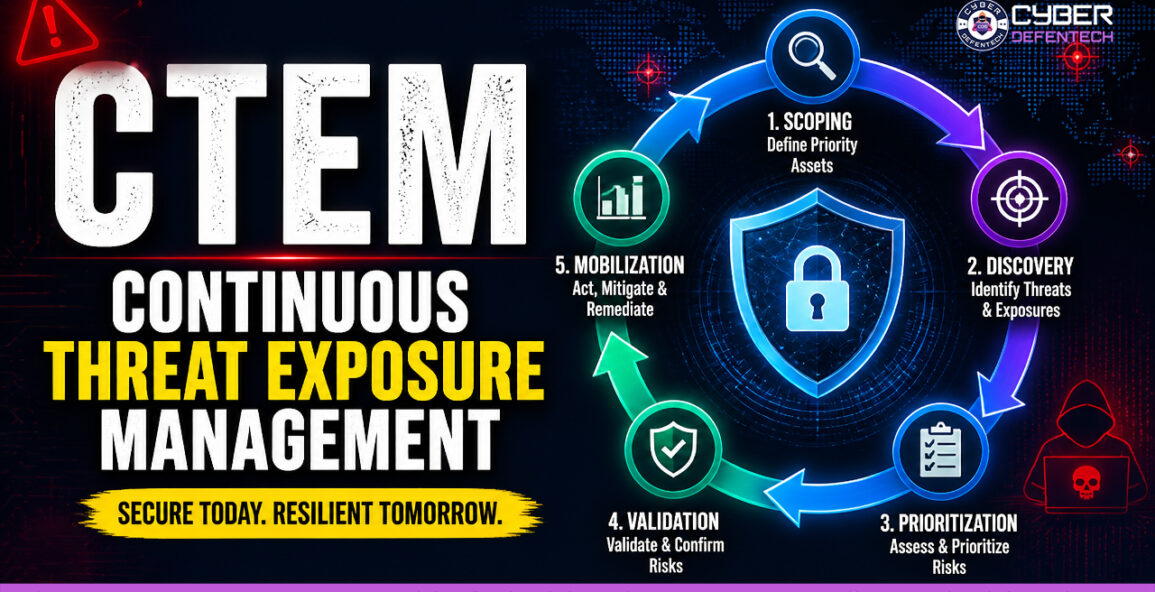
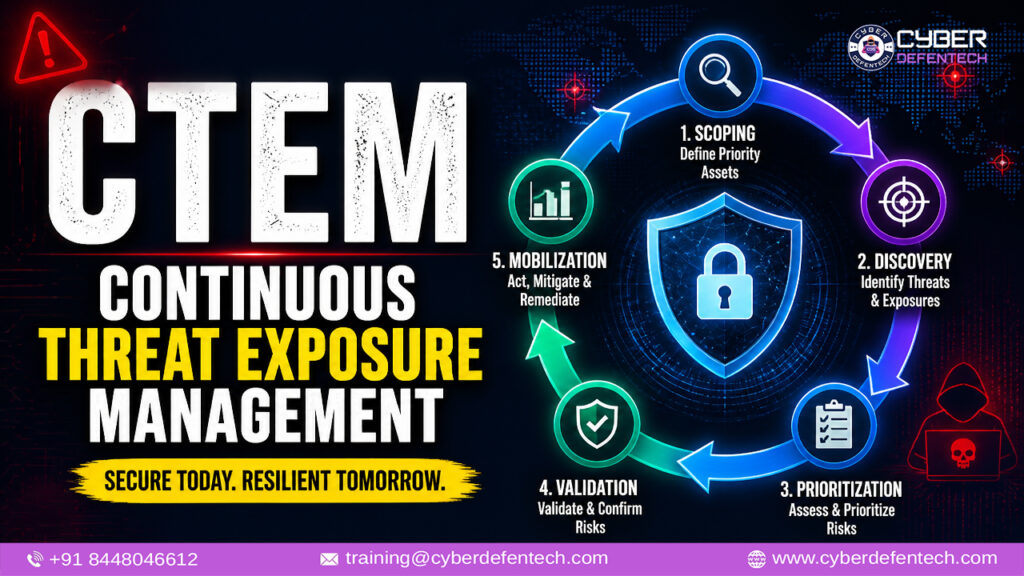
The CTEM program runs as a continuous cycle of five stages: Scoping, Discovery, Prioritization, Validation and Mobilization. Let’s look at each.
Stage 1: Scoping
Scoping defines what you will protect and why. Instead of trying to cover everything at once, you begin with the parts of the business that matter most, such as customer-facing applications, payment systems, critical data stores, or specific business units.
Good scoping involves:
- Identifying critical business processes and the assets that support them
- Including both internal and external attack surfaces
- Considering SaaS platforms, cloud environments and third-party connections
- Aligning with business leaders so security efforts match business priorities
A well-defined scope prevents wasted effort and ensures the program is tied to real business outcomes from day one.
Stage 2: Discovery
In the discovery stage, you build a complete and continuously updated picture of the assets and exposures within your scope. This goes beyond a simple asset inventory.
Discovery should uncover:
- Known and unknown (shadow) assets
- Vulnerabilities and misconfigurations
- Identity risks such as excessive permissions or exposed credentials
- Weaknesses in security controls
- Internet-exposed services and forgotten subdomains
- Risks introduced through vendors and partners
The goal is visibility. You cannot protect what you cannot see, and in modern environments new assets appear and disappear daily, which is why discovery must be continuous rather than occasional.
Stage 3: Prioritization
This is where CTEM truly separates itself from older methods. Since you can never fix everything, you must decide what to fix first.
Effective prioritization considers:
- Exploitability: Is there a known exploit in the wild? Is it actively used by threat actors?
- Asset criticality: How important is the affected system to the business?
- Attack paths: Can this exposure be chained with others to reach critical assets?
- Existing controls: Are there compensating controls that already reduce the risk?
- Business impact: What would be the financial, operational or reputational damage?
By combining threat intelligence with business context, teams can focus on the small percentage of exposures that create the largest real-world risk instead of chasing every high-severity score.
Stage 4: Validation
Validation answers an essential question: “Can this exposure actually be exploited in our environment?”
Instead of assuming risk, you test it. Common validation methods include:
- Breach and attack simulation (BAS)
- Automated penetration testing
- Red team and purple team exercises
- Attack path analysis
- Testing whether security controls detect and block real attack techniques
Validation reduces false urgency, because some “critical” findings turn out to be unexploitable, while others that looked minor prove to be dangerous. It also proves whether your existing tools, such as EDR, firewalls and email security, are really working as expected.
Stage 5: Mobilization
Even the best insights are useless if nothing gets fixed. Mobilization is about turning findings into action across the organization.
This stage involves:
- Creating clear remediation workflows with defined owners and deadlines
- Integrating with ticketing and IT operations tools
- Agreeing on approval processes for patching and configuration changes
- Defining what to do when a fix is not possible, such as virtual patching or compensating controls
- Reporting progress in language leadership understands
Mobilization requires cooperation between security, IT, DevOps, and business teams. Without this alignment, exposures remain open even when everyone knows they exist.
After mobilization, the cycle begins again. New scopes are added, new assets are discovered, and results feed into the next round of improvements.
Key Benefits of Implementing CTEM
1. Reduced Risk of Breaches
By focusing on exploitable exposures and validated attack paths, organizations fix what attackers are most likely to use. Gartner has predicted that by 2026, organizations that prioritize security investments based on a CTEM program will be significantly less likely to suffer a breach.
2. Better Use of Limited Resources
Security teams rarely have enough people or budget. CTEM helps you direct effort where it delivers the most value, rather than spreading resources across thousands of low-impact findings.
3. Complete Attack Surface Visibility
Continuous discovery ensures that cloud workloads, shadow IT and third-party risks do not stay hidden.
4. Improved Collaboration
CTEM encourages security, IT, DevOps and business teams to work from a shared view of risk, reducing friction and finger-pointing.
5. Stronger Alignment with Business Goals
Because scoping and prioritization are tied to business-critical assets, security conversations with executives become clearer and more meaningful.
6. Proof That Controls Work
Validation gives you evidence about whether your security investments are actually performing, which supports smarter purchasing decisions.
7. Easier Compliance and Reporting
Continuous monitoring and documented remediation make it easier to demonstrate due diligence for frameworks such as ISO 27001, SOC 2, PCI DSS, HIPAA and regional data protection regulations.
8. Faster Response to New Threats
When a new zero-day or widely exploited vulnerability is announced, a CTEM program lets you quickly identify which assets are affected and whether they are truly exposed.
Common Challenges in CTEM Adoption
CTEM delivers strong results, but organizations should be ready for some obstacles.
Tool sprawl and data overload. Many companies already own several security tools. Integrating data from all of them into one view takes planning.
Lack of asset ownership. If nobody owns a system, nobody fixes its exposures. Clear ownership is essential.
Cultural resistance. Teams used to periodic audits may find continuous programs demanding. Strong leadership support helps.
Skill gaps. Prioritization, attack path analysis and validation require specialized expertise that is not always available in-house.
Remediation bottlenecks. Finding exposures is often easier than fixing them. Change control, legacy systems and limited maintenance windows can slow progress.
Measuring success. Without defined metrics, it is hard to show progress. Organizations should agree on measurable goals early.
Recognizing these challenges upfront makes them much easier to manage.
How to Implement CTEM: A Practical Roadmap
You do not need to transform everything at once. A phased approach works best.
Step 1: Get executive sponsorship. Explain CTEM in business terms: fewer breaches, lower downtime and better use of budget. Secure support from both security and business leaders.
Step 2: Define a focused initial scope. Start with one high-value area, such as your external attack surface or a critical application, and expand later.
Step 3: Build an accurate asset and exposure inventory. Combine existing scanners, cloud security tools, identity data and external attack surface monitoring to create a unified view.
Step 4: Establish a risk-based prioritization model. Include exploit intelligence, asset criticality and business impact, not just CVSS scores.
Step 5: Introduce validation. Begin with attack path analysis or automated testing of your most critical assets, then add simulation and red team exercises as your program matures.
Step 6: Create remediation workflows. Define owners, service-level agreements (SLAs) and escalation paths. Integrate with ITSM and DevOps tools to reduce manual handoffs.
Step 7: Track metrics and report regularly. Useful metrics include:
- Mean time to remediate critical exposures
- Percentage of critical assets covered by the program
- Number of validated attack paths closed
- Reduction in externally exposed vulnerabilities
- Control effectiveness scores from validation tests
Step 8: Repeat and mature. Treat CTEM as a living program. Expand scope, automate more steps and refine your processes with each cycle.
Best Practices for a Successful CTEM Program
- Think like an attacker. Evaluate exposures from the perspective of how an adversary would chain weaknesses together.
- Prioritize business context. The same vulnerability can be trivial on one server and catastrophic on another.
- Automate wherever possible. Automation in discovery, correlation and ticketing frees analysts to focus on high-value work.
- Include third parties. Vendors and partners can become your weakest link, so include them in scope.
- Integrate with threat intelligence. Real-time knowledge of active campaigns makes prioritization more accurate.
- Communicate in business language. Translate technical findings into impact, cost and risk for non-technical stakeholders.
- Start small, scale steadily. A successful pilot builds confidence and momentum for wider adoption.
The Future of CTEM
As attack surfaces keep growing, CTEM is becoming a core part of modern security strategy. Several trends are shaping its future:
- AI and automation are accelerating discovery, correlation and prioritization, helping teams keep pace with fast-moving threats.
- Convergence of tools is bringing vulnerability management, attack surface management, cloud security posture management and validation into more unified platforms.
- Identity-centric security is making identity exposures a central focus, since many modern attacks start with stolen or misused credentials.
- Regulatory pressure is encouraging organizations to demonstrate continuous risk management, not just periodic compliance checks.
Organizations that adopt CTEM early will be better prepared to handle this evolving landscape.
How Cyber Defentech Can Help
At Cyber Defentech, we help organizations move from reactive security to proactive, continuous exposure management. Whether you are just beginning your CTEM journey or looking to mature an existing program, our experts can support you with:
- Attack surface discovery and continuous monitoring
- Risk-based vulnerability and exposure prioritization
- Penetration testing and adversarial validation
- Security control effectiveness assessments
- Remediation planning and workflow guidance
- Executive-level risk reporting
Our approach is practical and business-focused. We do not just hand you a long list of findings. We help you understand what matters, prove what is exploitable, and fix it efficiently.
Frequently Asked Questions (FAQs)
Q1. What does CTEM stand for?
CTEM stands for Continuous Threat Exposure Management. It is a cybersecurity framework introduced by Gartner for continuously identifying, prioritizing, validating and remediating security exposures.
Q2. Is CTEM a tool or a framework?
CTEM is a program or framework, not a single product. Organizations use a combination of tools, processes and people to run it.
Q3. What are the five stages of CTEM?
Scoping, Discovery, Prioritization, Validation and Mobilization.
Q4. How is CTEM different from vulnerability management?
Vulnerability management focuses mainly on finding and patching software flaws. CTEM covers the full attack surface, validates whether exposures are exploitable, and ties remediation to business risk.
Q5. Who needs CTEM?
Any organization with a meaningful digital footprint can benefit, especially those in finance, healthcare, e-commerce, technology and government, where the cost of a breach is high.
Q6. How long does it take to implement CTEM?
It depends on size and maturity. Many organizations start a pilot within weeks and mature the program over several months, since CTEM is an ongoing cycle rather than a one-time project.
Q7. Does CTEM replace penetration testing?
No. Penetration testing becomes one of the validation methods within a broader, continuous CTEM program.
Conclusion
Cyber threats are evolving faster than traditional security models can handle. Annual tests, long vulnerability lists and disconnected tools simply cannot keep up with today’s dynamic environments.
Continuous Threat Exposure Management offers a smarter path. By following the five stages of scoping, discovery, prioritization, validation and mobilization, organizations gain a clear, continuous understanding of their real risk and a repeatable way to reduce it. The result is stronger protection, better use of resources, and security that supports the business instead of slowing it down.
The question is no longer whether you have exposures. Every organization does. The real question is whether you can see them, understand which ones matter, and fix them before an attacker finds them first.
Ready to start your CTEM journey? Contact Cyber Defentech today to assess your exposure and build a security program that stays ahead of threats.
📞 Call/WhatsApp: +91 8448046612
