
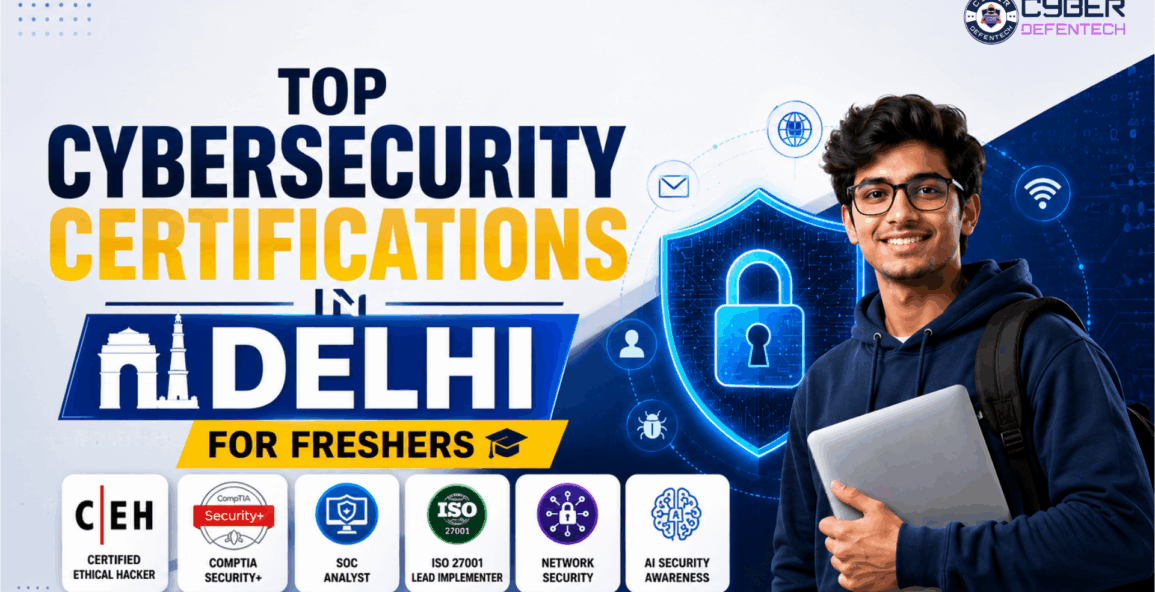
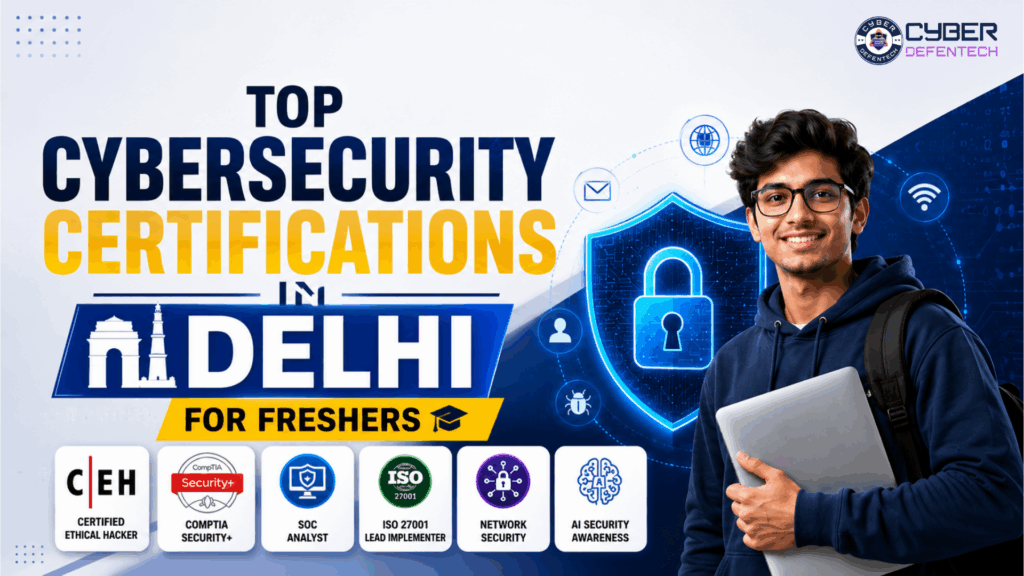
Top Cybersecurity Certifications in Delhi for Freshers
By Cyber Defentech Team | May 2026 | 14 Mins Read | Beginner to Advanced
Introduction
Cyberattacks are no longer limited to large enterprises or government systems. Today, even small businesses, hospitals, startups, schools, and individual users are becoming targets of ransomware, phishing attacks, AI-powered scams, and advanced data breaches. As organizations rapidly shift toward cloud infrastructure, automation, artificial intelligence, and remote work environments, the demand for skilled cybersecurity professionals has reached an all-time high.
At the same time, companies are struggling to find trained professionals who understand real-world cyber defense, ethical hacking, SOC operations, vulnerability assessment, cloud security, AI security risks, and compliance frameworks. This growing skill gap has created massive opportunities for freshers who want to build a stable, future-ready, and high-demand career in cybersecurity.
This is why more students and working professionals are searching for the Top Cybersecurity Certifications in Delhi for Freshers. The right certification not only helps beginners gain technical skills but also improves employability, interview confidence, and industry credibility.
Whether you are a college student, IT beginner, career switcher, or someone passionate about ethical hacking and cyber defense, choosing the right certification can completely transform your career journey.
What Are Cybersecurity Certifications?
Cybersecurity certifications are professional training programs designed to validate your knowledge and practical skills in protecting digital systems, networks, applications, and sensitive data from cyber threats.
These certifications help freshers learn:
- Ethical hacking techniques
- Security monitoring
- Incident response
- Network defense
- Malware analysis
- Risk management
- Cloud security
- AI-driven cyber threats
- Compliance and governance
Unlike traditional academic learning, modern cybersecurity certifications focus heavily on practical exposure, live labs, attack simulations, penetration testing environments, and real-world scenarios.
Some certifications are beginner-friendly, while others focus on specialized domains like ethical hacking, SOC analysis, digital forensics, or governance and compliance.
Why Are Cybersecurity Certifications Important?
The cybersecurity industry values skills and practical expertise more than theoretical knowledge alone. Many recruiters now prioritize candidates who have hands-on certifications and real-world exposure.
Why It Matters ?
- Cyber threats are becoming more advanced and AI-driven
- Organizations urgently need trained cybersecurity professionals
- Certifications improve credibility and hiring chances
- Practical skills help freshers compete with experienced candidates
- Cybersecurity offers long-term career stability and growth
- Remote and global job opportunities are increasing rapidly
A recognized cybersecurity certification demonstrates that you understand industry tools, security concepts, attack methodologies, and defense strategies.
Real-World Cyber Threats & Risks
The digital world is facing a new generation of cyber risks that are smarter, faster, and more dangerous than ever before.
Common Modern Cyber Threats
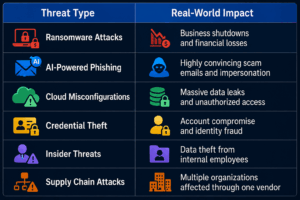
Modern hackers use automation, artificial intelligence, social engineering, and advanced malware techniques to exploit organizations.
This is why companies actively hire professionals trained in ethical hacking, SOC operations, incident response, threat hunting, and digital defense.
Why Companies Need Cybersecurity Professionals ?
Cybersecurity has become a business necessity rather than just an IT function. Every organization handling customer data, financial transactions, or cloud infrastructure requires skilled security professionals.
Industries Hiring Cybersecurity Professionals
- Banking and Financial Services
- Healthcare
- E-commerce
- Government Organizations
- IT & Software Companies
- Telecom
- EdTech Platforms
- Manufacturing
- Cloud Service Providers
- AI & Data Analytics Companies
Companies are especially looking for professionals who understand:
- AI security risks
- Cloud security
- Threat intelligence
- Security Operations Center (SOC) workflows
- Ethical hacking methodologies
- Compliance frameworks like ISO 27001
Top Cybersecurity Certifications in Delhi for Freshers
1. Certified Ethical Hacker (CEH)
The EC-Council Certified Ethical Hacker certification is one of the most recognized cybersecurity certifications globally.
It focuses on ethical hacking, penetration testing, reconnaissance, vulnerability analysis, web application attacks, and security testing techniques.
Skills Covered
- Footprinting and reconnaissance
- Web application security
- Network scanning
- Malware concepts
- System hacking
- Wireless security
- Social engineering
- AI-powered cyberattack awareness
Best For
- Beginners interested in ethical hacking
- Students passionate about offensive security
- Freshers seeking penetration testing careers
2. CompTIA Security+
CompTIA Security+ is highly recommended for beginners entering cybersecurity.
It builds strong foundational knowledge in networking, security operations, risk management, cryptography, and threat detection.
Why It’s Valuable ?
- Beginner-friendly
- Globally recognized
- Strong foundation for advanced certifications
- Widely accepted by recruiters
3. Certified SOC Analyst (CSA)
SOC Analyst certifications are becoming extremely popular because organizations now require continuous threat monitoring and incident response.
This certification focuses on:
- SIEM tools
- Threat monitoring
- Security alert investigation
- Incident response
- Threat intelligence
Freshers interested in blue-team cybersecurity roles often start here.
ISO 27001 certifications are highly valuable for governance, compliance, and information security management careers.
This certification teaches:
- Risk management
- Security policies
- Compliance frameworks
- Security audits
- ISMS implementation
It is ideal for freshers interested in governance and compliance careers.
5. CompTIA Network+
Strong networking knowledge is essential before mastering cybersecurity.
Network+ helps freshers understand:
- Routing and switching
- Network troubleshooting
- TCP/IP concepts
- Infrastructure security
- Wireless networking
This certification builds the technical foundation required for advanced cybersecurity roles.
Skills You Will Learn
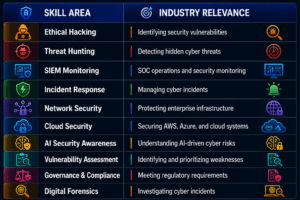
Career Opportunities After Cybersecurity Certifications
Cybersecurity certifications open doors to multiple career paths for freshers.
Popular Job Roles
- SOC Analyst
- Ethical Hacker
- Security Analyst
- Penetration Tester
- Information Security Analyst
- Incident Response Analyst
- Vulnerability Assessment Analyst
- GRC Analyst
- Cybersecurity Consultant
- Threat Intelligence Analyst
Many companies now hire freshers based on practical cybersecurity skills rather than traditional degrees alone.
Salary & Industry Demand
Cybersecurity remains one of the fastest-growing technology domains globally.
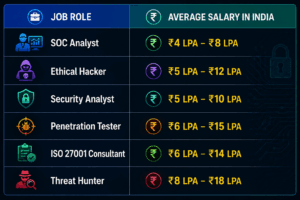
Salaries increase significantly with hands-on experience, certifications, and specialized expertise.
Real-World Importance of Cybersecurity Certifications
Cybersecurity is not just about learning tools or passing exams. It directly impacts business continuity, customer trust, financial security, and national infrastructure.
Real-World Example
A single phishing email can compromise an organization’s internal systems, expose sensitive customer data, and lead to massive financial losses.
Professionals trained in cybersecurity certifications learn how to:
- Detect suspicious activities
- Prevent attacks before escalation
- Investigate security incidents
- Strengthen organizational defenses
Why It Matters ?
Without trained cybersecurity professionals:
- Businesses face ransomware shutdowns
- Customer trust gets damaged
- Financial penalties increase
- Compliance violations occur
- AI-powered attacks spread faster
Cybersecurity professionals are now frontline digital defenders.
Tools & Technologies Used in Cybersecurity Training
Modern cybersecurity certifications include exposure to industry-standard tools and technologies.
Common Tools Covered
- Wireshark
- Nmap
- Burp Suite
- Metasploit
- Splunk
- Nessus
- Kali Linux
- SIEM Platforms
- Endpoint Detection Tools
- Threat Intelligence Platforms
Practical labs help students gain confidence in real-world attack and defense scenarios.
Beginner Roadmap for Cybersecurity Freshers
Starting cybersecurity can feel overwhelming because there are multiple domains and career paths.
Step-by-Step Beginner Roadmap
Step 1: Learn Networking Fundamentals
Understand TCP/IP, routing, switching, DNS, and firewalls.
Step 2: Understand Security Basics
Learn about malware, phishing, ransomware, and common attack vectors.
Step 3: Start Practical Labs
Use virtual labs and sandbox environments.
Step 4: Earn Beginner Certifications
Start with Security+, Network+, or SOC Analyst certifications.
Step 5: Choose a Specialization
- Ethical Hacking
- SOC Operations
- Cloud Security
- GRC & Compliance
- Threat Intelligence
Step 6: Build Hands-On Experience
Practice using cybersecurity tools and simulated attack environments.
Why Choose Cyber Defentech?
Cyber Defentech is becoming a preferred choice for students and freshers looking for practical cybersecurity training in Delhi.
What Makes Cyber Defentech Different?
- Industry-focused practical training
- Hands-on cybersecurity labs
- Real-world attack simulations
- Beginner-to-advanced learning paths
- Experienced cybersecurity trainers
- Interview preparation support
- Exposure to modern AI security concepts
- Career-focused certification guidance
Unlike purely theoretical training programs, Cyber Defentech focuses heavily on practical implementation and real-world cybersecurity exposure.
Students gain understanding of:
- Real attack methodologies
- Defensive security operations
- SOC workflows
- Vulnerability testing
- Compliance frameworks
- AI-driven cyber risks
Future Scope & Industry Trends
Cybersecurity is evolving rapidly due to artificial intelligence, automation, cloud computing, and digital transformation.
Emerging Cybersecurity Trends
- AI-powered threat detection
- Zero Trust Security
- Cloud-native security
- Threat intelligence automation
- AI governance and security
- Extended Detection & Response (XDR)
- IoT security
- Cyber resilience frameworks
The future belongs to professionals who continuously upgrade their practical skills and adapt to modern cyber threats.
Why Cybersecurity Has Strong Future Scope ?
- Global cyberattacks are increasing
- Companies require round-the-clock security monitoring
- Regulatory compliance is becoming stricter
- AI security risks are growing rapidly
- Cloud adoption continues to rise
Cybersecurity is no longer optional for organizations — it is mission-critical.
Final Thoughts
The demand for skilled cybersecurity professionals is growing faster than ever before. From ethical hacking and SOC operations to AI security and compliance management, the industry offers multiple career opportunities for freshers willing to learn practical skills.
Choosing the Top Cybersecurity Certifications in Delhi for Freshers can help you build a strong foundation, improve your industry credibility, and prepare for high-demand cybersecurity careers.
The key is not just earning certifications but gaining hands-on practical exposure, understanding real-world cyber threats, and developing industry-ready skills.
With the right learning approach, practical labs, and continuous upskilling, cybersecurity can become one of the most rewarding and future-ready career paths for beginners.
FAQs
1. Which cybersecurity certification is best for freshers?
Beginner-friendly certifications like Security+, CEH, SOC Analyst, and Network+ are highly recommended for freshers.
2. Is cybersecurity a good career for beginners?
Yes. Cybersecurity offers strong career growth, high demand, job stability, and multiple specialization options.
3. Do I need coding for cybersecurity?
Basic scripting knowledge helps, but many beginner cybersecurity roles do not require advanced programming initially.
4. Which is better: Ethical Hacking or SOC Analyst?
Ethical hacking focuses on offensive security testing, while SOC Analyst roles focus on defense and threat monitoring.
5. Are cybersecurity certifications worth it?
Yes. Certifications improve practical skills, industry credibility, and hiring opportunities.
6. Can non-IT students enter cybersecurity?
Yes. Many freshers from non-technical backgrounds successfully transition into cybersecurity with proper training.
7. What tools do cybersecurity beginners learn?
Beginners often learn Wireshark, Nmap, Burp Suite, Splunk, Kali Linux, and vulnerability scanning tools.
8. How long does it take to start a cybersecurity career?
With focused practical training and certifications, many beginners start applying for roles within a few months.
Ready to Build Your Career in Cybersecurity?
✅ Hands-on Practical Training
✅ Real-World Cybersecurity Skills
✅ Industry-Focused Learning
✅ Future-Ready Career Path
🌐 www.cyberdefentech.com
📞 +91 8448046612
