


Top Cyber Threats in 2026
By Cyber Defentech Team | May 2026 | 12 Mins Read | Beginner to Advanced
Introduction
Every few seconds, a cybercriminal somewhere in the world launches an attack. A ransomware gang encrypts a hospital’s systems. An AI-powered phishing campaign tricks employees into revealing credentials. A deepfake voice convinces a finance executive to authorize a fraudulent transaction worth millions.
The cybersecurity landscape in 2026 is more dangerous, automated, and sophisticated than ever before.
Artificial Intelligence has transformed both cyber defense and cybercrime. Attackers can now generate convincing phishing emails, automate vulnerability discovery, create realistic deepfake content, and launch highly targeted attacks at unprecedented scale. Meanwhile, organizations continue migrating to cloud environments, expanding remote workforces, and adopting AI tools—creating new attack surfaces for threat actors.
Understanding the Top Cyber Threats in 2026 is no longer optional. Whether you are a business leader, IT professional, cybersecurity enthusiast, or student planning a future-ready career, awareness of emerging cyber risks has become essential.
In this guide, we’ll explore the most dangerous cyber threats organizations face today, their real-world impact, and why cybersecurity expertise is among the most valuable skills in the modern digital economy.
What is Top Cyber Threats in 2026?
The term Top Cyber Threats in 2026 refers to the most significant cybersecurity risks targeting individuals, businesses, governments, and critical infrastructure throughout the year.
These threats include:
- AI-powered cyber attacks
- Advanced ransomware campaigns
- Deepfake-enabled fraud
- Cloud security breaches
- Supply chain compromises
- Identity theft attacks
- Insider threats
- Internet of Things (IoT) exploitation
- Zero-day vulnerabilities
- Nation-state cyber warfare
Unlike traditional cyberattacks, modern threats are faster, more automated, and increasingly difficult to detect.
Why is Top Cyber Threats in 2026 Important?
Cybersecurity incidents are no longer isolated IT problems.
Today’s cyberattacks can:
- Disrupt critical services
- Cause financial losses
- Damage brand reputation
- Expose sensitive customer data
- Trigger regulatory penalties
- Interrupt business operations
According to industry reports, global cybercrime damages are projected to exceed trillions of dollars annually. Organizations that fail to strengthen cybersecurity defenses risk becoming the next headline.
Why It Matters?
Businesses today operate in highly interconnected digital ecosystems. A single vulnerability can affect customers, partners, suppliers, and entire industries.
Understanding emerging cyber threats enables organizations to:
- Improve cyber resilience
- Reduce breach risks
- Strengthen security controls
- Protect customer trust
- Ensure regulatory compliance
Real-World Cyber Threats & Risks
1. AI-Powered Cyber Attacks
Artificial Intelligence has become one of the most powerful tools available to cybercriminals.
Attackers now use AI to:
- Generate phishing emails automatically
- Create malware variants
- Identify vulnerabilities faster
- Automate reconnaissance
- Conduct credential attacks
Modern AI tools can mimic writing styles, corporate communication patterns, and customer service interactions with alarming accuracy.
Risk
Traditional security awareness training alone may no longer be sufficient against AI-generated attacks.
2. Ransomware-as-a-Service (RaaS)
Ransomware continues to dominate the cyber threat landscape.
Criminal groups now operate like businesses, offering ransomware kits to affiliates who share profits from successful attacks.
Popular targets include:
- Hospitals
- Financial institutions
- Manufacturing companies
- Educational institutions
- Government agencies
Risk
Organizations face operational shutdowns, data loss, regulatory penalties, and costly recovery efforts.
3. Deepfake Social Engineering
Deepfake technology has evolved dramatically.
Cybercriminals can now create:
- Fake executive voices
- Synthetic video meetings
- Fraudulent business communications
- Impersonation attacks
Employees may unknowingly transfer funds or reveal confidential information based on fabricated communications.
Why It Matters?
Human trust is becoming one of the most exploited vulnerabilities in cybersecurity.
4. Cloud Security Breaches
Cloud adoption continues growing rapidly.
Misconfigured cloud environments remain one of the leading causes of data breaches.
Common cloud risks include:
- Misconfigured storage buckets
- Weak access controls
- Exposed APIs
- Privilege escalation attacks
- Insecure cloud applications
Risk
A single configuration mistake can expose millions of sensitive records.
5. Supply Chain Attacks
Instead of attacking large organizations directly, cybercriminals increasingly target vendors and service providers.
Attackers compromise trusted software updates, third-party tools, or managed services providers.
Examples
- Software update compromises
- Third-party vendor breaches
- Open-source dependency attacks
Impact
One successful supply chain attack can affect thousands of organizations simultaneously.
6. Zero-Day Vulnerabilities
Zero-day vulnerabilities are security flaws unknown to software vendors before exploitation.
Attackers actively search for:
- Operating system flaws
- Browser vulnerabilities
- Enterprise software weaknesses
- Network device exploits
Risk
Organizations have no immediate patch available when attacks begin.
7. Identity and Credential Attacks
Passwords remain one of the weakest security controls.
Cybercriminals use:
- Credential stuffing
- Password spraying
- Session hijacking
- MFA fatigue attacks
- Token theft
Compromised identities often provide attackers direct access to enterprise systems.
8. IoT and Smart Device Exploitation
Connected devices continue expanding across industries.
Examples include:
- Smart cameras
- Industrial sensors
- Medical devices
- Smart building systems
Many IoT devices suffer from poor security configurations and outdated firmware.
Risk
Compromised devices can provide entry points into larger networks.
9. Insider Threats
Not every threat originates externally.
Employees, contractors, or privileged users can intentionally or accidentally expose sensitive data.
Common causes include:
- Human error
- Negligence
- Credential misuse
- Data theft
- Privilege abuse
10. Nation-State Cyber Warfare
Governments increasingly use cyber operations for espionage, disruption, and intelligence gathering.
Targets include:
- Energy infrastructure
- Telecommunications
- Financial systems
- Transportation networks
- Defense organizations
Nation-state attacks often involve advanced persistent threats (APTs) and long-term infiltration campaigns.
Why Companies Need Cyber Threat Professionals?
As threats become more sophisticated, organizations require skilled professionals who can identify, analyze, and mitigate risks.
Cybersecurity teams help organizations:
- Detect threats early
- Investigate incidents
- Conduct penetration testing
- Monitor security events
- Secure cloud environments
- Respond to breaches
- Improve cyber resilience
The cybersecurity talent shortage continues growing worldwide, making skilled professionals highly valuable.
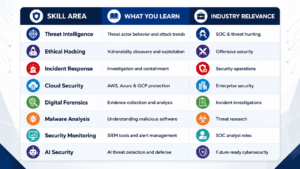
Skills You Will Learn
Career Opportunities
Growing cyber threats create opportunities across multiple domains.
Popular cybersecurity roles include:
- Security Analyst
- SOC Analyst
- Ethical Hacker
- Penetration Tester
- Incident Responder
- Threat Hunter
- Security Engineer
- Digital Forensics Investigator
- Cloud Security Engineer
- Security Consultant
- Security Architect
- Cyber Threat Intelligence Analyst
These positions exist across nearly every industry, including banking, healthcare, government, technology, defense, and telecommunications.
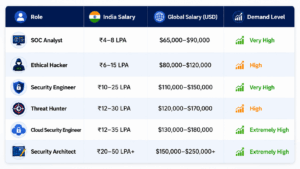
Salary & Industry Demand
Real-World Importance of Top Cyber Threats in 2026
Cybersecurity directly impacts:
- Business continuity
- Customer trust
- Financial stability
- National security
- Regulatory compliance
Organizations investing in cyber resilience experience:
- Faster incident response
- Reduced breach costs
- Improved operational reliability
- Better regulatory compliance
- Stronger customer confidence
Why It Matters?
Cybersecurity is no longer simply about preventing attacks.
It is about enabling secure innovation, digital transformation, and long-term business growth.
Tools & Technologies Used
Modern cybersecurity professionals use advanced tools to detect and defend against threats.
Security Operations
- Splunk
- Microsoft Sentinel
- IBM QRadar
- Elastic Security
Ethical Hacking
- Kali Linux
- Burp Suite
- Metasploit
- Nmap
Cloud Security
- Prisma Cloud
- Wiz
- CrowdStrike Falcon Cloud
- AWS Security Hub
Threat Intelligence
- MISP
- VirusTotal
- Shodan
- Recorded Future
AI Security
- Microsoft Security Copilot
- CrowdStrike Charlotte AI
- Google Security AI
- AI-powered SIEM platforms
Beginner Roadmap
For aspiring cybersecurity professionals:
Step 1
Learn networking fundamentals
Step 2
Understand operating systems (Windows & Linux)
Step 3
Study cybersecurity fundamentals
Step 4
Practice with cybersecurity labs
Step 5
Learn ethical hacking concepts
Step 6
Explore cloud security
Step 7
Develop incident response skills
Step 8
Build real-world projects
Step 9
Earn industry-recognized certifications
Step 10
Gain practical hands-on experience
Why Choose Cyber Defentech?
Cybersecurity is a practical field that requires more than theoretical knowledge.
At Cyber Defentech, learners gain exposure to:
✅ Real-world cyber attack simulations
✅ Practical ethical hacking labs
✅ SOC monitoring environments
✅ Cloud security scenarios
✅ Threat hunting exercises
✅ Industry-focused projects
✅ Internship guidance
✅ Career mentorship
Students learn how modern attacks work and how organizations defend against them using professional cybersecurity tools and methodologies.
Future Scope & Industry Trends
Several trends will define cybersecurity beyond 2026:
AI-Augmented Security Operations
AI will accelerate threat detection and response.
Autonomous Threat Hunting
Machine learning systems will identify suspicious behavior automatically.
Zero Trust Security
Organizations will increasingly adopt identity-centric security architectures.
Cloud-Native Security
Security controls will become integrated directly into cloud environments.
Quantum-Resistant Cryptography
Organizations will begin preparing for future quantum computing risks.
Cybersecurity Regulation Expansion
Governments worldwide will introduce stricter security and privacy requirements.
Why It Matters?
Cybersecurity professionals who continuously learn emerging technologies will remain among the most sought-after specialists in the global workforce.
Final Thoughts
The Top Cyber Threats in 2026 highlight a simple reality: cyber risks are growing faster than ever before.
AI-powered attacks, ransomware campaigns, cloud breaches, deepfake fraud, supply chain compromises, and advanced nation-state operations are reshaping the cybersecurity landscape. Organizations can no longer rely solely on traditional security strategies.
The demand for skilled cybersecurity professionals capable of identifying, preventing, and responding to these threats continues rising across every industry.
For students, IT professionals, and career changers, cybersecurity offers a future-ready, high-demand career path with strong growth potential, global opportunities, and meaningful impact.
Those who invest in practical cybersecurity skills today will be the professionals protecting tomorrow’s digital world.
FAQs
1. What are the biggest cyber threats in 2026?
AI-powered cyber attacks, ransomware, cloud security breaches, deepfake scams, supply chain attacks, insider threats, and zero-day vulnerabilities are among the biggest cyber threats in 2026.
2. Why are AI-powered cyber attacks increasing?
AI enables attackers to automate phishing campaigns, vulnerability discovery, malware development, and social engineering attacks at unprecedented scale.
3. Which industries face the highest cyber risk?
Healthcare, banking, government, manufacturing, education, telecommunications, and critical infrastructure sectors remain prime targets.
4. How can organizations reduce cyber threats?
Organizations should implement Zero Trust security, employee awareness training, multi-factor authentication, continuous monitoring, vulnerability management, and incident response planning.
5. Is cybersecurity a good career in 2026?
Yes. Cybersecurity remains one of the fastest-growing and highest-demand technology careers globally.
6. What skills are required for cybersecurity jobs?
Networking, Linux, threat detection, ethical hacking, cloud security, digital forensics, incident response, and security monitoring are highly valuable skills.
7. Are cybersecurity professionals in demand worldwide?
Yes. Most countries face a significant cybersecurity skills shortage, creating strong employment opportunities.
8. How can beginners start learning cybersecurity?
Begin with networking fundamentals, operating systems, cybersecurity basics, hands-on labs, and practical security tools before progressing into specialized domains.
Ready to Build Your Career in Cybersecurity and Defend Against Modern Threats?
✅ Hands-on Practical Training
✅ Real-World Cybersecurity Labs
✅ Ethical Hacking & VAPT Training
✅ SOC Analyst & Threat Hunting Skills
✅ Cloud Security & AI Security Exposure
✅ Industry-Focused Learning Environment
✅ Future-Ready Career Path
Cyber Defentech – Empowering the Next Generation of Cybersecurity Professionals
Start your cybersecurity journey today and gain the practical skills needed to combat the top cyber threats of 2026 and beyond.
