
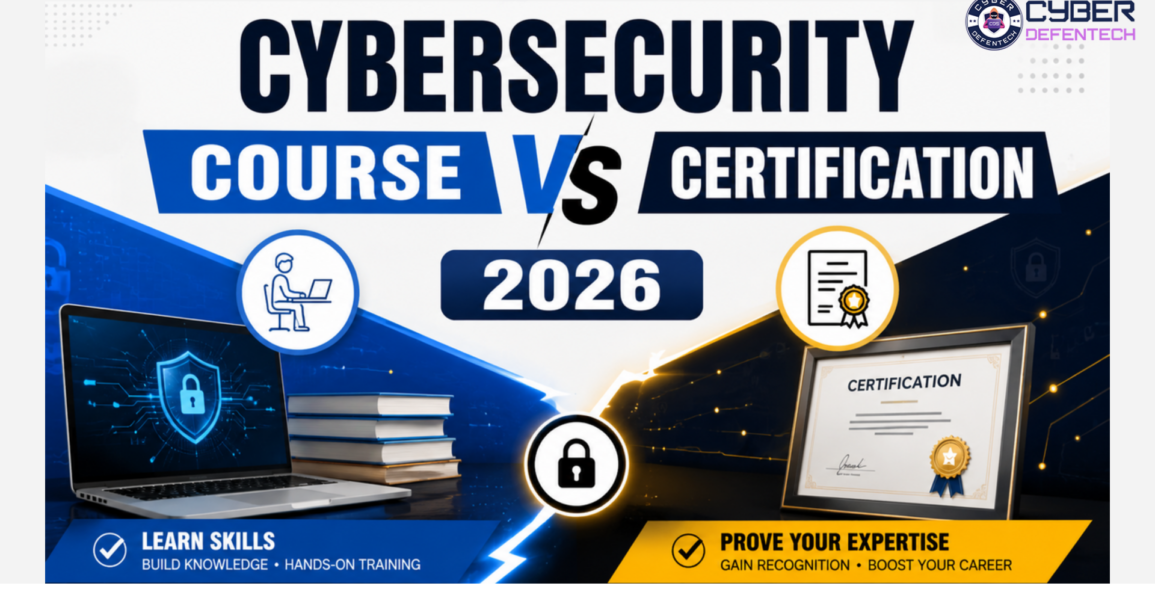
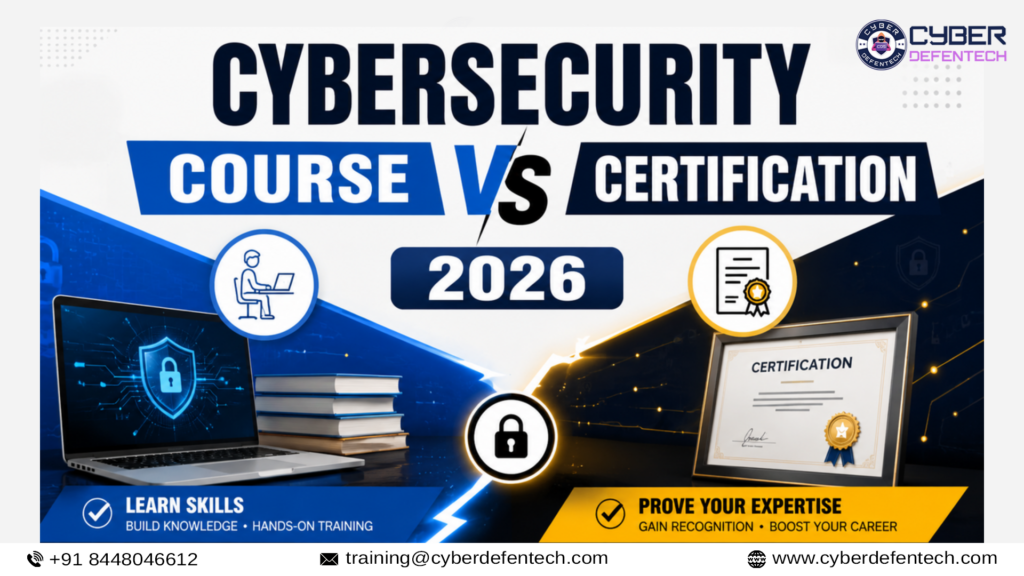
Cybersecurity Course vs Certification: What’s the Difference?
By Cyber Defentech Team | August 2026 | 9 Min Read | Beginner to Advanced
Introduction
Every 39 seconds, a cyberattack hits somewhere in the world. Ransomware gangs are automating attacks with AI. Deepfake-powered social engineering is fooling even trained employees. And somewhere, right now, a company is scrambling to hire a cybersecurity professional it should have hired six months ago.
If you’ve ever searched for “how to get into cybersecurity,” you’ve probably hit the same wall thousands of beginners face: should you take a cybersecurity course, or go straight for a cybersecurity certification? The internet gives conflicting answers, recruiters ask for both, and job portals seem to demand a mix of the two — leaving most beginners stuck before they even start.
This confusion isn’t just frustrating. It’s costly. Choosing the wrong path can mean months of wasted time, money spent on the wrong credential, and a resume that doesn’t match what employers are actually hiring for in 2026. That’s exactly why the debate around Cybersecurity Course vs Certification has become one of the most searched, most misunderstood questions for anyone trying to break into this industry.
At Cyber Defentech, we’ve trained hundreds of students who walked in with this exact confusion. This guide breaks the topic down in a beginner-friendly, industry-accurate way — so you can build a future-ready cybersecurity career with clarity, not guesswork.
What is a Cybersecurity Course?
A cybersecurity course is a structured, instructor-led or self-paced learning program designed to teach the practical, hands-on skills needed to defend systems, networks, and applications from cyber threats. Courses typically include labs, simulations, real-world attack scenarios, and mentorship — the foundation of actual job readiness.
A good course covers:
- Network security fundamentals
- Ethical hacking and penetration testing techniques
- Threat detection and incident response
- Security tools like Wireshark, Nmap, Metasploit, and Burp Suite
- Real-world lab environments that simulate live attacks
Courses are about skill-building. They teach you how to think like both an attacker and a defender — a mindset no exam alone can give you.
What is a Cybersecurity Certification?
A cybersecurity certification is a formal, third-party validated credential that proves you’ve met a specific industry standard of knowledge — usually through a proctored exam. Certifications like CEH, CompTIA Security+, CISSP, and OSCP are globally recognized benchmarks that employers use to filter candidates during hiring.
Certifications are about validation. They tell an employer, “This person has proven, tested knowledge in this domain” — even if they’ve never worked a single real incident.
Why is Cybersecurity Course vs Certification Important?
Understanding this difference isn’t academic — it directly affects your hiring chances, salary negotiations, and career speed.
Why It Matters: A certification without practical skill often results in candidates who can pass an exam but freeze during a real incident response scenario. A course without certification often results in highly skilled professionals who get filtered out by HR software before a human even sees their resume.
The smartest professionals combine both — practical, industry-focused training from a course, backed by the credibility of a recognized certification. This dual approach is quickly becoming the new industry standard for 2026 hiring.
Real-World Cyber Threats & Risks
Cybersecurity isn’t theoretical — the risks are immediate and expensive.
| Threat Type | Real-World Impact | Industry Sector Most Affected |
|---|---|---|
| Ransomware Attacks | Business shutdowns, data loss, multi-crore extortion demands | Healthcare, Manufacturing, Finance |
| Phishing & AI-Generated Deepfakes | Credential theft, executive impersonation fraud | Corporate, Banking, Government |
| Supply Chain Attacks | Compromise of thousands of downstream businesses via one vendor | IT, SaaS, E-commerce |
| Insider Threats | Data leaks, sabotage, regulatory penalties | All industries |
| Cloud Misconfigurations | Massive data exposure, compliance violations | Cloud-first startups, Enterprises |
Attackers today use AI to write malware, automate phishing at scale, and bypass traditional defenses. This is why AI security and next-generation threat detection skills are no longer optional — they’re core requirements for any serious cybersecurity professional.
Why Companies Need Cybersecurity Professionals?
Every organization — from a 10-person startup to a multinational bank — now runs on digital infrastructure. That means every organization is a target. Companies aren’t just looking for people who can define a firewall; they need professionals who can:
- Detect and respond to active breaches in real time
- Conduct penetration testing before attackers find the gaps first
- Secure cloud environments, APIs, and AI-integrated systems
- Ensure compliance with regulations like GDPR, ISO 27001, and India’s DPDP Act
- Train employees to recognize social engineering attempts
This growing dependency has created a high-demand, chronically understaffed job market — one of the few tech fields where demand still massively outpaces supply.
Skills You Will Learn
A well-structured cybersecurity course builds a complete, industry-ready skill set:
| Skill Category | What You Learn | Career Relevance |
|---|---|---|
| Network Security | Firewalls, VPNs, IDS/IPS, secure architecture | SOC Analyst, Network Security Engineer |
| Ethical Hacking | Penetration testing, vulnerability assessment | Penetration Tester, Red Team Analyst |
| Incident Response | Threat detection, malware analysis, forensics | Incident Responder, SOC Analyst |
| Cloud & AI Security | Cloud security posture, AI model risk, LLM security | Cloud Security Engineer, AI Security Specialist |
| Governance & Compliance | Risk management, audits, regulatory frameworks | GRC Analyst, Compliance Officer |
Career Opportunities
A career in cybersecurity isn’t a single path — it’s an entire ecosystem of specialized roles, including:
- SOC Analyst (Tier 1, 2, 3)
- Penetration Tester / Ethical Hacker
- Security Operations Engineer
- Incident Response Specialist
- Cloud Security Engineer
- AI Security Analyst
- GRC (Governance, Risk & Compliance) Analyst
- Chief Information Security Officer (long-term)
Each role offers a distinct growth trajectory, meaning cybersecurity isn’t just a job — it’s a long-term, future-ready career ladder.
Salary & Industry Demand
Cybersecurity remains one of the most resilient and well-paying fields in tech, even amid broader IT hiring slowdowns.
| Role | Experience Level | Approx. Annual Salary (India) |
|---|---|---|
| SOC Analyst | Entry-Level (0–2 yrs) | ₹4–7 LPA |
| Penetration Tester | Mid-Level (2–5 yrs) | ₹8–15 LPA |
| Cloud Security Engineer | Mid-Level (3–6 yrs) | ₹12–20 LPA |
| Security Architect | Senior (6+ yrs) | ₹20–35 LPA |
| CISO / Security Head | Leadership (10+ yrs) | ₹40 LPA+ |
(Figures are indicative industry estimates and vary by company, city, and skillset.)
Why It Matters: Unlike many saturated IT roles, cybersecurity salaries continue rising because the skills gap keeps widening — attackers innovate faster than the talent pool grows.
Real-World Importance of Cybersecurity Course vs Certification
Consider two candidates applying for the same SOC Analyst role. Candidate A has a certification but has never touched a live SIEM dashboard. Candidate B completed a practical, lab-heavy course, has handled simulated ransomware incidents, and understands real attacker behavior — but lacks a formal certificate.
In most modern hiring pipelines, Candidate B gets shortlisted for the interview, and Candidate A gets shortlisted by the applicant tracking system. The ideal outcome? Be both. This is precisely why industry-focused training providers now design courses that prepare students for certification exams while building genuine hands-on capability.
Tools & Technologies Used
Real-world cybersecurity work relies on a constantly evolving toolkit, including:
- Network & Recon: Nmap, Wireshark, Nessus
- Exploitation & Pen Testing: Metasploit, Burp Suite, Kali Linux
- SIEM & Monitoring: Splunk, IBM QRadar, Microsoft Sentinel
- Cloud Security: AWS Security Hub, Azure Defender, Prisma Cloud
- AI & Threat Intelligence: AI-driven anomaly detection platforms, MITRE ATT&CK framework
Mastery of these tools — not just theoretical knowledge — is what separates job-ready professionals from resume-only candidates.
Beginner Roadmap
For anyone starting from zero, here’s a practical, step-by-step path:
- Build IT fundamentals – networking, operating systems, basic scripting
- Learn core security concepts – CIA triad, threat models, common attack types
- Join a hands-on cybersecurity course – labs, simulations, real-world exposure
- Earn a recognized certification – CEH, Security+, or equivalent
- Practice on real platforms – TryHackMe, Hack The Box, CTF competitions
- Build a portfolio – document projects, labs, and findings
- Apply strategically – target SOC Analyst or Junior Pen Tester roles first
Why Choose Cyber Defentech?
At Cyber Defentech, we don’t believe in choosing between theory and practice — we believe in merging them. Our programs are built around real-world, lab-based learning environments where students actively defend systems, simulate attacks, and respond to live-style incidents, not just memorize slides.
What sets us apart:
- Practical, hands-on labs mirroring real corporate environments
- Industry-focused curriculum aligned with current threat landscapes, including AI security
- Mentorship from professionals with real-world incident response experience
- Certification-aligned training so you graduate exam-ready and job-ready
- A learning path designed for both absolute beginners and working professionals looking to upskill
We built our training philosophy around one principle: a credential should prove what you can actually do — not just what you memorized.
Future Scope & Industry Trends
Cybersecurity is entering its most transformative decade yet. Key trends shaping the next few years include:
- AI-powered attacks and AI-powered defense becoming the new normal
- Zero Trust Architecture replacing traditional perimeter security
- Cloud-native security demand rising as more infrastructure moves off-premise
- LLM and AI model security emerging as a specialized, high-paying niche
- Regulatory pressure (DPDP Act, GDPR) increasing demand for compliance-savvy professionals
Professionals who combine advanced technical skill with adaptability to these shifts will be the most valuable — and the most secure — in their careers.
Final Thoughts
The debate isn’t really “course vs certification” — it’s about building a career that’s both credible and capable. A certification opens doors. A course teaches you what to do once you’re inside the room. In 2026’s threat landscape, where AI is weaponized on both sides of the battlefield, half-preparation isn’t an option.
The organizations you’ll one day defend need professionals who are trained, tested, and ready — not just certified on paper. That’s the standard Cyber Defentech trains every student to meet.
FAQs
1. Is a cybersecurity certification enough to get a job? Rarely on its own. Most employers now expect practical, demonstrable skills alongside a certification, especially for hands-on roles like SOC Analyst or Penetration Tester.
2. Should beginners start with a course or a certification? Start with a hands-on course to build real skills, then pursue certification to validate that knowledge formally — this order improves both learning and exam performance.
3. Which certification is best for beginners in cybersecurity? CompTIA Security+ is a strong entry-level choice, while CEH suits those focused on ethical hacking and penetration testing paths.
4. Do I need a technical background to start a cybersecurity course? No. Most beginner-to-advanced courses, including those at Cyber Defentech, start with IT and networking fundamentals before moving into advanced security topics.
5. How long does it take to become job-ready in cybersecurity? With consistent, hands-on training, most beginners can reach job-ready SOC Analyst level within 4 to 8 months.
6. Is cybersecurity a good career choice in 2026 and beyond? Yes. With AI-driven threats rising and a persistent global talent shortage, cybersecurity remains one of the most stable, high-demand career fields in tech.
7. What is the difference between ethical hacking and cybersecurity in general? Ethical hacking is a specialized offensive-security subset of the broader cybersecurity field, which also includes defense, compliance, cloud security, and governance.
8. Does Cyber Defentech provide certification-aligned training? Yes. Cyber Defentech’s programs are structured to build practical skills while aligning with major industry certification standards.
CTA Section
Ready to Build Your Career in Cybersecurity?
✅ Hands-on Practical Training
✅ Real-World Cybersecurity Skills
✅ Industry-Focused Learning
✅ Future-Ready Career Path
📞 Call/WhatsApp: +91 8448046612
