
CEH Skills vs Real-World Hacking Skills
By Cyber Defentech Team | August 2026 | 10 Min Read | Beginner to Advanced
Introduction
Cybersecurity is no longer a field where knowing a few hacking tools is enough.
Organizations today face phishing, ransomware, credential theft, API attacks, cloud misconfigurations, supply-chain risks, identity-based attacks, and increasingly sophisticated threats supported by artificial intelligence. As attack surfaces continue to expand, companies need security professionals who can do more than understand cybersecurity terminology—they need professionals who can identify weaknesses, validate risks, think like attackers, and communicate practical security solutions.
This creates an important question for anyone starting an ethical hacking career:
Is learning CEH enough to become a real-world ethical hacker?
The answer is simple: CEH can provide an excellent foundation, but certification knowledge alone does not equal real-world hacking capability.
CEH, or Certified Ethical Hacker, helps learners understand the methodologies, concepts, tools, and techniques used in ethical hacking. However, professional environments require additional capabilities such as hands-on penetration testing, vulnerability validation, reporting, troubleshooting, scripting, networking, web security, cloud security, and security analysis.
Understanding the difference between CEH skills vs real-world hacking skills can help aspiring cybersecurity professionals build a more effective learning path and prepare for actual industry expectations.
What Is CEH and What Skills Does It Teach?
Certified Ethical Hacker (CEH) is a cybersecurity certification focused on ethical hacking methodologies and security concepts. It introduces learners to how attackers identify weaknesses and how security professionals can use similar techniques for defensive purposes.
A CEH learning path commonly covers areas such as reconnaissance, scanning, vulnerability identification, system security, network attacks, web application security, social engineering, wireless security, cryptography, malware concepts, and defensive techniques.
The goal is not simply to teach someone how to use a particular tool. The broader objective is to develop an understanding of the attack lifecycle and the techniques attackers may use against an organization.
Core CEH Skills
| CEH Skill Area | What You Learn |
|---|---|
| Reconnaissance | Information gathering and target profiling |
| Scanning | Discovering hosts, services, and potential weaknesses |
| Vulnerability Analysis | Understanding and identifying security weaknesses |
| Network Security | Common network-based attacks and defenses |
| Web Security | Web vulnerabilities and attack concepts |
| Social Engineering | Human-focused attack techniques |
| Malware Concepts | Understanding malicious software and attack behavior |
| Cryptography | Encryption, hashing, and security principles |
These concepts provide a valuable foundation, particularly for beginners entering cybersecurity.
But there is an important distinction.
Knowing what an attack is and being able to perform a controlled security assessment are two different levels of capability.
Why Is the Difference Important?
Imagine two candidates applying for a junior penetration testing role.
Candidate A has studied certification material and can explain SQL injection, privilege escalation, reconnaissance, and password attacks.
Candidate B can explain those concepts but can also configure a testing environment, identify an exposed service, validate a vulnerability, document evidence, understand the impact, troubleshoot unexpected results, and communicate remediation recommendations.
Both may understand cybersecurity concepts.
But Candidate B demonstrates stronger real-world hacking skills.
This is why practical experience has become increasingly important.
Why It Matters?
A real penetration test rarely follows a perfectly structured textbook scenario.
You may encounter:
- Incomplete information
- Unexpected network configurations
- Security controls blocking standard techniques
- False positives
- Custom applications
- Modern authentication mechanisms
- Cloud environments
- API endpoints
- Web application vulnerabilities
- Logging and monitoring systems
- Strict testing limitations
- Business-critical systems that cannot be disrupted
A professional ethical hacker needs the ability to adapt.
Real-world cybersecurity rewards problem-solving, not just memorization.
CEH Skills vs Real-World Hacking Skills
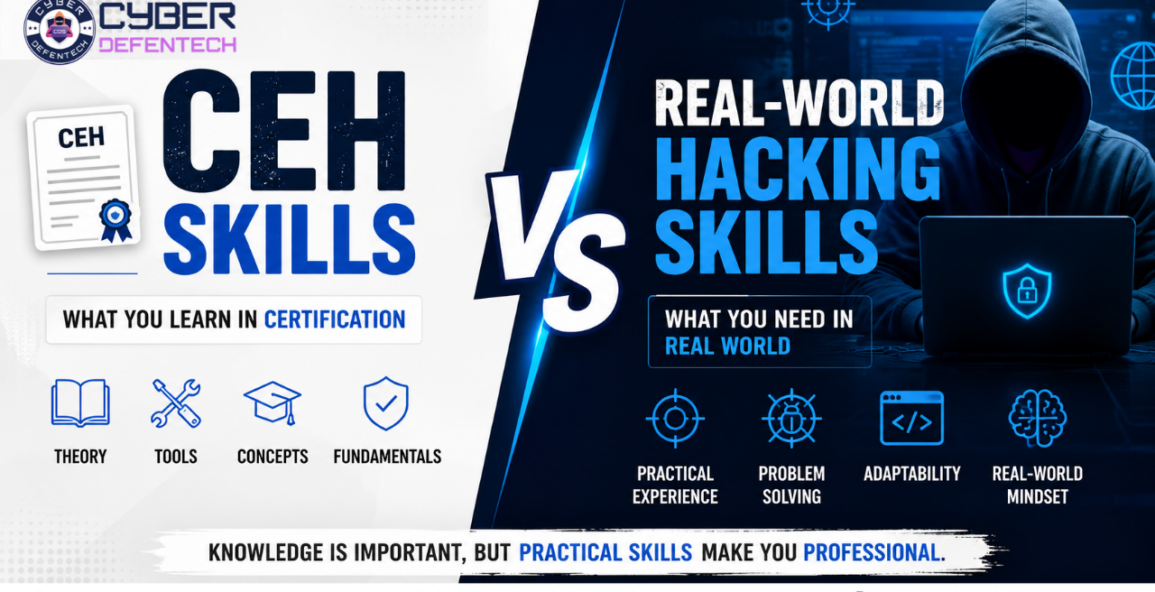
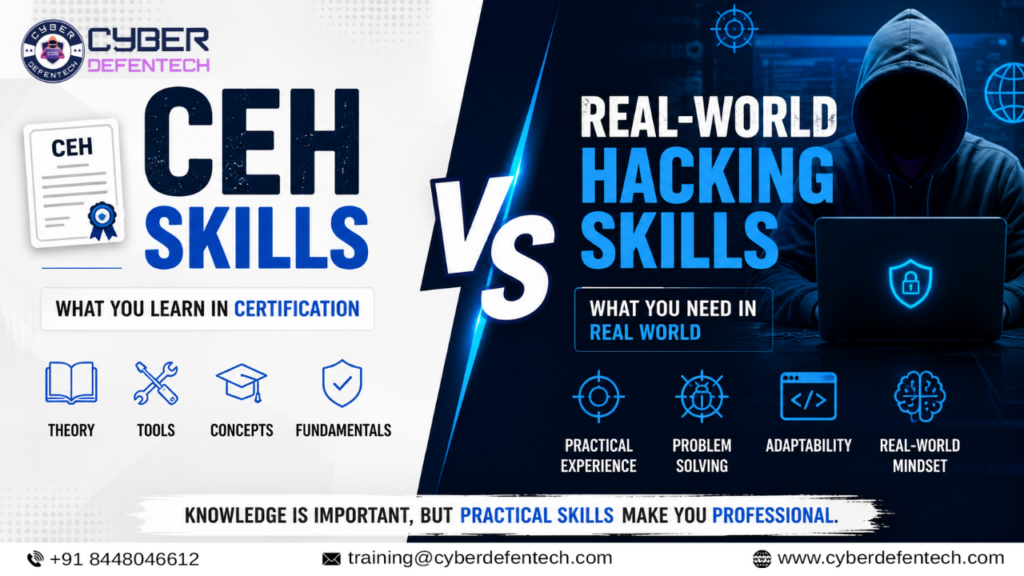
The biggest difference can be summarized as knowledge versus application.
CEH helps you understand the concepts and methodologies behind ethical hacking. Real-world experience teaches you how those concepts behave when systems, applications, people, and security controls interact.
| CEH-Oriented Knowledge | Real-World Application |
|---|---|
| Understand reconnaissance | Perform structured reconnaissance within authorized scope |
| Learn vulnerability concepts | Validate vulnerabilities and determine actual impact |
| Study attack techniques | Select appropriate techniques based on the environment |
| Learn security tools | Configure, troubleshoot, and interpret tool output |
| Understand web vulnerabilities | Test applications and APIs systematically |
| Learn attack methodologies | Build an assessment strategy |
| Study security concepts | Make risk-based security decisions |
| Learn reporting concepts | Produce actionable professional reports |
Neither side should be viewed as unnecessary.
Certification knowledge gives you the foundation. Practical experience turns that foundation into professional capability.
Real-World Cyber Threats & Risks
Modern attackers do not always rely on complicated zero-day exploits.
Many successful incidents involve weaknesses such as:
- Exposed services
- Weak authentication
- Stolen credentials
- Poor access controls
- Unpatched software
- Misconfigured cloud resources
- Vulnerable APIs
- Social engineering
- Insecure application logic
- Excessive user privileges
For example, an organization may have strong perimeter security but still expose a vulnerable application through an internet-facing API.
A professional security tester needs to understand not only which vulnerability exists, but also:
What can an attacker do with it?
That distinction is critical.
A vulnerability without business context can be just a technical finding. A professional assessment connects the technical weakness to potential business impact.
Why Companies Need Ethical Hacking Professionals?
Organizations are increasingly adopting cloud services, APIs, SaaS platforms, remote access technologies, mobile applications, and AI-powered systems.
This creates a constantly changing attack surface.
Security teams need professionals who can assess these environments before attackers exploit them.
Ethical hackers and penetration testers help organizations:
- Identify weaknesses before attackers do.
- Validate whether vulnerabilities are actually exploitable.
- Assess the potential impact of security weaknesses.
- Identify weaknesses in security controls.
- Support remediation teams with actionable findings.
- Improve an organization’s overall security posture.
However, professional penetration testing requires more than knowing popular hacking tools.
It requires methodology, judgment, technical depth, documentation, communication, and ethics.
Skills You Need Beyond CEH
If your goal is to build a career in ethical hacking, CEH should be viewed as one part of a broader skill set.
1. Networking Fundamentals
Understanding TCP/IP, DNS, HTTP/HTTPS, routing, ports, protocols, firewalls, VPNs, and network architecture is essential.
Without networking knowledge, it becomes difficult to understand what security tools are actually detecting.
2. Linux Skills
Linux is heavily used across cybersecurity, servers, cloud environments, security tools, and penetration testing labs.
Professionals should become comfortable with:
- Command-line navigation
- File permissions
- Processes
- Networking commands
- Shell environments
- Logs
- Package management
- Basic scripting
3. Web Application Security
Modern organizations depend heavily on web applications.
A practical ethical hacker should understand vulnerabilities such as:
- Injection
- Broken access control
- Authentication weaknesses
- Security misconfiguration
- Cross-site scripting
- Server-side vulnerabilities
- Insecure APIs
Understanding application logic is particularly important because automated scanners cannot always identify business-logic weaknesses.
4. Scripting and Automation
You do not need to become a software engineer to start ethical hacking.
However, basic knowledge of Python, Bash, PowerShell, or another scripting language can significantly improve productivity.
Automation can help with repetitive tasks such as data processing, reconnaissance workflows, log analysis, and testing support.
5. Vulnerability Validation
A scanner may report hundreds of findings.
A professional must determine:
- Is the vulnerability real?
- Can it actually be exploited?
- What is the impact?
- What evidence supports the finding?
- How should it be prioritized?
- How can it be fixed?
This is where technical judgment becomes extremely valuable.
Hands-On Labs: Where Theory Becomes Skill
One of the biggest differences between studying cybersecurity and practicing cybersecurity is the feedback loop.
When you perform a task in a controlled lab, you discover what happens when something fails.
You learn how to:
Plan → Test → Fail → Troubleshoot → Adapt → Validate → Document
That process builds practical capability.
Hands-on environments can include intentionally vulnerable web applications, network labs, Windows and Linux machines, security monitoring environments, API testing labs, and controlled penetration-testing scenarios.
The objective should not be to collect screenshots of tools.
The objective should be to understand why something worked, why it failed, and what the result means.
Tools & Technologies Used in Practical Ethical Hacking
A professional security environment can involve many different technologies.
Some commonly encountered categories include:
| Area | Example Technologies |
|---|---|
| Network Analysis | Wireshark, Nmap |
| Web Security | Burp Suite, OWASP testing resources |
| Vulnerability Assessment | Nessus and similar scanners |
| Exploitation Frameworks | Metasploit |
| Operating Systems | Linux, Windows |
| Scripting | Python, Bash, PowerShell |
| Security Monitoring | SIEM and EDR platforms |
| Cloud Security | IAM, cloud security controls, logging platforms |
The important point is that tools are not the skill.
A tool produces information.
A cybersecurity professional interprets that information and decides what to do next.
The Hacker Mindset: A Skill Certifications Cannot Fully Teach
One of the most valuable abilities in penetration testing is learning to ask better questions.
Instead of asking:
“Which tool should I run?”
A professional starts asking:
“What am I trying to discover?”
For example:
- What assets are exposed?
- What trust relationships exist?
- What authentication controls are present?
- What privileges does this account have?
- Where does sensitive data flow?
- What happens if this control fails?
- Can two seemingly low-risk weaknesses be chained together?
This analytical mindset separates basic tool usage from professional security assessment.
Career Opportunities
Developing both certification knowledge and practical skills can open multiple cybersecurity career paths.
Potential Roles
- Ethical Hacker
- Junior Penetration Tester
- Security Analyst
- SOC Analyst
- Vulnerability Assessment Analyst
- Web Application Security Tester
- Network Security Analyst
- Security Consultant
- Red Team Associate
- Application Security Analyst
Your career direction should influence the skills you prioritize.
For example, someone targeting web penetration testing should invest heavily in HTTP, web technologies, APIs, authentication, application architecture, and web security testing.
Someone targeting SOC operations should focus more on networking, logs, SIEM, detection engineering, incident response, and threat analysis.
Salary & Industry Demand
Cybersecurity salaries vary significantly based on experience, location, organization, technical specialization, and practical capability. The following ranges are broad indicative ranges for the Indian market rather than guaranteed salaries.
| Role | Approx. Experience | Indicative Annual Range in India |
|---|---|---|
| Junior Security Analyst | 0–2 years | ₹3–6 LPA |
| SOC Analyst | 0–3 years | ₹3.5–7 LPA |
| Junior Penetration Tester | 0–3 years | ₹4–8 LPA |
| Security Engineer | 2–5 years | ₹6–12 LPA |
| Penetration Tester | 3–6 years | ₹7–15 LPA |
| Security Consultant | 4+ years | ₹8–18+ LPA |
Actual compensation can be considerably higher or lower depending on specialization and employer.
The important career lesson is this:
Certifications may help you get noticed, but practical skills help you perform.
Real-World Importance of CEH Skills
CEH should not be underestimated.
For beginners, it can provide a structured introduction to the cybersecurity attack lifecycle and help organize a large number of security concepts.
It can also give learners a vocabulary for discussing security issues professionally.
But the strongest learning strategy is to connect certification concepts with practical exercises.
For example:
Learn reconnaissance → perform reconnaissance in a legal lab → analyze the results → document findings.
Learn web vulnerabilities → test an intentionally vulnerable application → understand the request/response behavior → document the security impact.
Learn privilege escalation concepts → practice them in a controlled lab → understand why the weakness existed → identify defensive controls.
This approach transforms passive learning into active capability.
Beginner Roadmap: From CEH Knowledge to Real-World Skills
If you are starting your cybersecurity journey, consider the following progression.
Step 1: Build Networking Fundamentals
Learn TCP/IP, DNS, HTTP, ports, protocols, routing, firewalls, and common network architectures.
Step 2: Learn Linux and Windows
Understand command-line operations, permissions, processes, services, users, networking, and system administration basics.
Step 3: Study Ethical Hacking Concepts
Use CEH-oriented learning to understand reconnaissance, scanning, vulnerability analysis, attack techniques, and defensive concepts.
Step 4: Practice in Legal Labs
Use authorized environments designed for cybersecurity training. Never test systems without explicit permission.
Step 5: Learn Web and API Security
Develop a strong understanding of modern web applications, authentication, authorization, APIs, sessions, and common application vulnerabilities.
Step 6: Develop Scripting Skills
Learn enough Python, Bash, or PowerShell to automate repetitive tasks and understand security-related scripts.
Step 7: Practice Reporting
A professional security assessment is incomplete without clear documentation.
Learn how to explain:
- Finding
- Evidence
- Risk
- Impact
- Severity
- Reproduction steps
- Remediation
Step 8: Build a Portfolio
Document legal lab projects, security research, write-ups, and learning projects.
Your portfolio can demonstrate practical ability beyond what appears on your certification list.
AI and the Future of Ethical Hacking
Artificial intelligence is changing both sides of cybersecurity.
Attackers can use AI to improve phishing, automate information processing, generate malicious variations, and accelerate certain tasks.
Defenders and ethical hackers can use AI for security research, code analysis, documentation, threat analysis, automation, and productivity.
But AI does not eliminate the need for cybersecurity fundamentals.
In fact, as AI makes technical tasks easier to automate, human judgment may become even more valuable.
Professionals will need to understand whether an AI-generated result is accurate, relevant, safe, and actionable.
The future-ready ethical hacker will therefore combine:
Cybersecurity fundamentals + practical hacking skills + automation + AI awareness + analytical thinking.
Why Choose Cyber Defentech?
Learning cybersecurity effectively requires more than watching tutorials or memorizing certification terminology.
Cyber Defentech focuses on developing cybersecurity knowledge through an industry-focused and practical learning approach, helping learners connect foundational concepts with hands-on cybersecurity skills.
For aspiring ethical hackers, practical exposure can help bridge the gap between:
“I know what this vulnerability means.”
and
“I understand how to identify, validate, document, and communicate this vulnerability in an authorized environment.”
A strong cybersecurity learning journey should include structured concepts, practical labs, guided learning, problem-solving, and exposure to real-world security scenarios.
That combination can help learners build confidence while preparing for the evolving demands of the cybersecurity industry.
Future Scope & Industry Trends
The cybersecurity profession is moving beyond traditional network security.
Professionals increasingly need awareness of:
- Cloud security
- API security
- Identity and access management
- Application security
- DevSecOps
- AI security
- Security automation
- Threat intelligence
- Zero Trust architecture
- Detection and response
- Supply-chain security
This means aspiring ethical hackers should avoid becoming dependent on a single certification or tool.
Technology will continue to change.
Fundamentals, curiosity, analytical thinking, and the ability to learn continuously will remain valuable.
The ethical hacker of the future is not simply someone who knows more tools.
It is someone who understands systems deeply enough to identify how those systems can fail.
Final Thoughts
The debate between CEH skills vs real-world hacking skills should not be viewed as certification versus practical learning.
It should be viewed as: Foundation + Application = Professional Capability
CEH can help you build a structured foundation in ethical hacking concepts, methodologies, and security techniques.
But becoming an effective cybersecurity professional requires more.
You need networking knowledge, operating system fundamentals, web and API security skills, scripting, vulnerability validation, hands-on labs, reporting ability, problem-solving, and an attacker mindset—combined with strong ethics and authorization boundaries.
If you are serious about an ethical hacking career, don’t stop when you understand the theory.
Build. Practice. Test. Analyze. Document. Improve.
The cybersecurity industry needs professionals who can turn knowledge into action.
And that is the real difference between knowing ethical hacking and being ready to practice it professionally.
FAQs
1. Is CEH enough to become an ethical hacker?
CEH can provide a strong foundation, but certification alone is generally not enough for professional ethical hacking. Practical labs, networking, Linux, web security, scripting, vulnerability assessment, and reporting skills are also important.
2. What are the most important real-world ethical hacking skills?
Important skills include networking, Linux and Windows administration, reconnaissance, vulnerability assessment, web and API security, scripting, penetration testing methodology, vulnerability validation, reporting, and analytical problem-solving.
3. Is CEH useful for beginners?
Yes. CEH can be useful for beginners because it provides a structured introduction to ethical hacking concepts and methodologies. Beginners should combine certification preparation with hands-on practice.
4. What is the difference between CEH and penetration testing?
CEH focuses on ethical hacking knowledge, concepts, methodologies, and tools. Penetration testing is a practical security assessment process that involves planning, testing, validating vulnerabilities, analyzing risk, documenting evidence, and reporting findings.
5. Do ethical hackers need programming skills?
Advanced programming is not mandatory for every ethical hacking role, but basic scripting and programming knowledge can significantly improve automation, troubleshooting, tool customization, and understanding of applications.
6. Which tools should an ethical hacker learn?
Tools vary by specialization. Common categories include network analysis, vulnerability assessment, web security testing, exploitation frameworks, operating systems, scripting environments, and security monitoring platforms. More important than memorizing tools is understanding what their results mean.
7. Can AI replace ethical hackers?
AI can automate and accelerate many cybersecurity tasks, but human judgment, security context, creativity, validation, risk assessment, and responsible decision-making remain important. Future professionals are likely to use AI as a productivity tool rather than simply compete against it.
8. How can I gain real-world hacking experience safely?
Practice only in environments where you have explicit authorization. Use cybersecurity labs, intentionally vulnerable applications, training platforms, CTF environments, and controlled virtual machines to develop practical skills without targeting real systems.
CTA
Ready to Build Your Ethical Hacking Career?
Don’t stop at certification knowledge. Build the practical skills that cybersecurity employers value.
✅ Hands-on Practical Training
✅ Real-World Cybersecurity Skills
✅ Industry-Focused Learning
✅ Ethical Hacking & Penetration Testing Exposure
✅ Future-Ready Cybersecurity Career Path
Start your journey with Cyber Defentech and turn cybersecurity knowledge into practical capability.
Explore Cyber Defentech’s cybersecurity training programs and take the next step toward becoming a future-ready cybersecurity professional.
📞 Call/WhatsApp: +91 8448046612
