
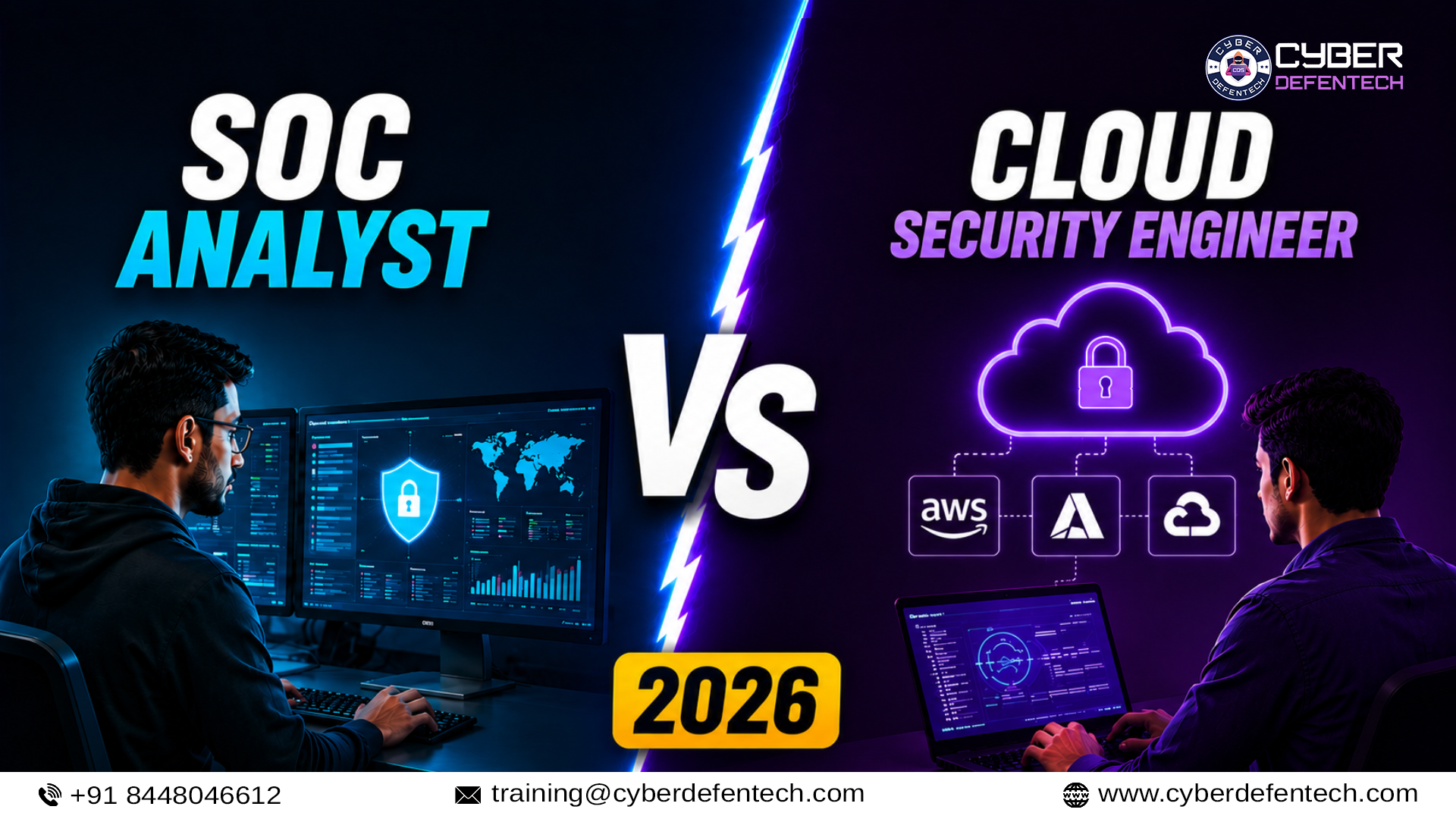
SOC Analyst vs Cloud Security Engineer
By Cyber Defentech Team | June 2026 | 13 Min Read | Beginner to Advanced
Introduction
Somewhere in the world right now, an attacker is probing a misconfigured cloud server. Somewhere else, a SOC dashboard just lit up red with a suspicious login attempt from a country the employee has never visited. This is the new normal — a 24/7 digital battlefield where AI-powered attacks, ransomware-as-a-service, and cloud misconfigurations have become daily headlines rather than rare incidents.
As organizations rush to digitize, migrate to the cloud, and adopt AI across their operations, the demand for skilled cybersecurity professionals has exploded. Two roles sit at the very heart of this defense ecosystem: the SOC Analyst and the Cloud Security Engineer. Both are high-demand, future-ready career paths — but they are fundamentally different in scope, skills, and daily responsibilities.
If you’re a student, IT professional, or career switcher trying to decide where to begin your cybersecurity journey, this guide is for you. We’ll break down what each role actually does, the real-world threats they tackle, the tools they use, expected salaries, and how you can build a practical, job-ready skill set with Cyber Defentech’s industry-focused training programs.
By the end of this article, you’ll have a clear, confident answer to the question: “SOC Analyst or Cloud Security Engineer — which path fits my goals?”
What is SOC Analyst vs Cloud Security Engineer?
A SOC Analyst — short for Security Operations Center Analyst — is the frontline guardian of an organization’s IT environment. Working from a Security Operations Center, SOC Analysts monitor network traffic, system logs, and security alerts around the clock. When something suspicious happens — an unusual login, a malware signature, an unexpected spike in outbound traffic — the SOC Analyst is the first to investigate, triage, and respond.
A Cloud Security Engineer, by contrast, works upstream. Instead of reacting to alerts, they design and maintain the secure foundations on which modern businesses run their applications and data — primarily on platforms like AWS, Microsoft Azure, and Google Cloud Platform (GCP). Their job is to make sure cloud infrastructure is configured correctly, access is tightly controlled, and vulnerabilities are minimized before attackers can exploit them.
Think of it this way: the Cloud Security Engineer builds the vault, sets the locks, and configures the alarm system. The SOC Analyst sits in the control room, watches the cameras, and responds the moment someone tries to break in. Both roles are essential, and increasingly, they work in tandem as part of a unified security strategy.
In 2026, with hybrid work, multi-cloud adoption, and AI-driven automation becoming standard, these two roles have never been more relevant — or more in demand.
Why is SOC Analyst vs Cloud Security Engineer Important?
The shift to cloud computing has fundamentally changed where data lives and how it’s attacked. A decade ago, most company data sat behind a physical firewall in an on-premise data center. Today, that same data might be spread across AWS S3 buckets, Azure Blob Storage, SaaS applications, and remote employee devices — all accessible from anywhere in the world.
This expanded “attack surface” means two things. First, organizations need constant, real-time monitoring to catch threats as they happen — the job of the SOC Analyst. Second, they need the underlying cloud infrastructure to be secure by design — the job of the Cloud Security Engineer. Without both layers working together, even the best monitoring tools can’t compensate for poorly configured cloud environments, and even the most secure architecture can’t stop a determined attacker armed with stolen credentials.
Why It Matters?
Cybersecurity is no longer an “IT problem” — it’s a board-level business risk. A single major breach can result in regulatory fines, lawsuits, loss of customer trust, and in some cases, the complete collapse of a business. Companies are no longer asking “do we need cybersecurity staff?” — they’re asking “how fast can we hire skilled SOC Analysts and Cloud Security Engineers?”
For job seekers, this translates directly into opportunity. The persistent global cybersecurity talent shortage means that professionals with practical, demonstrable skills in either of these roles are being hired faster, paid better, and given more responsibility earlier in their careers than in almost any other tech field.
Real-World Cyber Threats & Risks
Understanding the threat landscape is essential to understanding why these roles exist. Below is a breakdown of common threats and which role typically handles them.
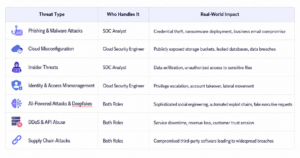
Real-world example: Some of the largest data exposure incidents in recent years have not come from sophisticated zero-day exploits, but from something as simple as a publicly accessible cloud storage bucket — a configuration error that falls squarely within a Cloud Security Engineer’s domain. On the other end, ransomware groups continue to rely heavily on phishing emails as their primary entry point, which SOC teams are trained to detect and contain before encryption begins.
Another growing concern in 2026 is the rise of AI-generated phishing content and deepfake voice calls used in CEO fraud scams. These attacks are harder to detect using traditional rule-based systems, pushing both SOC teams and cloud security teams to adopt AI-driven anomaly detection tools.
Why It Matters?
The threats above aren’t theoretical — they’re happening to real companies, every single day, across every industry. For aspiring cybersecurity professionals, understanding these scenarios isn’t just academic knowledge — it’s the foundation of the practical skills employers are actively hiring for.
Why Companies Need SOC Analyst vs Cloud Security Engineer Professionals?
Modern businesses operate without boundaries — employees work remotely, customers access services from mobile apps, and infrastructure spans multiple cloud providers. This always-on, borderless environment means threats can emerge at any hour, from anywhere.
Companies need SOC Analysts to staff Security Operations Centers around the clock (often in shifts), ensuring that no alert goes unnoticed, no matter when an attack occurs. A delay of even a few hours in detecting a breach can mean the difference between containing an incident and facing a full-scale data leak.
At the same time, as companies adopt DevOps practices and deploy new cloud resources daily — sometimes hourly — they need Cloud Security Engineers to embed security into these fast-moving pipelines. This is where concepts like DevSecOps (integrating security into development and operations) and Zero Trust Architecture (never automatically trusting any user or device, even inside the network) become critical.
Compliance is another major driver. Industries like finance, healthcare, and e-commerce must adhere to strict regulatory frameworks such as ISO 27001, SOC 2, HIPAA, PCI-DSS, and GDPR. Both SOC Analysts (through monitoring and reporting) and Cloud Security Engineers (through secure configuration and access controls) play direct roles in maintaining compliance and avoiding costly penalties.
Why It Matters?
This isn’t a “nice to have” hiring decision for companies — it’s existential. Organizations that fail to staff these roles adequately face not just technical risk, but legal, financial, and reputational consequences that can take years to recover from. This urgency is exactly why these roles remain among the most resilient, recession-proof careers in tech.
Skills You Will Learn
Whether you choose the SOC Analyst path, the Cloud Security Engineer path, or decide to build skills across both, here’s a detailed breakdown of what you’ll need to master.
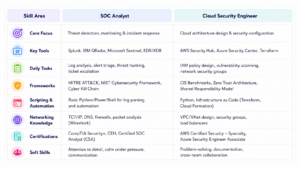
At Cyber Defentech, both skill paths are taught through practical, hands-on labs rather than just theory. Learners get to work inside real SOC dashboards, simulate cyberattacks, configure cloud environments, and resolve realistic security incidents — exactly the kind of experience employers look for.
Career Opportunities
A career that starts as a SOC Analyst rarely stays static. After gaining 1-3 years of experience, professionals often move into specialized roles such as Threat Hunter, Incident Responder, Malware Analyst, or Digital Forensics Investigator. With further experience, many progress into SOC Team Lead or Security Operations Manager positions, overseeing entire monitoring teams.
For those who choose the Cloud Security Engineer path, career progression often leads toward roles like Cloud Security Architect, DevSecOps Engineer, Cloud Compliance Manager, or Cloud Infrastructure Security Lead. With enough experience across security domains, both paths can eventually lead to senior leadership roles such as Security Architect, Director of Information Security, or Chief Information Security Officer (CISO).
What makes 2026 particularly exciting is the emergence of hybrid roles. As companies increasingly run security operations within cloud-native environments, professionals who understand both SOC monitoring and cloud architecture — sometimes called “Cloud Security Operations” specialists — are becoming some of the most sought-after hires in the industry.
Why It Matters?
Neither path is a dead end — both offer multiple branching career trajectories. Starting in either role gives you exposure to core security principles that transfer across the industry. The key is to start with practical, foundational training that opens doors to multiple specializations down the line, rather than narrow, theory-only learning that limits your flexibility.
Salary & Industry Demand
Compensation for both roles has grown steadily as demand continues to outpace supply. Below is a general salary overview for the Indian market, though figures can vary based on company size, location, and certifications held.
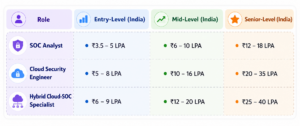
Internationally, both roles consistently rank among the highest-demand cybersecurity positions, with cloud security roles often commanding a premium due to the specialized certifications required and the critical nature of cloud infrastructure to business operations.
It’s worth noting that salary isn’t the only metric of demand — job availability matters too. SOC Analyst roles tend to have a higher volume of entry-level openings, making them an accessible starting point. Cloud Security Engineer roles, while fewer at entry-level, offer a faster trajectory to higher pay once foundational cloud certifications are obtained.
Why It Matters?
For career planners, this data offers a practical roadmap: if you need to enter the workforce quickly with limited prior experience, SOC Analyst roles offer more accessible entry points. If you’re willing to invest extra time in cloud certifications upfront, the Cloud Security Engineer path can lead to faster long-term salary growth.
Real-World Importance of SOC Analyst vs Cloud Security Engineer
Let’s walk through a realistic scenario to see how these two roles function together in practice.
Imagine a mid-sized fintech company. One evening, the SOC team’s SIEM dashboard flags a login attempt to a senior executive’s account from an IP address located in a country where the company has no operations. The SOC Analyst on duty immediately investigates — checking the login timestamp, device fingerprint, and recent account activity. Within minutes, they confirm this is not a legitimate login and isolate the account, force a password reset, and escalate the incident to the security team.
Why was this detection even possible? Because months earlier, the Cloud Security Engineer had configured geo-based access restrictions, enabled multi-factor authentication (MFA) across all admin accounts, and set up automated alerting rules within the company’s cloud identity management system. Without that proactive configuration, the suspicious login might never have triggered an alert in the first place — or worse, MFA might not have stopped the attacker from gaining full access.
This example illustrates a core truth about cybersecurity in 2026: prevention and detection are two sides of the same coin. Cloud Security Engineers reduce the number of ways an attacker can get in, and SOC Analysts catch the ones that slip through anyway. Neither role can fully replace the other — they’re complementary layers of a single defense strategy.
Why It Matters?
Even if you specialize in one role, understanding how the other operates makes you significantly more valuable. SOC Analysts who understand cloud architecture can investigate incidents faster and with more context. Cloud Security Engineers who understand how SOC teams operate can design systems that generate clearer, more actionable alerts. This cross-domain awareness is increasingly what separates good professionals from great ones.
Tools & Technologies Used
The tools you’ll work with differ significantly depending on the path you choose, though there’s growing overlap as AI integration becomes standard across both domains.
SOC Analysts spend much of their day inside SIEM (Security Information and Event Management) platforms like Splunk, IBM QRadar, and Microsoft Sentinel — these tools aggregate logs from across the network and flag suspicious patterns. They also use Endpoint Detection and Response (EDR) and Extended Detection and Response (XDR) platforms to monitor individual devices, along with packet analysis tools like Wireshark for deep network investigation. Ticketing systems such as ServiceNow help manage the workflow of incidents from detection to resolution.
Cloud Security Engineers work primarily within cloud provider security consoles — AWS Security Hub, Azure Security Center, and Google Cloud Security Command Center — to monitor configurations and compliance posture. Infrastructure as Code (IaC) tools like Terraform and AWS CloudFormation allow them to define and enforce security configurations programmatically, ensuring consistency across environments. As containerization becomes standard, familiarity with Docker and Kubernetes security — including tools for scanning container images for vulnerabilities — has become essential.
A growing trend across both roles is the integration of AI and machine learning into security tooling. AI-powered SIEM platforms can now correlate millions of events to surface genuinely suspicious patterns, reducing alert fatigue for SOC teams. Similarly, AI-driven cloud security posture management (CSPM) tools can automatically detect and even remediate misconfigurations before they become exploitable.
Beginner Roadmap
If you’re starting from scratch, here’s a practical, step-by-step approach to building skills for either path.
For aspiring SOC Analysts, begin with networking fundamentals — understanding TCP/IP, DNS, HTTP/HTTPS, and how firewalls work. Next, build familiarity with operating system internals for both Windows and Linux, since most security incidents involve one or both. From there, move into SIEM tools, learning how to read and analyze logs, followed by studying incident response frameworks like the Cyber Kill Chain and MITRE ATT&CK. Earning a certification like CompTIA Security+ provides a strong, recognized foundation, with CEH as a valuable next step for those interested in offensive security perspectives.
For aspiring Cloud Security Engineers, start with the fundamentals of cloud computing — understanding compute, storage, and networking concepts within AWS, Azure, or GCP (pick one to start, then expand). Next, dive into Identity and Access Management (IAM), learning how permissions, roles, and policies control access to resources. From there, study cloud networking security — virtual networks, security groups, and firewalls within the cloud context. As you advance, learn Infrastructure as Code with Terraform, explore container security with Docker and Kubernetes, and study the Zero Trust security model. Certifications like AWS Certified Security – Specialty or Microsoft Azure Security Engineer Associate validate this knowledge to employers.
In both cases, the single most important factor in becoming job-ready is hands-on practice. Reading about a SIEM tool or an IAM policy is fundamentally different from configuring one yourself, breaking it, and fixing it — which is exactly the kind of practical exposure that separates candidates who get hired from those who don’t.
Why Choose Cyber Defentech?
Cyber Defentech has built its training programs around one core principle: real skills come from real practice. Rather than relying on slide-heavy lectures and outdated theory, Cyber Defentech’s curriculum is designed around hands-on labs, live attack-and-defense simulations, and exposure to actual SOC dashboards and cloud security environments.
Whether you’re aiming to become a SOC Analyst, a Cloud Security Engineer, or want to explore both before choosing, Cyber Defentech’s programs are structured to mirror real workplace environments. Learners work through realistic incident scenarios, configure cloud security settings in sandboxed environments, and learn to use the same industry-standard tools — Splunk, AWS/Azure security consoles, Terraform, and more — that they’ll encounter on the job.
Beyond technical training, Cyber Defentech places strong emphasis on building the practical, communication, and problem-solving skills that interviewers actually look for. The curriculum is regularly updated to reflect 2026 industry trends, including AI-driven security tools and modern DevSecOps practices, ensuring learners aren’t just job-ready today, but future-ready for the next several years of their careers.
Why It Matters?
The gap between “knowing about” cybersecurity and “being able to do” cybersecurity is the single biggest factor in whether a candidate gets hired. Choosing a training provider that prioritizes hands-on, real-world exposure — like Cyber Defentech — directly translates into stronger interview performance, faster job placement, and greater long-term career confidence.
Future Scope & Industry Trends
Looking ahead, the convergence of AI and cybersecurity will define both of these roles in the coming years. SOC teams are rapidly adopting AI-powered SIEM and SOAR (Security Orchestration, Automation, and Response) platforms that can automatically triage low-priority alerts, freeing up analysts to focus on genuinely complex threats. This shift means future SOC Analysts will need to understand not just how to use these AI tools, but how to interpret and validate their outputs — a skill sometimes called “AI-assisted threat hunting.”
On the cloud security side, the trend toward multi-cloud environments — where companies use AWS, Azure, and GCP simultaneously — is creating demand for engineers who can manage security consistently across different platforms. Zero Trust Architecture, once a buzzword, is becoming a baseline expectation in enterprise security strategies. Additionally, as AI models themselves become embedded into business applications, a new specialization is emerging: AI security, which focuses on protecting AI systems from prompt injection attacks, data poisoning, and model theft — an area where both SOC and cloud security professionals will increasingly need foundational knowledge.
Another significant trend is the rise of “security as code” — where security policies, compliance checks, and even incident response playbooks are written and version-controlled like software. This blurs the line between traditional SOC work and cloud engineering, reinforcing the value of professionals who can speak both languages.
For anyone entering the field in 2026, the message is clear: the fundamentals of SOC monitoring and cloud security remain as important as ever, but layering AI literacy and cross-domain skills on top of these fundamentals will be what separates good careers from exceptional ones.
Final Thoughts
Choosing between a SOC Analyst and a Cloud Security Engineer career isn’t about picking the “better” option — both are high-demand, future-ready paths with strong salary growth and long-term stability. The right choice depends on your interests and working style.
If you’re energized by real-time problem-solving, investigation, and the adrenaline of incident response, the SOC Analyst path offers a faster entry point and a dynamic, ever-changing work environment. If you’re drawn to architecture, systems thinking, and building secure foundations that prevent problems before they start, the Cloud Security Engineer path offers a path toward higher long-term earning potential and architectural influence.
Whichever path you choose, the most important factor in your success will be practical, hands-on experience. Theoretical knowledge can get you through an interview question, but only real-world practice — the kind offered through Cyber Defentech’s industry-focused training programs — can get you through your first day on the job with confidence.
Cybersecurity isn’t just a career choice in 2026 — it’s one of the few fields where demand is guaranteed to grow, skills remain transferable across industries, and the work you do has a direct, measurable impact on protecting businesses and people. Whether you start as a SOC Analyst or a Cloud Security Engineer, you’re stepping into a career that matters.
FAQs
1. Which is better: SOC Analyst or Cloud Security Engineer?
Both are excellent, high-demand career choices. SOC Analyst roles are ideal for beginners seeking faster entry into the field, while Cloud Security Engineer roles often lead to higher salaries but typically require cloud-specific certifications and a bit more upfront learning.
2. Do I need coding skills for SOC Analyst or Cloud Security Engineer roles?
Basic scripting knowledge in Python, PowerShell, or Bash is helpful for both roles — especially for log analysis automation and Infrastructure as Code — but advanced programming expertise is not mandatory to get started.
3. What certifications help for a SOC Analyst career?
CompTIA Security+, Certified SOC Analyst (CSA), and Certified Ethical Hacker (CEH) are commonly recommended starting certifications that are well recognized by employers.
4. What certifications help for a Cloud Security Engineer career?
AWS Certified Security – Specialty, Microsoft Azure Security Engineer Associate, and Google Professional Cloud Security Engineer are among the most valued certifications in this field.
5. Can a SOC Analyst transition to a Cloud Security Engineer role?
Yes, this is a common and natural career progression. Many professionals start as SOC Analysts to build foundational security knowledge, then specialize in cloud security by learning AWS, Azure, or GCP security fundamentals.
6. Is cybersecurity a good career choice in 2026?
Absolutely. With rising cyberattacks, AI-driven threats, and continued cloud adoption across every industry, cybersecurity remains one of the most stable, high-demand, and future-proof career fields globally.
7. How long does it take to become job-ready in these roles?
With focused, practical training such as Cyber Defentech’s hands-on programs, motivated beginners can typically become job-ready in 4 to 6 months, depending on prior IT knowledge and the time invested in practice.
8. Does Cyber Defentech offer placement support?
Yes, Cyber Defentech provides industry-focused, hands-on training along with placement guidance to help learners transition smoothly into real-world SOC Analyst or Cloud Security Engineer roles.
Ready to Build Your Career in Cybersecurity?
✅ Hands-on Practical Training
✅ Real-World Cybersecurity Skills
✅ Industry-Focused Learning
✅ Future-Ready Career Path
 Visit Now:
 Call/WhatsApp:
