



SOC Analyst Career: Salary, Skills & Growth Opportunities in 2026
By Cyber Defentech Team | June 2026 | 11 Mins Read | Beginner to Advanced
Introduction
At 2:47 AM, an alert fires in a financial institution’s Security Operations Center. A single anomalous authentication attempt from an unrecognized IP in Eastern Europe. To most automated systems, it looks like noise. To a skilled SOC Analyst, it looks like the opening move of a credential-stuffing attack. Within minutes, the account is isolated, the IP is blocked, and a threat intelligence ticket is opened. The attack is stopped before a single record is exfiltrated.
That analyst just saved their organization from a potential multi-million dollar breach. And right now, there are tens of thousands of companies around the world desperately searching for more professionals just like them.
The Security Operations Center (SOC) is the nerve center of modern enterprise cybersecurity — and the SOC Analyst is its most essential and high-demand role. According to Cybersecurity Ventures, cybercrime damages are projected to exceed $10.5 trillion annually in 2026. Simultaneously, the global cybersecurity workforce gap has widened to over 4.7 million unfilled positions, with SOC-related roles accounting for the largest share of that deficit.
If you’re exploring a career in cybersecurity, or considering your next move within the industry, the SOC Analyst career path offers an unparalleled combination of purpose, growth, and financial reward. This guide covers everything you need to know — from the realities of the role and the skills that matter most, to salary benchmarks, career progression roadmaps, and how Cyber Defentech can accelerate your journey.
What Is a SOC Analyst?
A Security Operations Center (SOC) Analyst is a cybersecurity professional responsible for continuously monitoring an organization’s IT infrastructure, detecting security incidents, analyzing threats, and coordinating response activities to minimize damage and restore normal operations.
SOC Analysts operate within a Security Operations Center — a centralized unit staffed around the clock (24/7/365) that functions as an organization’s first and most critical line of cyber defense. Using a combination of advanced security tools, threat intelligence feeds, and deep investigative expertise, SOC Analysts act as the watchers who never sleep.
The role is structured into tiers reflecting increasing responsibility and expertise:
Tier 1 — Alert Triage Analyst
The entry point for most SOC professionals. Tier 1 analysts monitor dashboards, triage incoming alerts from SIEM platforms, categorize incidents by severity, and escalate confirmed threats to senior analysts. Speed, accuracy, and the ability to distinguish real threats from false positives are core competencies at this level.
Tier 2 — Incident Responder
Tier 2 analysts conduct in-depth investigation of escalated incidents. They perform threat hunting, analyze malware behavior, examine network forensics, and lead containment and remediation efforts. This tier requires a strong grasp of attacker TTPs (Tactics, Techniques, and Procedures) as mapped in frameworks like MITRE ATT&CK.
Tier 3 — Threat Hunter / Senior Analyst
Tier 3 is where proactive security happens. Senior analysts don’t wait for alerts — they hunt for hidden threats already inside the environment, develop detection rules, build automation playbooks, and advise on architectural improvements. This is the most strategic and highest-compensated tier within the analyst structure.
Why Is the SOC Analyst Role Critically Important?
In an era where cyberattacks are automated, AI-augmented, and relentlessly persistent, the human intelligence and judgment of a skilled SOC Analyst remains irreplaceable. Here’s why this role is foundational to every organization’s security posture:
The Scale of the Threat Is Unprecedented
IBM’s 2025 Cost of a Data Breach Report found that the average global data breach cost reached $4.88 million — with organizations that lacked mature SOC capabilities experiencing significantly higher costs and longer detection times. The average time to identify and contain a breach without robust SOC monitoring was 277 days. With an active, skilled SOC team, that number drops dramatically.
Every Industry Is a Target
Healthcare, finance, government, retail, critical infrastructure — no sector is exempt from targeted cyberattacks. The universal need for SOC capabilities means SOC Analysts are among the most broadly employable professionals in technology, with opportunities spanning every industry vertical and geography.
Regulatory Compliance Demands It
Frameworks and regulations including ISO 27001, NIST CSF, SOC 2, PCI-DSS, HIPAA, and GDPR increasingly mandate continuous security monitoring, incident detection and response capabilities, and documented audit trails — all functions that sit squarely in the SOC Analyst’s domain. Compliance requirements alone are driving massive SOC investment worldwide.
Real-World Cyber Threats SOC Analysts Confront Daily
Understanding the actual threat landscape SOC Analysts operate in brings the role into sharp focus. These are not abstract risks — they are documented incidents occurring globally, every single day.
Ransomware-as-a-Service (RaaS) Operations
Groups like LockBit, BlackCat/ALPHV, and Cl0p operate as sophisticated criminal enterprises offering ransomware capabilities to affiliates on a subscription model. Their attacks begin with subtle initial access methods — phishing emails, vulnerable RDP instances, supply chain compromises — that a vigilant SOC Analyst can detect in the early stages. The Colonial Pipeline attack (2021), which disrupted fuel supplies across the US East Coast and cost $4.4 million in ransom, is a defining example of what happens when SOC monitoring capabilities are inadequate.
Advanced Persistent Threats (APTs) and Nation-State Actors
Nation-state threat actors — including groups attributed to Russia (APT29/Cozy Bear), China (APT41), North Korea (Lazarus Group), and Iran (Charming Kitten) — conduct long-duration intrusions designed to remain undetected for months or years. Detecting these actors requires the advanced threat hunting and behavioral analytics skills found at Tier 2 and Tier 3 SOC levels.
Insider Threats and Privilege Abuse
Not all threats originate externally. The Verizon Data Breach Investigations Report found that insider threats account for approximately 35% of all data breaches. SOC Analysts using User and Entity Behavior Analytics (UEBA) tools play a critical role in detecting anomalous access patterns, privilege escalation, and data exfiltration by both malicious insiders and compromised credentials.
AI-Augmented Phishing and Social Engineering
Modern AI-powered phishing campaigns generate hyper-personalized, grammatically flawless lure emails at industrial scale. These campaigns are often the precursor to ransomware deployments and financial fraud. SOC Analysts trained in email forensics, link analysis, and header inspection are critical to catching these attacks before they reach end users.
Why Organizations Are Desperately Hiring SOC Analysts?
The demand for qualified SOC professionals has never been more acute. The (ISC)² Cybersecurity Workforce Study reported that 67% of organizations indicated their security teams were critically understaffed, directly impacting their ability to respond to incidents in a timely manner.
Here’s what’s driving this urgent, global demand:
- Accelerating attack frequency — organizations are experiencing more incidents per year, requiring expanded SOC capacity
- Cloud migration complexity — hybrid and multi-cloud environments create expanded attack surfaces that demand specialized monitoring
- AI-powered threat evolution — adversarial AI is outpacing legacy security tools, creating demand for analysts who understand next-generation detection methods
- Regulatory expansion — new compliance mandates globally are compelling organizations to build or expand SOC capabilities
- Cyber insurance requirements — insurers now routinely require evidence of active SOC monitoring as a condition of coverage
The result is a candidate’s market of extraordinary opportunity. Organizations including global banks, healthcare systems, cloud service providers, defense contractors, government agencies, and managed security service providers (MSSPs) are all competing for the same limited pool of trained SOC talent. Professionals who enter this field with genuine, practical skills — not just theoretical knowledge — are positioned to command premium compensation and rapid career advancement.
Core Skills You Will Master as a SOC Analyst
A comprehensive SOC Analyst training program — such as the advanced curriculum offered at Cyber Defentech — builds expertise across the full technical and analytical stack required by modern security operations teams:
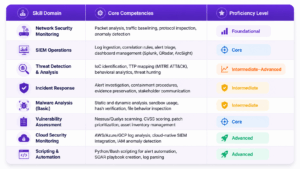
At Cyber Defentech, every skill domain is taught through hands-on lab environments that mirror real enterprise SOC infrastructure. Students triage live-simulated alerts, investigate actual malware samples in sandboxed environments, and practice incident response workflows in scenarios drawn from real-world breach cases — not textbook theory.
Career Opportunities: Where the SOC Analyst Path Leads
One of the most compelling aspects of the SOC Analyst career is its remarkable versatility as a professional foundation. The analytical skills, technical depth, and operational discipline developed in a SOC role open doors across the entire cybersecurity spectrum:
Vertical Growth Within the SOC
- SOC Analyst Tier 1 → Tier 2 → Tier 3 progression with defined skill milestones
- SOC Team Lead / Shift Supervisor managing analyst teams and shift operations
- SOC Manager overseeing operations, tooling, and strategic program direction
- Director of Security Operations leading enterprise-wide SOC transformation
Lateral Career Transitions
- Penetration Tester / Red Team Analyst — applying offensive knowledge to expose organizational weaknesses
- Threat Intelligence Analyst — tracking and profiling advanced threat actor groups
- Digital Forensics & Incident Response (DFIR) Specialist — conducting post-breach investigations
- Cloud Security Engineer — architecting and monitoring cloud-native security environments
- Security Architect — designing enterprise security frameworks and zero-trust architectures
- GRC Analyst — translating technical findings into policy and regulatory frameworks
Leadership and Executive Pathways
The SOC Analyst career naturally evolves toward senior leadership for professionals who combine technical mastery with communication ability and strategic thinking. Chief Information Security Officer (CISO) roles — commanding salaries of $180,000–$260,000+ globally — are frequently held by executives who built their foundations in security operations.
SOC Analyst Salary & Industry Demand in 2026
Compensation for SOC professionals has risen significantly in recent years, driven by persistent talent shortages and the escalating cost of cybercrime. Here’s a comprehensive view of current salary benchmarks across career stages:
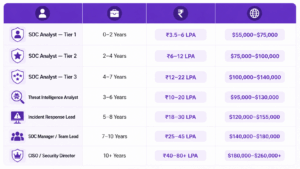
💡 Beyond base salary, SOC professionals at mid-to-senior levels typically receive annual performance bonuses (10–25%), employer-funded certification support, remote/hybrid work flexibility, and accelerated promotion timelines due to persistent talent shortages.
India’s cybersecurity market is experiencing particularly dramatic growth in 2026, driven by the rapid digitization of financial services, healthcare, and government infrastructure. MSSPs and global tech companies with India-based SOC centers — including TCS, Infosys, Wipro, HCL, IBM, and Accenture — are actively competing for trained SOC talent, creating exceptional leverage for certified professionals.
Why It Matters: The Real-World Importance of SOC Analysts?
It’s easy to view cybersecurity through the lens of technology — firewalls, endpoints, SIEM rules. But the SOC Analyst role is fundamentally a human endeavor, and its importance extends far beyond any individual organization.
When a hospital’s SOC Analyst detects ransomware before it encrypts patient records, they may have prevented delayed surgeries, inaccessible medication histories, or worse. When a bank’s security operations team neutralizes an account takeover campaign, they protect customers’ life savings and retirement funds. When a government SOC identifies an APT intrusion into critical infrastructure, they may be preventing disruption to power grids, water systems, or emergency services.
The stakes of this work are genuinely high — and for professionals who want a career that combines intellectual challenge with real-world impact, few roles in technology can match what a SOC Analyst does every day.
📊 Organizations with mature SOC capabilities detect breaches 74% faster and contain them 58% more cost-effectively than those without dedicated security operations functions. (IBM Security / Ponemon Institute)
Tools & Technologies Used by SOC Analysts
Proficiency with the industry’s leading security platforms is non-negotiable for a working SOC Analyst. The tools below represent the core technology stack that employers expect candidates to know:
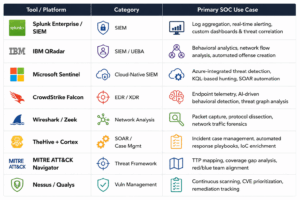
Cyber Defentech’s lab environments provide guided, hands-on access to Splunk, QRadar, Microsoft Sentinel, CrowdStrike, and other industry-standard platforms — ensuring students graduate with verifiable, practical skills rather than surface-level familiarity.
Beginner Roadmap: Your Journey to SOC Analyst
Starting from zero doesn’t mean starting slowly. Here is a structured, time-efficient roadmap that Cyber Defentech recommends for aspiring SOC professionals:
Phase 1 — Core Foundations (Weeks 1–6)
- Networking fundamentals: OSI model, TCP/IP stack, DNS, HTTP/S, routing and switching
- Operating systems: Linux command-line proficiency, Windows Active Directory basics
- Cybersecurity fundamentals: CIA Triad, attack lifecycle, threat taxonomy
- Introduction to log analysis: syslog, Windows Event Logs, firewall logs
Phase 2 — Security Operations Fundamentals (Weeks 7–12)
- SIEM introduction: Splunk basics, log ingestion, basic query language (SPL)
- Network security monitoring: Wireshark packet analysis, IDS/IPS concepts
- Vulnerability management: Nessus scanning, CVSS scoring, patch management workflows
- Introduction to incident response: detection → containment → eradication → recovery
Phase 3 — Analyst-Level Skills (Weeks 13–18)
- MITRE ATT&CK framework: TTP identification, threat actor profiling, detection mapping
- Malware analysis basics: static analysis, sandbox detonation, behavioral indicators
- Threat hunting fundamentals: hypothesis-driven investigation, anomaly detection
- SOAR basics: automated playbook creation, alert enrichment workflows
Phase 4 — Advanced Specialization & Certification (Weeks 19–24)
- Advanced SIEM: correlation rule creation, custom detection content, tuning false positives
- Cloud security monitoring: AWS/Azure log analysis, IAM anomaly detection, CSPM tools
- Threat intelligence: IoC management, STIX/TAXII feeds, threat actor tracking
- Certification preparation: CompTIA CySA+, EC-Council CEH, Splunk Core Certified User
This progression is built into Cyber Defentech’s SOC Analyst training track — designed to take motivated learners from foundation to job-ready in as little as six months, with the flexibility to accommodate working professionals.
Why Choose Cyber Defentech for Your SOC Analyst Training?
In a training market filled with recorded video courses and surface-level certifications, Cyber Defentech is built differently — by active security practitioners, for the real-world demands of modern security operations.
Live, Hands-On Lab Environments
Every Cyber Defentech student spends the majority of their training time doing — not watching. Live SIEM labs, simulated SOC environments, real malware analysis exercises, and incident response scenarios drawn from documented breach cases ensure that graduates can hit the ground running from day one on the job.
Curriculum Built by Working Professionals
Cyber Defentech’s instructors are not academics — they are current threat analysts, incident responders, and SOC managers with firsthand experience defending enterprise environments. This means the curriculum reflects how SOC operations actually work today, including AI-augmented threat detection, cloud security monitoring, and advanced SOAR automation.
Industry-Aligned Certification Support
Cyber Defentech’s programs are structured to prepare students for the certifications that matter most to employers: CompTIA Security+, CompTIA CySA+, EC-Council CEH, Splunk Certified User, and Microsoft SC-200. Certification guidance, mock exams, and exam strategy are integrated throughout the training.
Career Placement Infrastructure
From resume optimization and LinkedIn profile coaching to mock technical interviews and connections with hiring managers at partner organizations, Cyber Defentech’s career support infrastructure is built around one goal: getting graduates employed, at the right level, in the right roles.
A Community of Future-Ready Professionals
Joining Cyber Defentech means joining a network of cybersecurity professionals at every stage of their careers — from fellow learners to senior practitioners, CTF participants to industry mentors. That community is an asset that compounds over the course of an entire career.
Future Scope & Industry Trends: The SOC of Tomorrow
The Security Operations Center is evolving rapidly, driven by AI, automation, cloud transformation, and the ever-escalating sophistication of threat actors. Here are the trends defining the next generation of SOC careers in 2026 and beyond:
AI-Augmented SOC Operations
AI and machine learning are being integrated into every layer of SOC tooling — from alert triage (reducing analyst fatigue by filtering false positives) to threat hunting (identifying behavioral anomalies at machine speed). Future SOC Analysts will need to understand how to work with, configure, and critically evaluate AI-driven detection systems — making AI literacy an increasingly non-negotiable competency.
Extended Detection and Response (XDR)
XDR platforms are unifying endpoint, network, cloud, and identity telemetry into a single detection and response workflow — fundamentally changing how SOC Analysts investigate incidents. Proficiency with XDR architectures from vendors like CrowdStrike, Microsoft, and Palo Alto Networks is rapidly becoming a core hiring criterion.
The Rise of MSSP and Virtual SOC Models
Managed Security Service Providers (MSSPs) and virtual SOC models are proliferating as small and mid-size organizations outsource their security operations. This creates a parallel career pathway for SOC professionals — operating across multiple client environments simultaneously, developing broader threat pattern recognition, and accelerating skills development at exceptional speed.
Autonomous Security Operations
SOAR platforms are advancing toward near-autonomous response capabilities — automatically containing compromised endpoints, revoking credentials, and notifying stakeholders without human intervention. SOC Analysts who can design, implement, and govern these automated playbooks will be among the most valued professionals in the industry.
Quantum-Ready Security Monitoring
As quantum computing matures, the cryptographic foundations of current security architectures will face unprecedented challenges. SOC teams are beginning to incorporate post-quantum cryptography monitoring into their detection strategies — a niche but rapidly growing area of specialization.
Final Thoughts
The SOC Analyst career is not a stepping stone — it is a destination in itself, and a launching pad for the highest levels of the cybersecurity profession. It offers something rare in modern technology careers: the combination of genuine intellectual challenge, measurable real-world impact, extraordinary compensation growth, and virtually unlimited career optionality.
Every day you work as a SOC Analyst, you are on the front line of one of the defining challenges of the digital age. You are the reason patient data stays private. The reason financial systems stay secure. The reason the infrastructure people depend on keeps running.
The world needs more of these professionals — urgently, at scale, across every geography and industry. The question is simply whether you will be one of them.
Cyber Defentech exists to make the answer yes — providing the practical, industry-focused, future-ready training that bridges the gap between ambition and expertise.
Frequently Asked Questions (FAQs)
1. What does a SOC Analyst do on a typical day?
A Tier 1 SOC Analyst typically spends their shift monitoring SIEM dashboards for alerts, triaging and categorizing security events by severity, investigating suspicious activity, escalating confirmed incidents to senior analysts, and documenting findings in a case management system. At Tier 2 and Tier 3 levels, work shifts toward deeper forensic investigation, threat hunting, malware analysis, and the development of new detection logic and response playbooks.
2. Do I need a degree to become a SOC Analyst?
A formal degree in computer science or cybersecurity is not a prerequisite for most SOC Analyst positions. Employers consistently prioritize practical skills, relevant certifications (CompTIA CySA+, CEH, Splunk certifications), and demonstrated hands-on experience over academic credentials alone. Structured training programs like those at Cyber Defentech are widely recognized as an effective and efficient alternative path into the field.
3. What certifications are most valuable for a SOC Analyst career?
The most employer-valued certifications for SOC Analyst roles include: CompTIA Security+ (foundational), CompTIA CySA+ (analyst-level), EC-Council CEH, Splunk Core Certified User, Microsoft SC-200 (Security Operations Analyst), and GIAC Security Essentials (GSEC). At senior levels, GIAC Certified Incident Handler (GCIH) and Certified SOC Analyst (CSA) from EC-Council are highly regarded.
4. What is the starting salary for a SOC Analyst in India?
Entry-level SOC Analyst (Tier 1) positions in India typically offer compensation in the range of ₹3.5–6 LPA, depending on the employer, location, and the candidate’s certification portfolio. Progression to Tier 2 within 2–3 years commonly brings compensation to ₹6–12 LPA, with Tier 3 and specialist roles reaching ₹12–22+ LPA.
5. Is the SOC Analyst role stressful?
Like any high-responsibility security role, SOC work can be demanding — particularly during active incident response. Shift work, alert fatigue from high-volume environments, and the pressure of real-time decision-making are genuine aspects of the role. However, well-structured SOC teams with modern tooling, strong SOAR automation, and effective management mitigate much of this pressure. For professionals who thrive on problem-solving and pattern recognition, the challenges are a significant part of the role’s appeal.
6. How long does it take to become job-ready as a SOC Analyst?
With a structured, intensive training program focused on hands-on practical skills, motivated learners can reach Tier 1 job-readiness in 4–6 months. Advancing to Tier 2 competencies typically takes an additional 6–18 months of combined training and on-the-job experience. Cyber Defentech’s SOC Analyst training track is designed to maximize this acceleration significantly.
7. What industries hire the most SOC Analysts?
SOC Analysts are hired across virtually every industry, but the highest concentrations of roles — and the most competitive compensation — are found in financial services and banking, healthcare and life sciences, government and defense, cloud technology and SaaS, telecommunications, energy and critical infrastructure, and managed security service providers (MSSPs).
8. How does Cyber Defentech prepare students for SOC Analyst roles specifically?
Cyber Defentech‘s SOC Analyst training combines theoretical foundations with intensive hands-on labs using industry-standard tools including Splunk, QRadar, Microsoft Sentinel, and CrowdStrike. Students work through real incident scenarios, perform live threat hunting exercises, analyze actual malware samples in sandboxed environments, and complete structured incident response simulations — with full career support integrated throughout.
Start Your SOC Analyst Career Today
The cybersecurity talent shortage is not narrowing — it is widening. Every month, more organizations launch or expand their security operations capabilities. Every month, the gap between available SOC talent and employer demand grows larger. That gap represents an exceptional window of opportunity for professionals willing to invest in the right skills.
Don’t let that window close while you’re still considering. The next cohort at Cyber Defentech is forming now — and the professionals who start today will be the ones fielding premium job offers six months from now.
Ready to Build Your SOC Analyst Career?
✅ Hands-on Practical Training
✅ Real-World Cybersecurity Skills
✅ Industry-Focused Learning
✅ Future-Ready Career Path
