


Online vs Offline Cybersecurity Certification Courses in 2026?
By Cyber Defentech Team | June 2026 | 12 Mins Read | Beginner to Advanced
Introduction
Every 39 seconds, a cyberattack hits somewhere in the world. By 2026, the global cybersecurity workforce gap has swelled past 3.5 million unfilled positions — and organisations are scrambling. AI-powered malware, deepfake social engineering, ransomware-as-a-service, and zero-day exploits are no longer the domain of nation-state actors; they are weekend projects on the dark web.
The industry does not just need more cybersecurity professionals — it needs battle-ready ones. That means the decision you make right now about your training path is not a minor career preference. It is a life-defining choice.
So here is the real question: when choosing between online vs offline cybersecurity certification courses, which format actually prepares you to protect Fortune 500 infrastructure, stop ransomware in its tracks, and command a six-figure salary? In this comprehensive guide, Cyber Defentech breaks down every dimension of this debate — facts, career data, real-world relevance, and your smartest path forward.
What Are Online vs Offline Cybersecurity Certification Courses?
Before diving into the comparison, let’s ground ourselves in definitions. Cybersecurity certification courses are structured training programmes designed to validate your knowledge and practical skills in protecting digital assets, networks, systems, and data from cyber threats.
Online Cybersecurity Certification Courses
These are instructor-led or self-paced programmes delivered through digital platforms — live virtual classes, recorded video sessions, browser-based labs, and cloud-hosted environments. Learners access course content from anywhere with an internet connection.
Popular online certifications include: Certified Ethical Hacker (CEH), CompTIA Security+, CISSP, Offensive Security Certified Professional (OSCP), AWS Security Specialty, and more. Platforms like Coursera, Udemy, SANS OnDemand, and Cyber Defentech’s virtual learning environment host these offerings.
Offline Cybersecurity Certification Courses
These are in-person, classroom-based programmes conducted at physical training centres, universities, or bootcamp facilities. Learners attend scheduled sessions, work in dedicated hardware labs, and engage directly with instructors and peers face-to-face.
Institutions like Cyber Defentech offer intensive offline bootcamps with dedicated ethical hacking labs, forensic workstations, network simulation environments, and real-world capture-the-flag (CTF) competitions.
Why Are Cybersecurity Certification Courses Important in 2026?
The cybersecurity industry is no longer just about firewalls and antivirus software. Today it encompasses AI-driven threat detection, zero-trust architecture, cloud-native security, DevSecOps, and the protection of critical infrastructure from state-sponsored threat actors.
A certification is your proof of competence in this high-stakes environment. Hiring managers at banks, healthcare companies, government agencies, and tech giants do not have time to evaluate every candidate’s self-taught skills — they look for certifications that act as verified trust signals.
Beyond credentials, a well-structured cybersecurity course gives you the mental models, technical vocabulary, and practical muscle memory to respond under pressure when a real breach occurs. The difference between a trained professional and an untrained one can be millions of dollars and thousands of compromised records.
Real-World Cyber Threats & Risks Making Training Urgent
1. AI-Powered Cyberattacks
Threat actors are now using generative AI to craft undetectable phishing emails, polymorphic malware that evolves to bypass signature-based detection, and automated vulnerability scanning at machine speed. Security teams without AI security training are operating with a 2019 mindset in a 2026 threat landscape.
2. Ransomware-as-a-Service (RaaS)
Criminal groups have productised ransomware. For a fee, anyone can deploy enterprise-grade ransomware against hospitals, schools, and power grids. The 2024 Change Healthcare attack disrupted US medical billing for months, costing over $22 billion in downstream damages.
3. Supply Chain Attacks
The SolarWinds and XZ Utils incidents proved that attackers do not need to breach you directly — they compromise a trusted vendor and ride the update pipeline into thousands of organisations simultaneously. Detecting and responding to these attacks requires advanced threat hunting skills that only structured, hands-on training delivers.
4. Deepfake & Social Engineering
AI-generated voice cloning and video deepfakes are now being used to impersonate executives and authorise fraudulent wire transfers. Security awareness and identity verification protocols have never been more critical.
These are not hypothetical scenarios. They are last quarter’s headlines — and they are precisely why organisations are paying premium salaries to professionals with recognised cybersecurity certifications and practical, real-world training.
Why Companies Need Cybersecurity-Certified Professionals?
According to IBM’s 2025 Cost of a Data Breach Report, the average breach now costs $4.88 million. Organisations with a fully staffed, trained security team detect breaches 74 days faster and contain them 83 days sooner — saving an average of $1.76 million per incident.
Regulatory pressure is equally fierce. GDPR fines can reach 4% of global annual turnover. India’s Digital Personal Data Protection Act (DPDPA), SEC cybersecurity disclosure rules in the US, and NIS2 in Europe have made having certified security personnel a legal and compliance necessity, not a luxury.
The demand is not limited to IT companies. Banking, healthcare, defence, e-commerce, manufacturing, and even agriculture are all high-demand sectors actively hiring cybersecurity professionals in 2026. Your certification is your passport into any of them.
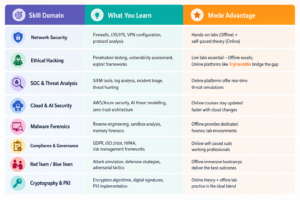
Skills You Will Learn in a Cybersecurity Certification Course
Whether you choose online or offline, a quality cybersecurity programme covers a comprehensive skills stack:
Career Opportunities After Cybersecurity Certification
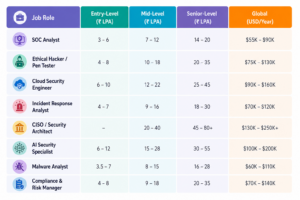
A recognised cybersecurity certification unlocks a career landscape that is both lucrative and purpose-driven. High-demand roles include:
- ✅ SOC Analyst (Tier 1, 2, 3)
- ✅ Penetration Tester / Ethical Hacker
- ✅ Cloud Security Engineer
- ✅ Threat Intelligence Analyst
- ✅ Incident Response Specialist
- ✅ AI Security Engineer
- ✅ Application Security (AppSec) Engineer
- ✅ Malware Analyst / Digital Forensics Expert
- ✅ Compliance & Risk Manager
- ✅ Chief Information Security Officer (CISO)
The cybersecurity career ladder is steep and well-rewarded. Most entry-level roles lead naturally to specialised domains within two to three years, and senior positions command salaries that rival or exceed software engineering compensation globally.
Salary & Industry Demand — 2026 Data
Real-World Importance: Online vs Offline — Why This Choice Matters
This is the section most comparison blogs skip. The format of your cybersecurity training has a direct impact on your job readiness — and different roles reward different learning styles.
Why Offline Training Wins for Hands-On Roles?
For penetration testers, red teamers, and malware analysts, nothing replaces physical lab access. Working with dedicated network hardware, physical vulnerable-machine setups, hardware hacking kits, and face-to-face peer collaboration produces a depth of muscle memory that virtual environments struggle to replicate. Offline bootcamps at Cyber Defentech include live CTF competitions, simulated breach scenarios, and real enterprise-grade lab environments — giving students the confidence to handle Day-1 adversarial scenarios.
Why Online Training Wins for Flexibility and Breadth?
For cloud security engineers, compliance analysts, and threat intelligence professionals, the ability to learn asynchronously, access globally-current course material, and integrate study into a working professional’s schedule is invaluable. Online cybersecurity certification courses also tend to stay updated faster — critical in a domain where threat landscapes shift monthly.
The Hybrid Advantage
The most forward-thinking training providers — including Cyber Defentech — now offer hybrid models: self-paced online theory modules combined with scheduled offline lab intensives. This approach delivers both the flexibility of digital learning and the irreplaceable depth of physical hands-on experience, making graduates genuinely industry-ready.
Tools & Technologies You Will Work With
Offensive Security & Ethical Hacking Tools
- Kali Linux, Parrot OS – primary attack platforms
- Metasploit Framework – exploitation and post-exploitation
- Burp Suite Pro – web application security testing
- Nmap, Nessus, OpenVAS – network scanning and vulnerability assessment
- Wireshark – deep packet inspection and network forensics
Defensive & Blue Team Tools
- Splunk, IBM QRadar, Microsoft Sentinel – SIEM platforms
- CrowdStrike Falcon, SentinelOne – next-generation endpoint detection
- Palo Alto Networks Cortex XSOAR – security orchestration and automation
- Volatility, Autopsy – memory and disk forensics
Cloud & AI Security Tools
- AWS Security Hub, Azure Defender, Google Chronicle – cloud-native security
- Darktrace, Vectra AI – AI-powered threat detection
- HashiCorp Vault – secrets management and PKI
- Terraform with security modules – infrastructure-as-code security
Beginner Roadmap: How to Start Your Cybersecurity Certification Journey ?
- Build Your Foundation — Start with CompTIA A+, Network+, and Linux Essentials. Understand how networks, operating systems, and protocols function at a fundamental level.
- Choose Your Entry Certification — CompTIA Security+ is the globally recognised starting point. It covers core domains: threats, cryptography, identity management, and risk management.
- Develop Practical Skills — Enrol in an ethical hacking or CEH course. Supplement with free platforms like TryHackMe, Hack The Box, and PicoCTF to build CTF skills.
- Pick Your Specialisation — Choose between red team (offensive), blue team (defensive), cloud security, or AI security based on your strengths and interests.
- Pursue Advanced Certifications — OSCP, CISSP, CISM, or cloud provider certifications (AWS Security, Google Professional Cloud Security Engineer) based on your chosen path.
- Build a Portfolio — Document your CTF wins, penetration testing reports (on lab environments), and GitHub security projects. Employers value demonstrated ability over certificates alone.
- Get Industry-Ready Training — Partner with a provider like Cyber Defentech that offers mentorship, placement support, and real-world project exposure to bridge the gap between training and employment.
Why Choose Cyber Defentech for Your Cybersecurity Certification?
Cyber Defentech is not just a training institute — it is a next-generation cybersecurity education ecosystem built by industry practitioners who have worked in real security operations centres, red team engagements, and enterprise incident response scenarios.
What Sets Cyber Defentech Apart:
- Industry-Focused Curriculum — Content designed by active security professionals, not academics alone. Every module maps directly to current threat landscapes and employer requirements.
- Advanced Lab Infrastructure — Dedicated ethical hacking labs, network simulation environments, forensics workstations, and cloud security sandboxes — both online and offline.
- Certified Expert Instructors — All trainers hold industry certifications such as CEH, OSCP, CISSP, and CISM, with active field experience.
- Practical-First Methodology — Every concept is immediately applied in hands-on lab scenarios. Theory without practice is memory; theory with practice is skill.
- Real-World Project Exposure — Students complete capstone projects modelled on actual industry scenarios, building a portfolio that employers can evaluate.
- Placement Support & Mentorship — Cyber Defentech’s career services team connects graduates with hiring partners across banking, IT, defence, healthcare, and government sectors.
- Flexible Learning Modes — Choose from full online, full offline, or hybrid formats based on your schedule, location, and learning style.
- Community & Networking — Join a growing alumni network of cybersecurity professionals across India and globally.
Future Scope & Industry Trends in Cybersecurity
The cybersecurity industry is not facing a temporary shortage — it is facing a structural, decade-long talent deficit driven by digital transformation, cloud adoption, IoT expansion, and AI proliferation.
AI & Machine Learning Security
As AI models are embedded in critical decision-making — from loan approvals to medical diagnostics — adversarial attacks on AI systems, model poisoning, and prompt injection are emerging as frontline threats. AI security engineers will be among the highest-paid specialists of the decade.
Quantum Cryptography Preparedness
Quantum computing threatens to break current RSA and ECC encryption standards within this decade. Organisations are investing now in post-quantum cryptography migration, creating a new sub-specialisation for forward-thinking security professionals.
OT/ICS and Critical Infrastructure Security
Operational technology security — protecting power grids, water treatment plants, and manufacturing systems — is a rapidly growing field following high-profile attacks on industrial targets. It commands some of the highest premiums in the security compensation scale.
Zero Trust Architecture Implementation
The perimeter is dead. Zero-trust — where every user, device, and network request is verified regardless of location — is now the security standard for enterprise. Professionals skilled in zero-trust implementation are in exceptional demand across all verticals.
Global Regulatory Expansion
As governments worldwide tighten data protection laws, demand for compliance professionals who understand both technical security and legal frameworks will surge. The intersection of law and cybersecurity creates a uniquely valuable and well-compensated career niche.
Final Thoughts
The debate between online vs offline cybersecurity certification courses ultimately comes down to this: your goals, your learning style, and your available resources — not a universal right answer.
Online courses offer unmatched flexibility, global access, and faster content updates. Offline bootcamps deliver unparalleled depth, hands-on lab intensity, and face-to-face mentorship. The most successful cybersecurity professionals leverage both strategically — building theoretical foundations online and sharpening practical, real-world skills in immersive offline environments.
What matters most is that you start — and that you start with the right provider. In a field where your knowledge is your shield, training quality is not a place to cut corners. Cyber Defentech exists precisely to ensure your cybersecurity journey is built on industry-grade foundations, delivered by professionals who have been on the front lines, and supported by a community invested in your success.
The threat landscape is not waiting. Neither should you.
Frequently Asked Questions (FAQs)
Q1. Which is better for beginners — online or offline cybersecurity courses?
For absolute beginners, a hybrid approach works best. Online courses let you absorb foundational concepts at your own pace. Once you have the basics, transitioning to offline labs or Cyber Defentech’s hands-on intensive sessions gives you the practical confidence employers look for.
Q2. Are online cybersecurity certifications recognised by employers in India and globally?
Yes — but with nuance. Globally recognised certifications like CEH, CompTIA Security+, OSCP, and CISSP carry full employer recognition regardless of online or offline delivery mode. What matters is the certifying body’s credibility and your demonstrated skills.
Q3. How long does it take to complete a cybersecurity certification course?
Entry-level certifications like CompTIA Security+ can be covered in 8–12 weeks. Intermediate programmes like CEH typically take 3–6 months. Advanced certifications like OSCP or CISSP demand 6–12 months of dedicated preparation.
Q4. What is the minimum educational qualification for cybersecurity courses?
Most programmes require no strict degree — a 10+2 background with basic computer literacy is sufficient to start. Many of the field’s most respected practitioners are bootcamp-trained professionals without conventional CS degrees.
Q5. Can I get a cybersecurity job after an online certification course without prior IT experience?
Yes. Entry-level SOC analyst and IT support roles are accessible to certified candidates without prior IT experience, especially when paired with a strong portfolio of CTF achievements, home lab projects, and practical training from providers like Cyber Defentech.
Q6. How much does a cybersecurity certification course cost in India?
Short online courses can cost as little as ₹500–₹2,000. Professional certification prep courses range from ₹15,000 to ₹80,000. Premium bootcamps with lab access and placement support like Cyber Defentech range from ₹40,000 to ₹1,50,000 — an investment that typically delivers returns within the first year of employment.
Q7. Which cybersecurity certification is most in demand in 2026?
As of 2026, the highest-demand certifications are OSCP (pen testers), CISSP (security managers), CEH (ethical hackers), CompTIA Security+ (entry-level), and AWS/Azure Security Specialty (cloud security engineers).
Q8. Does Cyber Defentech offer placement assistance after the cybersecurity course?
Yes. Cyber Defentech provides dedicated career support including resume building, interview preparation, mock technical assessments, and connections with hiring partners across IT, BFSI, healthcare, defence, and government sectors.
Ready to Build Your Career in Cybersecurity?
✅ Hands-on Practical Training
✅ Real-World Cybersecurity Skills
✅ Industry-Focused Learning
✅ Future-Ready Career Path
✅ Expert Mentorship & Placement Support
 Visit Now:
 Call/WhatsApp:
