

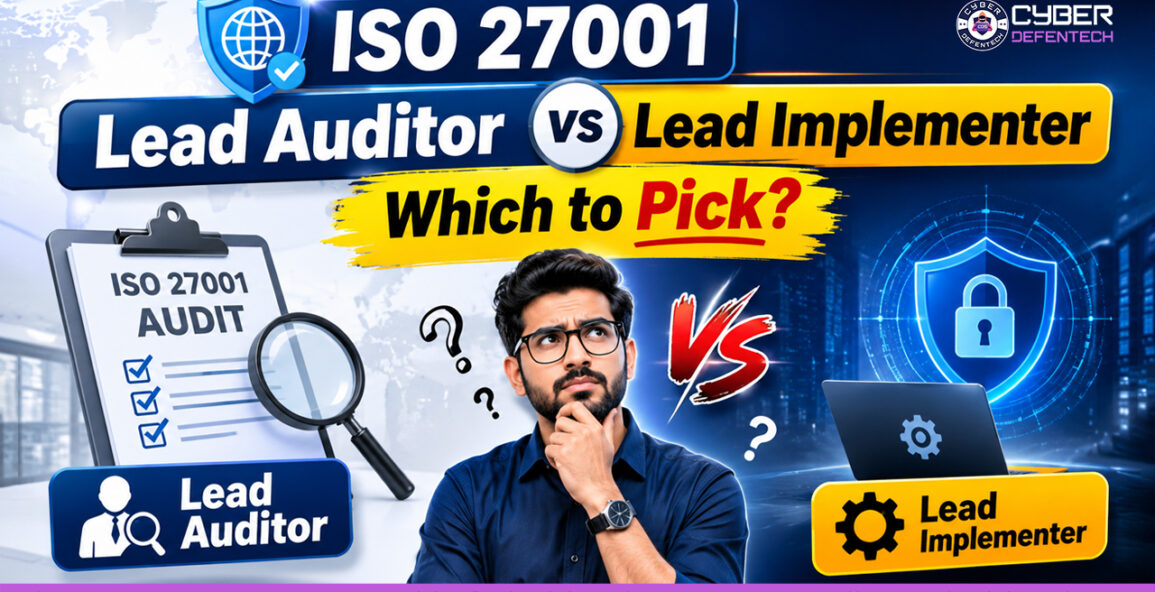
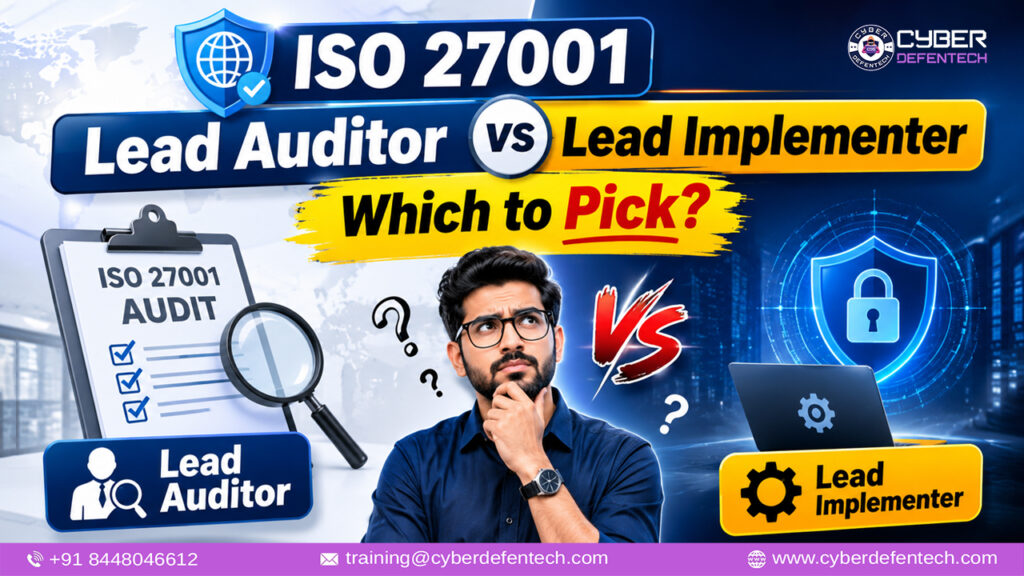
ISO 27001 Lead Auditor vs Lead Implementer: Which Course Should You Choose?
By CyberDefenTech | Information Security Training Guide
Introduction
Information security is no longer a back-office concern. Data breaches, ransomware, regulatory pressure and customer due-diligence questionnaires have pushed organisations everywhere to prove that they manage information risk in a structured way. For most of them, the answer is ISO/IEC 27001, the international standard for an Information Security Management System (ISMS).
This demand has created strong career opportunities for professionals who understand the standard in depth. Two certifications stand out: ISO 27001 Lead Implementer and ISO 27001 Lead Auditor. Both are respected, both are in demand, and both build serious expertise. Yet they prepare you for very different roles.
If you are standing at this crossroads,this ISO 27001 Lead Auditor vs Lead Implementer guide will help at CyberDefenTech, we train professionals in both courses, so our aim here is simple: explain each path honestly, compare them side by side, and help you pick the one that fits your background, your goals and your current job.
Why ISO 27001 Certification Skills Matter
ISO/IEC 27001 (the current edition is ISO/IEC 27001:2022) sets out requirements for establishing, implementing, maintaining and continually improving an ISMS. It covers people, processes and technology, and it is built on a risk-based approach. Annex A of the standard lists 93 controls grouped into four themes: organisational, people, physical and technological.
Organisations pursue ISO 27001 certification for several reasons:
- To win customer trust and meet contractual or tender requirements
- To comply with data protection and sector regulations
- To reduce the likelihood and impact of security incidents
- To create a repeatable, auditable way of managing risk
Every one of these goals needs two kinds of people. Someone has to build the ISMS, and someone has to verify that it works. That, in short, is the difference between a Lead Implementer and a Lead Auditor.
What Is the ISO 27001 Lead Implementer Course?
The Lead Implementer course teaches you how to plan, build, run and improve an ISMS inside an organisation. It is a hands-on, project-oriented programme. You learn how to take a company from “we have some security controls” to “we have a mature, certifiable management system.”
What You Typically Learn
- Understanding the structure and clauses of ISO/IEC 27001 and the purpose of its Annex A controls
- Defining the scope of the ISMS and building a business case with top management
- Conducting risk assessments and preparing the risk treatment plan
- Writing the Statement of Applicability (SoA), policies, procedures and records
- Selecting and implementing controls that fit the organisation
- Running awareness and training programmes
- Setting up monitoring, measurement, internal audit and management review
- Preparing the organisation for a certification audit
- Driving continual improvement
Who Is It For?
- Information security managers and officers
- IT managers, system administrators and network engineers
- Risk and compliance professionals
- Project managers leading certification projects
- Consultants who help clients achieve ISO 27001
- Professionals moving from technical roles into governance
Typical Career Outcomes
Lead Implementers often work as ISMS managers, information security consultants, GRC (Governance, Risk and Compliance) specialists, security programme managers or CISO-track leaders. The role is largely constructive: you design, build and improve.
What Is the ISO 27001 Lead Auditor Course?
The Lead Auditor course teaches you how to plan and conduct audits of an ISMS against ISO/IEC 27001. It follows internationally recognised auditing principles, such as those in ISO 19011, and trains you to gather evidence, evaluate it objectively and report findings clearly.
What You Typically Learn
- Fundamental audit concepts, principles and terminology
- The difference between first-party (internal), second-party (supplier) and third-party (certification) audits
- Planning an audit programme and preparing an audit plan
- Opening and closing meetings, interviews and observation techniques
- Collecting and verifying audit evidence
- Identifying nonconformities, observations and opportunities for improvement
- Writing audit reports and following up on corrective actions
- Leading an audit team and managing difficult situations
- Ethics, impartiality and professional conduct
Who Is It For?
- Internal auditors and quality or compliance auditors
- Professionals who want to work with certification bodies
- Supplier assurance and vendor-risk specialists
- Consultants who offer gap assessments and readiness audits
- Risk, assurance and IT audit professionals
- Anyone responsible for reviewing the performance of an ISMS
Typical Career Outcomes
Lead Auditors work as ISMS internal auditors, third-party auditors, IT and security assurance analysts, compliance auditors or supplier auditors. The role is largely evaluative: you examine, verify and report.
Lead Auditor vs Lead Implementer: Side-by-Side Comparison
| Factor | ISO 27001 Lead Implementer | ISO 27001 Lead Auditor |
|---|---|---|
| Core purpose | Build, implement and improve an ISMS | Audit and verify an ISMS against the standard |
| Main mindset | Constructive, project-driven | Evaluative, evidence-driven |
| Primary focus | Risk assessment, controls, policies, ISMS operation | Audit planning, evidence, nonconformities, reporting |
| Key skills | Project management, risk treatment, documentation, stakeholder buy-in | Interviewing, sampling, objectivity, report writing |
| Typical roles | ISMS manager, security consultant, GRC specialist | Internal auditor, third-party auditor, assurance analyst |
| Works with | Top management, IT teams, process owners | Auditees, management, certification or client teams |
| Best suited to | Those who enjoy designing and delivering systems | Those who enjoy analysing and verifying systems |
| Relation to the standard | Applies it to build compliance | Uses it as audit criteria |
| Good starting point if you are | In IT, security operations, project or risk roles | In audit, quality, compliance or assurance roles |
| Offered by CyberDefenTech | Yes | Yes |
Key Differences Explained
1. Building vs Verifying
The simplest way to remember the ISO 27001 Lead Auditor vs Lead Implementer difference: the Lead Implementer is the architect and builder, and the Lead Auditor is the inspector. An implementer asks, “How do we design and run controls that reduce our risk and satisfy the standard?” An auditor asks, “Is there objective evidence that these controls exist and work as intended?”
2. Different Daily Work
An implementer spends time running risk workshops, drafting policies, coordinating with department heads and tracking implementation tasks. An auditor spends time reviewing documents, interviewing staff, sampling records, writing findings and agreeing on corrective actions.
3. Different Skill Emphasis
Implementation rewards persuasion, planning and practical problem-solving. Auditing rewards attention to detail, neutrality and clear, factual communication. Neither skill set is “easier” or “harder.” They are simply different.
4. Different Employer Types
Implementers are commonly found inside organisations pursuing or maintaining certification and in consulting firms. Auditors are found in certification bodies, assurance teams, large enterprises with internal audit functions and consulting practices offering audit services.
Which Course Should You Choose? A Practical Decision Guide
Instead of asking “Which is better?”, ask “Which is better for me, right now?” Use the questions below to settle the ISO 27001 Lead Auditor vs Lead Implementer question.
Choose Lead Implementer If…
- You want to build or manage an ISMS from scratch
- Your current role involves IT, security operations, risk or project management
- You enjoy designing processes, writing policies and leading change
- You are planning to become an ISMS manager, GRC lead or security consultant
- Your organisation is preparing for ISO 27001 certification
Choose Lead Auditor If…
- You want to evaluate, assess and report on management systems
- Your background is in audit, quality, compliance or assurance
- You enjoy analysing evidence and asking the right questions
- You aim to work as an internal, supplier or third-party auditor
- You need to review vendors or business partners against ISO 27001
Consider Both If…
- You are a consultant who supports clients from gap analysis to certification
- You want a complete view of the ISMS lifecycle
- You are building a long-term career in governance, risk and compliance
- You lead a security team and want to understand both the builder’s and the inspector’s viewpoint
Many experienced professionals eventually complete both courses, so the ISO 27001 Lead Auditor vs Lead Implementer choice is often about sequence, not exclusion. Implementers who understand auditing design more audit-ready systems, and auditors who understand implementation give more practical, realistic findings.
Prerequisites and Preparation
Most professional ISO 27001 courses do not require advanced technical knowledge, but a few things will make your learning smoother:
- Basic understanding of information security concepts such as confidentiality, integrity and availability
- Familiarity with common business processes and IT environments
- A first read of the ISO/IEC 27001 standard, even if you do not understand all of it yet
- For Lead Auditor: an interest in audit methodology and professional ethics
- For Lead Implementer: an interest in risk management and project delivery
For both ISO 27001 Lead Auditor vs Lead Implementer courses, formats, duration and exam details vary by training provider and certification body, so always confirm the specifics before enrolling. The CyberDefenTech team can walk you through the format, schedule and exam process for each programme.
Salary ranges (₹ LPA = lakh rupees per annum):
| Experience | Indicative salary |
|---|---|
| 0-3 years | ₹2.5-6 LPA |
| 4-8 years | ₹6-12 LPA |
| 9+ years | ₹12-22 LPA and above |
How the Two Courses Complement Each Other
It helps to picture the ISMS as a continuous cycle:
- Plan the scope, risks and controls (Implementer territory)
- Do by implementing and operating the controls (Implementer territory)
- Check through internal audits and reviews (Auditor territory)
- Act by correcting issues and improving the system (shared territory)
A healthy ISMS needs both sides. Implementers keep the system alive and growing. Auditors keep it honest and effective. Organisations that invest in both skill sets are generally better prepared for certification audits and day-to-day security challenges.
Common Myths About These Courses
Myth 1: One course is only for technical people and the other is only for managers.
Not true. Both courses welcome technical and non-technical professionals. What matters is your interest and career direction.
Myth 2: You must complete one course before taking the other.
There is no fixed order in the ISO 27001 Lead Auditor vs Lead Implementer decision. Choose the one that matches your current role, and add the other when you are ready.
Myth 3: Auditors do not need to understand implementation.
Good auditors benefit greatly from understanding how controls are implemented in real organisations.
Myth 4: Implementers do not need to understand auditing.
Good implementers think like auditors while designing the system, which makes certification smoother.
Tips for Making the Final Decision
- Look at your current job.
If you already build or manage security processes, Lead Implementer is a natural extension. If you already review or assess processes, Lead Auditor is a natural extension. - Think about your 3-5 year goal.
Write down the job title you want and check which ISO 27001 Lead Auditor vs Lead Implementer skills it demands. - Talk to professionals in the field.
Ask what they do day to day. - Consider your organisation’s needs.
A company starting its certification journey may need an implementer first, while one with an established ISMS may need strong auditors. - Speak to a training adviser.
A short conversation can save you months of uncertainty. CyberDefenTech’s team is happy to guide you based on your experience, not on a sales target.
Why Train with CyberDefenTech?
Choosing between ISO 27001 Lead Auditor vs Lead Implementer is only half the journey. The quality of training matters just as much. CyberDefenTech offers both ISO 27001 Lead Implementer and ISO 27001 Lead Auditor programmes designed for working professionals. Our approach focuses on:
- Practical understanding of the standard rather than memorisation
- Real-world examples drawn from implementation and audit scenarios
- Exam readiness through structured guidance and practice
- Balanced advice so you choose the course that truly suits your goals
- Support for individuals and teams who want to upskill together
Whether you want to build an ISMS or audit one, CyberDefenTech can help you take the next step with confidence.
Frequently Asked Questions
1. Is ISO 27001 Lead Auditor harder than Lead Implementer?
Neither is universally harder. Implementer training involves more planning and documentation concepts, while auditor training involves more audit techniques and evidence evaluation. Difficulty depends on your background.
2. Can I take both courses?
Yes. Many professionals complete both to gain a full view of the ISMS lifecycle.
3. Do I need an IT background?
Not necessarily. A basic understanding of information security helps, but professionals from compliance, quality, risk and management backgrounds also succeed.
4. Which course is better for consultants?
Consultants often benefit from both, since clients may need help with implementation as well as gap assessments and audits.
5. Which course is better for beginners in ISO 27001?
Beginners can start with the one that matches their current role. Those who build processes may prefer Lead Implementer, and those who review them may prefer Lead Auditor.
6. Does CyberDefenTech offer both courses?
Yes. CyberDefenTech provides both ISO 27001 Lead Implementer and Lead Auditor training.
conclusion
The ISO 27001 Lead Implementer and Lead Auditor certifications are two sides of the same coin. One teaches you to build a strong, risk-based security management system. The other teaches you to verify that it is working and to help it improve. Both lead to meaningful, in-demand careers, and neither is superior to the other.
| The right ISO 27001 Lead Auditor vs Lead Implementer choice depends on who you are today |
and where you want to go. If you enjoy building and leading, Lead Implementer is a strong fit. If you enjoy examining and assuring, Lead Auditor is a strong fit. If you want complete mastery of the ISMS lifecycle, take both.
Ready to start? Get in touch with CyberDefenTech to discuss your goals, compare course options and begin your ISO 27001 journey.
 Call/WhatsApp: +91 8448046612


