



SOC Analyst vs Threat Hunter: Which Career Should You Pick?
Introduction
If you are planning a career in cybersecurity, you have probably noticed that two roles come up again and again in the defensive (blue team) space: the SOC Analyst and the Threat Hunter. Both protect organizations from cyberattacks. Both work with logs, alerts, and attacker behavior. Yet the daily work, the mindset, and the long-term career trajectory of each role are quite different.
So which one should you choose? The honest answer is that neither is “better.” They are two valuable paths that suit different personalities, skill sets, and goals. A SOC Analyst is the first line of defense, monitoring and responding to security events as they happen. A Threat Hunter is a proactive investigator who goes looking for attackers that have already slipped past automated defenses.
In this guide, we break down what each role does, the skills and tools you need, how the two compare side by side, what the career growth looks like, and how to decide which path fits you best. At CyberDefenTech, we train learners for both paths, so this comparison is built to help you choose based on your own strengths, not on hype.
What Is a SOC Analyst?
A Security Operations Center (SOC) is the team, and often the physical or virtual room, responsible for continuously monitoring an organization’s systems for security threats. A SOC Analyst is the professional who sits at the center of that operation.
Think of a SOC Analyst as a digital security guard and first responder combined. Security tools such as SIEM platforms, EDR solutions, firewalls, and email gateways generate thousands of alerts every day. The SOC Analyst reviews those alerts, decides which ones are real threats and which are false alarms, and takes action accordingly.
Typical SOC Analyst Responsibilities
- Monitoring security alerts and dashboards in real time
- Triaging alerts and separating true positives from false positives
- Investigating suspicious logins, malware detections, phishing emails, and unusual network traffic
- Escalating confirmed incidents to senior analysts or the incident response team
- Documenting incidents, tickets, and investigation notes
- Following playbooks and standard operating procedures (SOPs)
- Tuning detection rules to reduce noise
- Supporting compliance and reporting requirements
SOC Analyst Levels
Most organizations structure the SOC in tiers:
- Tier 1 (Alert Analyst): Monitors and triages alerts, follows playbooks, escalates when needed.
- Tier 2 (Incident Responder): Performs deeper investigation, containment, and remediation of confirmed incidents.
- Tier 3 (Senior Analyst / Threat Hunter): Handles advanced threats, builds detection content, and often performs proactive hunting.
This structure is one reason the SOC Analyst role is considered one of the most accessible entry points into cybersecurity. You can start at Tier 1 and grow steadily.
What Is a Threat Hunter?
A Threat Hunter takes a different approach. Instead of waiting for an alert to fire, a threat hunter assumes that an attacker may already be inside the network and goes looking for evidence of that intrusion.
This proactive mindset is often described as “assume breach.” Threat hunters study attacker tactics, techniques, and procedures (TTPs), form a hypothesis, and then search through logs, endpoints, and network data to prove or disprove it.
For example, a hunter might ask: “If an attacker were using PowerShell to move laterally in our environment, what traces would that leave, and do we see any of them?” The hunter then queries data, analyzes patterns, and investigates anomalies that automated tools never flagged.
Typical Threat Hunter Responsibilities
- Developing hunting hypotheses based on threat intelligence and the MITRE ATT&CK framework
- Searching large datasets for hidden or low-and-slow attacker activity
- Analyzing endpoint, network, cloud, and identity telemetry
- Identifying gaps in existing detection coverage
- Creating new detection rules, queries, and analytics from hunt findings
- Collaborating with SOC, incident response, and threat intelligence teams
- Documenting hunts and reporting findings to security leadership
- Emulating or studying adversary behavior to improve defenses
A good hunt does not always end with a discovered intruder. Even a hunt that finds nothing can reveal visibility gaps and lead to better detections, which is a valuable outcome in itself.
SOC Analyst vs Threat Hunter: Side-by-Side Comparison
The table below summarizes the key differences between the two roles.
| Factor | SOC Analyst | Threat Hunter |
|---|---|---|
| Core approach | Reactive: responds to alerts and incidents | Proactive: searches for hidden threats |
| Starting point | An alert or detection | A hypothesis or threat intelligence lead |
| Daily work | Monitoring, triage, investigation, ticketing | Data analysis, querying, research, hypothesis testing |
| Work pace | Fast, structured, often shift-based | Deeper, research-oriented, more flexible |
| Experience level | Entry-level friendly | Usually mid-level to senior |
| Primary tools | SIEM, EDR, SOAR, ticketing systems | EDR, SIEM query languages, network analysis tools, scripting |
| Key skills | Alert triage, log analysis, incident handling | Adversary behavior analysis, advanced querying, scripting, analytical thinking |
| Framework focus | Playbooks, NIST incident response, MITRE ATT&CK | MITRE ATT&CK, threat intelligence, hunting methodologies |
| Typical output | Closed tickets, escalations, incident reports | New detections, hunt reports, coverage improvements |
| Work style | Team-oriented, process-driven | Investigative, curiosity-driven |
| Best suited for | Beginners and those who like structure | Analytical thinkers who enjoy open-ended problem-solving |
Skills Required for Each Role
Core Skills for a SOC Analyst
To succeed as a SOC Analyst, you need a strong foundation in the following areas:
- Networking fundamentals: TCP/IP, DNS, HTTP/HTTPS, VPNs, firewalls, and common ports and protocols
- Operating systems: Windows and Linux internals, event logs, and processes
- Security basics: The CIA triad, common attack types, malware behavior, phishing, and social engineering
- Log analysis: Reading and correlating logs from multiple sources
- SIEM usage: Searching, filtering, and building dashboards and alerts
- Incident response: Understanding the incident lifecycle, from detection to recovery
- Communication: Writing clear tickets, escalation notes, and incident summaries
- Attention to detail: Spotting small anomalies in large volumes of data
Core Skills for a Threat Hunter
Threat hunting builds on SOC knowledge and adds deeper analytical and technical skills:
- Advanced log and endpoint analysis: Process trees, registry changes, persistence mechanisms, and command-line activity
- Adversary knowledge: Deep understanding of attacker TTPs and the MITRE ATT&CK framework
- Query languages: Writing efficient searches in SIEM and EDR platforms
- Scripting: Python, PowerShell, or Bash for automation and data analysis
- Network forensics: Packet analysis and traffic baselining
- Threat intelligence: Turning indicators and reports into actionable hunts
- Hypothesis-driven thinking: Structuring an investigation around testable questions
- Detection engineering basics: Converting findings into reusable detection logic
Tools You Will Use
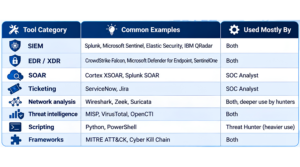
Exact tools vary by employer, but the concepts transfer easily. Learning how to think about data and attacker behavior matters more than memorizing a single product.
A Day in the Life
A Day as a SOC Analyst
Your shift begins with a handover from the previous team. You open the SIEM dashboard and review overnight alerts. A phishing alert catches your attention: a user clicked a suspicious link. You check email logs, review the URL reputation, look at endpoint activity, and confirm that a credential-harvesting page was opened but no password was submitted. You reset the user’s session, block the domain, document everything, and close the ticket. Later, you escalate a suspicious login from an unusual country to Tier 2 for deeper investigation.
The pace is steady, the tasks are varied, and every decision has a direct, immediate impact.
A Day as a Threat Hunter
You start by reading a fresh threat intelligence report about a ransomware group that abuses a specific remote management tool. You form a hypothesis: “If this group were in our network, we would see that tool running from unusual locations.” You query endpoint telemetry across the whole environment, filter out legitimate administrator use, and examine the outliers. After hours of analysis, you find nothing malicious, but you notice that one data source is not being logged at all. You document the gap, write a new detection rule, and share the results with the SOC.
The work is slower and more exploratory, and the impact comes from making the entire organization harder to attack.
Career Growth and Salary Outlook
SOC Analyst Career Path
A common progression looks like this:
- SOC Analyst Tier 1
- SOC Analyst Tier 2 / Incident Responder
- SOC Analyst Tier 3 / Senior Analyst
- SOC Team Lead or SOC Manager
- Security Operations Director or CISO track
From the SOC, you can also branch into incident response, digital forensics, detection engineering, threat intelligence, or threat hunting.
Threat Hunter Career Path
Threat hunting is rarely a first job. Many professionals move into it after gaining SOC or incident response experience. A typical path is:
- SOC Analyst or Incident Responder
- Threat Hunter
- Senior Threat Hunter or Detection Engineer
- Threat Intelligence Lead, Red/Purple Team Specialist, or Security Architect
- Head of Threat Hunting or Security Leadership
Salary Outlook
Salaries depend heavily on country, city, company size, certifications, and individual skills, so exact numbers vary widely. In general:
- SOC Analysts start at entry-level salary bands and grow steadily as they move into Tier 2 and Tier 3 roles.
- Threat Hunters typically earn more than entry-level SOC Analysts because the role demands deeper experience and specialized skills.
- Senior professionals in both paths, especially those with strong detection engineering, automation, or leadership skills, can reach high-paying positions.
It is best to check current salary data for your region and target industry rather than relying on a single global figure.
Certifications That Help
| Level | SOC Analyst | Threat Hunter |
|---|---|---|
| Beginner | CompTIA Security+, CompTIA CySA+, Blue Team Level 1 | CompTIA CySA+, Security+ |
| Intermediate | GIAC GCIA, GCIH, Splunk certifications, Microsoft SC-200 | GIAC GCTI, GCIH, GCFA |
| Advanced | GIAC GCED, GCDA | GIAC GNFA, GREM, advanced hunting and DFIR credentials |
Certifications help, but hands-on practice matters just as much. Employers want to see that you can investigate real scenarios, which is why lab-based training is so valuable.
Pros and Cons of Each Path
| SOC Analyst | Threat Hunter | |
|---|---|---|
| Pros | Beginner-friendly entry point; high demand; clear career ladder; strong exposure to real incidents; builds a broad foundation | Intellectually stimulating; proactive and creative work; high specialization; strong growth potential; direct impact on detection quality |
| Cons | Alert fatigue; shift work in many organizations; repetitive tasks at Tier 1; can feel reactive | Harder to enter directly; requires deeper technical skills; results are not always immediate; findings can be uncertain |
SOC Analyst vs Threat Hunter Salary in India (2026)
| Career Stage | SOC Analyst (₹ LPA) | Threat Hunter (₹ LPA) |
|---|---|---|
| Entry level (0–2 years) | 4–8 | Rarely hired directly at this level |
| Mid level (3–5 years) | 8–18 | 12–28 |
| Senior level (6+ years) | 15–26 (L3 / lead) | 22–40 |
Which Career Path Should You Choose?
Use the following guide to match your profile with the right role.
Choose SOC Analyst If You:
- Are new to cybersecurity and want a clear entry point
- Enjoy fast-paced work and solving problems in real time
- Like structured processes, playbooks, and teamwork
- Want broad exposure to many types of attacks and tools
- Prefer to build your career step by step through well-defined levels
Choose Threat Hunter If You:
- Already understand security fundamentals and SOC operations
- Love research, data analysis, and open-ended investigation
- Enjoy thinking like an attacker to predict their moves
- Are comfortable with scripting and complex queries
- Prefer deep, focused work over constant alert handling
Not Sure Yet? Start With the SOC
For most beginners, the SOC is the best launching pad. It teaches you how real attacks appear in logs, how organizations respond, and how detection tools work. Those are exactly the building blocks you need later to become an effective threat hunter. Think of it as a ladder rather than a fork in the road: the two careers are closely connected, and many hunters began as SOC Analysts.
That said, if you already have a strong technical background in networking, systems, or programming, you can aim for a hunting-oriented path sooner by building skills in detection, scripting, and adversary analysis.
How CyberDefenTech Helps You Prepare for Either Path
Choosing a career is only the first step. The real challenge is building job-ready skills. CyberDefenTech offers training for both career paths, so you can learn in the way that matches your goals.
- SOC Analyst training: Learn alert triage, SIEM investigation, log analysis, phishing analysis, and incident response workflows through practical, scenario-based labs.
- Threat Hunting training: Learn hypothesis-driven hunting, MITRE ATT&CK mapping, advanced querying, and how to turn findings into detections.
- Hands-on practice: Work with realistic attack simulations instead of only reading theory.
- Career guidance: Get help with resume building, interview preparation, and understanding what employers expect.
Whether you want to begin in a SOC or aim for a threat hunting role, CyberDefenTech helps you build skills step by step, with practice that mirrors real security operations.
Tips to Get Started Today
- Build your fundamentals. Learn networking, Windows and Linux basics, and core security concepts.
- Set up a home lab. Practice with a SIEM, sample logs, and free security tools.
- Learn the MITRE ATT&CK framework. It is the shared language of both SOC teams and threat hunters.
- Practice investigations. Work through blue team challenges and incident simulations regularly.
- Learn basic scripting. Python and PowerShell will help you in either role.
- Document your work. A portfolio of write-ups and investigations impresses employers.
- Join the community. Follow security researchers, read threat reports, and participate in forums and meetups.
Frequently Asked Questions
Is a SOC Analyst the same as a Threat Hunter?
No. A SOC Analyst mainly monitors and responds to alerts, while a Threat Hunter proactively searches for threats that automated tools may have missed. The roles overlap and often work together.
Can a beginner become a Threat Hunter directly?
It is possible but uncommon. Most threat hunters have prior experience in a SOC, incident response, or a related technical role.
Which role pays more?
Threat hunting roles generally pay more on average because they require deeper experience, but pay varies by location, employer, and skill level. Senior SOC professionals can also earn very competitive salaries.
Do I need to know programming for these roles?
Basic scripting helps a SOC Analyst, and it is considered essential for most threat hunters.
Which role is less stressful?
Stress depends on the employer. SOC roles can involve shift work and alert pressure, while threat hunting involves the pressure of uncertainty and deep analysis. Neither is universally easier.
Can I switch from SOC Analyst to Threat Hunter later?
Yes. This is one of the most common career moves in blue team security.
Conclusion
The SOC Analyst and the Threat Hunter are two sides of the same defensive mission. The SOC Analyst keeps the organization safe moment by moment, while the Threat Hunter strengthens defenses by finding what everyone else missed. Both roles are in demand, both offer rewarding long-term growth, and both reward curiosity, discipline, and continuous learning.
If you want structure, variety, and an accessible entry point, start as a SOC Analyst. If you love deep analysis and thinking like an attacker, work toward threat hunting. And remember that you are not locked in: skills from one role strengthen the other, and many of the best security professionals have worked in both.
Ready to take the next step? Explore the SOC Analyst and Threat Hunting training programs at CyberDefenTech and start building the practical skills that employers are looking for.
📞 Call/WhatsApp: +91 8448046612
