
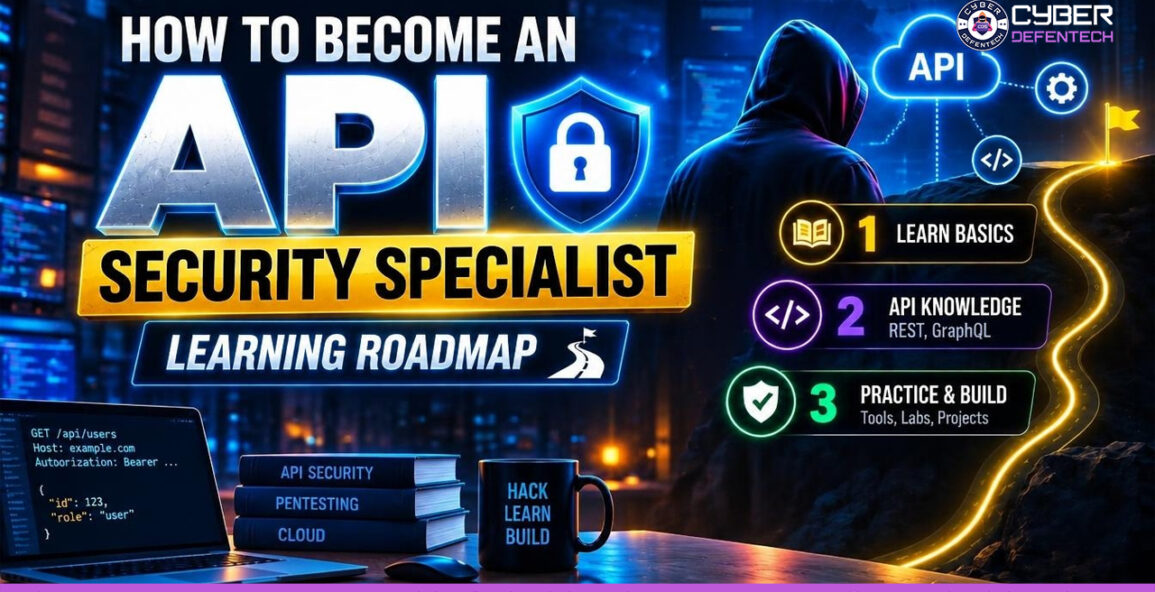
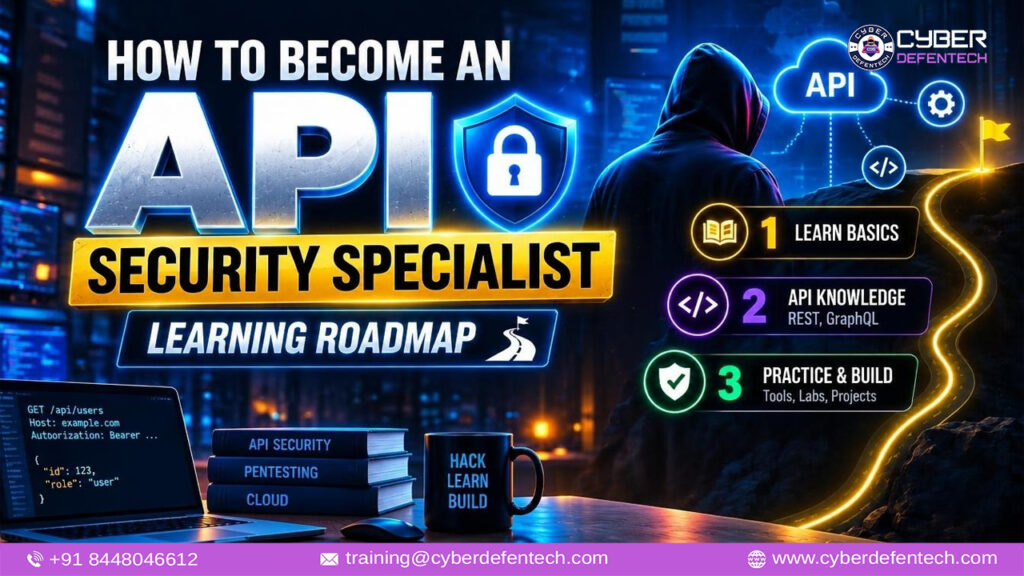
How to Become an API Security Specialist: Learning Roadmap
Introduction
APIs are the invisible backbone of the modern internet. Every time you check your bank balance on a mobile app, book a cab, stream a video, or pay through a digital wallet, APIs are quietly moving data between systems. As businesses move towards microservices, cloud platforms and mobile-first products, the number of APIs in production has exploded, and so has the number of attacks targeting them.
That is why API security specialists are among the most in-demand professionals in cybersecurity today. Companies need people who can find broken authorization, leaky endpoints and insecure integrations before attackers do. The challenge for beginners is knowing where to start. Should you learn networking first? Programming? Burp Suite? Cloud security?
This guide answers those questions with a practical, stage-by-stage roadmap. Whether you are a student, a developer, a network engineer or a career switcher, you will learn what an API security specialist actually does, which skills matter, which tools to practice with, how to build a portfolio, and how to grow your career. Platforms such as CyberDefenTech also provide structured, hands-on learning paths to help learners follow a roadmap like this with guidance and practice.
What Is an API Security Specialist?
An API security specialist is a cybersecurity professional who designs, tests, monitors and protects Application Programming Interfaces. APIs expose business logic and data, so a single weakness can lead to large-scale data exposure, account takeover or fraud.
Depending on the organisation, an API security specialist may work as:
- API penetration tester, who attacks APIs in a controlled way to find vulnerabilities
- Application security (AppSec) engineer, who builds security into the development lifecycle
- Security architect, who designs secure authentication, authorization and gateway patterns
- DevSecOps engineer, who automates API security checks in CI/CD pipelines
- Bug bounty hunter or security researcher, who reports API flaws responsibly for rewards
The common thread is a deep understanding of how APIs work and how they fail.
Why API Security Is a Great Career Choice
There are several reasons this specialization is worth your time:
- Growing attack surface. Mobile apps, single-page applications, IoT devices and partner integrations all rely on APIs.
- Business impact. Many high-profile data exposures have been traced to poorly protected endpoints, so organisations take this risk seriously.
- Skills gap. General web testers are common, but professionals who understand modern API architectures in depth are fewer.
- Flexible career paths. You can move into penetration testing, cloud security, DevSecOps, consulting or product security.
- Remote-friendly work. API testing and secure design reviews can be done from anywhere.
The Learning Roadmap at a Glance
| Stage | Focus Area | Key Topics | Suggested Duration |
|---|---|---|---|
| 1 | Foundations | Networking, HTTP/HTTPS, Linux, basic security concepts | 3 to 4 weeks |
| 2 | Programming and Web Basics | Python or JavaScript, JSON, databases, web architecture | 4 to 6 weeks |
| 3 | API Fundamentals | REST, GraphQL, SOAP, gRPC, Postman, OpenAPI | 3 to 4 weeks |
| 4 | Authentication and Authorization | OAuth 2.0, OpenID Connect, JWT, API keys, RBAC | 3 to 4 weeks |
| 5 | API Vulnerabilities | OWASP API Security Top 10, injection, BOLA, mass assignment | 4 to 6 weeks |
| 6 | Tools and Hands-On Practice | Burp Suite, Postman, OWASP ZAP, ffuf, vulnerable labs | 4 to 6 weeks |
| 7 | Defense and Automation | API gateways, WAF, rate limiting, logging, CI/CD scanning | 3 to 4 weeks |
| 8 | Portfolio and Career | Write-ups, bug bounty, certifications, interviews | Ongoing |
Timelines vary with your background and the time you can dedicate each week. A consistent routine of one to two hours daily usually beats occasional long sessions.
Stage 1: Build Strong Foundations
Before you test APIs, you must understand the environment they live in.
Networking essentials.
Learn the OSI and TCP/IP models, IP addressing, DNS, ports, TLS handshakes, proxies and load balancers. You should be comfortable explaining what happens when a browser sends a request to a server.
HTTP in depth.
APIs speak HTTP, so master methods (GET, POST, PUT, PATCH, DELETE), status codes, headers, cookies, caching and content types. Knowing the difference between a 401 and a 403 response, or why a header like Content-Type matters, will save you hours later.
Linux and command line.
Most servers run Linux and most security tools work well from a terminal. Practice file permissions, process management, curl, grep and basic shell scripting.
Core security concepts.
Understand the CIA triad (confidentiality, integrity, availability), threat modeling, least privilege, defense in depth and the difference between authentication and authorization.
Stage 2: Learn Programming and Web Basics
You do not need to be a software architect, but you must be able to read and write code. Security specialists who cannot code are limited to running tools, while those who can code understand why vulnerabilities occur.
- Python is excellent for writing automation scripts, fuzzers and proof-of-concept exploits.
- JavaScript and Node.js help you understand modern web back ends and front ends.
- JSON and XML are the data formats you will read every day.
- SQL and NoSQL basics help you understand injection attacks and data exposure.
- Git helps you manage scripts, notes and projects.
Also study how web applications are structured: front end, back end, database, caching layer, microservices and API gateway. When you understand the architecture, you can predict where weaknesses may hide.
Stage 3: Understand API Fundamentals
Now focus on the technology itself. A good API security specialist knows the strengths and risks of each API style.
| API Type | Description | Common Security Considerations |
|---|---|---|
| REST | Resource-based, uses HTTP methods and JSON | Broken object-level authorization, excessive data exposure, improper rate limiting |
| GraphQL | Single endpoint with flexible queries | Introspection exposure, deeply nested queries, batching abuse, field-level access control |
| SOAP | XML-based, strict contracts | XML external entities (XXE), WS-Security misconfiguration |
| gRPC | Binary protocol using Protocol Buffers | Weak authentication between services, limited visibility in traditional tools |
| WebSocket | Persistent two-way communication | Missing origin checks, weak session handling, message validation gaps |
Learn to read OpenAPI (Swagger) specifications, because they reveal endpoints, parameters and data models. Practice sending requests with Postman or curl, and learn how to build collections, use environments and chain requests together.
Stage 4: Master Authentication and Authorization
Most serious API breaches involve failures in access control, so this stage deserves extra time.
Authentication mechanisms to study:
- API keys and their limitations
- Basic and token-based authentication
- OAuth 2.0 flows, such as authorization code, client credentials and PKCE
- OpenID Connect for identity
- JSON Web Tokens (JWT), including signature validation, algorithm confusion, weak secrets and token expiry
- Mutual TLS for service-to-service communication
Authorization models to study:
- Role-based access control (RBAC)
- Attribute-based access control (ABAC)
- Object-level and function-level permission checks
A simple exercise helps here. Create two user accounts in a practice lab, request a resource with User A, then replay the same request using User B’s token. If User B can read User A’s data, you have just discovered a classic access control flaw.
Stage 5: Study Common API Vulnerabilities
The OWASP API Security Top 10 is the standard reference for this field. Read it carefully, and then practice each category in a lab. The table below summarizes the major risk areas you should be able to explain and test.
| Vulnerability Category | What It Means | Example Test Idea |
|---|---|---|
| Broken Object Level Authorization (BOLA) | The API does not verify that a user owns the requested object | Change an object ID in the URL and check whether other users’ data is returned |
| Broken Authentication | Weak login, token or session handling | Test for weak JWT validation, missing lockouts and predictable tokens |
| Broken Object Property Level Authorization | Excessive data exposure or mass assignment | Add unexpected fields like role or isAdmin to a request body |
| Unrestricted Resource Consumption | No limits on requests, payload size or processing | Send repeated or oversized requests to check rate limits |
| Broken Function Level Authorization | Regular users can access administrative functions | Call admin endpoints using a low-privilege token |
| Unrestricted Access to Sensitive Business Flows | Automation abuse of critical flows | Test for scripted abuse of sign-ups, coupons or purchases |
| Server-Side Request Forgery (SSRF) | The API fetches attacker-controlled URLs | Supply internal addresses in URL parameters |
| Security Misconfiguration | Insecure defaults, verbose errors, open CORS | Inspect headers, error messages and CORS policy |
| Improper Inventory Management | Old, undocumented or shadow API versions remain exposed | Look for /v1/, /beta/ or forgotten endpoints |
| Unsafe Consumption of APIs | Blind trust in third-party API responses | Review how external data is validated before use |
Beyond the OWASP list, also study injection attacks (SQL, NoSQL, command), insecure deserialization, business logic flaws and race conditions.
Stage 6: Get Hands-On with Tools and Labs
Theory becomes skill only through practice. Build a small home lab and work through intentionally vulnerable applications.
Essential tools:
| Tool | Purpose |
|---|---|
| Burp Suite | Intercepting proxy for inspecting and modifying API traffic |
| Postman | Building, organizing and automating API requests |
| OWASP ZAP | Open-source scanner and proxy |
| ffuf / Gobuster | Discovering hidden endpoints and parameters |
| Nmap | Service and port discovery |
| jwt_tool | Testing and manipulating JSON Web Tokens |
| GraphQL tools (e.g., InQL, GraphQL Voyager) | Exploring and testing GraphQL schemas |
| Docker | Running vulnerable labs locally |
Practice environments:
- OWASP crAPI (Completely Ridiculous API)
- OWASP Juice Shop
- Damn Vulnerable Web Services and similar vulnerable API projects
- PortSwigger Web Security Academy API testing labs
- Intentionally vulnerable GraphQL applications
For each lab, follow a repeatable method: map the API, understand authentication, enumerate endpoints, test access controls, test inputs, review responses, and document findings. Keep detailed notes, because they become the foundation of your portfolio.
If you prefer guided, instructor-led practice, CyberDefenTech offers training programs where learners can work through real-world scenarios and receive structured feedback, which can be helpful when self-study feels overwhelming.
Stage 7: Learn Defense, Monitoring and Automation
A complete API security specialist does not only break things; they also help fix and prevent problems. Learn the defensive side as well.
- API gateways for centralized authentication, throttling and routing
- Web Application Firewalls (WAF) and API-aware protection
- Rate limiting and quotas to prevent abuse
- Input validation and schema enforcement using OpenAPI definitions
- Secure secrets management so keys and tokens are never hard-coded
- Logging, monitoring and alerting to detect suspicious API behavior
- Secure SDLC practices, including threat modeling and secure code review
- CI/CD security, including automated dynamic and static testing for APIs
- Cloud security basics for AWS, Azure or Google Cloud, since many APIs run there
This defensive knowledge makes your reports far more valuable, because you can recommend practical remediation instead of only listing problems.
Stage 8: Build Your Portfolio and Launch Your Career
Employers want proof of skill. Here is how to show it.
1. Publish write-ups.
Document your lab solutions and learning notes on a blog or GitHub. Explain the vulnerability, how you found it, the impact and the fix.
2. Build small tools.
A Python script that tests for missing rate limits or checks JWT weaknesses demonstrates both coding and security understanding.
3. Try bug bounty programs carefully.
Start with programs that clearly allow API testing, always read the scope and rules, and never test systems without permission.
4. Contribute to the community.
Join security forums, attend meetups and webinars, and share what you learn.
5. Consider certifications and structured training.
Choose training that matches your goals, budget and experience level. Look for programs with hands-on labs, current content and practical assessments rather than only theory. Providers such as CyberDefenTech combine guided learning with practical exercises, which can support both knowledge and confidence.
6. Prepare for interviews.
Be ready to explain the OWASP API Top 10, demonstrate how you would test an endpoint, discuss JWT and OAuth risks, and walk through a real example from your lab work.
Sample 6-Month Study Plan
| Month | Goal | Activities |
|---|---|---|
| Month 1 | Foundations | Networking, HTTP, Linux, security basics |
| Month 2 | Coding and web architecture | Python scripting, JSON, databases, Git |
| Month 3 | API and authentication concepts | REST, GraphQL, OAuth 2.0, JWT, Postman practice |
| Month 4 | Vulnerability learning | OWASP API Top 10, first labs on crAPI and Juice Shop |
| Month 5 | Advanced testing | Burp Suite workflows, automation scripts, GraphQL testing |
| Month 6 | Defense and portfolio | Gateways, monitoring, write-ups, mock interviews, job applications |
Adjust the pace to your own schedule. The goal is steady progress, not speed.
Soft Skills That Set You Apart
Technical ability alone is not enough. The best specialists also develop:
- Clear communication. You must explain risk to developers, managers and executives in language each can understand.
- Report writing. A well-structured report with reproduction steps, impact and remediation advice is a core deliverable.
- Curiosity and persistence. Many findings come from asking “what happens if I change this?”
- Ethics and responsibility. Always test with permission, respect scope and protect sensitive data.
- Continuous learning. New frameworks, protocols and attack techniques appear every year.
Common Mistakes to Avoid
- Jumping straight into tools without understanding HTTP and authentication
- Relying only on automated scanners, which often miss logic and authorization flaws
- Ignoring programming, which limits your ability to automate and understand root causes
- Skipping documentation, which makes it hard to build a portfolio
- Testing without authorization, which can lead to legal trouble
- Stopping at offense, when defensive knowledge makes you a more complete professional
Career Paths and Growth
Once you have a solid foundation, several directions open up:
| Career Path | Typical Focus |
|---|---|
| API Penetration Tester | Offensive testing of web, mobile and API targets |
| Application Security Engineer | Secure design, code review and developer enablement |
| DevSecOps Engineer | Automating security in pipelines and cloud platforms |
| Security Consultant | Assessments and advisory work for multiple clients |
| Product Security Specialist | Securing the APIs of a specific product or platform |
| Security Architect | Designing organization-wide secure API strategy |
Salaries and demand vary by country, experience and company size, but API security skills are consistently valued because they sit at the intersection of development, cloud and cybersecurity.
Salary in India (annual, INR)
| Role and Source | Reported Range |
|---|---|
| Application Security Engineer (AmbitionBox, based on 747 salaries) | ₹11 L to ₹36.5 L |
| Application Security Specialist (AmbitionBox) | ₹4.9 L to ₹27.5 L (2 to 12 years of experience) |
| Application Security Engineer (CorpReady) | Entry ₹9 L to ₹17 L; mid ₹20 L to ₹45 L; senior ₹50 L to ₹1.3 Cr |
| Security Engineer, general (Hyring) | Fresher ₹4 L to ₹6.5 L; median about ₹9.5 L |
| Sample job posting, Bengaluru (Workable) | ₹18 L to ₹25 L |
India salary by experience level (application security engineer, annual CTC):
| Experience Level | Years of Experience | Reported Range (INR) |
|---|---|---|
| Entry level | 0 to 2 years | ₹9 L to ₹17 L |
| Mid level | 3 to 7 years | ₹20 L to ₹45 L |
| Senior level | 8+ years | ₹50 L to ₹1.3 Cr |
Frequently Asked Questions (FAQs)
1. Do I need a degree to become an API security specialist?
Not always. Many professionals enter the field through self-study, practical labs, certifications and portfolio work. A degree can help but is not the only route.
2. How long does it take to become job-ready?
With consistent effort, many learners reach an entry-level skill set in six to twelve months. Prior experience in development or networking can shorten this.
3. Which programming language should I learn first?
Python is a popular choice because it is beginner-friendly and excellent for automation. JavaScript is also very useful for understanding modern web applications.
4. Is API security different from web application security?
They overlap, but API security focuses more on authorization logic, data exposure, token handling and machine-to-machine communication rather than browser-based interfaces.
5. Can beginners start with bug bounty?
Yes, but it is best to build fundamentals and practice in labs first. Always follow program rules and test only within the allowed scope.
6. Where can I find structured training?
You can combine free resources and labs with guided programs from training providers such as CyberDefenTech to follow a clear, practical path.
Conclusion
Becoming an API security specialist is not about memorizing a list of attacks. It is about understanding how systems communicate, where trust is assumed, and how that trust can be abused. Start with strong foundations, learn programming, study authentication deeply, master the OWASP API Security Top 10, practice in safe labs, and document everything you learn.
The journey takes patience, but the reward is a future-proof career in one of the fastest-growing areas of cybersecurity. If you want structured guidance, mentorship and practical labs along the way, CyberDefenTech can be a helpful partner in your learning journey. Take the first step today, stay consistent, and build one skill at a time.
📞 Call/WhatsApp: +91 8448046612
