

How to Become a SOC Analyst in India
By Cyber Defentech Team | July 2026 | 11 Mins Read | Beginner to Advanced
Introduction
Somewhere in India, right now, a hacker is probing a company’s network, looking for one unpatched server, one weak password, one careless click. In the last few years, India has become one of the most targeted countries in the world for cyberattacks — ransomware on hospitals, phishing campaigns against banks, data breaches at e-commerce giants, and AI-powered scams draining crores from unsuspecting citizens. Behind every one of these headlines is a simple, uncomfortable truth: there aren’t enough skilled defenders to stop them.
This is exactly why the role of a SOC Analyst has become one of the most high-demand and future-ready careers in the cybersecurity industry. Organizations across banking, IT, healthcare, and government are racing to build stronger Security Operations Centers — and they need trained professionals who can detect, investigate, and respond to threats in real time.
If you’ve ever wondered how to become a SOC Analyst in India, this guide will walk you through everything — from the fundamentals to a practical, industry-focused roadmap that takes you from beginner to job-ready professional.
What is a SOC Analyst?
A SOC Analyst (Security Operations Center Analyst) is a cybersecurity professional responsible for monitoring, detecting, analyzing, and responding to security threats within an organization’s IT infrastructure. Think of them as the digital equivalent of a 24/7 security guard — except instead of watching CCTV footage, they’re watching network traffic, system logs, and security alerts to catch attackers before real damage happens.
SOC Analysts typically work within a Security Operations Center, a centralized unit where security teams use advanced tools to keep an eye on an organization’s entire digital environment. This includes servers, endpoints, cloud infrastructure, applications, and user activity — all monitored around the clock.
The role sits at Level 1 or Level 2 of most SOC hierarchies, making it the most common entry point into the cybersecurity field in India today.
Why is a SOC Analyst Career Important?
Why It Matters?
The digital transformation of Indian businesses — from UPI payments to cloud-first startups — has expanded the attack surface dramatically. Every new app, API, and cloud service is a potential entry point for attackers. SOC Analysts are the professionals standing between that vulnerability and a full-blown data breach.
Without a strong SOC team, companies risk:
- Delayed detection of ransomware and malware attacks
- Regulatory penalties under India’s Digital Personal Data Protection (DPDP) Act
- Loss of customer trust after a breach
- Financial losses running into crores of rupees
- Reputational damage that can take years to recover from
This is why SOC Analyst roles are no longer “optional” for Indian enterprises — they are a business necessity.
Real-World Cyber Threats & Risks
India has witnessed a sharp rise in sophisticated cyber threats over the past few years. Some of the most common real-world risks that SOC Analysts are trained to detect and respond to include:
- Ransomware attacks targeting hospitals, manufacturing units, and financial institutions, encrypting critical data and demanding payment.
- Phishing and spear-phishing campaigns impersonating banks, government portals, and HR departments to steal credentials.
- Insider threats, where employees or contractors misuse access to leak sensitive data.
- AI-powered attacks, including deepfake voice scams and automated social engineering, that are becoming increasingly difficult to detect with traditional tools.
- Supply chain attacks, where a trusted vendor or software update becomes the entry point for a much larger breach.
- Cloud misconfigurations, exposing sensitive data due to poorly secured cloud storage buckets or APIs.
Each of these threats requires next-generation detection capabilities — a blend of human expertise and advanced security tools — which is exactly what a well-trained SOC Analyst brings to the table.
Why Companies Need SOC Analyst Professionals?
Every industry, from fintech to pharma, now depends on digital infrastructure — and every digital system is a potential target. Here’s why companies across India are actively hiring SOC Analysts:
- 24/7 threat monitoring — Attacks don’t follow business hours, and neither can defense.
- Faster incident response — The quicker a threat is detected, the lower the damage.
- Regulatory compliance — Frameworks like ISO 27001, RBI guidelines, and DPDP Act require active monitoring.
- Reduced financial risk — Early detection can save organizations from massive breach-related losses.
- Customer trust — Businesses that demonstrate strong security posture retain customer confidence.
With cyber insurance providers and regulators tightening requirements, having a skilled SOC team is now a competitive advantage, not just a defensive measure.
Skills You Will Learn
Becoming a job-ready SOC Analyst requires a mix of technical, analytical, and practical skills. Here’s a breakdown of the core skill set:
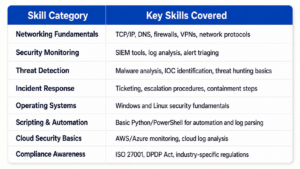
This blend of skills ensures that a SOC Analyst isn’t just theoretically trained but is genuinely industry-ready from day one.
Career Opportunities
A SOC Analyst role is just the beginning of a long and rewarding cybersecurity career path. With experience and additional certifications, professionals can progress into specialized and leadership roles such as:
- SOC Analyst (L1) → SOC Analyst (L2) → SOC Team Lead
- Threat Hunter
- Incident Responder
- Malware Analyst
- Security Engineer
- Penetration Tester
- SOC Manager
- Chief Information Security Officer (CISO) — long-term career path
The beauty of this career track is its flexibility — you can specialize in offensive security, defensive operations, cloud security, or governance, depending on your interests as you grow.
Salary & Industry Demand
Cybersecurity salaries in India have grown consistently over the past few years, driven by a severe shortage of skilled professionals compared to industry demand.
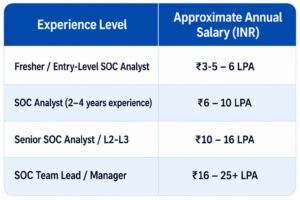
Note: Salaries vary based on city, company size, certifications, and specialization.
Industry demand for SOC Analysts continues to rise sharply, with sectors like BFSI, IT services, e-commerce, and government agencies actively recruiting. As India strengthens its cybersecurity regulations, this demand is only expected to accelerate.
Real-World Importance of SOC Analysts
Beyond the numbers, SOC Analysts play a genuinely critical role in protecting everyday digital life. When a bank prevents a fraudulent transaction, when a hospital’s patient data stays safe during a ransomware attempt, when an e-commerce platform blocks a large-scale credential-stuffing attack — a SOC Analyst was very likely watching, detecting, and responding behind the scenes.
Why It Matters?
For a country rapidly digitizing its economy — from Digital India initiatives to widespread UPI adoption — the strength of its cybersecurity workforce directly impacts national digital trust. SOC Analysts are, quite literally, front-line defenders of India’s digital economy.
Tools & Technologies Used
A modern SOC Analyst works with an advanced toolkit to detect and respond to threats efficiently. Commonly used tools and technologies include:
- SIEM platforms — Splunk, IBM QRadar, Microsoft Sentinel
- Endpoint Detection & Response (EDR) — CrowdStrike, SentinelOne
- Network monitoring tools — Wireshark, Zeek
- Threat intelligence platforms — MISP, VirusTotal
- Ticketing & SOAR tools — ServiceNow, Splunk SOAR
- Vulnerability scanners — Nessus, Qualys
- AI-driven security analytics — increasingly used for anomaly detection and automated threat correlation
Hands-on familiarity with these tools is what separates a theoretical candidate from a genuinely practical, job-ready SOC Analyst.
Beginner Roadmap
If you’re starting from scratch, here’s a practical roadmap to becoming a SOC Analyst:
- Build IT fundamentals — Learn networking, operating systems, and basic system administration.
- Understand core security concepts — CIA triad, common attack types, security frameworks.
- Learn SIEM and log analysis — Get hands-on with tools like Splunk or QRadar.
- Practice on labs — Use real-world simulated environments to detect and respond to attacks.
- Earn foundational certifications — Consider CompTIA Security+, CEH, or equivalent industry-recognized credentials.
- Get practical, guided training — Structured mentorship accelerates readiness far faster than self-study alone.
- Apply for internships or entry-level roles — Real-world exposure solidifies your skills.
- Keep learning continuously — Cybersecurity evolves fast; staying updated is non-negotiable.
Why Choose Cyber Defentech?
At Cyber Defentech, we believe cybersecurity careers are built through practice, not just theory. Our SOC Analyst training program is designed to take learners from beginner to industry-ready through:
- Hands-on labs simulating real-world attack and defense scenarios
- Live SIEM tool training using industry-standard platforms
- Mentorship from experienced cybersecurity professionals
- Real-world case studies based on actual breach incidents
- Career-focused guidance, including resume building and interview preparation
- Up-to-date curriculum covering AI security trends and modern threat landscapes
Our goal is simple: to help you become not just certified, but genuinely job-ready and confident in a real SOC environment from day one.
Future Scope & Industry Trends
The SOC Analyst role is evolving rapidly, shaped by emerging technologies and threat patterns:
- AI-powered SOC operations — Automation and machine learning are increasingly used to triage alerts, reducing analyst fatigue and improving response times.
- Cloud-native security monitoring — As more Indian businesses move to the cloud, SOC skills are expanding to cover multi-cloud environments.
- Zero Trust architecture adoption — SOC teams are playing a bigger role in enforcing continuous verification models.
- Rise of AI-driven threats — Deepfakes and automated phishing are pushing SOC teams to adopt smarter, next-generation detection tools.
- Growing regulatory pressure — Compliance-driven security monitoring will keep SOC hiring strong for years to come.
Professionals who stay updated with these trends will find themselves consistently in demand, regardless of economic shifts in other industries.
Final Thoughts
The path to becoming a SOC Analyst in India has never been more promising — or more urgent. With cyber threats growing in scale and sophistication, and with organizations across every sector actively hiring, this is a career built on genuine, long-term relevance. Whether you’re a fresh graduate, an IT professional looking to switch fields, or someone passionate about technology and problem-solving, a SOC Analyst career offers a future-ready, high-growth path into the cybersecurity industry.
The key to success isn’t just learning concepts — it’s practical, real-world training that prepares you for what actually happens inside a live Security Operations Center. That’s exactly the kind of training Cyber Defentech is built to deliver.
FAQs
- Is a SOC Analyst a good career in India?
Yes. With rising cyberattacks and a growing shortage of skilled professionals, SOC Analyst roles offer strong job security, competitive salaries, and long-term career growth across multiple industries. - Do I need a technical degree to become a SOC Analyst?
Not necessarily. While a background in IT or computer science helps, many successful SOC Analysts come from non-technical backgrounds and build their skills through focused, practical training programs. - What certifications help in becoming a SOC Analyst?
Certifications like CompTIA Security+, CEH, and SIEM-specific credentials strengthen your resume, but hands-on, practical experience is equally important to employers. - How long does it take to become a SOC Analyst?
With focused, structured training, most beginners can become job-ready within a few months, depending on their prior IT knowledge and the intensity of their learning path. - What is the average SOC Analyst salary in India?
Entry-level SOC Analysts in India typically earn between ₹3.5–6 LPA, with salaries increasing significantly as experience and specialization grow. - What tools should a SOC Analyst know?
Key tools include SIEM platforms (Splunk, QRadar), EDR solutions (CrowdStrike, SentinelOne), and network monitoring tools like Wireshark. - Is coding required for a SOC Analyst role?
Not mandatory, but basic scripting knowledge in Python or PowerShell is highly valuable for automating tasks and analyzing logs efficiently. - Does Cyber Defentech offer hands-on SOC Analyst training?
Yes. Cyber Defentech provides practical, lab-based SOC Analyst training with real-world scenarios, industry tools, and mentorship to make learners genuinely job-ready.
Ready to Build Your Career as a SOC Analyst?
✅ Hands-on Practical Training
✅ Real-World Cybersecurity Skills
✅ Industry-Focused Learning
✅ Future-Ready Career Path
 Visit Now:
 Call/WhatsApp:
