
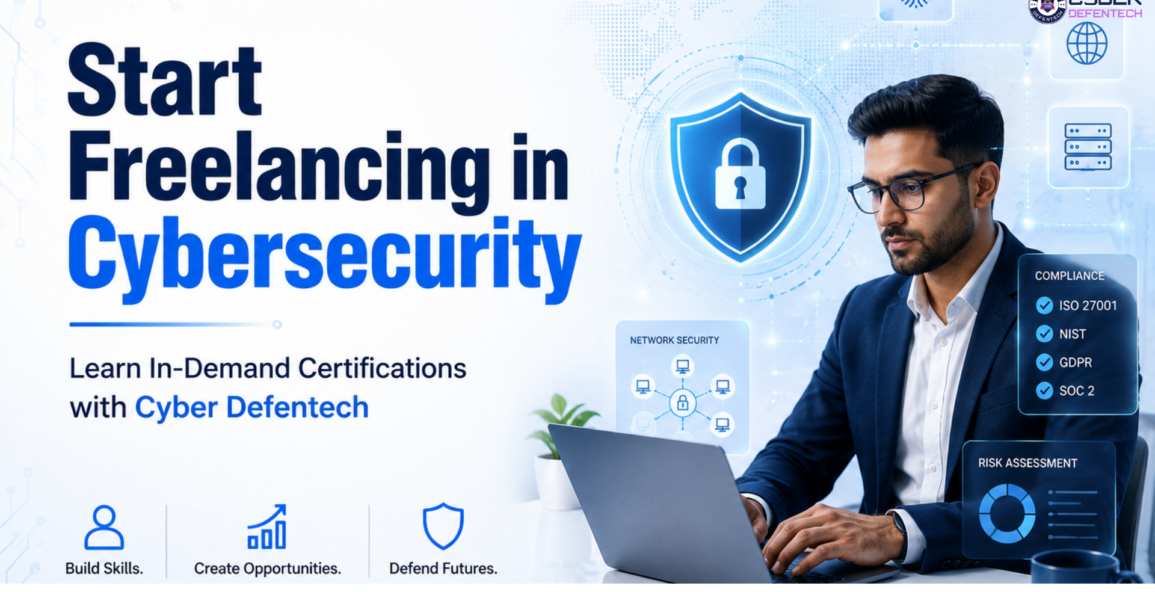
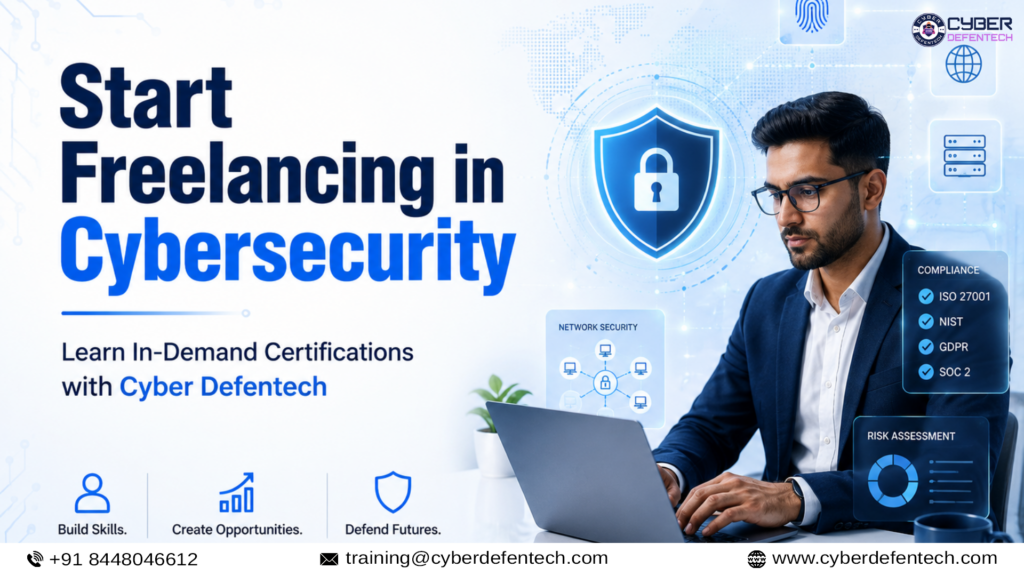
Want to Start Freelancing in Cybersecurity? Build In-Demand Skills with Cyber Defentech
Cybersecurity freelancing is becoming an attractive career option for students, IT professionals, auditors, consultants, compliance specialists, and people planning a career transition.
Organisations are rapidly adopting cloud platforms, artificial intelligence, mobile applications, digital payment systems, remote-working technologies, and data-driven business processes. These technologies create opportunities for growth, but they also introduce security, privacy, governance, and regulatory risks.
Not every startup or growing organisation has the budget or requirement to maintain a large, full-time cybersecurity department. Many businesses therefore work with independent cybersecurity consultants for specific assignments.
These assignments may include security audits, information security risk assessments, ISO implementation, policy development, data privacy assessments, compliance reviews, third-party risk management, employee awareness programmes, and cybersecurity documentation.
This creates valuable opportunities for professionals who have practical skills, recognised credentials, strong communication abilities, and the confidence to work with real client requirements.
However, successful freelancing in cybersecurity requires more than completing a certification. A freelancer must be able to understand business risks, define a project’s scope, gather evidence, prepare professional documents, communicate findings, and recommend realistic improvements. Freelancing in cybersecurity can help professionals build a flexible and independent career.
Cyber Defentech provides practical, industry-oriented cybersecurity training designed to help learners build these capabilities and prepare for certification examinations, consulting assignments, and long-term careers in cybersecurity governance, risk, compliance, audit, artificial intelligence governance, and data privacy.
Can You Really Start Freelancing in Cybersecurity?
Yes, you can start freelancing in cybersecurity after developing a clear specialisation, practical knowledge, a professional portfolio, and the ability to deliver reliable work.
Beginners do not need to offer every cybersecurity service. A more practical approach is to choose one area, such as information security audits, ISO documentation, risk assessment, employee awareness, data privacy, or vendor security reviews.
You can then build sample projects, study recognised frameworks, earn relevant certifications, and begin with smaller assignments.
Your early freelance services may include:
- Basic information security gap assessments
- Security policy development
- Risk-register preparation
- Asset-inventory documentation
- Employee security awareness sessions
- Vendor security questionnaires
- ISO readiness assessments
- Data privacy documentation support
- Internal audit assistance
- Security control reviews
The most important requirement is to work within your actual level of competence. A freelancer should never promise expertise that they do not possess or perform security testing without written authorisation.
Why Is Cybersecurity Freelancing Growing?
Every modern organisation handles sensitive information. This may include customer records, employee data, payment details, intellectual property, contracts, business plans, source code, health information, credentials, and confidential communications.
Protecting this information is no longer only an information technology responsibility. Cybersecurity has become a business, operational, legal, and reputational priority.
A security incident may interrupt operations, damage customer trust, expose confidential information, and create compliance-related challenges. Organisations therefore need professionals who can help them understand their risks and strengthen their security processes.
Several factors are contributing to the growth of cybersecurity freelancing.
1. Startups Need Flexible Security Support
Startups may not initially require a permanent cybersecurity team. However, they may still need security policies, risk assessments, vendor reviews, cloud-security guidance, compliance documentation, or customer security questionnaires.
Hiring an independent consultant allows them to receive specialised support for a particular project or period.
2. Customers Are Asking Security Questions
Large organisations often evaluate the security practices of their vendors, suppliers, and technology partners.
A growing company may receive detailed questionnaires covering access control, encryption, incident management, data retention, business continuity, employee training, cloud security, and privacy.
Cybersecurity freelancers can help businesses understand these questionnaires, gather evidence, identify gaps, and prepare appropriate responses.
3. Compliance Requirements Are Increasing
Organisations must understand the laws, contractual obligations, standards, and industry requirements that apply to their operations.
Cybersecurity and compliance consultants can help businesses develop policies, assess controls, document responsibilities, and prepare for internal or external reviews.
4. Artificial Intelligence Is Creating New Risks
Businesses are integrating artificial intelligence into customer support, analytics, software development, hiring, marketing, and decision-making.
These systems introduce questions related to transparency, accountability, data quality, bias, security, privacy, human oversight, and third-party AI services.
Professionals with knowledge of AI governance and ISO/IEC 42001 may support organisations that want a structured approach to managing AI-related risks.
5. Remote Consulting Has Become Practical
Many governance, risk, compliance, policy, documentation, awareness, and audit-support activities can be delivered remotely.
A cybersecurity freelancer may conduct interviews through video meetings, review documents securely, analyse evidence, prepare reports, and deliver awareness sessions to distributed teams.
This allows professionals to work with organisations outside their immediate location.
What Services Can a Cybersecurity Freelancer Offer?
Cybersecurity is a broad field. Freelancers should define a service area based on their training, experience, interest, and level of technical competence. Professionals pursuing freelancing in cybersecurity can offer specialised audit, compliance, privacy, and risk-management services.
Some of the most relevant cybersecurity freelancing services include the following.
Information Security Risk Assessments
A risk assessment helps an organisation identify important assets, possible threats, existing vulnerabilities, current controls, potential business impact, and required risk-treatment actions.
A freelancer may assist with:
- Creating an asset inventory
- Identifying threats and vulnerabilities
- Evaluating likelihood and impact
- Reviewing existing controls
- Preparing a risk register
- Recommending risk-treatment options
- Tracking corrective actions
ISO/IEC 27001 Readiness Assessments
ISO/IEC 27001 defines requirements for establishing, implementing, maintaining, and continually improving an Information Security Management System, or ISMS. The standard is applicable to organisations of different sizes and industries.
A trained consultant may help an organisation understand its current level of readiness, identify missing documentation, review security controls, and create an implementation plan.
Security Policy Development
Many organisations need formal policies to define responsibilities and acceptable practices.
A cybersecurity freelancer may help prepare documents such as:
- Information security policy
- Access control policy
- Password policy
- Acceptable use policy
- Incident response policy
- Remote-working policy
- Data backup policy
- Data retention policy
- Vendor security policy
- Business continuity policy
Policies should always reflect the organisation’s actual operations. Copying generic templates without understanding the business may create documents that are difficult to implement or audit.
Internal Audit Support
An internal information security audit evaluates whether documented processes and controls are being followed and whether they are effective.
Freelancers with appropriate audit knowledge may help with audit planning, interview preparation, evidence review, audit checklists, findings, non-conformities, observations, and corrective-action tracking.
Data Privacy Support
Businesses processing personal data may need support with data mapping, privacy notices, consent processes, retention practices, vendor arrangements, grievance procedures, data-protection responsibilities, and security safeguards.
In India, privacy-related consulting should consider the Digital Personal Data Protection Act, 2023, along with the applicable rules and official government notifications. MeitY published the Digital Personal Data Protection Rules, 2025, and related implementation documents on its official portal.
Legal interpretations should be reviewed by a qualified legal professional. A cybersecurity consultant may support operational readiness but should not present non-qualified advice as formal legal counsel.
Third-Party Risk Assessments
Organisations depend on cloud providers, software vendors, payment processors, consultants, and outsourced service providers.
A freelancer may help evaluate third-party security practices through questionnaires, evidence reviews, contract-control checklists, risk ratings, and remediation recommendations.
Security Awareness Programmes
Employees are regularly exposed to phishing emails, weak passwords, unsafe links, impersonation scams, social engineering, and insecure data-sharing practices.
A freelancer may develop and deliver awareness sessions covering:
- Phishing identification
- Password and authentication security
- Safe internet practices
- Data-classification responsibilities
- Remote-working security
- Social engineering
- Incident reporting
- Mobile-device security
- Responsible use of AI tools
AI Governance Assessments
Organisations adopting AI may need help documenting AI systems, identifying risks, defining responsibilities, evaluating third-party models, and establishing acceptable-use policies.
Professionals trained in ISO/IEC 42001 may support structured AI governance and Artificial Intelligence Management System implementation.
Who Can Start Freelancing in Cybersecurity?
Cybersecurity freelancing is not limited to penetration testers or highly experienced security engineers.
Professionals from different backgrounds can enter the field by selecting a suitable specialisation.
Students and Fresh Graduates
Students can begin by learning cybersecurity fundamentals, documentation, risk-management concepts, audit principles, networking basics, and information security frameworks.
They should first create sample projects and work under guidance before accepting high-responsibility client assignments.
IT Professionals
System administrators, network engineers, cloud professionals, software developers, technical-support engineers, and database administrators already understand technology environments.
They can combine their existing experience with audit, risk, compliance, security management, or privacy skills.
Auditors and Compliance Professionals
Professionals with experience in audits, process reviews, quality management, finance, or compliance may transition into information security governance and IT auditing.
Their understanding of evidence, controls, documentation, and reporting can be highly valuable.
Managers and Consultants
Professionals with business, project-management, consulting, or leadership experience may focus on security governance, programme management, risk, policy development, or compliance readiness.
Career Changers
A career changer can enter cybersecurity, but the transition should be structured.
The individual should develop foundational knowledge, choose a realistic specialisation, complete practical assignments, build a portfolio, and gain supervised experience before offering independent services.
Skills Required for Cybersecurity Freelancing
Certifications can strengthen credibility, but clients ultimately evaluate your ability to solve problems and deliver usable results.
A successful cybersecurity freelancer should develop both technical and professional skills.
Cybersecurity Fundamentals
You should understand basic concepts such as:
- Confidentiality, integrity, and availability
- Threats, vulnerabilities, risks, and controls
- Access management
- Authentication and authorisation
- Network and endpoint security
- Data protection
- Incident response
- Business continuity
- Cloud-security fundamentals
- Security monitoring
Risk-Assessment Skills
A consultant should understand how to identify assets, analyse threats, evaluate business impact, review controls, prioritise risks, and recommend appropriate treatments.
Audit Skills
Audit assignments require planning, professional questioning, evidence collection, sampling, documentation, objective reporting, and follow-up.
An auditor must distinguish between assumptions, observations, supporting evidence, and verified findings.
Documentation Skills
Many cybersecurity consulting projects involve preparing policies, procedures, risk registers, audit reports, scope documents, statements of applicability, treatment plans, and management presentations.
Documents must be clear, consistent, version-controlled, and relevant to the client.
Business Understanding
A security recommendation may be technically strong but commercially unrealistic.
Freelancers should understand the client’s size, industry, systems, budget, operations, legal obligations, and business priorities before recommending controls.
Communication Skills
Cybersecurity consultants interact with senior management, IT teams, human resources, legal teams, vendors, and non-technical employees.
They must explain risks in language that each audience can understand.
Project-Management Skills
Freelancers need to manage timelines, meetings, evidence requests, deliverables, dependencies, revisions, and client expectations.
Missing deadlines or failing to document decisions can damage trust.
Ethical and Professional Conduct
Clients may provide access to confidential records, infrastructure details, security reports, and sensitive employee or customer information.
Freelancers must follow confidentiality agreements, secure client data, avoid conflicts of interest, and work only within an approved scope.
Certifications That Can Support Your Cybersecurity Freelancing Career
Cyber Defentech offers practical, industry-oriented training programmes designed to help learners prepare for recognised certifications and real-world consulting responsibilities.
The right certification depends on the services you want to offer.
ISO/IEC 27001 Lead Auditor
ISO/IEC 27001 Lead Auditor training develops knowledge related to planning, conducting, managing, and reporting Information Security Management System audits.
ISO/IEC 27001:2022 is the current published edition of the information security management system requirements standard. It helps organisations manage information-security risks through a structured system involving people, processes, policies, and technology.
Lead Auditor knowledge may support freelancers who want to work on:
- Internal ISMS audits
- ISO readiness assessments
- Control reviews
- Evidence evaluation
- Audit planning
- Non-conformity reporting
- Corrective-action follow-up
- Supplier security audits
Auditors must remain objective and base conclusions on verifiable evidence. Freelancing in cybersecurity requires continuous learning, ethical conduct, and strong client-management skills.
ISO/IEC 27001 Lead Implementer
The ISO/IEC 27001 Lead Implementer learning path focuses on developing, implementing, maintaining, and continually improving an ISMS.
Learners may develop practical knowledge of:
- Organisational context
- Interested parties
- ISMS scope
- Information security policies
- Risk assessments
- Risk-treatment plans
- Security objectives
- Roles and responsibilities
- Control implementation
- Internal audits
- Management reviews
- Corrective actions
- Continual improvement
These skills are valuable for consultants supporting an organisation from initial assessment through implementation and certification readiness.
A consultant should not simply produce documents. The objective is to help the organisation establish processes that employees understand and can consistently follow.
ISO/IEC 42001 Lead Auditor
ISO/IEC 42001:2023 specifies requirements for establishing, implementing, maintaining, and continually improving an Artificial Intelligence Management System.
ISO describes it as the first AI management system standard. It provides organisations with a structured approach to responsible AI development and use, including risk management, transparency, accountability, and continual improvement.
Professionals trained in ISO/IEC 42001 auditing may support organisations by evaluating:
- AI governance structures
- AI policies and objectives
- AI risk-management processes
- Data-governance controls
- Roles and accountability
- Human oversight
- Transparency requirements
- Third-party AI services
- Performance monitoring
- Continual improvement
This area may be particularly relevant for technology companies, SaaS providers, consulting firms, financial organisations, healthcare organisations, and businesses using AI-supported decision-making.
ISO/IEC 42001 Lead Implementer
ISO/IEC 42001 Lead Implementer training helps professionals understand how to establish an Artificial Intelligence Management System.
The learning may include:
- Identifying AI systems used by the organisation
- Defining AI governance responsibilities
- Preparing AI policies
- Assessing AI-related risks and impacts
- Establishing lifecycle controls
- Evaluating data quality
- Managing third-party AI providers
- Documenting human-oversight requirements
- Monitoring AI-system performance
- Establishing continual-improvement processes
For freelancers, this specialisation may create opportunities in AI governance, responsible AI consulting, policy development, readiness assessments, and implementation support.
CISA — Certified Information Systems Auditor
CISA is an ISACA certification focused on information systems auditing, governance and management of IT, system acquisition and implementation, operations and resilience, and protection of information assets.
CISA knowledge can support freelance assignments such as:
- Information system audits
- IT general control reviews
- Governance assessments
- Risk-based audit planning
- Business continuity reviews
- Access-control assessments
- Change-management reviews
- Security-control evaluations
- Audit-report preparation
It is important to distinguish between completing training, passing the examination, and becoming fully certified.
ISACA requires candidates to satisfy its certification requirements, including relevant professional experience, before using the CISA designation.
CISM — Certified Information Security Manager
CISM is focused on information security governance, risk management, security programme development, and incident management.
This certification path is particularly relevant for professionals interested in strategic consulting and management-level assignments.
CISM-related knowledge can support services such as:
- Information security strategy
- Security governance reviews
- Risk-management programmes
- Security programme development
- Incident-management planning
- Security metrics and reporting
- Management presentations
- Policy and governance frameworks
CISM is generally more suitable for experienced professionals who want to connect cybersecurity activities with business objectives.
ISACA also requires relevant professional experience and other conditions before an individual can hold the full CISM certification.
Digital Personal Data Protection Act Training
India’s Digital Personal Data Protection framework has increased the need for professionals who understand personal-data handling, consent, organisational responsibilities, security safeguards, grievance processes, and data-governance practices.
Training in this area may help professionals support businesses with:
- Personal-data inventories
- Data-flow mapping
- Privacy notices
- Consent-management processes
- Retention and deletion procedures
- Vendor data-protection reviews
- Incident-response coordination
- Employee privacy awareness
- Internal privacy documentation
- Operational compliance assessments
Cybersecurity professionals should work with qualified legal specialists where formal legal interpretation is required.
Which Certification Should You Choose?
| Career Goal | Relevant Learning Path |
|---|---|
| Conducting ISMS audits | ISO/IEC 27001 Lead Auditor |
| Implementing an ISMS | ISO/IEC 27001 Lead Implementer |
| Auditing AI governance systems | ISO/IEC 42001 Lead Auditor |
| Implementing responsible AI governance | ISO/IEC 42001 Lead Implementer |
| Information systems and IT auditing | CISA |
| Security governance and programme management | CISM |
| Supporting Indian privacy-readiness activities | DPDP Act training |
You do not need to complete every certification before starting. Relevant certifications can strengthen credibility for freelancing in cybersecurity.
Choose one clear direction, build practical skills in that area, and gradually expand your service portfolio.
Learn Through Real-World Projects at Cyber Defentech
Cyber Defentech focuses on practical, industry-oriented learning rather than theory alone.
Training may include:
- Industry-relevant case studies
- Audit-planning exercises
- Risk-assessment activities
- Policy and procedure development
- Compliance scenarios
- Evidence-review exercises
- Implementation planning
- Reporting practice
- Interactive learning sessions
- Real organisational examples
This approach helps learners understand how cybersecurity frameworks operate within actual businesses.
A learner preparing for freelancing should be able to convert knowledge into specific deliverables.
For example, understanding risk management is useful, but preparing a complete risk register is a stronger demonstration of practical capability.
Similarly, reading an audit standard is important, but creating an audit plan, interview checklist, evidence register, and final report demonstrates a higher level of readiness.
How to Build a Portfolio for Freelancing in Cybersecurity
Most clients want evidence that you can complete the assignment they are offering.
When you do not yet have client experience, you can create fictional or laboratory-based projects without using confidential information.
Your portfolio may include:
1. Sample Risk Assessment
Create a fictional organisation and prepare:
- Asset inventory
- Threat list
- Vulnerability analysis
- Risk-scoring method
- Risk register
- Risk-treatment plan
2. ISO/IEC 27001 Gap-Assessment Report
Develop a sample gap assessment showing:
- Requirement
- Current status
- Evidence reviewed
- Identified gap
- Risk level
- Recommended action
- Responsible owner
- Target completion date
3. Security Policy Pack
Prepare a small policy pack covering:
- Information security
- Access control
- Password management
- Remote working
- Incident reporting
- Data backup
4. Internal Audit Kit
Create:
- Audit programme
- Audit plan
- Interview questionnaire
- Evidence checklist
- Finding template
- Corrective-action tracker
5. Security Awareness Presentation
Develop a professional presentation covering phishing, passwords, social engineering, mobile security, and incident reporting.
6. AI Governance Assessment
Prepare a sample AI-system inventory, AI-risk register, acceptable-use policy, governance roles, and monitoring plan.
Every sample should clearly state that it is a demonstration project and not a real client document.
How to Start Freelancing in Cybersecurity Step by Step
Step 1: Choose a Specific Service
Avoid marketing yourself as an expert in every cybersecurity domain.
Select one or two services that match your current ability.
For example:
- ISO 27001 readiness assessments
- Security policy documentation
- Employee awareness training
- Vendor risk assessments
- DPDP operational-readiness support
- Internal audit assistance
Step 2: Build Foundational Knowledge
Learn how businesses use technology, store data, manage employees, work with vendors, and deliver services.
Understand the difference between technical vulnerabilities, business risks, legal obligations, contractual requirements, and management controls.
Step 3: Complete Relevant Training
Select training that supports your chosen service.
Practical exercises should be a priority because clients require deliverables, not only theoretical explanations.
Step 4: Create Portfolio Projects
Prepare two or three complete sample assignments.
Your samples should be well formatted, logically organised, and free from confidential or copied client information.
Step 5: Define Your Service Packages
Instead of simply saying “I provide cybersecurity services,” create clear packages.
For example:
Basic Security Documentation Package
- Initial consultation
- Review of current documents
- Five customised security policies
- One revision round
- Final editable documents
ISO 27001 Readiness Package
- Scope discussion
- Document review
- Gap-assessment checklist
- Findings report
- Prioritised improvement roadmap
Clear packages help clients understand what they are purchasing.
Step 6: Create a Professional Profile
Your professional profile should explain:
- Your specialisation
- Problems you solve
- Industries you understand
- Training and certifications
- Services offered
- Sample deliverables
- Contact method
Avoid unsupported claims such as “100% compliance guaranteed” or “complete security guaranteed.”
No consultant can eliminate every security risk.
Step 7: Start with Controlled Projects
Begin with projects that match your experience.
Smaller documentation, awareness, or assessment assignments can help you understand client communication, revisions, timelines, and expectations.
Step 8: Collect Feedback and References
After completing an assignment, request permission to use a short testimonial.
Never publish the client’s name, documents, findings, or project details without written approval.
Step 9: Improve Your Processes
Create reusable templates for:
- Proposals
- Scope documents
- Evidence requests
- Meeting notes
- Project plans
- Status updates
- Findings
- Final reports
- Client feedback
Templates improve consistency, but every deliverable must still be customised.
How to Find Clients for Freelancing in Cybersecurity?
You can explore several client-acquisition channels.
Professional Networking Platforms
Publish educational content related to your specialisation.
Instead of repeatedly promoting your services, share useful insights such as:
- Common ISO implementation mistakes
- How to prepare a risk register
- Questions to ask a cloud vendor
- How to conduct an internal audit
- AI governance risks
- Basic DPDP readiness steps
Educational content demonstrates knowledge and builds credibility.
Freelancing Platforms
Create focused service listings with clear deliverables and boundaries.
Avoid extremely broad service descriptions.
A listing titled “I will prepare five customised information security policies” is easier for a buyer to understand than “I will do complete cybersecurity.”
Partnerships
Build relationships with:
- IT service companies
- Cloud consultants
- Legal firms
- Chartered accountants
- HR consultants
- Software-development companies
- Certification consultants
These professionals may encounter clients who need cybersecurity support.
Local Businesses and Startups
Small businesses may need simple, practical support but may not know where to begin.
A short introductory assessment can help them understand their priority risks.
Training and Awareness Sessions
Employee awareness workshops can become an entry point for larger assignments involving policies, risk assessments, or compliance readiness.
What Should a Cybersecurity Freelance Proposal Include?
A professional proposal should define:
- Client problem
- Project objective
- Scope of work
- Activities included
- Activities excluded
- Required client support
- Deliverables
- Timeline
- Meeting schedule
- Commercial terms
- Confidentiality requirements
- Revision policy
- Acceptance criteria
- Assumptions
- Limitations
Scope clarity is essential.
For example, an ISO readiness assessment is not the same as guaranteeing certification. Certification decisions are made by the relevant independent certification body.
Similarly, a security review does not guarantee that no vulnerability or incident will ever occur.
Important Ethical and Legal Considerations
Cybersecurity professionals may work with sensitive systems and confidential information.
Always obtain written authorisation before performing vulnerability scanning, penetration testing, configuration reviews, or any activity that could affect a client’s systems.
The written scope should specify:
- Approved systems
- Approved dates and timings
- Permitted techniques
- Prohibited activities
- Data-handling requirements
- Emergency contacts
- Reporting process
- Rules for storing and deleting evidence
Never test systems that the client does not own or is not authorised to include.
For audit, compliance, and privacy projects, protect all evidence and share deliverables through approved channels.
Delete or return client information according to the contract and retention requirements.
Common Mistakes New Cybersecurity Freelancers Should Avoid
Offering Too Many Services
A broad profile may appear impressive, but it can reduce credibility when the freelancer has limited experience.
Build depth before expanding.
Depending Only on Certifications
Certifications demonstrate learning and commitment, but they do not automatically prove consulting ability.
Clients also expect practical deliverables, communication, reliability, and business understanding.
Copying Generic Documents
A policy downloaded from the internet may not match the client’s systems, responsibilities, or risks.
Every document should be adapted to the organisation.
Working Without a Defined Scope
Undefined scope leads to missed expectations, repeated revisions, and commercial disputes.
Document what is included and excluded.
Making Compliance Guarantees
A freelancer should support readiness and improvement, not promise guaranteed certification or absolute compliance.
Ignoring Communication
Clients need regular updates, not only a final report.
Communicate progress, blockers, evidence requirements, and changes.
Accepting Work Beyond Your Capability
Cybersecurity errors may create serious consequences.
Refer specialised work to experienced professionals when necessary.
A Practical 90-Day Roadmap for Freelancing in Cybersecurity
Days 1–30: Learn and Select
- Choose one specialisation
- Study cybersecurity fundamentals
- Understand the relevant framework
- Review sample business scenarios
- Practise professional documentation
- Identify the type of client you want to support
Days 31–60: Build and Practise
- Complete one detailed sample project
- Create reusable templates
- Prepare a service description
- Develop an introductory presentation
- Practise explaining risks in simple language
- Request feedback from trainers or experienced professionals
Days 61–90: Publish and Approach
- Build a professional profile
- Publish educational content
- Connect with potential partners
- Create focused freelance listings
- Approach suitable small businesses
- Accept only assignments that match your current skills
- Improve your portfolio after every project
Consistency is more important than attempting to master every cybersecurity domain at once.
Why Choose Cyber Defentech for Cybersecurity Training?
Cyber Defentech focuses on helping learners connect certification knowledge with practical industry requirements.
The training approach is suitable for learners who want to:
- Prepare for recognised certification examinations
- Understand real organisational cybersecurity challenges
- Build audit and implementation skills
- Practise policies and documentation
- Develop consulting confidence
- Learn through practical examples
- Explore cybersecurity freelancing
- Build careers in governance, risk, compliance, privacy, audit, and AI governance
Guidance from experienced trainers can help learners understand not only what a standard says, but also how its requirements may be applied within an organisation.
Build Skills. Create Opportunities. Defend Futures.
Freelancing in cybersecurity offers flexibility, independence, continuous learning, and the opportunity to work with organisations across different industries.
However, sustainable success requires more than a certificate.
Professionals must develop practical expertise, ethical judgement, strong communication skills, documentation ability, business understanding, and the discipline to deliver reliable results.
Start with a clear specialisation. Build realistic portfolio projects. Learn how to define scope, assess evidence, communicate risks, and prepare professional deliverables.
Whether you are a student, IT engineer, auditor, consultant, manager, working professional, or career changer, the right cybersecurity training can help you begin your freelancing journey with greater confidence.
Cyber Defentech’s industry-oriented training programmes can help you build knowledge in information security auditing, ISO implementation, AI governance, risk management, security management, and data protection.
Ready to Upgrade Your Cybersecurity Skills?
📞 Call/WhatsApp: +91 8448046612
Cyber Defentech — Building Skills, Defending Futures.
Frequently Asked Questions
1. Can a beginner start freelancing in cybersecurity?
Yes. Beginners can start by learning cybersecurity fundamentals and choosing a controlled service area such as security documentation, awareness training, basic risk assessment, or audit support. They should build sample projects and avoid assignments beyond their experience.
2. Which cybersecurity skill is best for freelancing?
There is no single best skill for everyone. Information security auditing, ISO 27001 implementation, security policy development, data privacy, vendor risk assessment, awareness training, cloud security, and vulnerability assessment can all support freelancing opportunities.
3. Do I need a certification to become a cybersecurity freelancer?
A certification is not legally required for every freelance project, but recognised credentials may strengthen credibility. Practical experience, portfolio quality, ethical conduct, communication, and reliable delivery are equally important.
4. Is ISO 27001 useful for cybersecurity freelancing?
Yes. ISO/IEC 27001 knowledge can support services related to ISMS implementation, gap assessments, risk management, internal audits, policies, documentation, and certification readiness.
5. Is ISO 42001 a good career option?
ISO/IEC 42001 can be valuable for professionals interested in AI governance, responsible AI, AI risk management, and management-system implementation or auditing. Demand may grow as more organisations adopt AI systems.
6. Can CISA help in freelancing?
CISA-related knowledge can support IT audit, governance, risk, control assessment, business-resilience, and information-asset protection assignments. Candidates must satisfy ISACA’s official requirements before representing themselves as CISA-certified.
7. Is CISM suitable for freelancers?
CISM is especially relevant for experienced professionals offering information security governance, risk-management, programme-development, and incident-management consulting.
8. What projects should I add to my cybersecurity portfolio?
You can include a sample risk register, ISO gap assessment, security policy pack, internal audit plan, vendor questionnaire, awareness presentation, AI governance assessment, or privacy-readiness checklist.
9. How do cybersecurity freelancers find clients?
Freelancers can find clients through professional networking, educational content, freelance platforms, partnerships with IT or legal consultants, startup communities, local businesses, and professional referrals.
10. Can cybersecurity freelancing be done remotely?
Many audit-support, governance, documentation, risk, privacy, awareness, and compliance projects can be delivered remotely. Technical testing may also be remote when the client provides clear written authorisation and secure access.
11. How much can a cybersecurity freelancer earn?
Earnings vary according to experience, specialisation, client type, location, project complexity, reputation, and deliverables. New freelancers should focus on competence and client trust rather than assuming guaranteed income.
