
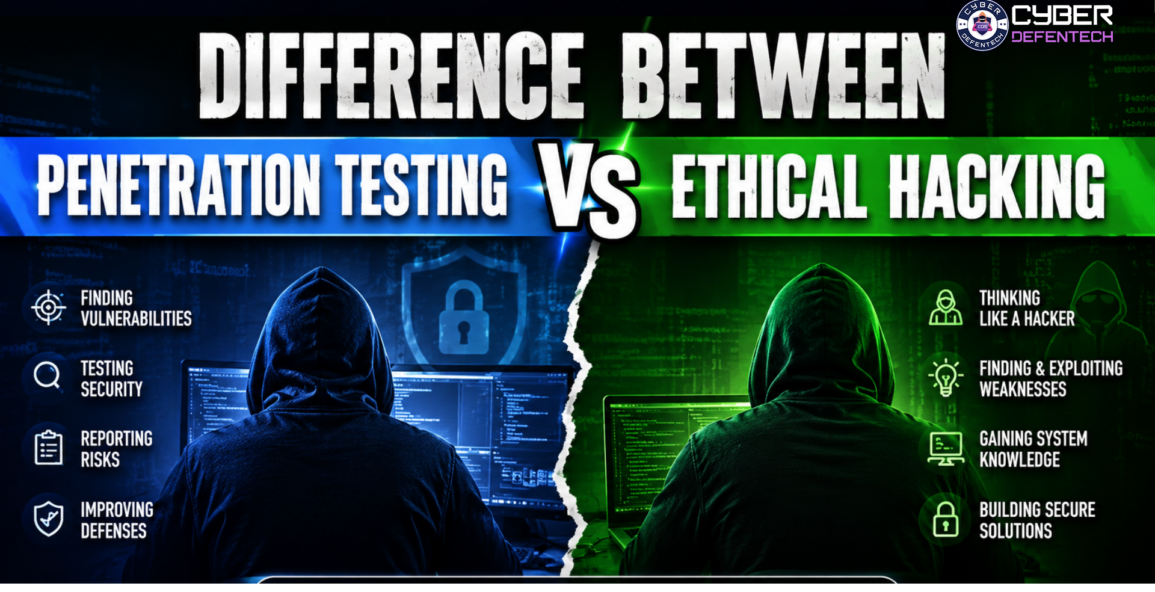
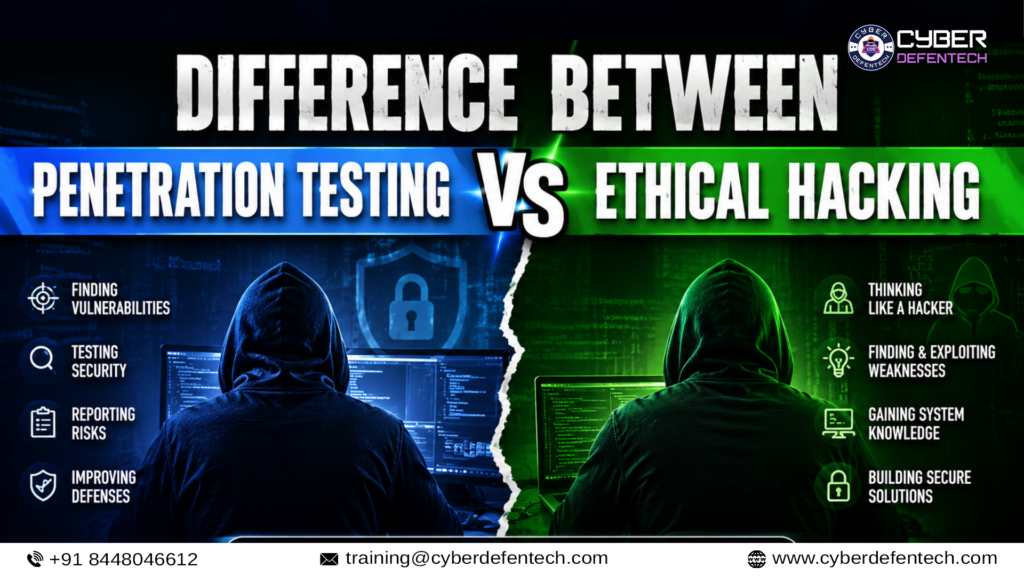
Difference between Penetration Testing and Ethical Hacking
By Cyber Defentech Team | June 2026 | 10 Mins Read | Beginner to Advanced
Introduction
In 2024, global cybercrime damages exceeded $9.5 trillion — a figure projected to cross $13.8 trillion by 2028. AI-powered cyberattacks are evolving at unprecedented speed — targeting banks, hospitals, government systems, and startups alike. A single security gap can bring down an entire organization overnight.
So how do organizations fight back? They hire professionals who think like attackers — Ethical Hackers and Penetration Testers. But here’s where most beginners get confused: Are these the same thing? Are these two terms interchangeable?
The short answer: No. While they overlap significantly, Ethical Hacking and Penetration Testing have distinct scopes, purposes, methodologies, and career trajectories. Understanding the difference is not just academic — it is the first step toward building a future-ready, high-demand cybersecurity career.
In this industry-level guide by Cyber Defentech, we break down every critical difference — backed by real-world context, career insights, and 2026 industry data — so you can make informed decisions and take the right path forward.
What is Ethical Hacking?
Ethical Hacking — also known as White-Hat Hacking — is the practice of intentionally probing computer systems, networks, applications, and digital infrastructure with the explicit permission of the owner to identify security vulnerabilities before malicious hackers can exploit them.
An Ethical Hacker thinks, acts, and operates exactly like a cybercriminal — but with a defined mission: protect, not destroy. They employ the same tools, the same techniques, and the same psychological mindset as black-hat hackers, but operate within a legally authorized, structured framework.
Core Characteristics of Ethical Hacking:
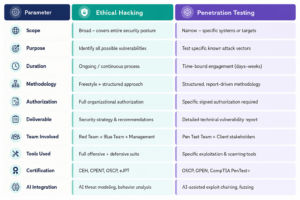
- Broad, holistic approach covering the entire attack surface
- Encompasses network, web, mobile, IoT, cloud, and social engineering
- May include red team vs. blue team simulations
- AI-powered threat modeling and behavioral analysis
- Continuous, evolving engagement — not a one-time activity
- Legally authorized with full organizational buy-in
What is Penetration Testing?
Penetration Testing — commonly called Pen Testing — is a specific, structured, time-bound security assessment where a security professional simulates a real-world cyberattack against a defined system, application, or network scope to identify exploitable vulnerabilities and document the attack path.
Think of Penetration Testing as a surgical strike — highly targeted, deeply technical, and focused on answering one critical question: Can an attacker get in, and how far can they go?
Core Characteristics of Penetration Testing:
- Specific scope: a defined application, network segment, or environment
- Time-bound: typically conducted over days, weeks, or a sprint cycle
- Follows structured frameworks: OWASP, PTES, NIST, OSSTMM
- Concludes with a detailed technical report and remediation roadmap
- Increasingly AI-assisted — using intelligent fuzzing and exploit chaining
- Requires signed Rules of Engagement (RoE) and legal authorization
Ethical Hacking vs Penetration Testing: Side-by-Side Comparison
Why It Matters: The Real-World Cyber Threat Landscape in 2026
The cybersecurity battlefield has fundamentally changed. Attackers are no longer just human — AI-powered malware, autonomous exploit frameworks, and large language model (LLM)-assisted phishing campaigns are being deployed at machine speed. In this environment, understanding the precise role of Ethical Hackers vs Penetration Testers isn’t a luxury — it’s a career necessity.
Real-World Incidents That Made Organizations Rethink Security:
▸ The SolarWinds Supply Chain Attack (2020 – Still Rippling in 2026)
Attackers embedded malicious code into trusted software updates, compromising 18,000+ organizations including US government agencies. A proactive ethical hacking program with supply chain security coverage could have detected the anomaly before deployment.
▸ MOVEit Data Breach (2023)
The Cl0p ransomware group exploited a zero-day SQL injection vulnerability, exposing data from 2,500+ organizations globally. A targeted web application penetration test with SQLi focus would have uncovered this exact flaw.
▸ AI-Generated Deepfake CFO Fraud (2024)
A finance employee in Hong Kong was deceived into transferring $25 million after a video call featuring AI-generated deepfakes of company executives. This represents the next generation of social engineering — an area exclusively within the ethical hacker’s domain.
▸ India’s AIIMS Ransomware Attack
The All India Institute of Medical Sciences suffered a crippling ransomware attack that disrupted patient care for weeks. A comprehensive ethical hacking engagement covering network segmentation, endpoint security, and user behavior analytics could have prevented this.
Why Companies Urgently Need Both: Ethical Hackers AND Pen Testers?
The 2026 global cybersecurity workforce gap stands at 4.8 million professionals. Demand is not slowing down — it is accelerating. Here is why organizations across every industry need both disciplines:
- Banks and FinTech: Mandatory RBI and PCI DSS compliance require regular pen tests and ethical hacking audits
- Healthcare: HIPAA and DPDP Act compliance demand vulnerability assessments protecting patient data
- Government & Defence: Nation-state cyberattacks require advanced red team capabilities
- E-Commerce & SaaS: API security, payment gateway hardening, and zero-day protection demand both disciplines
- Startups & Enterprises: ISO 27001 and SOC 2 certification demand documented security testing evidence
Skills You Will Learn: Ethical Hacking & Penetration Testing
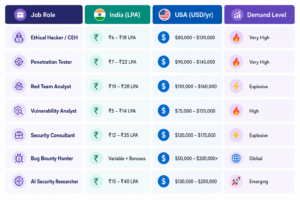
Career Opportunities: Where Your Path Leads
Whether you specialize in Ethical Hacking or Penetration Testing — or master both — the career landscape in 2026 is extraordinary.
Top Career Paths in Ethical Hacking:
- Ethical Hacker / White Hat Hacker
- Red Team Operator
- Cybersecurity Analyst
- AI Security Researcher
- Security Architect
- Bug Bounty Hunter (HackerOne, Bugcrowd, Intigriti)
Top Career Paths in Penetration Testing:
- Penetration Tester / Pentester
- Web Application Security Tester
- Network Penetration Tester
- Mobile Application Pen Tester
- Cloud Penetration Tester (AWS / Azure / GCP)
- VAPT (Vulnerability Assessment & Penetration Testing) Specialist
Salary & Industry Demand in 2026
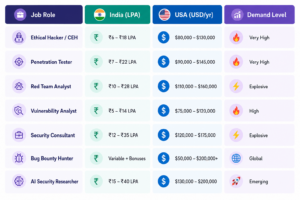
Pro Insight: Professionals who combine Ethical Hacking knowledge with specialized Penetration Testing skills command 30–50% higher salaries than single-skill practitioners. AI Security specialization adds another premium tier.
Real-World Importance: Why the Distinction Is Career-Critical
Imagine you apply for a ‘Penetration Tester’ role at a leading cybersecurity firm. You’ve been studying ‘Ethical Hacking’ broadly. During the interview, you’re asked: “Walk me through a black-box web application pen test methodology using OWASP Top 10 as your framework.” If you don’t understand the specific, structured nature of penetration testing — you will not get that job.
Conversely, if a CISO (Chief Information Security Officer) asks you to design a company-wide Red Team operation covering physical, social, and digital attack vectors — that requires the broad, multi-domain mindset of an Ethical Hacker.
This is why Cyber Defentech designs its training programs to give students mastery over both disciplines — not just surface-level exposure, but deep, practical, hands-on expertise that makes you immediately employable.
Tools & Technologies Used in 2026
Ethical Hacking Tools:
- Kali Linux & Parrot OS — Primary operating environments
- Metasploit Framework — Exploitation and post-exploitation
- Burp Suite Professional — Web application testing
- Nmap & Masscan — Network discovery and port scanning
- Social-Engineer Toolkit (SET) — Phishing and social engineering
- Wireshark & Tcpdump — Packet analysis and traffic inspection
- Maltego — OSINT and intelligence gathering
- Covenant & Cobalt Strike — Advanced red team C2 frameworks
- AI-Powered Tools — Darktrace, Microsoft Defender XDR, CrowdStrike Falcon
Penetration Testing Tools:
- OWASP ZAP — Open-source web app scanner
- Nikto — Web server vulnerability scanner
- SQLmap — Automated SQL injection detection and exploitation
- Nessus / OpenVAS — Vulnerability scanning platforms
- Hashcat & John the Ripper — Password cracking
- Aircrack-ng — Wireless network security testing
- Gobuster / Dirsearch — Directory brute-forcing
- Bloodhound — Active Directory attack path visualization
Beginner Roadmap: From Zero to Cybersecurity Professional
Phase 1 — Foundation (0–3 Months)
earn networking fundamentals (TCP/IP, OSI Model, DNS, HTTP/S), Linux command line, Python scripting basics, and core cybersecurity concepts. Start with CompTIA Network+ or Security+ as a baseline.
Phase 2 — Ethical Hacking Core (3–6 Months)
Master Kali Linux, network scanning with Nmap, exploitation with Metasploit, web attacks, password cracking, and wireless security. Pursue CEH (Certified Ethical Hacker) or eJPT certification.
Phase 3 — Penetration Testing Specialization (6–12 Months)
Deep-dive into OWASP Top 10, web app pen testing with Burp Suite, Active Directory attacks, buffer overflow, and advanced exploitation. Target OSCP (Offensive Security Certified Professional) — the gold standard.
Phase 4 — Advanced & AI Security (12–18 Months)
Explore Red Team operations, cloud pen testing (AWS/Azure), AI-powered threat detection, and bug bounty programs. Pursue CPENT, GPEN, or cloud security certifications.
Phase 5 — Real-World Projects & Career Launch
Complete capstone projects, contribute to CTF (Capture the Flag) competitions, build a public GitHub security portfolio, and apply for internships or junior roles.
Why Choose Cyber Defentech for Your Cybersecurity Training?
India’s Premier Cybersecurity Training Institute Practical. Industry-Focused. Future-Ready.
At Cyber Defentech, we don’t just teach cybersecurity — we engineer cybersecurity professionals. Our programs are designed by active industry practitioners with decades of combined experience in ethical hacking, red team operations, penetration testing, and AI security research.
✅ Hands-On Labs — Real attack simulations in isolated virtual environments, not just theory
✅ Industry-Aligned Curriculum — Mapped to CEH, OSCP, CPENT, and CompTIA PenTest+ certifications
✅ AI Security Modules — Next-generation training covering LLM attacks, AI-powered threat detection, and prompt injection
✅ Expert Mentors — Learn from certified ethical hackers with real-world bug bounty and red team backgrounds
✅ Career Placement Support — Resume building, interview preparation, and direct industry connections
✅ Flexible Learning — Weekend batches, online live sessions, and self-paced modules
✅ Real-World Projects — Capstone penetration testing reports that showcase your skills to employers
✅ Beginner-Friendly Onboarding — No prior experience required — we take you from zero to job-ready
Thousands of students have transformed their careers through Cyber Defentech’s industry-focused, practical cybersecurity programs. Your journey starts here.
Future Scope & Industry Trends: What 2026 and Beyond Holds
1. AI vs AI Security Wars
Attackers are using Generative AI to craft polymorphic malware, hyper-personalized phishing campaigns, and autonomous exploit chains. Organizations are responding with AI-powered Security Operations Centers (SOCs). Ethical Hackers who understand both offensive AI and defensive AI will be the most sought-after professionals on the planet.
2. The Rise of Cloud Penetration Testing
With 94% of enterprises now using cloud services, cloud security misconfigurations are the #1 attack vector. AWS, Azure, and GCP penetration testing is a specialized, high-paying niche exploding with demand.
3. Zero Trust Architecture Testing
As organizations implement Zero Trust security models, they require professionals who can validate these architectures under real attack conditions — a hybrid skill combining ethical hacking philosophy with penetration testing precision.
4. IoT & OT/ICS Security Testing
Smart factories, connected medical devices, and critical infrastructure are becoming prime attack targets. Specialized penetration testing for Industrial Control Systems (ICS) and Operational Technology (OT) is an emerging high-value niche.
5. Bug Bounty Economy & Continuous Security Testing
Companies like Google, Microsoft, Meta, and thousands of startups now run continuous bug bounty programs paying millions annually. Skilled ethical hackers and pen testers are earning life-changing income through legitimate vulnerability disclosure.
Final Thoughts: Two Sides of the Same Shield
Ethical Hacking and Penetration Testing are not rivals — they are complementary disciplines that together form a comprehensive cybersecurity defense strategy. Ethical Hacking provides the broad, strategic view of an organization’s security posture, while Penetration Testing delivers the deep, tactical validation of specific systems and controls.
In 2026’s threat landscape — where AI-powered attacks, ransomware-as-a-service, and nation-state cyber warfare are daily realities — professionals who master both disciplines will define the next generation of cybersecurity leadership.
Don’t just observe this revolution from the sidelines. Step into the arena. Build the skills. Earn the certifications. And let Cyber Defentech guide your transformation from a cybersecurity enthusiast to a highly paid, industry-recognized professional.
Frequently Asked Questions (FAQs)
Q1. Is Ethical Hacking and Penetration Testing the same thing?
No, they are related but distinct. Ethical Hacking is a broader discipline covering the entire security posture of an organization using various offensive and defensive techniques. Penetration Testing is a specific, time-bound, structured engagement targeting a defined scope. Think of Ethical Hacking as the profession and Penetration Testing as one of its most important methodologies.
Q2. Which is better to learn first — Ethical Hacking or Penetration Testing?
Start with Ethical Hacking fundamentals. Understanding the broad attack surface, networking, operating systems, and core offensive techniques gives you the knowledge base required to then specialize in specific Penetration Testing domains such as web application, network, or cloud pen testing.
Q3. What certifications should I pursue for Ethical Hacking vs Pen Testing?
For Ethical Hacking: CEH (Certified Ethical Hacker), eJPT, and CPENT are excellent starting points. For Penetration Testing: OSCP (Offensive Security Certified Professional) is the industry gold standard, followed by GPEN and CompTIA PenTest+. Cyber Defentech’s training programs are aligned with all these certifications.
Q4. Can I earn a good salary as an Ethical Hacker or Pen Tester in India in 2026?
Absolutely. Entry-level Ethical Hackers in India earn ₹6–10 LPA, with experienced professionals commanding ₹18–35 LPA. Penetration Testers with OSCP certification and 3–5 years of experience can earn ₹22–40 LPA. International remote opportunities in the USA pay $90,000–$160,000 annually for skilled professionals.
Q5. Do I need a degree in computer science to become an Ethical Hacker?
No. While a computer science background is helpful, thousands of successful ethical hackers and pen testers are self-taught or certificate-trained professionals. What matters most is your hands-on skill set, certifications (CEH, OSCP), and practical project portfolio. Cyber Defentech’s programs are designed for both freshers and career changers.
Q6. What is the role of AI in Ethical Hacking and Penetration Testing in 2026?
AI is transforming both disciplines. Attackers use AI for automated exploit discovery, polymorphic malware creation, and social engineering at scale. Defenders and security testers use AI for intelligent vulnerability scanning, behavioral anomaly detection, and automated pen test report generation. Understanding AI-powered security tools is now a mandatory skill for modern cybersecurity professionals.
Q7. Is Bug Bounty Hunting related to Ethical Hacking or Penetration Testing?
Bug Bounty Hunting sits at the intersection of both. It requires the broad vulnerability discovery mindset of an Ethical Hacker combined with the specific, technical exploitation skills of a Penetration Tester. Top Bug Bounty Hunters earn millions annually through platforms like HackerOne, Bugcrowd, and Intigriti.
Q8. How can Cyber Defentech help me launch my cybersecurity career?
Cyber Defentech offers end-to-end cybersecurity career support — from beginner-friendly foundational courses to advanced red team and penetration testing programs. With hands-on labs, real-world project exposure, industry-aligned curriculum, expert mentors, and dedicated placement assistance, Cyber Defentech is your fastest path to a high-paying cybersecurity career in 2026 and beyond.
Ready to Build Your Career in Ethical Hacking & Penetration Testing?
Join India’s Most Trusted Cybersecurity Training Institute
✅ Hands-On Practical Labs — Real Attack Simulations
✅ Industry-Focused Curriculum — CEH, OSCP, CPENT Aligned
✅ AI Security & Next-Generation Cyber Skills
✅ Expert Mentors — Active Ethical Hackers & Red Teamers
✅ Career Placement Assistance & Interview Preparation
✅ Future-Ready Skills for a High-Demand Cyber Career in 2026
 Visit Now:
 Call/WhatsApp:
Your Cybersecurity Career Starts Today. Don’t Wait.
