
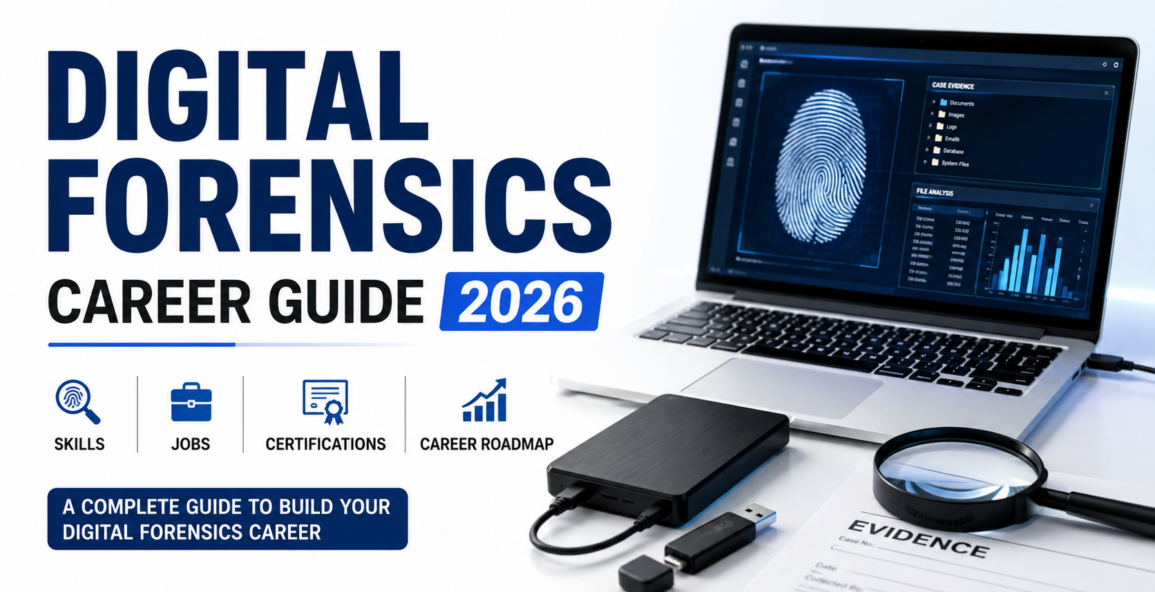
Digital Forensics Career Guide 2026: Skills, Jobs, Salary and Career Roadmap
A cyberattack does not end when the malicious activity stops. Organisations must still determine what happened, which systems were affected, whether sensitive information was accessed, how the attacker entered the environment and what actions are required to prevent the incident from happening again.
This investigation may involve analysing computers, mobile phones, storage devices, system logs, network traffic, cloud accounts, email records, memory captures and other sources of digital evidence.
That is where digital forensics professionals become essential.
Digital forensics combines cybersecurity, investigation, evidence handling and analytical thinking. Professionals working in this field identify, collect, preserve, examine and analyse electronic information connected to cyber incidents, fraud, insider threats, data breaches and criminal investigations.
The Digital Forensics Career Guide 2026 explains what digital forensics involves, which technical skills employers may expect, the job roles available, the certifications learners can consider and how beginners can build practical experience.
Quick Answer: Is Digital Forensics a Good Career in 2026?
Digital forensics can be a valuable career option for people interested in cybersecurity investigations, incident response, evidence analysis and cybercrime.
A digital forensics professional may investigate compromised computers, analyse system and network activity, recover deleted information, examine malware-related evidence and prepare reports explaining what occurred.
To begin a digital forensics career, learners should develop knowledge of:
- Windows and Linux operating systems
- Computer networking
- File systems
- Cybersecurity fundamentals
- Evidence acquisition and preservation
- Memory and disk analysis
- Log investigation
- Incident response
- Malware fundamentals
- Professional report writing
Practical laboratories, investigation exercises and documented portfolio projects are particularly important because digital forensics is an applied technical discipline.
What Is Digital Forensics?
Digital forensics is the process of identifying, collecting, preserving, examining, analysing and reporting information obtained from electronic devices and digital systems.
NIST defines digital forensics as applying scientific methods to the identification, collection, examination and analysis of data while preserving its integrity and maintaining a strict chain of custody.
Digital evidence may be found in:
- Desktop computers
- Laptops
- Mobile phones
- Tablets
- Hard drives
- USB devices
- Email accounts
- Cloud platforms
- Network devices
- Databases
- Web applications
- System and security logs
- Internet of Things devices
- Virtual machines
- Memory captures
NIST describes digital forensics as retrieving, storing and analysing electronic data that may be useful in investigations.
The objective is not simply to locate files. Investigators must determine whether the information is relevant, preserve its integrity, document how it was obtained and explain what conclusions can reasonably be drawn from it.
What Is Digital Evidence?
Digital evidence is information stored, received or transmitted through an electronic device that may have value to an investigation.
Examples may include:
- Documents and spreadsheets
- Images and videos
- Emails
- Chat records
- Browser history
- Login activity
- File timestamps
- Deleted files
- Application records
- GPS information
- Network connections
- Cloud-access records
- Security alerts
- Malware artefacts
- User-account activity
The National Institute of Justice explains that digital evidence may exist on computers, mobile phones and other electronic devices. It also emphasises appropriate collection, preservation and examination procedures.
Digital evidence can be fragile. Opening a file, switching on a device, connecting it to a network or using the wrong acquisition method may alter relevant information.
This is why trained investigators follow documented procedures and maintain a chain of custody.
Digital Forensics vs Ethical Hacking
Digital forensics and ethical hacking are both cybersecurity disciplines, but they have different objectives.
| Area | Digital Forensics | Ethical Hacking |
|---|---|---|
| Primary purpose | Investigate incidents and analyse evidence | Identify vulnerabilities before attackers exploit them |
| Typical timing | During or after a suspected incident | Before an incident as a preventive assessment |
| Primary activities | Collection, preservation, examination and reporting | Reconnaissance, testing and vulnerability validation |
| Main output | Evidence-based investigation report | Penetration-testing or vulnerability report |
| Evidence handling | Central requirement | Important but engagement-dependent |
| Common roles | Forensics analyst, DFIR analyst, investigator | Penetration tester, VAPT analyst, ethical hacker |
Ethical hackers test approved systems to identify security weaknesses. Digital forensics professionals reconstruct events by analysing evidence connected to suspicious activity or an incident.
However, digital forensics should not be viewed only as work that begins after an attack. Organisations can also establish forensic readiness before an incident by defining evidence-retention policies, improving logging, identifying investigation contacts and preparing acquisition procedures.
Digital Forensics vs Incident Response
Incident response focuses on containing, managing and recovering from cybersecurity incidents.
Digital forensics supports incident response by providing evidence-based answers to questions such as:
- How did the attacker enter?
- Which account was compromised?
- What commands were executed?
- Which systems were accessed?
- Was information copied or deleted?
- How long was the attacker present?
- Is the attacker still active?
- Which indicators should defenders search for?
- What security controls failed?
CERT-In describes incident response as a process focused on restoring affected systems, containing damage and helping organisations take action to prevent similar incidents.
Together, digital forensics and incident response are commonly referred to as DFIR.
Why Is Digital Forensics Important in 2026?
Organisations store customer information, financial records, employee data, intellectual property, business communications and operational information in digital systems.
When an incident occurs, the organisation must understand its scope and impact. Without reliable forensic processes, teams may struggle to determine:
- Which systems were compromised
- When the activity began
- What the attacker accessed
- Whether information was stolen
- How the intrusion occurred
- Whether evidence was altered
- What remediation should be prioritised
- Whether legal or regulatory reporting is required
Digital forensics can support:
- Cybercrime investigations
- Ransomware investigations
- Data-breach analysis
- Insider-threat investigations
- Financial-fraud investigations
- Intellectual-property theft cases
- Employee-misconduct investigations
- Malware analysis
- Incident response
- eDiscovery
- Litigation support
- Regulatory investigations
CERT-In’s current responsibilities include collecting and analysing information about cyber incidents, coordinating incident-response activities and issuing guidance on prevention, response and reporting.
CERT-In’s 2026 guidance also recommends that organisations maintain updated incident-response contacts, including relevant forensics partners and law-enforcement contacts.
What Does a Digital Forensics Professional Do?
A digital forensics professional examines devices, accounts and technical records connected to a suspected incident.
The exact responsibilities depend on the organisation, investigation type and job role.
Common Responsibilities
A digital forensics professional may:
- Secure and document electronic devices
- Acquire forensic images of storage media
- Verify acquired data using hashes
- Preserve original evidence
- Recover deleted information
- Examine Windows and Linux systems
- Analyse file systems
- Review browser history
- Examine email records
- Analyse system and application logs
- Review network activity
- Investigate suspicious user accounts
- Analyse memory captures
- Identify malware artefacts
- Build an incident timeline
- Document investigative actions
- Maintain chain-of-custody records
- Prepare technical reports
- Present findings to management, legal teams or investigators
- Support remediation and incident-response teams
The NIST NICE Framework describes the Digital Evidence Analysis work role as identifying, collecting, examining and preserving digital evidence through controlled and documented investigative techniques.
The Digital Forensics Investigation Process
NIST presents a four-stage forensic process:
- Collection
- Examination
- Analysis
- Reporting
1. Collection
The investigator identifies potential evidence and acquires it using suitable procedures.
This stage may involve:
- Identifying relevant devices
- Recording device condition
- Photographing equipment
- Collecting volatile information
- Creating forensic images
- Calculating hash values
- Securing original evidence
- Documenting chain of custody
2. Examination
The collected data is processed to locate information that may be relevant to the investigation.
Activities may include:
- File-system examination
- Deleted-file recovery
- Keyword searching
- Log extraction
- Metadata review
- Browser-history extraction
- Email examination
- Data filtering
- Timeline creation
3. Analysis
The investigator evaluates the extracted information and determines what it may reveal about the incident.
Analysis may seek to establish:
- The initial point of entry
- Compromised accounts
- Tools used by the attacker
- Files accessed or modified
- Persistence methods
- Lateral movement
- Information exfiltration
- Duration of unauthorised access
- Relationships between different artefacts
4. Reporting
The investigator documents the process, findings, limitations and conclusions.
A professional report should clearly distinguish:
- Verified facts
- Technical observations
- Reasonable conclusions
- Unconfirmed possibilities
- Investigation limitations
The report should be understandable to both technical and non-technical readers.
Major Types of Digital Forensics
Computer Forensics
Computer forensics involves examining desktops, laptops, servers and storage media.
Learners may study:
- Hard-drive acquisition
- File systems
- Deleted files
- Registry analysis
- User activity
- Application artefacts
- Browser records
- Operating-system logs
Mobile Device Forensics
Mobile device forensics involves recovering and analysing information from smartphones, tablets and similar devices.
It can include:
- Calls and messages
- Application data
- Images and videos
- Location information
- Device backups
- Browser activity
- Cloud-linked records
NIST describes mobile device forensics as recovering digital evidence from mobile devices under forensically sound conditions using accepted methods.
Network Forensics
Network forensics focuses on communications and activity across a network.
It may include:
- Packet analysis
- Firewall logs
- Proxy logs
- DNS activity
- VPN connections
- Network-flow data
- Intrusion-detection alerts
- Suspicious connections
Memory Forensics
Memory forensics involves examining volatile memory captured from a running system.
It may help investigators identify:
- Active processes
- Network connections
- Loaded modules
- Command history
- Credentials or keys in memory
- Injected code
- Fileless malware
- Malicious processes
Cloud Forensics
Cloud forensics examines evidence from cloud infrastructure and services.
It may include:
- Identity and access activity
- Audit logs
- Virtual machines
- Storage buckets
- Cloud applications
- Administrative actions
- Authentication events
- API activity
Cloud investigations require knowledge of provider-specific logging, shared-responsibility models and evidence-access limitations.
Malware Forensics
Malware forensics examines suspicious software and related artefacts to understand:
- What the malware does
- How it entered the system
- Which files it created
- What persistence it established
- Which systems it contacted
- Whether information was collected
- How defenders can detect it
Email Forensics
Email forensics may involve analysing:
- Message headers
- Sender information
- Routing information
- Attachments
- Embedded links
- Authentication records
- Mailbox activity
- Phishing indicators
Skills Required for a Digital Forensics Career
A successful digital forensics career requires technical knowledge, investigative thinking, patience and professional communication.
1. Windows and Linux Knowledge
Investigators should understand:
- Users and groups
- Files and directories
- Permissions
- Processes and services
- System logs
- Scheduled tasks
- Software installation
- Storage devices
- Command-line tools
- Operating-system artefacts
2. Networking Fundamentals
Important concepts include:
- TCP/IP
- IP addresses
- Ports and protocols
- DNS
- HTTP and HTTPS
- Routing
- Firewalls
- VPNs
- Network segmentation
- Packet analysis
3. File-System Knowledge
Learners should understand how file systems organise information and record activity.
Useful concepts include:
- File allocation
- Metadata
- Timestamps
- Deleted files
- Partitions
- Slack space
- Journaling
- Access permissions
4. Evidence Handling
Evidence-handling knowledge should include:
- Chain of custody
- Evidence identification
- Secure acquisition
- Hash verification
- Storage procedures
- Access control
- Documentation
- Preservation of original data
5. Log Analysis
Investigators may need to examine:
- Operating-system logs
- Authentication logs
- Firewall logs
- Application logs
- Web-server logs
- Cloud audit records
- Endpoint-security alerts
- Database activity
6. Incident-Response Fundamentals
Digital forensics professionals should understand:
- Preparation
- Detection
- Triage
- Containment
- Eradication
- Recovery
- Post-incident review
7. Malware Fundamentals
Investigators do not always need to be advanced reverse engineers, but they should understand:
- Malware behaviour
- Persistence
- Command-and-control traffic
- Suspicious processes
- Malicious files
- Indicators of compromise
- Safe analysis environments
8. Analytical Thinking
Strong investigators carefully connect evidence without making unsupported assumptions.
Important abilities include:
- Attention to detail
- Logical reasoning
- Pattern recognition
- Timeline reconstruction
- Hypothesis testing
- Documentation
- Patience
- Professional scepticism
9. Report Writing
A digital forensics report should explain:
- Investigation objective
- Evidence received
- Tools and procedures used
- Findings
- Event timeline
- Supporting evidence
- Limitations
- Conclusions
- Recommended actions
10. Communication and Confidentiality
Digital forensic investigations may involve confidential employee, customer, legal or business information.
Professionals must communicate carefully and protect sensitive evidence throughout the investigation.
Common Digital Forensics Tools
A professional digital forensics course may introduce different categories of tools rather than relying on one platform.
| Tool Category | Purpose |
|---|---|
| Disk-imaging tools | Create forensic copies of storage media |
| File-system analysis tools | Examine files, metadata and deleted data |
| Memory-analysis tools | Investigate volatile memory |
| Network-analysis tools | Review packet captures and network activity |
| Mobile-forensics tools | Acquire and examine mobile-device data |
| Timeline tools | Correlate activity across multiple sources |
| Malware-analysis tools | Examine suspicious software and behaviour |
| Reporting tools | Organise evidence and prepare reports |
Popular training environments may introduce tools such as Autopsy, The Sleuth Kit, Wireshark, Volatility, FTK Imager, Magnet AXIOM or commercial forensic suites.
A tool result should never be accepted without validation. Investigators must understand what the tool collected, how it interpreted the artefact and what limitations may apply.
Digital Forensics Career Opportunities
Digital-forensics skills can support opportunities in:
- Cybersecurity companies
- IT service providers
- Consulting firms
- Banks and financial institutions
- Government organisations
- Law-enforcement agencies
- Healthcare organisations
- Telecommunications companies
- Legal and eDiscovery firms
- Large enterprises
- Security operations centres
- Incident-response teams
Popular Digital Forensics Jobs
- Digital Forensics Analyst
- Computer Forensics Investigator
- DFIR Analyst
- Incident Response Analyst
- Cybercrime Investigator
- Malware Analyst
- Mobile Forensics Analyst
- Network Forensics Analyst
- Forensic Consultant
- Cybersecurity Investigator
- eDiscovery Specialist
- SOC Analyst
- Threat Hunter
- Forensic Lab Examiner
Job titles and responsibilities vary between organisations. Some employers combine digital forensics, incident response, threat hunting and malware analysis within a single role.
Digital Forensics Career Progression
A possible career path may look like this:
| Career Stage | Possible Role |
|---|---|
| Foundation | IT Support, Network Support or SOC Intern |
| Entry Level | Junior Forensics Analyst or SOC Analyst |
| Developing Professional | Digital Forensics Analyst or Incident Response Analyst |
| Experienced Professional | Senior DFIR Analyst or Forensics Consultant |
| Advanced Level | Lead Investigator, DFIR Manager or Threat-Hunting Lead |
| Leadership | Head of Incident Response or Digital Forensics Practice Lead |
This is not a fixed path. Professionals may enter digital forensics from networking, system administration, SOC operations, law enforcement, auditing, legal technology or cybersecurity consulting.
Digital Forensics Salary in India
There is no single fixed digital forensics salary in India.
Compensation can depend on:
- Professional experience
- Technical depth
- Job role
- City and work location
- Employer type
- Investigation responsibilities
- Incident-response knowledge
- Cloud and mobile-forensics skills
- Professional certifications
- Report-writing ability
- Legal or regulatory knowledge
- Leadership responsibilities
Entry-level professionals may begin in SOC, cybersecurity operations, IT support or junior investigation roles before moving into dedicated digital-forensics positions.
Experienced professionals may progress into senior DFIR, consulting, threat-hunting, incident-response leadership or forensic-practice management.
Do not choose this field only because of salary claims. Practical capability, investigation quality, confidentiality and professional credibility are critical to long-term growth.
Digital Forensics Certifications to Consider
Certifications can provide structured learning, but they should be combined with labs and investigation projects.
CHFI
EC-Council’s Computer Hacking Forensic Investigator programme covers evidence handling, chain of custody, acquisition, preservation, analysis and reporting. Its current scope also includes areas such as mobile, cloud, IoT and malware forensics.
GIAC GCFE
The GIAC Certified Forensic Examiner certification focuses on collecting and analysing Windows-system evidence, including browser activity, user activity, acquisition and forensic reporting.
GIAC GCFA
The GIAC Certified Forensic Analyst certification is aimed at more advanced forensic investigations and incident-response scenarios, including breach investigations, threat activity and complex forensic cases.
Vendor-Specific Certifications
Professionals working with particular commercial tools may also consider relevant product-specific training.
Before registering, verify:
- Current syllabus
- Prerequisites
- Exam format
- Practical requirements
- Voucher validity
- Renewal requirements
- Total cost
- Training-provider authorisation
A certification does not guarantee employment. Employers also assess practical investigation skills, technical foundations, documentation and communication.
How to Start a Career in Digital Forensics
Step 1: Learn Computer Fundamentals
Understand computer hardware, storage, software installation, operating systems and basic troubleshooting.
Step 2: Study Windows and Linux
Learn command-line tools, users, permissions, services, processes, system logs and common operating-system artefacts.
Step 3: Build Networking Knowledge
Study TCP/IP, DNS, ports, protocols, web traffic, firewalls and packet analysis.
Step 4: Learn Cybersecurity Fundamentals
Understand threats, vulnerabilities, malware, authentication, access control, incident response and security monitoring.
Step 5: Study Evidence Handling
Learn chain of custody, forensic acquisition, data integrity, hashing, documentation and preservation.
Step 6: Practise Disk and File-System Analysis
Use authorised laboratory images and intentionally prepared datasets to examine files, metadata and deleted information.
Step 7: Learn Memory and Log Analysis
Practise analysing memory captures, authentication activity, security events and endpoint logs.
Step 8: Complete Investigation Scenarios
Work through realistic cases involving:
- Suspicious login activity
- Deleted files
- Malware infection
- Data theft
- Insider activity
- Phishing
- Unauthorised USB usage
- Compromised user accounts
Step 9: Prepare Professional Reports
Document objectives, evidence, procedures, findings, timelines, limitations and conclusions.
Step 10: Build a Portfolio
Your portfolio should demonstrate methodology and reporting without exposing confidential or unauthorised information.
Six-Month Digital Forensics Learning Roadmap
Month 1: Computer, Windows and Linux Fundamentals
Study storage, users, permissions, processes, services, file systems and system logs.
Month 2: Networking and Cybersecurity
Learn TCP/IP, DNS, HTTP, ports, firewalls, malware concepts and security monitoring.
Month 3: Evidence Acquisition and Disk Forensics
Practise imaging, hashing, preservation, metadata analysis and deleted-file recovery.
Month 4: Memory, Network and Log Forensics
Analyse memory captures, packet data, authentication events and incident timelines.
Month 5: Mobile, Cloud and Malware Fundamentals
Learn the main investigation concepts related to mobile devices, cloud services and malicious software.
Month 6: Mock Investigation and Reporting
Complete an authorised case from evidence collection to final reporting.
The final project should include:
- Case objective
- Evidence inventory
- Chain-of-custody record
- Investigation methodology
- Event timeline
- Findings
- Supporting screenshots
- Limitations
- Recommendations
- Executive summary
Portfolio Projects for Digital Forensics Students
1. Deleted File Investigation
Analyse a training disk image and document recovered files, metadata and relevant timestamps.
2. Windows User-Activity Timeline
Review system artefacts and prepare a timeline of user logins, application use and file activity.
3. Phishing Email Investigation
Examine email headers, links, attachments and authentication details in a safe laboratory.
4. Memory-Forensics Exercise
Investigate a prepared memory capture for suspicious processes and network connections.
5. Network-Traffic Analysis
Use a legal packet capture to identify unusual communication or malware-related traffic.
6. Insider-Threat Scenario
Analyse an authorised dataset involving unusual file access, USB activity or information transfer.
7. Executive Investigation Report
Convert technical findings into a clear summary for business leadership.
Every portfolio project should state that the investigation was completed using an authorised lab, public training dataset or intentionally prepared evidence image.
Why Practical Digital Forensics Training Matters
Digital forensics cannot be mastered through theory alone.
Each investigation may involve different devices, evidence sources, operating systems and incident conditions. Learners must know how to choose suitable procedures, validate results, maintain evidence integrity and explain their conclusions.
Practical learning helps students develop:
- Evidence-handling discipline
- Tool familiarity
- Troubleshooting ability
- Investigation methodology
- Timeline-analysis skills
- Technical confidence
- Documentation habits
- Professional reporting
A strong course should not only demonstrate tools. Learners should complete their own investigations and submit original reports.
Digital Forensics Course in Delhi NCR
Learners searching for a digital forensics course in Delhi NCR may compare classroom, online and hybrid options across:
- Delhi
- Noida
- Gurugram
- Ghaziabad
- Faridabad
A professional programme should ideally include:
- Windows and Linux foundations
- Networking fundamentals
- Evidence acquisition
- Disk and file-system analysis
- Memory forensics
- Network forensics
- Mobile-forensics concepts
- Malware fundamentals
- Incident response
- Chain of custody
- Investigation laboratories
- Professional report writing
- Portfolio preparation
- Interview guidance
Students should ask for written information about:
- Trainer experience
- Full syllabus
- Lab access
- Class format
- Batch schedule
- Certification package
- Exam voucher
- Internship conditions
- Placement-support terms
- Total fee
- Refund policy
Build Your Digital Forensics Career with Cyber Defentech
Cyber Defentech provides cybersecurity training support for students, graduates, working professionals and learners interested in digital forensics and incident response.
The learning approach focuses on technical foundations, practical exercises, investigation methodology and career preparation.
Develop Skills In
- Digital-evidence handling
- Windows and Linux investigation
- Disk and file-system analysis
- Log analysis
- Network forensics
- Incident response
- Malware-investigation fundamentals
- Chain-of-custody documentation
- Forensics reporting
- Investigation case studies
Start Your Learning Journey
Location: D-12/77, 2nd Floor, Sector 8, Near Rohini East Metro Station Gate No. 2, Rohini, Delhi – 110085
Primary CTA Button: Book a Free Career Counselling Session
Secondary CTA Button: Request Digital Forensics Course Details
Request the latest written information regarding syllabus, trainers, laboratory access, batch schedule, certification package and fees before enrolling.
Frequently Asked Questions
What is digital forensics?
Digital forensics is the process of identifying, collecting, preserving, examining, analysing and reporting electronic evidence from computers, mobile phones, networks, cloud systems and other digital devices.
Is digital forensics a good career in 2026?
It can be a strong career option for learners interested in cybersecurity investigations, cybercrime, evidence analysis, incident response and technical problem-solving. Career outcomes depend on practical skills, education, experience and employer requirements.
What qualifications are required for digital forensics?
Employers may accept backgrounds in computer science, information technology, cybersecurity, digital forensics or related areas. Practical skills and investigation experience are also important.
Can beginners learn digital forensics?
Yes. Beginners should first learn computer fundamentals, networking, Windows, Linux, cybersecurity basics and evidence-handling principles.
Is coding required for digital forensics?
Advanced programming is not always required for entry-level roles. Basic Python, PowerShell, Bash and SQL can help with automation, data processing and investigation tasks.
What does a digital forensics investigator do?
A digital forensics investigator collects and preserves evidence, examines devices and logs, recovers information, builds incident timelines and prepares evidence-based reports.
What are the main digital forensics job roles?
Common roles include Digital Forensics Analyst, DFIR Analyst, Incident Response Analyst, Cybercrime Investigator, Malware Analyst, Mobile Forensics Analyst and Forensic Consultant.
What is the salary of a digital forensics professional in India?
Salary varies according to experience, job role, location, technical skills, employer, certifications and investigation responsibilities. Candidates should compare current vacancies for their chosen city and specialisation.
Is digital forensics different from cybersecurity?
Digital forensics is a specialised area within the wider cybersecurity field. Cybersecurity includes prevention, monitoring, testing and response, while digital forensics concentrates on evidence and investigation.
Is digital forensics the same as ethical hacking?
No. Ethical hacking usually identifies security weaknesses through authorised testing. Digital forensics investigates evidence related to an incident or suspicious activity.
Which certification is best for digital forensics?
The right certification depends on experience and career goals. CHFI may provide broad forensic knowledge, while GCFE and GCFA focus on more specialised practitioner-level capabilities.
Can commerce or arts students enter digital forensics?
Yes, but they need to build strong technical foundations in computers, operating systems, networking, cybersecurity and investigation methodology.
How long does it take to learn digital forensics?
A beginner may need several months to build foundational skills. Professional capability requires continued laboratory practice, case analysis and reporting experience.
Can I investigate another person’s device for practice?
No. Investigate only devices and data that you own or have explicit permission to examine. Use authorised laboratories and public training datasets.
Final Thoughts
The Digital Forensics Career Guide 2026 shows that this career requires much more than operating forensic tools.
Professionals must understand computers, networks, file systems, evidence handling, incident response, investigation methodology and report writing. They must also remain objective, protect confidential information and clearly distinguish confirmed evidence from assumptions.
Beginners should start with Windows, Linux, networking and cybersecurity fundamentals. They can then progress into disk analysis, memory forensics, network investigation, mobile forensics and incident response.
Certifications can support professional development, but practical investigation experience is essential. Building a laboratory, solving authorised cases and producing original reports can demonstrate your capabilities more effectively than collecting certificates without practice.
The strongest digital forensics professionals combine technical accuracy, analytical thinking, ethical responsibility and clear communication.
About This Guide
This article was developed to help students, graduates and cybersecurity professionals understand digital-forensics skills, job roles, certifications and career pathways.
Written by: Cyber Defentech Editorial Team
Reviewed by: Digital Forensics and Incident Response Training Team
Last Updated: August 2026
