
CEH vs Security+ vs CISSP: Which Certification Is Best?
By Cyber Defentech Team | May 2026 | 10 Mins Read | Beginner to Advanced
Introduction
If you are serious about a career in cybersecurity, three names will come up constantly: CEH (Certified Ethical Hacker), CompTIA Security+, and CISSP (Certified Information Systems Security Professional). Each is powerful. Each opens different doors. But choosing the wrong one at the wrong stage of your career can cost you time, money, and momentum.
This guide breaks down all three certifications — head to head — so you can make a confident, future-ready decision backed by real-world insight.
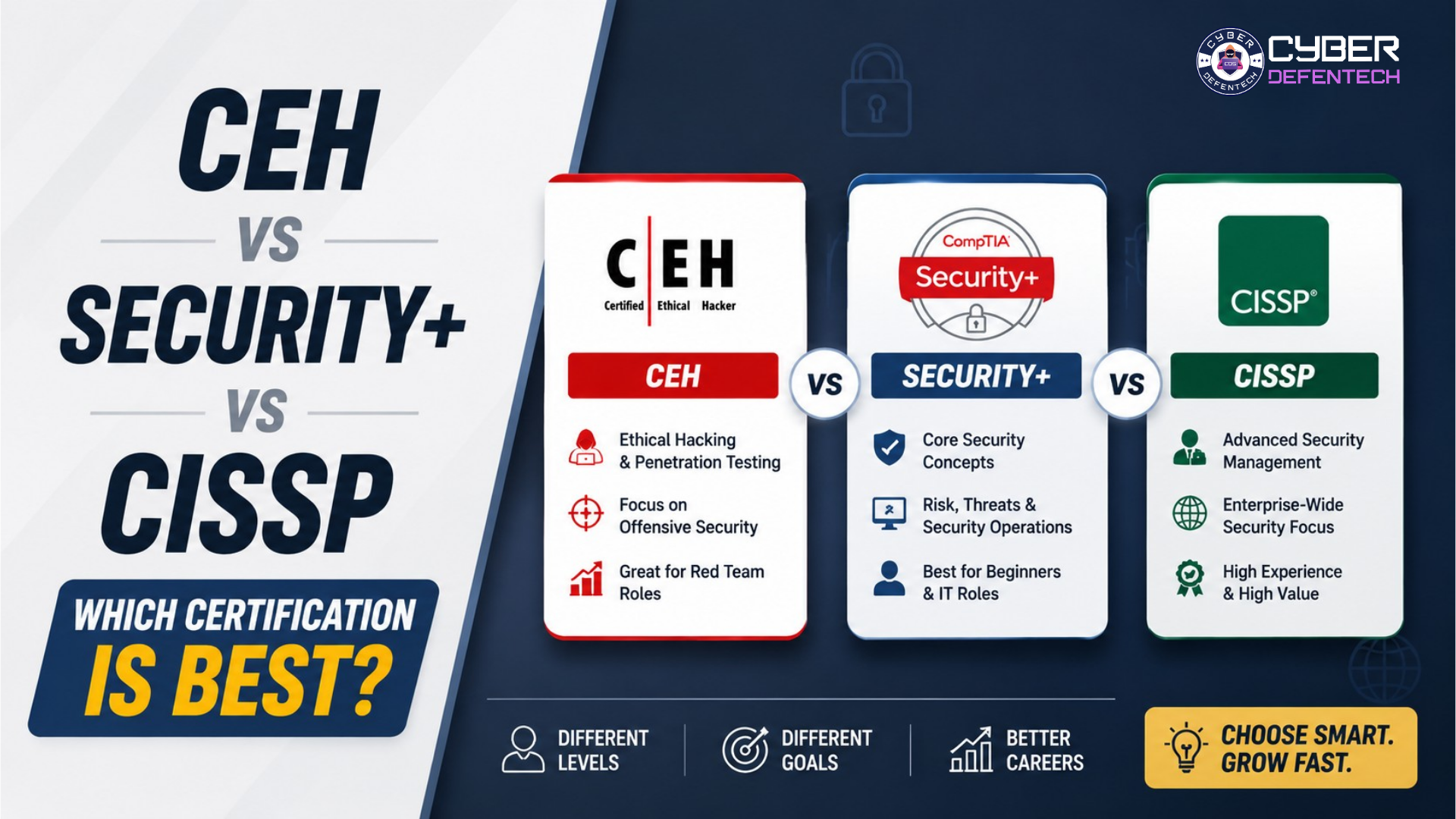
CEH vs Security+ vs CISSP :What Are CEH, Security+,and CISSP?
Before comparing, let’s understand what each certification actually represents.
CompTIA Security+ is a globally recognized entry-level cybersecurity certification issued by CompTIA. It covers foundational security concepts including threats, vulnerabilities, cryptography, network security, identity management, and risk management. It is vendor-neutral and widely accepted as the starting point for cybersecurity careers. The U.S. Department of Defense recognizes it under DoD 8570 compliance.
CEH (Certified Ethical Hacker) is offered by EC-Council and is one of the most recognized certifications in offensive security. It trains professionals to think like attackers — using hacking tools, penetration testing techniques, vulnerability scanning, and exploit frameworks to identify and fix security gaps before malicious actors do. CEH is highly respected in red team environments, pen testing roles, and security operations centers.
CISSP (Certified Information Systems Security Professional) is issued by (ISC)² and is widely regarded as the gold standard of cybersecurity certifications. It covers eight domains of security knowledge including asset security, identity management, software development security, and security operations. CISSP is designed for senior professionals and requires a minimum of five years of relevant work experience. It is a certification that signals strategic leadership capability, not just technical skills.
Why Choosing the Right Certification Matters ?
In cybersecurity, the wrong certification at the wrong time can delay your career by years. A fresher who jumps straight to CISSP without experience requirements will face rejection. A senior professional who only holds Security+ may get passed over for managerial roles that expect CISSP-level depth.
The cybersecurity job market has matured. Hiring managers now filter resumes by specific certifications for specific roles. The right credential tells a recruiter exactly what you can do, how deep your knowledge goes, and whether you are ready for the position on offer.
Beyond hiring, certifications directly influence salary brackets, team credibility, client trust, and promotion opportunities. In a field where stakes involve national infrastructure, financial systems, and personal data — credibility backed by certification is non-negotiable.
Real-World Cyber Threats Making These Certifications Urgent
The threat landscape is not theoretical. It is live, aggressive, and evolving daily.
AI-powered phishing attacks now generate hyper-personalized emails that bypass traditional filters. Security+ trains professionals to recognize and mitigate social engineering threats at the foundational level.
Advanced Persistent Threats (APTs) from nation-state actors infiltrate corporate networks for months before detection. CEH teaches the reconnaissance, lateral movement, and post-exploitation techniques these attackers use — so defenders can identify the same patterns in their own environments.
Cloud misconfigurations and insider threats have led to some of the most damaging data breaches in recent history. CISSP’s domains on asset security, access management, and security architecture directly address enterprise-scale governance failures that make these breaches possible.
The average cost of a data breach globally has reached $4.88 million according to IBM’s Cost of a Data Breach Report. Organizations are no longer asking if they need certified cybersecurity professionals. They are asking how quickly they can hire them.
Why Companies Actively Seek Certified Cybersecurity Professionals ?
Certification is proof of competence that HR teams, compliance officers, and CISOs can verify. Here is why organizations prioritize certified talent:
Regulatory compliance mandates like GDPR, HIPAA, ISO 27001, and India’s DPDP Act require organizations to employ qualified security personnel. Certifications satisfy these compliance requirements directly.
Insurance and risk management firms increasingly require certified staff before approving cyber insurance policies. CISSP holders, in particular, are trusted to design and validate security programs that reduce organizational risk.
Government and defense contracts in India and globally often require DoD 8570-compliant certifications — a category that includes both Security+ and CEH — as a baseline requirement for vendors and contractors.
Client and stakeholder trust is directly enhanced when a firm can show its security team holds internationally recognized credentials. For consulting firms, MSSPs, and IT service providers, certification is a competitive differentiator.
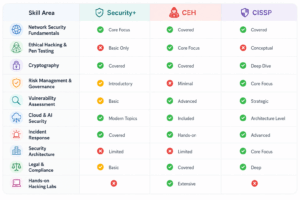
Skills You Will Learn: Certification Comparison
Career Opportunities After Each Certification
After Security+: You are ready for roles such as IT Security Analyst, Junior SOC Analyst, Help Desk Security Specialist, Network Security Technician, and Systems Administrator with a security focus. Security+ is ideal for IT professionals transitioning into cybersecurity and students entering the field for the first time.
After CEH: You are qualified for roles such as Ethical Hacker, Penetration Tester, Red Team Analyst, Vulnerability Assessment Specialist, Cybersecurity Consultant, and Threat Intelligence Analyst. CEH is ideal for those who want to specialize in offensive security and understand how attacks are launched and neutralized.
After CISSP: Senior-level roles open up immediately — Chief Information Security Officer (CISO), Security Manager, Security Architect, Risk and Compliance Manager, Security Director, and IT Audit Manager. CISSP is the certification that signals readiness for strategic leadership in enterprise security environments.
Salary & Industry Demand
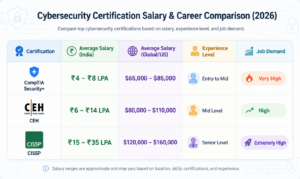
Salary data is indicative and based on current industry averages. Actual compensation varies by employer, location, and experience.
Cybersecurity professionals in India are among the highest-paid IT workers, and the gap between demand and supply continues to widen. Organizations from BFSI, healthcare, defense, and e-commerce are competing aggressively for certified talent. If you hold a CEH or CISSP, you are not just employable — you are in active demand.
Real-World Importance: Which Certification Fits Which Scenario ?
Scenario 1: You are a fresh graduate with 0–1 years of IT experience who wants to enter cybersecurity. → Start with Security+. It builds your foundational knowledge and gets you hired in entry-level roles quickly.
Scenario 2: You have 1–3 years of IT or security experience and want to specialize in hacking, penetration testing, or red team operations. → Pursue CEH. The hands-on labs and offensive security techniques will set you apart in technical roles.
Scenario 3: You have 5+ years in cybersecurity and want to move into management, architecture, or CISO-track roles. → Go for CISSP. It is the credential that defines senior security professionals globally.
Scenario 4: You want maximum long-term impact and a future-ready career. → Build the stack: Security+ → CEH → CISSP. Many top cybersecurity professionals hold all three, with each building on the last.
Tools & Technologies Covered
Security+ covers tools and concepts such as firewalls, IDS/IPS systems, SIEM platforms, VPNs, PKI infrastructure, and basic threat analysis tools like Wireshark and Nmap at an introductory level.
CEH dives deep into offensive security tools including Metasploit, Burp Suite, Nmap, Nikto, John the Ripper, Aircrack-ng, Maltego, BeEF, and dozens of others. The curriculum is lab-intensive and mirrors real-world penetration testing workflows.
CISSP focuses less on individual tools and more on security frameworks, methodologies, and governance standards such as NIST, ISO 27001, COBIT, SABSA, and risk management models. The emphasis is on architectural thinking and organizational security strategy.
Why Choose Cyber Defentech?
At Cyber Defentech, we do not just teach cybersecurity — we engineer career transformations.
Our training programs for CEH, Security+, and CISSP are designed by active industry practitioners who have worked in red team operations, enterprise security architecture, and government-grade defense environments. Every course includes:
Hands-on practical labs that simulate real-world attack and defense scenarios in controlled environments. You do not just read about tools — you use them.
Industry-aligned curriculum built around the latest exam objectives and updated to reflect emerging threats including AI-powered attacks, cloud vulnerabilities, and zero-trust architecture requirements.
Mentorship from certified professionals who have navigated the same career paths you are pursuing. Our instructors hold active CEH, CISSP, OSCP, and other advanced credentials.
Placement assistance and career support that goes beyond the classroom — mock interviews, resume building, LinkedIn optimization, and direct connections with our hiring partner network.
Flexible learning formats including weekend batches, online live sessions, and self-paced modules designed for working professionals and students alike.
Cyber Defentech has helped hundreds of professionals across India earn globally recognized certifications and land roles in top MNCs, cybersecurity firms, and government bodies. When you train with us, you are not just preparing for an exam — you are building a future-ready career.
Future Scope & Industry Trends
The cybersecurity landscape is being shaped by forces that make certified professionals more valuable than ever before.
AI and machine learning are being weaponized by attackers and deployed as defenses simultaneously. Security professionals who understand AI security concepts — adversarial attacks, model poisoning, LLM exploitation — will command premium salaries in the coming years.
Zero Trust Architecture has moved from a buzzword to a global standard. Organizations are rebuilding their entire network security posture around zero-trust principles, and CISSP-trained architects are leading those projects.
Cloud-native security is now a baseline expectation. CEH and CISSP curricula increasingly focus on AWS, Azure, and GCP security environments, serverless architecture risks, and container security.
Regulatory expansion globally — from India’s DPDP Act to the EU’s NIS2 Directive — is creating new compliance mandates that require organizations to employ or engage certified security professionals.
The demand for ethical hackers, security architects, and compliance specialists will only accelerate. Getting certified today is not just a career decision — it is a strategic investment in your professional future.
Final Thoughts
CEH, Security+, and CISSP are not competing certifications. They are complementary milestones on a high-impact cybersecurity career path. The question is not which one is better — it is which one is right for you, right now.
If you are starting out, Security+ builds the foundation. If you want to specialize in offensive security, CEH opens the door to elite technical roles. If you are ready to lead, CISSP is the credential that earns you a seat at the table.
The cybersecurity industry does not wait. Threats evolve daily. Certifications that seem optional today will become mandatory requirements tomorrow. The professionals who act now — who invest in the right training, earn the right credentials, and build real-world skills — are the ones who will define the next generation of cybersecurity leadership.
Your career in cybersecurity starts with one decision. Make it the right one.
FAQs
Q1. Which certification is best for beginners — CEH, Security+, or CISSP?
CompTIA Security+ is widely recommended for beginners. It has no strict prerequisites, covers core security fundamentals, and is globally recognized as the ideal entry point into cybersecurity careers.
Q2. Can I pursue CEH without work experience?
Yes. EC-Council allows candidates without prior experience to appear for CEH by completing an official EC-Council training program. However, having 2+ years of IT security experience strengthens both your preparation and your job prospects post-certification.
Q3. How difficult is CISSP compared to CEH and Security+?
CISSP is considered significantly more challenging. It requires five years of professional experience, covers eight broad security domains at a strategic level, and demands both technical knowledge and managerial thinking. CEH is moderately difficult with a heavy focus on practical hacking skills, while Security+ is the most accessible of the three.
Q4. Which certification gives the highest salary in India?
CISSP holders typically command the highest salaries, ranging from ₹15 LPA to ₹35 LPA or more at the senior level. CEH professionals earn ₹6–₹14 LPA on average, while Security+ professionals start at ₹4–₹8 LPA.
Q5. Is CEH recognized globally or only in India?
CEH is globally recognized. It is accepted by employers in the US, UK, Middle East, Singapore, Australia, and India, and is particularly valued in sectors like banking, defense, consulting, and IT services worldwide.
Q6. How long does it take to prepare for each certification?
Security+ typically requires 2–3 months of dedicated preparation. CEH preparation usually takes 3–4 months, especially if lab practice is included. CISSP preparation typically ranges from 4–6 months depending on prior experience and study intensity.
Q7. Can Cyber Defentech help me get placement after certification?
Yes. Cyber Defentech offers comprehensive placement assistance including mock interviews, resume preparation, LinkedIn profile optimization, and active connections with hiring partners across India and the Middle East.
Q8. Which certification should I choose if I want to become an ethical hacker?
CEH is purpose-built for ethical hacking careers. It covers offensive security methodologies, real-world hacking tools, penetration testing frameworks, and lab-based attack simulations that directly prepare you for roles as a penetration tester, red team analyst, or ethical hacker.
Ready to Build Your Career in Cybersecurity?
The next generation of cybersecurity leaders is being built right now. The only question is whether you will be part of it.
At Cyber Defentech, we give you everything you need to earn your CEH, Security+, or CISSP certification — and land the career you have been working toward.
✅ Hands-on Practical Training
✅ Real-World Cybersecurity Skills
✅ Industry-Focused Learning
✅ Expert Mentorship from Certified Professionals
✅ Placement Assistance & Career Support
✅ Future-Ready Career Path
🌐 Visit us: https://cyberdefentech.com/
📞 Call / WhatsApp: +91 8448046612
📍 Enroll Now and Start Your Cybersecurity Journey Today.
