


Best Pentesting Courses 2026 for Cybersecurity Professionals
Cybersecurity professionals are expected to protect increasingly complex technology environments. Modern organisations depend on web applications, cloud platforms, APIs, wireless networks, remote-access systems, mobile applications, databases and connected devices. Although organisations use firewalls, endpoint-security tools and monitoring platforms, they must also verify whether those security controls can withstand realistic attacks.
Penetration testing helps organisations evaluate their security through authorised and controlled assessments. A penetration tester examines systems, applications or networks to identify vulnerabilities, validate selected weaknesses and explain the potential business impact. The testing must take place under written authorisation, an agreed scope and defined rules of engagement.
Students and professionals searching for the Best Pentesting Courses 2026 may find dozens of options online. Some programmes focus on beginners, while others expect prior knowledge of networking, Linux, Windows and cybersecurity. Certain courses cover broad ethical-hacking concepts, whereas others concentrate on enterprise networks, Active Directory, web applications, reporting or advanced red-team techniques.
There is no single course that is best for every learner. The right programme depends on your technical background, preferred specialisation, budget, learning format and career goals.
This guide compares some of the Best Pentesting Courses, explains what professional training should cover and helps learners choose suitable Pentesting Courses for their experience level.
Quick Answer: What Are the Best Pentesting Courses in 2026?
The Best Pentesting Courses 2026 are programmes that combine technical foundations, authorised practical laboratories, realistic assessments and professional report writing.
Strong options for different learning goals include:
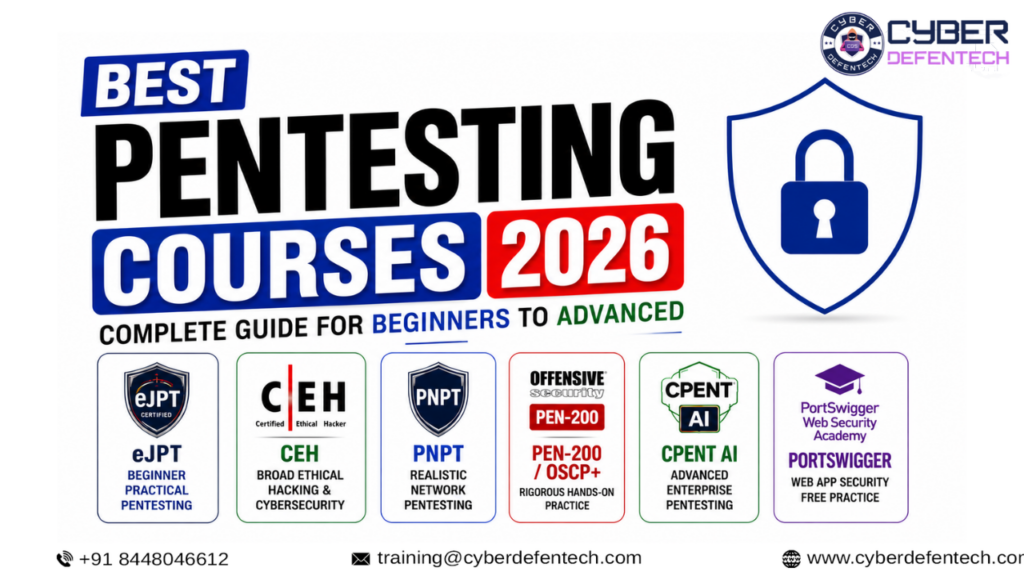
- eJPT: Entry-level practical penetration testing
- CEH: Broad ethical-hacking and cybersecurity knowledge
- PNPT: Realistic network penetration-testing methodology
- PEN-200 and OSCP+: Rigorous hands-on penetration testing
- CPENT: Advanced enterprise-level penetration testing
- PortSwigger Web Security Academy: Web application security practice
Beginners should select courses that start with networking, Linux, Windows and security fundamentals. Experienced professionals can consider advanced Pentesting Courses covering Active Directory, web applications, APIs, cloud platforms, privilege escalation and enterprise attack paths.
What Is Penetration Testing?
Penetration testing is an authorised security assessment that simulates realistic attack activity against an approved environment. Its purpose is to determine whether security controls can prevent, detect or limit a potential compromise.
NIST’s technical testing guidance explains that organisations should plan and conduct security assessments, analyse their findings and develop mitigation strategies. This means penetration testing is not limited to running tools or discovering vulnerabilities. It also includes planning, evidence collection, risk analysis and remediation.
A professional penetration-testing engagement normally includes:
- Defining the objective
- Confirming written authorisation
- Establishing the testing scope
- Identifying permitted techniques
- Conducting reconnaissance
- Discovering systems and services
- Assessing vulnerabilities
- Validating selected weaknesses
- Collecting evidence
- Reporting business impact
- Recommending remediation
- Retesting corrected findings
The objective is not to damage systems or gain unrestricted access. The goal is to help the organisation understand realistic risks and improve its defences.
Pentesting vs Ethical Hacking
Ethical hacking is a broad term describing authorised activities used to identify and understand security weaknesses. Penetration testing is a structured type of ethical-hacking engagement conducted against a defined scope and objective.
An ethical-hacking course may introduce many areas, including:
- Reconnaissance
- Network security
- Malware concepts
- Social engineering
- Wireless security
- Web applications
- Cloud security
- Cryptography
Professional Pentesting Courses generally go deeper into assessment methodology, vulnerability validation, attack paths, evidence collection, reporting and retesting.
Students interested in general cybersecurity exposure may begin with ethical hacking. Learners targeting dedicated penetration-testing roles should eventually complete deeper, lab-focused training.
Pentesting vs Vulnerability Assessment
Vulnerability assessment and penetration testing are related but different activities.
| Area | Vulnerability Assessment | Penetration Testing |
|---|---|---|
| Main purpose | Identify and prioritise weaknesses | Validate realistic attack paths |
| Approach | Broad scanning and review | Targeted manual and automated testing |
| Output | List of vulnerabilities | Evidence, impact and attack narrative |
| Frequency | Often conducted regularly | Conducted periodically or after major changes |
| Validation | May be limited | Important findings are manually validated |
| Reporting | Technical vulnerability report | Technical and executive-level report |
A vulnerability scanner may report a missing update or insecure configuration. A penetration tester determines whether that weakness can contribute to a meaningful compromise within the authorised scope.
The Best Pentesting Courses should teach learners how to use scanners responsibly, validate results and avoid treating every automated finding as confirmed evidence.
Why Pentesting Skills Matter in 2026
Organisations increasingly operate across cloud environments, software-as-a-service platforms, APIs, mobile devices and third-party integrations. Weak access permissions, exposed credentials or insecure configurations can create attack paths across several systems.
Penetration testing helps organisations:
- Evaluate their real security posture
- Validate whether controls operate effectively
- Identify weaknesses before malicious attackers exploit them
- Understand how multiple findings could be combined
- Prioritise remediation according to business impact
- Test detection and incident-response capabilities
- Improve network and application security
- Support assurance and compliance activities
CERT-In’s cybersecurity-audit framework includes vulnerability assessment and penetration-testing capabilities as part of its empanelment and practical-assessment process. Its security-audit guidance also highlights the importance of systematic assessments and reliable evidence.
Recent CERT-In guidance also discusses exposure created by AI-assisted vulnerability exploitation and recommends activities including cyber-resilience testing and adversarial simulations.
This makes practical testing, defensive validation and continuous skill development increasingly valuable for cybersecurity professionals.
How to Choose the Best Pentesting Courses
Before choosing from the available Best Pentesting Courses 2026, evaluate the programme using the following criteria.
1. Your Current Experience
Absolute beginners need foundational training before attempting advanced enterprise assessments.
A beginner-friendly programme should introduce:
- Computer fundamentals
- Networking
- Linux
- Windows
- Cybersecurity terminology
- Basic web technologies
- Command-line usage
- Vulnerability assessment
- Ethical and legal boundaries
Intermediate learners can move toward Active Directory, manual web testing, privilege escalation and complex lab networks.
2. Practical Lab Access
A course should provide individual or clearly supervised access to authorised environments.
Useful labs may include:
- Windows and Linux machines
- Networked virtual environments
- Intentionally vulnerable applications
- API-testing targets
- Active Directory domains
- Cloud-security simulations
- Reporting exercises
- Complete mock engagements
Watching a trainer perform demonstrations is not enough. Students should complete assignments independently.
3. Course Methodology
The Best Pentesting Courses should teach the complete engagement process rather than isolated tools.
Training should explain:
- How to scope an assessment
- How to select a testing methodology
- How to document evidence
- How to validate automated findings
- How to explain business risk
- How to prepare recommendations
- How to conduct retesting
4. Trainer Experience
Check whether the trainer has experience in authorised security testing, vulnerability assessments, report writing and client communication.
A trainer should be able to explain why a technique works, what risks it creates and how organisations can remediate the issue.
5. Professional Reporting
Penetration testers must communicate technical findings to clients, developers, administrators and senior management.
Students should practise preparing:
- Executive summaries
- Scope and methodology sections
- Technical findings
- Evidence screenshots
- Risk explanations
- Remediation recommendations
- Retesting results
6. Certification Alignment
A course may prepare learners for a specific certification or provide independent skill development.
Before paying, confirm:
- Certification provider
- Exam format
- Voucher inclusion
- Voucher validity
- Retake policy
- Renewal requirements
- Lab-access duration
- Additional costs
Best Pentesting Courses 2026: Detailed Comparison
1. eJPT — Best for Entry-Level Practical Learning
INE Security describes eJPT as a hands-on, entry-level red-team certification that simulates skills used during real-world engagements. Its scope includes assessment methodology and host, network and web application testing.
Suitable For
- Cybersecurity beginners
- IT-support professionals
- Networking students
- Learners completing their first practical certification
- Students moving from theory to lab-based assessments
Skills Learners Should Develop
- Basic information gathering
- Host discovery
- Network assessment
- Service enumeration
- Vulnerability analysis
- Introductory web application testing
- Basic exploitation methodology
- Evidence-based problem-solving
Advantages
eJPT is positioned as an entry-level practical certification rather than a purely theory-based examination. This can help beginners understand how assessment activities connect within a simulated engagement.
Limitations
It should not be treated as preparation for every advanced penetration-testing role. Learners may still need deeper training in Active Directory, advanced web testing, privilege escalation, reporting and enterprise environments.
Best for: Beginners seeking their first practical penetration-testing milestone.
2. CEH — Best for Broad Ethical-Hacking Knowledge
EC-Council’s current CEH programme is structured across 20 modules and includes hundreds of hands-on laboratory activities and attack techniques. Its framework combines learning, certification, mock engagements and ongoing challenges.
CEH covers a broad range of ethical-hacking and cybersecurity concepts rather than specialising only in professional penetration-testing engagements.
Suitable For
- Students exploring ethical hacking
- IT professionals moving into cybersecurity
- SOC analysts
- Network administrators
- Security analysts
- Professionals seeking broad coverage of attack methods
Major Learning Areas
- Reconnaissance
- Scanning and enumeration
- Vulnerability analysis
- System security
- Web applications
- Wireless security
- Cloud security
- Cryptography
- Malware and social-engineering concepts
Advantages
CEH provides a structured overview of multiple ethical-hacking areas. The current programme includes a knowledge examination, a separate practical assessment and simulated engagement activities.
Limitations
Learners targeting dedicated penetration-testing positions should add deeper manual testing, Active Directory, web-security, scripting and professional reporting practice.
Best for: Learners seeking broad ethical-hacking knowledge and a recognised certification pathway.
3. PNPT — Best for Realistic Network Pentesting Methodology
TCM Security describes the Practical Network Penetration Tester certification as a realistic penetration-testing exam experience. Its certification portfolio focuses on simulating complete professional engagements rather than isolated multiple-choice knowledge checks.
Suitable For
- Learners with basic networking and Linux knowledge
- Junior penetration testers
- Professionals interested in network testing
- Students who want realistic reporting practice
- Learners preparing for internal network assessments
Expected Learning Areas
- Open-source intelligence
- External reconnaissance
- Network discovery
- Active Directory fundamentals
- Internal network testing
- Privilege escalation
- Professional report writing
- Client-style communication
Advantages
PNPT is framed around a realistic engagement experience. This makes it relevant to learners who want to understand assessment methodology and professional deliverables.
Limitations
It may be challenging for learners without networking, Linux or cybersecurity foundations. Absolute beginners may benefit from introductory training before attempting it.
Best for: Learners wanting an engagement-focused network penetration-testing pathway.
4. PEN-200 and OSCP+ — Best for Rigorous Hands-On Practice
OffSec describes PEN-200 as a foundational, learn-by-doing penetration-testing course. It is designed to develop the mindset, technical skills and methodology required for professional penetration testing and supports preparation for the OSCP and OSCP+ certification pathway.
The OSCP+ examination validates practical skills including vulnerability identification, exploitation, privilege escalation and documentation in a hands-on environment.
Suitable For
- Learners with networking fundamentals
- Linux and Windows users
- Cybersecurity professionals
- Vulnerability analysts
- Junior penetration testers
- Candidates comfortable with independent troubleshooting
Important Learning Areas
- Information gathering
- Vulnerability analysis
- Network-service testing
- Windows and Linux exploitation concepts
- Privilege escalation
- Active Directory
- Pivoting
- Tunnelling
- Report writing
Advantages
PEN-200 emphasises independent problem-solving and hands-on practice. It is commonly considered by learners who want a technically demanding penetration-testing pathway.
Limitations
Although OffSec describes the course as foundational, it expects learners to have reasonable networking, Windows and Linux knowledge. Absolute beginners should develop those skills before enrolling.
Best for: Determined intermediate learners seeking a rigorous practical challenge.
5. CPENT — Best for Advanced Enterprise Pentesting
EC-Council’s CPENT programme is positioned as an advanced, multidisciplinary penetration-testing course. Its current programme includes practical enterprise-focused training and combines manual and automated testing approaches.
Suitable For
- Experienced ethical hackers
- Penetration testers
- Security consultants
- Red-team professionals
- Learners progressing beyond foundational certifications
Important Learning Areas
- Enterprise network testing
- Advanced Windows environments
- Active Directory
- Pivoting and segmented networks
- IoT security
- Operational-technology environments
- Binary-analysis concepts
- Scripting
- Professional reporting
The CPENT certification uses a remotely proctored, practical examination format designed to assess performance in a lab-based environment.
Advantages
CPENT covers a broad selection of advanced enterprise environments that may not be included in beginner Pentesting Courses.
Limitations
The programme is not an ideal starting point for learners who are still developing networking, operating-system and basic security skills.
Best for: Experienced professionals seeking multidisciplinary enterprise-level training.
6. PortSwigger Web Security Academy — Best Free Web Security Resource
PortSwigger’s Web Security Academy provides free learning materials, interactive vulnerability laboratories and tutorials covering modern web application security. The platform is continuously updated and includes learning paths for several vulnerability categories.
Suitable For
- Web application security beginners
- Developers
- Bug-bounty learners
- Application-security analysts
- Penetration testers improving manual web skills
Topics Covered
- SQL injection
- Cross-site scripting
- Authentication weaknesses
- Access-control vulnerabilities
- Server-side request forgery
- Request smuggling
- File-upload vulnerabilities
- Business-logic weaknesses
- API testing
- Client-side security
Advantages
The Web Security Academy offers realistic interactive labs and is available without a course fee. It is an excellent supplementary resource for learners enrolled in other Pentesting Courses.
Limitations
It focuses mainly on web security. Learners also need separate training for network infrastructure, Active Directory, cloud platforms and professional engagement management.
Best for: Free and specialised web application security practice.
Best Pentesting Courses Comparison Table
| Programme | Level | Main Focus | Ideal Learner |
|---|---|---|---|
| eJPT | Beginner | Foundational practical pentesting | First practical certification |
| CEH | Beginner to Intermediate | Broad ethical-hacking knowledge | Students and IT professionals |
| PNPT | Intermediate | Realistic network engagements | Junior network pentesters |
| PEN-200 / OSCP+ | Intermediate | Rigorous practical testing | Independent hands-on learners |
| CPENT | Advanced | Enterprise penetration testing | Experienced professionals |
| Web Security Academy | Beginner to Advanced | Web application security | Web testers and bug hunters |
The most suitable option depends on your existing skills and career objective. Learners should verify current syllabus, exam format and package details directly through each official provider before registration.
Skills Covered in Professional Pentesting Courses
The Best Pentesting Courses 2026 should provide more than tool demonstrations. They should develop technical judgement and a repeatable methodology.
Networking Fundamentals
Learners should understand:
- TCP and UDP
- IP addressing
- Subnetting
- DNS
- HTTP and HTTPS
- Routing
- Switching
- Firewalls
- VPNs
- Network segmentation
- Common ports and protocols
Without networking knowledge, scan results and attack paths become difficult to interpret.
Windows and Linux Administration
Pentesting professionals should understand:
- Users and groups
- Files and permissions
- Processes and services
- System logs
- Network configuration
- Software installation
- Security updates
- Command-line tools
- Basic troubleshooting
Reconnaissance and Attack-Surface Mapping
Training should explain how to identify relevant exposure using lawful and authorised techniques.
This may include:
- Domain information
- DNS records
- Public services
- Internet-facing applications
- Technology identification
- Subdomains
- Public metadata
- Third-party exposure
Scanning and Enumeration
Students should learn how to:
- Discover active hosts
- Identify ports
- Recognise services
- Validate versions
- Enumerate approved systems
- Interpret responses
- Reduce false positives
- Document results
Vulnerability Assessment
Learners should understand:
- Vulnerability-scanner configuration
- Risk ratings
- CVE references
- False positives
- Manual validation
- Credentialed scanning
- Remediation prioritisation
- Retesting
Automated results should be treated as starting points rather than complete evidence.
Web Application Security
OWASP’s Web Security Testing Guide provides a structured methodology covering information gathering, configuration, authentication, authorisation, session management, input validation, business logic, client-side testing and APIs.
Professional training should cover:
- Application mapping
- Authentication testing
- Authorisation testing
- Session security
- Input validation
- Injection vulnerabilities
- File-upload risks
- Business-logic testing
- Security misconfiguration
- API interaction
Active Directory Pentesting
Many enterprise environments use Active Directory for identity and access management.
Training may include:
- Domains and forests
- Users and groups
- Group Policy
- Service accounts
- Privileged access
- Trust relationships
- Authentication concepts
- Delegation
- Attack-path mapping
- Defensive hardening
Practice must take place in controlled laboratory domains.
Privilege Escalation
Privilege escalation involves evaluating whether a limited account can obtain additional permissions because of insecure configurations or access-control weaknesses.
Students should study:
- File and service permissions
- Weak scheduled tasks
- Exposed credentials
- Misconfigured roles
- Excessive privileges
- Unpatched systems
- Insecure applications
The defensive objective is to identify and correct privilege-management problems.
Pivoting and Segmented Networks
Advanced courses may teach how professional testers assess reachable systems through authorised intermediary hosts.
Learners should understand:
- Network routes
- Tunnelling concepts
- Segmentation
- Trust boundaries
- Access limitations
- Evidence handling
- Operational risks
Cloud Security Testing
Cloud-focused training should introduce:
- Identity and access roles
- Public storage
- Network controls
- Secrets and credentials
- Logging
- Security groups
- Serverless services
- Cloud APIs
- Shared responsibility
- Provider testing policies
Scripting and Automation
Advanced programming is not mandatory for beginners, but basic scripting can improve efficiency.
Useful languages include:
- Python
- Bash
- PowerShell
- JavaScript
- SQL
Learners should understand any script before running it and should never execute unverified code in client or business environments.
Professional Reporting
A professional penetration-test report should include:
- Executive summary
- Assessment objective
- Scope
- Methodology
- Limitations
- Risk-rating process
- Technical findings
- Evidence
- Business impact
- Remediation recommendations
- Retesting results
NIST’s testing guidance connects technical assessment with analysis and mitigation, reinforcing that a list of vulnerabilities alone is not a complete professional deliverable.
Best Pentesting Courses for Beginners
Beginners should avoid programmes that immediately begin with advanced exploitation commands.
A reliable beginner roadmap is:
Stage 1: Computer and Operating-System Fundamentals
Learn Windows, Linux, files, users, permissions, services and command-line basics.
Stage 2: Networking
Study IP addresses, DNS, TCP/IP, ports, routing, HTTP and firewalls.
Stage 3: Cybersecurity Fundamentals
Understand vulnerabilities, threats, risk, access control, encryption and incident response.
Stage 4: Introductory Practical Course
Consider beginner Pentesting Courses such as eJPT preparation or a structured ethical-hacking foundation.
Stage 5: Portfolio Projects
Complete authorised projects such as:
- Network-mapping report
- Vulnerability-assessment report
- Intentionally vulnerable web application review
- Linux hardening checklist
- Basic executive summary
Stage 6: Intermediate Certification
After developing practical confidence, consider PNPT, PEN-200 or another role-aligned programme.
Advanced Pentesting Courses for Professionals
Experienced professionals should choose specialisations based on their current role.
Infrastructure Pentesting
Focus on:
- Enterprise networks
- Windows and Linux
- Active Directory
- Privilege escalation
- Segmented environments
- Pivoting
Web and API Pentesting
Focus on:
- Authentication
- Access control
- Sessions
- Business logic
- APIs
- Manual validation
- Secure-development recommendations
Cloud Pentesting
Focus on:
- Cloud identity
- Public exposure
- Misconfigurations
- Secrets
- Logging
- Container and serverless concepts
Red-Team Training
Focus on:
- Adversary simulation
- Operational planning
- Attack-path development
- Detection evaluation
- Client communication
- Reporting
Advanced programmes should still emphasise authorisation, scope and risk management.
Six-Month Pentesting Learning Roadmap
Month 1: Networking and Linux
Learn common protocols, IP addressing, ports, Linux administration and command-line tools.
Month 2: Windows and Security Fundamentals
Study Windows services, users, permissions, logging, authentication and basic cybersecurity.
Month 3: Scanning and Vulnerability Assessment
Practise host discovery, service enumeration, vulnerability analysis and report writing in an authorised lab.
Month 4: Web Application and API Security
Follow OWASP-aligned learning and complete intentionally vulnerable application labs.
Month 5: Active Directory
Build or use a legal training domain and study users, groups, privileges, policies and attack-path concepts.
Month 6: Mock Penetration Test
Complete one assessment covering:
- Scope
- Methodology
- Reconnaissance
- Testing
- Evidence
- Findings
- Remediation
- Executive reporting
Pentesting Courses in India
Indian learners can access online, classroom and hybrid Pentesting Courses offered by certification providers, colleges and independent cybersecurity institutes.
Before joining a programme, verify:
- Whether the institute is an authorised partner
- Exact certification included
- Trainer’s professional experience
- Lab-access duration
- Exam-voucher conditions
- Practical assignments
- Report-writing coverage
- Internship terms
- Placement-support terms
- Total course fee
- Refund policy
Students should avoid choosing solely on the basis of advertisements claiming guaranteed jobs or fixed salaries.
The Indian cybersecurity-audit ecosystem includes CERT-In’s formal framework for empanelled security-auditing organisations and practical VA/PT assessments, demonstrating the importance of professional methodology and validated skills.
Best Pentesting Courses in Delhi NCR
Learners searching for the Best Pentesting Courses in Delhi NCR can compare options in Delhi, Noida, Gurugram, Ghaziabad and Faridabad.
A professional Delhi NCR programme should ideally provide:
- Networking and Linux foundations
- Individual lab access
- Network penetration testing
- Web application security
- API testing
- Active Directory labs
- Cloud-security fundamentals
- Professional reporting
- Portfolio projects
- Interview preparation
Cyber Defentech provides cybersecurity learning options from Rohini, Delhi. Students should request current written information about the trainer, course syllabus, practical laboratories, certification package, fees and placement-support conditions before enrolment.
Location: D-12/77, 2nd Floor, Sector 8, Near Rohini East Metro Station Gate No. 2, Rohini, Delhi – 110085
📞 Call/WhatsApp: +91 8448046612
Career Opportunities After Pentesting Courses
Completing practical Pentesting Courses may support career paths such as:
- Vulnerability Assessment Analyst
- Junior Penetration Tester
- Network Penetration Tester
- Web Application Security Analyst
- API Security Tester
- Cybersecurity Consultant
- Red-Team Associate
- Application Security Analyst
- Cloud Security Analyst
- VAPT Consultant
- Security Researcher
Course completion or certification alone does not guarantee employment. Employers may also assess:
- Technical foundations
- Lab experience
- Original projects
- Report writing
- Communication
- Problem-solving
- Professional experience
- Ethical judgement
Portfolio Projects for Pentesting Learners
1. Home Cybersecurity Lab
Create an isolated environment using authorised Windows, Linux and intentionally vulnerable machines.
Document:
- Network architecture
- System purpose
- Security controls
- Lab scope
- Safety measures
2. Vulnerability Assessment Report
Assess an intentionally vulnerable target and prepare:
- Asset details
- Findings
- Risk ratings
- Evidence
- Remediation
- Retesting plan
3. Web Application Assessment
Use a legal training application and follow an OWASP-aligned methodology.
4. Active Directory Review
Document users, groups, privileges and risky configurations in a controlled training domain.
5. Executive Security Report
Convert technical findings into a short report that senior management can understand.
Every project should clearly mention that it was completed in an authorised lab or intentionally vulnerable environment.
Ethical and Legal Responsibilities
Penetration testing must only be performed against systems the tester owns or has explicit permission to assess.
Professional learners should:
- Obtain written authorisation
- Follow the agreed scope
- Respect excluded systems
- Protect sensitive data
- Avoid unnecessary disruption
- Follow cloud-provider policies
- Store evidence securely
- Report vulnerabilities responsibly
- Remove temporary test artefacts
- Stop when authorised limits are reached
Unauthorised scanning or testing may violate laws, contracts and organisational policies. Completing one of the Best Pentesting Courses does not give a learner permission to test public websites or external networks.
Common Mistakes Learners Should Avoid
Learning Tools Without Fundamentals
Tools change frequently. Networking, operating systems, methodology and critical thinking remain essential.
Collecting Certifications Without Practice
Certifications can structure learning, but practical ability requires repeated labs, troubleshooting and original projects.
Ignoring Report Writing
Discovering a weakness has limited value when the tester cannot explain its impact or remediation.
Using Unauthorised Exam Dumps
Exam dumps can violate certification policies and do not develop professional competence.
Practising on Public Systems
Use only personal labs, authorised cyber ranges and recognised bug-bounty programmes within their stated scope.
Choosing Only by Price
A low-cost course without labs, qualified trainers or support may not provide meaningful skill development.
Frequently Asked Questions
What are the Best Pentesting Courses 2026?
The Best Pentesting Courses 2026 include practical options such as eJPT for beginners, PNPT for realistic network assessments, PEN-200 for rigorous hands-on practice and CPENT for advanced enterprise environments. CEH provides broad ethical-hacking knowledge, while PortSwigger Web Security Academy supports web-security learning.
Which pentesting course is best for beginners?
Beginners should choose a course that starts with networking, Windows, Linux and cybersecurity fundamentals. eJPT or a structured beginner ethical-hacking programme can provide an accessible starting point.
Which pentesting course is best for experienced professionals?
Experienced professionals can consider PEN-200, PNPT or CPENT depending on whether they want infrastructure, enterprise, Active Directory or red-team skills.
Is CEH a penetration-testing course?
CEH covers broad ethical-hacking concepts and practical labs. It can provide a useful foundation, but dedicated penetration-testing roles may require deeper manual assessment, Active Directory and report-writing skills.
Is OSCP suitable for beginners?
PEN-200 is described as foundational, but it expects reasonable networking, Linux and Windows knowledge. Absolute beginners should develop these skills first.
Is coding required for pentesting?
Advanced coding is not mandatory for beginners. Basic Python, Bash and PowerShell can help with automation, tool understanding and data analysis.
Is Kali Linux enough to become a penetration tester?
No. Kali Linux provides security tools, but professional pentesting also requires networking, operating systems, methodology, manual validation, ethics and report writing.
Are online pentesting courses effective?
Online courses can be effective when they include individual labs, trainer support, practical assignments, recordings and complete assessment projects.
Can Commerce and Arts students learn pentesting?
Yes. Students from any stream can begin after developing computer, networking, Linux, Windows and cybersecurity fundamentals.
How long does it take to learn penetration testing?
The timeline depends on previous knowledge and consistency. Beginners may require several months to build fundamentals before becoming ready for intermediate practical assessments.
Do Pentesting Courses guarantee a job?
No. Career outcomes depend on skills, projects, experience, communication and employer requirements.
Can I practise pentesting on public websites?
No. Testing should only be performed in authorised environments or recognised bug-bounty programmes within the published scope.
Final Thoughts
The Best Pentesting Courses 2026 are not necessarily the courses with the longest tool lists or strongest advertising claims. The right programme should match the learner’s current skills, preferred specialisation and long-term career goals.
Beginners should prioritise networking, Linux, Windows and cybersecurity fundamentals. Intermediate professionals should develop practical assessment, Active Directory, web application and report-writing skills. Advanced learners can explore enterprise networks, cloud security, pivoting and red-team operations.
When comparing the Best Pentesting Courses, look for:
- Authorised practical laboratories
- Structured methodology
- Manual vulnerability validation
- Realistic projects
- Professional reporting
- Remediation guidance
- Experienced trainers
- Transparent certification details
The most valuable outcome of professional Pentesting Courses is not only a certificate. It is the ability to assess systems responsibly, identify meaningful risk, explain technical findings and help organisations improve their security.
About This Guide
This article has been prepared to help students and cybersecurity professionals evaluate the Best Pentesting Courses 2026, certification pathways, practical laboratories and career opportunities.
Written by: Cyber Defentech Editorial Team
Reviewed by: Cybersecurity and VAPT Training Team
Last Updated: August 2026
Editorial Disclaimer
Course curricula, examination formats, eligibility requirements, lab packages, voucher conditions and fees can change. Readers should verify current information directly through official certification providers before enrolling.
Training and certification do not guarantee employment, promotion or salary growth.
