
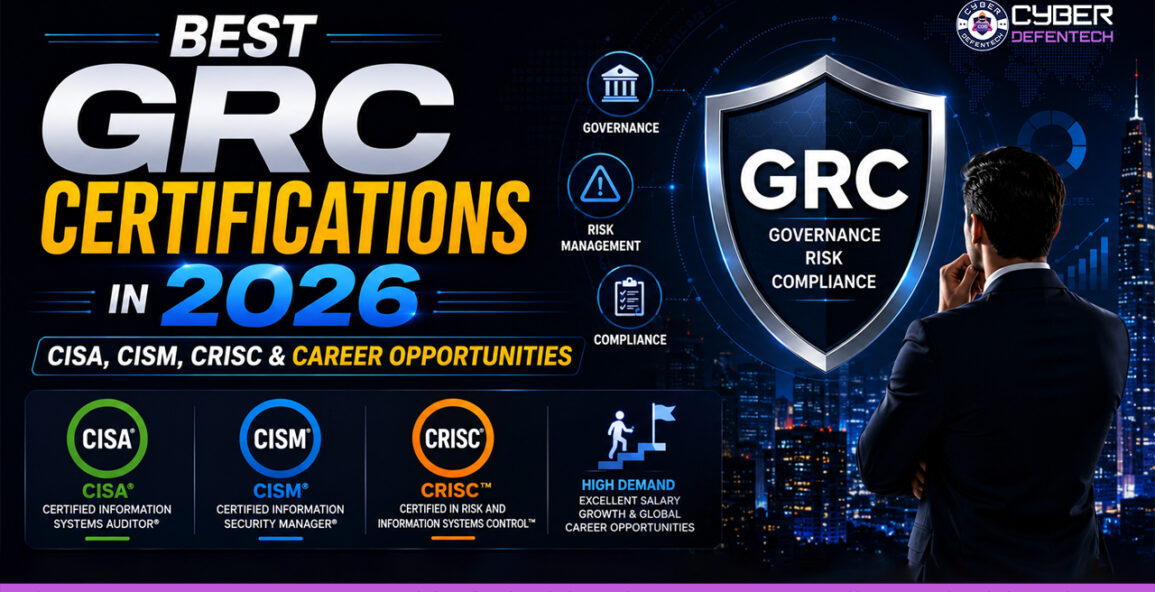
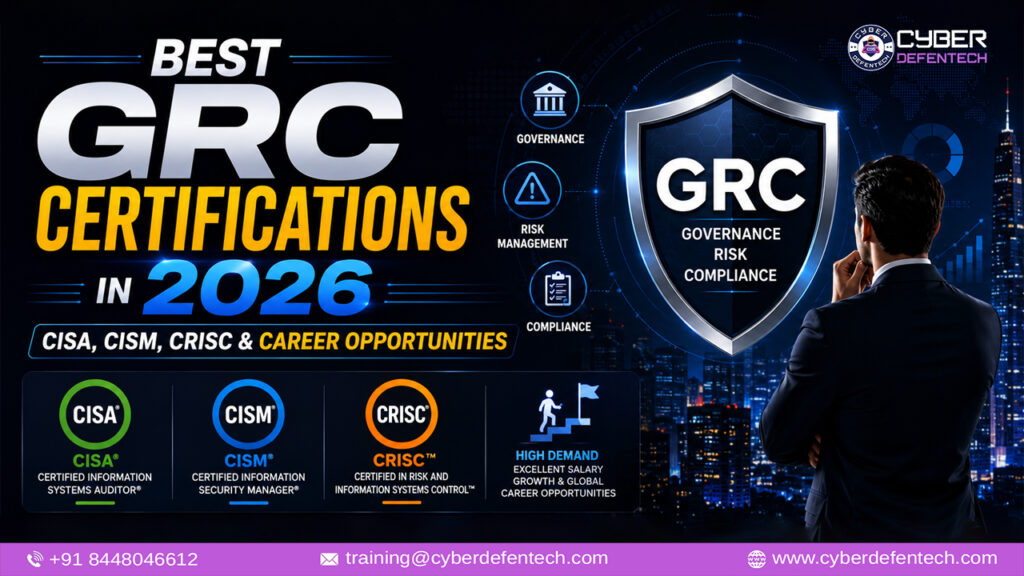
Best GRC Certifications in 2026: CISA, CISM, CRISC & Career Opportunities
Introduction
In 2026, GRC certifications have become the fastest way for IT professionals to move into audit, risk and compliance leadership Ten years ago, a typical IT audit meant checking server logs, reviewing access lists and preparing a long report for the audit committee. In 2026, that picture has changed completely. Regulators are stricter, data protection laws are expanding, cyber incidents make headlines every week, and boards now ask a direct question: “Are we managing technology risk properly?”
This is why Governance, Risk and Compliance (GRC) has become one of the most in-demand domains in cybersecurity and IT assurance. Companies no longer want only technical experts. They want professionals who can connect security controls with business risk, regulatory requirements and strategic decisions.
If you are an IT auditor or a working professional planning your next career move, the right GRC certifications can be the biggest accelerator. They validate your knowledge, build credibility with employers and open doors to senior roles in audit, risk, compliance and security leadership.
In this guide, we break down the most valuable GRC certifications for 2026: CISA, CISM, CRISC and ISO 27001. We explain who each one suits, what skills it builds, how to choose between them and what career paths follow. We also show how structured training, such as the programs offered by CyberDefenTech, can help you prepare with confidence.
What Is GRC and Why Does It Matter in 2026?
GRC stands for Governance, Risk and Compliance. It is a structured approach that helps organizations align IT and security with business goals while managing risk and meeting legal and regulatory obligations.
- Governance defines who makes decisions, who is accountable and how policies are set and enforced.
- Risk Management identifies, assesses and treats threats that could affect business objectives.
- Compliance ensures the organization follows laws, regulations, contractual obligations and standards such as ISO 27001.
Several trends are pushing GRC to the front of the hiring agenda in 2026:
- Growing regulation. Data protection laws, financial sector rules and sector-specific cyber requirements keep increasing, and organizations need people who can interpret and implement them.
- Third-party and supply chain risk. Vendors and cloud providers now hold critical business data, so vendor risk assessment has become a core skill.
- AI and emerging technology risk. Organizations are adopting AI tools quickly and need governance frameworks for responsible, secure use.
- Board-level accountability. Cyber risk is now a business risk, and leadership wants clear reporting from people who understand both technology and governance.
- Audit complexity. Cloud, hybrid work and automation have made IT environments harder to assess, which raises the value of skilled auditors.
Because of these shifts, certified GRC professionals are among the most sought-after in the market, and certifications are often the quickest way to prove you belong in that group.
Why GRC Certifications Matter for IT Auditors and Working Professionals
You may already have years of experience. So why add a certification?
- Industry recognition: Certifications from respected bodies like ISACA and ISO-aligned training providers are understood worldwide.
- Career mobility: Many job descriptions list CISA, CISM or CRISC as a requirement or a strong preference.
- Structured knowledge: Real-world experience can leave gaps, and certification syllabi fill them with frameworks and best practices.
- Higher earning potential: Certified professionals generally have stronger negotiating power, especially for senior and consulting roles.
- Credibility with clients and auditors: For consulting and advisory work, a recognized credential builds trust quickly.
- Global opportunities: These certifications are accepted across countries, which helps if you plan to work abroad or with international clients.
The Best GRC Certifications in 2026
1. CISA – Certified Information Systems Auditor
Offered by: ISACA Best for: IT auditors, internal auditors, compliance analysts, IS/IT assurance professionals
CISA is often called the gold standard for IT audit. If your work involves evaluating controls, testing systems or reporting to audit committees, this certification is a natural fit.
What it covers: The exam is built around five domains: auditing information systems, governance and management of IT, information systems acquisition, development and implementation, information systems operations and business resilience, and protection of information assets.
Key skills you build:
- Planning and executing IT audits
- Evaluating IT governance and control frameworks
- Assessing business continuity and disaster recovery
- Reporting audit findings clearly to management
- Understanding risk-based audit approaches
Experience requirement: ISACA typically requires around five years of relevant work experience in information systems audit, control, assurance or security, with some substitutions and waivers available. Always verify the latest rules on the official ISACA website.
Career paths: IT Auditor, Senior IT Auditor, Information Systems Auditor, Audit Manager, Internal Audit Lead, Compliance Manager.
Why it matters in 2026: As organizations adopt cloud, automation and AI, the demand for auditors who can assess these environments keeps growing. CISA proves you can do that with structure and rigor.
2. CISM – Certified Information Security Manager
Offered by: ISACA Best for: Security managers, aspiring CISOs, risk and compliance leads, IT managers
If CISA is about evaluating controls, CISM is about managing and leading an information security program. It has a management and strategy focus rather than a purely technical one.
What it covers: The exam spans four domains: information security governance, information risk management, information security program development and management, and incident management.
Key skills you build:
- Aligning security strategy with business objectives
- Building and running an enterprise security program
- Managing risk appetite and risk treatment
- Leading incident response and recovery
- Communicating with senior leadership and the board
Experience requirement: CISM generally expects around five years of information security management experience, with certain waivers. Check ISACA for current details.
Career paths: Information Security Manager, Security Program Manager, Head of Information Security, Deputy CISO, CISO, GRC Manager.
Why it matters in 2026: Organizations need leaders who can translate technical risk into business language. CISM positions you for exactly that move from practitioner to decision-maker.
3. CRISC – Certified in Risk and Information Systems Control
Offered by: ISACA Best for: Risk analysts, risk managers, control owners, compliance professionals, IT auditors moving toward risk
CRISC is the most risk-focused credential of the three. It is designed for professionals who identify and manage IT and enterprise risk and implement the controls that mitigate it.
What it covers: CRISC is organized into four domains: governance, IT risk assessment, risk response and reporting, and information technology and security.
Key skills you build:
- Identifying and assessing IT risk scenarios
- Designing and monitoring risk responses and controls
- Maintaining risk registers and reporting metrics
- Linking IT risk to enterprise risk management
- Supporting risk-based decision making
Experience requirement: CRISC usually requires about three years of experience in at least two of the exam domains. Confirm current requirements on ISACA’s site.
Career paths: IT Risk Analyst, Risk Manager, Enterprise Risk Consultant, Control Assurance Lead, Head of Risk and Compliance.
Why it matters in 2026: With third-party, cloud and AI-related risks rising, risk specialists are in high demand. CRISC is one of the few certifications that focuses specifically on this skill set.
4. ISO 27001 – Lead Implementer and Lead Auditor
Offered by: Accredited training and certification bodies Best for: Compliance professionals, consultants, internal auditors, security officers, ISMS managers
ISO/IEC 27001 is the international standard for an Information Security Management System (ISMS). Many organizations pursue ISO 27001 certification to win client trust, meet contractual needs and demonstrate security maturity.
There are two main professional tracks:
- ISO 27001 Lead Implementer: For professionals who design, build and maintain an ISMS.
- ISO 27001 Lead Auditor: For professionals who plan and conduct audits against the standard, either internally or as third-party auditors.
Key skills you build:
- Understanding the ISO 27001 clauses and Annex A controls
- Performing gap analysis and risk assessment
- Preparing for and supporting certification audits
- Writing policies, procedures and the Statement of Applicability
- Auditing an ISMS and reporting nonconformities
Career paths: ISMS Manager, Information Security Compliance Officer, ISO 27001 Consultant, Lead Auditor, Third-Party Auditor.
Why it matters in 2026: Since the transition to the 2022 version of the standard, organizations expect their teams to be aligned with the updated controls. Professionals who can implement and audit against it are in steady demand, especially in IT services, SaaS, finance and outsourcing.
CISA vs CISM vs CRISC vs ISO 27001: Quick Comparison
| Certification | Primary Focus | Ideal Role | Level |
|---|---|---|---|
| CISA | Audit, control and assurance | IT Auditor | Intermediate to advanced |
| CISM | Security management and strategy | Security Manager / CISO track | Advanced |
| CRISC | IT risk and control | Risk Analyst / Manager | Intermediate to advanced |
| ISO 27001 LI/LA | ISMS implementation and auditing | Compliance / ISMS professional | Beginner to advanced |
A simple way to remember it:
- Want to audit? Choose CISA.
- Want to lead and manage security? Choose CISM.
- Want to specialize in risk? Choose CRISC.
- Want to implement or audit a standard? Choose ISO 27001.
How to Choose the Right GRC Certification for You
Instead of asking “Which certification is best?”, ask “Which one fits my next career step?” Use these questions:
1. What is my current role? An internal or IT auditor will usually start with CISA. A security analyst moving into management leans toward CISM. A risk or control specialist should look at CRISC.
2. Where do I want to be in five years? If the goal is CISO or a head-of-security position, CISM is highly relevant. If you want to be a chief audit executive or senior assurance leader, CISA is a strong base. If you see yourself as a head of risk, CRISC will help.
3. How much experience do I have? CISA, CISM and CRISC have experience requirements for full certification, though you can often pass the exam first and complete the experience afterward. ISO 27001 courses are more accessible if you are earlier in your career.
4. What does my employer or target market need? Check job postings in your target industry. Banks and consulting firms often lean toward CISA and CRISC, while SaaS and IT service companies frequently value ISO 27001 experience.
5. Can I combine certifications? Absolutely. Many senior professionals hold two or three credentials. A common and powerful pairing is CISA + CRISC for audit and risk, or CISM + ISO 27001 for security leadership and compliance.
Career Opportunities After GRC Certifications
Certified GRC professionals work across almost every industry. Here are the main career directions:
IT Audit and Assurance Roles include IT Auditor, Senior IT Auditor, Internal Audit Manager and Technology Risk Auditor. These are common in banks, insurance firms, Big Four consulting and large enterprises.
Risk Management Roles include IT Risk Analyst, Operational Risk Manager, Third-Party Risk Manager and Enterprise Risk Consultant. Risk teams are expanding as vendor and cloud dependence grows.
Compliance and Governance Roles include Compliance Officer, Information Security Compliance Manager, Data Privacy and Governance Lead, and Policy and Controls Manager.
Security Leadership Roles include Security Manager, Head of GRC, Deputy CISO and CISO. These positions combine technical understanding with business leadership.
Consulting and Advisory Many experienced professionals move into consulting, helping organizations prepare for ISO 27001 certification, regulatory audits and risk assessments. This path often offers flexibility and strong earning potential.
Industries hiring GRC talent in 2026: banking and financial services, fintech, healthcare, IT services and SaaS, telecom, e-commerce, manufacturing, government and consulting.
Salaries vary widely by country, city, industry and experience, so rely on current job portals and salary surveys instead of fixed numbers. As a general pattern, professionals holding recognized certifications along with relevant experience tend to qualify for more senior and better-paid roles than those without them.
Skills That Make You Stand Out Beyond Certification
A certificate opens the door, but these skills help you grow once inside:
- Business communication: Explaining risk in plain language to non-technical leaders.
- Framework knowledge: Familiarity with COBIT, NIST, ISO standards and relevant local regulations.
- Cloud and AI awareness: Understanding how controls change in cloud and AI-driven environments.
- Data analytics: Using data to test controls and spot anomalies efficiently.
- Report writing: Producing clear, actionable audit and risk reports.
- Continuous learning: Keeping up with regulations, threats and technology changes.
A Practical Roadmap for Working Professionals
Here is a simple plan for those balancing a job with study:
Step 1: Assess your goal and experience. Decide whether you are heading toward audit, risk, management or compliance.
Step 2: Pick one primary certification. Do not attempt everything at once. Choose the one that best matches your next role.
Step 3: Build a study schedule. Many working professionals plan roughly two to four months of consistent preparation, depending on background. Set weekly goals and protect your study time.
Step 4: Use structured training and practice questions. Instructor-led or guided programs, such as those from CyberDefenTech, help you cover the whole syllabus, understand the exam style and avoid common mistakes. Practice questions are essential because these exams test judgment and scenario thinking, not memorization.
Step 5: Take the exam and apply for certification. Complete the experience and ethics requirements and maintain your credential through continuing professional education.
Step 6: Add a complementary certification. Once your first credential is secure, consider a second one that broadens your profile, for example adding ISO 27001 Lead Auditor after CISA.
How CyberDefenTech Can Support Your GRC Journey
Preparing for a professional certification while managing a full-time job is challenging. This is where the right learning partner makes a real difference.
CyberDefenTech focuses on practical, career-oriented cybersecurity and GRC training. For professionals preparing for CISA, CISM, CRISC and ISO 27001, a structured program can help you:
- Understand each exam domain with clear, real-world examples
- Practice scenario-based questions in the style of the actual exams
- Learn how concepts apply to audits, risk assessments and compliance projects
- Stay focused with a defined study plan instead of scattered self-study
- Connect certification knowledge to real job responsibilities
Whether you are an IT auditor aiming to formalize your expertise or a professional transitioning into GRC, guided training from CyberDefenTech can shorten your preparation time and strengthen your confidence on exam day.
Common Mistakes to Avoid
- Studying without a plan. Random reading wastes time. Follow the official domain structure.
- Memorizing instead of understanding. These exams reward the ability to choose the best answer in a scenario.
- Ignoring the experience requirement. Plan early so your documentation is ready when you pass.
- Choosing a certification only for popularity. Pick the one that matches your goal, not just the trending one.
- Stopping after certification. Keep building skills and renewing your credential through continuing education.
Frequently Asked Questions (FAQs)
Q1. Which is the best GRC certification in 2026? There is no single best option. CISA is ideal for auditors, CISM for security managers, CRISC for risk specialists and ISO 27001 for compliance and ISMS professionals. The best choice depends on your role and goals.
Q2. Which certification should an IT auditor choose first? Most IT auditors begin with CISA because it directly aligns with audit work. CRISC or ISO 27001 Lead Auditor can follow later.
Q3. Can I take the exam before completing the required experience? Generally, ISACA allows candidates to pass the exam first and apply for certification after meeting the experience requirement within a defined period. Please verify the current policy on ISACA’s website.
Q4. Is CISM better than CISA? Neither is better overall. CISA focuses on auditing and assurance, while CISM focuses on security management and strategy. They serve different career paths.
Q5. Are GRC certifications worth it for non-technical professionals? Yes. GRC roles value governance, risk and compliance knowledge as much as technical depth, so professionals from audit, finance, legal and operations backgrounds can succeed.
Q6. How long does it take to prepare? It varies with your background and study time, but many working professionals prepare in a few months with consistent effort and structured guidance.
Q7. Do I need to renew these certifications? Yes. ISACA certifications require continuing professional education and annual maintenance fees, and ISO-related credentials may have their own maintenance rules.
Conclusion
The demand for GRC expertise will keep growing through 2026 and beyond. As regulation tightens, technology risk increases and boards demand clearer assurance, organizations will rely on professionals who can govern, assess and manage risk effectively.
CISA builds your foundation in IT audit, CISM prepares you to lead security programs, CRISC sharpens your risk expertise, and ISO 27001 gives you hands-on capability in implementing and auditing an ISMS. Each one is valuable, and together they form a powerful career toolkit.
The key is to start with a clear goal, choose the certification that fits it and prepare with the right guidance. With a structured learning partner like CyberDefenTech, you can turn your ambition into a recognized credential and your credential into a stronger career.
If you are an IT auditor or working professional ready to move ahead, now is the right time to begin your GRC certification journey. Start your journey with the right GRC certifications and build a future-proof career.
📞 Call/WhatsApp: +91 8448046612
