
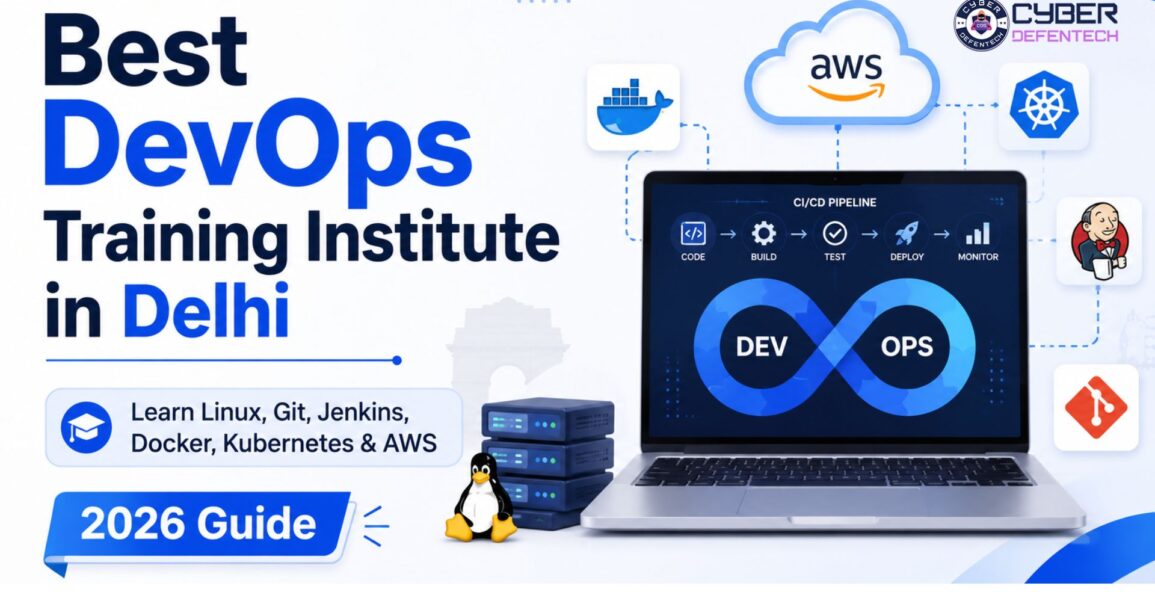
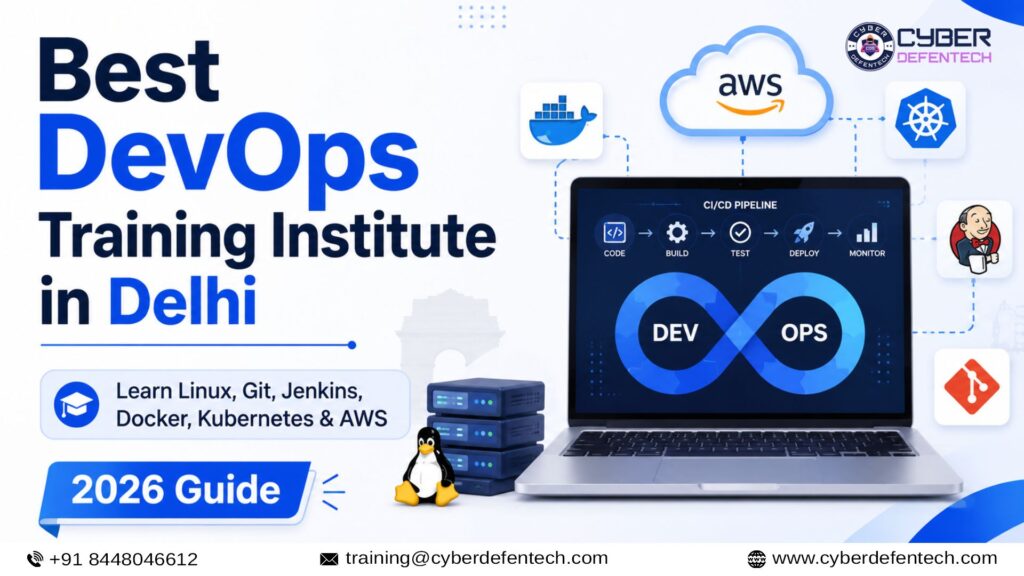
Best DevOps Training Institute in Delhi
Choosing the Best DevOps Training Institute in Delhi can be an important step for students, fresh graduates, software professionals, system administrators and cloud learners who want to build a practical career in modern IT operations.
Businesses today need faster software delivery, reliable infrastructure, improved collaboration, automated testing, secure deployments and continuous monitoring. DevOps brings these requirements together by connecting software development, IT operations, quality assurance, cloud infrastructure, automation and security teams.
A well-structured DevOps course in Delhi should not be limited to theory or basic tool demonstrations. It should teach learners how software moves from planning and coding to testing, deployment, monitoring, troubleshooting and continuous improvement.
Students should receive practical exposure to Linux, Git, GitHub, Jenkins, Docker, Kubernetes, Ansible, Terraform, AWS, monitoring platforms, scripting, CI/CD pipelines and DevSecOps practices.
This practical approach is important because employers usually evaluate what a candidate can build, automate, deploy, monitor and troubleshoot—not only which certificates they have collected.
Cyber Defentech offers career-oriented learning for candidates searching for DevOps training in Delhi with guided exercises, practical labs, project-based learning and a clear roadmap.
The learning approach is designed to help beginners understand the fundamentals while allowing working professionals to strengthen their automation, cloud, deployment and operational skills.
This guide explains DevOps, the course syllabus, tools, practical projects, career opportunities, certifications, learning modes, prerequisites and the factors you should evaluate before selecting a DevOps training institute in Delhi.
What Is DevOps?
DevOps is a combination of culture, processes, practices and tools that helps development and operations teams work together to deliver applications and services faster and more reliably.
DevOps is not a single software product, programming language or job role. It is an operating approach that encourages:
- Collaboration
- Automation
- Continuous feedback
- Shared responsibility
- Faster delivery
- Consistent environments
- Continuous improvement
- Reliable operations
Traditional software teams often worked in separate departments. Developers wrote the code, testing teams checked it and operations teams deployed and maintained it.
This separation could create delays, communication gaps, inconsistent environments, manual errors and disagreements between teams.
DevOps helps reduce these barriers by improving collaboration and automating repetitive parts of the software delivery lifecycle.
A professional DevOps certification training program should help students understand people, processes and technology together. Learners need technical knowledge, but they also need to understand release planning, change management, feedback loops, documentation, reliability, incident response and secure collaboration.
AWS defines DevOps as a combination of cultural philosophies, practices and tools that allows organisations to deliver applications and services at greater speed. Microsoft describes DevOps as the connection of people, processes and technology across application planning, development, delivery and operations.
Why DevOps Skills Matter in 2026
Modern organisations release applications frequently, use cloud infrastructure, depend on APIs, manage distributed systems and serve users across multiple locations.
Manual deployment processes are difficult to scale in these environments. Companies need professionals who can automate:
- Application builds
- Software testing
- Infrastructure provisioning
- Server configuration
- Application deployments
- Monitoring
- Security checks
- Recovery processes
A strong DevOps course in Delhi teaches students to understand the complete delivery pipeline rather than concentrating on one isolated tool.
For example:
- Git manages source-code versions.
- Jenkins automates build and deployment stages.
- Docker packages applications into containers.
- Kubernetes manages containerised workloads.
- Terraform provisions infrastructure.
- Ansible manages server configurations.
- Prometheus collects monitoring data.
- Grafana displays metrics through dashboards.
- AWS provides cloud infrastructure and managed services.
DevOps also supports faster feedback. When code is committed, an automated pipeline can build the application, run tests, create an image, deploy it to a testing environment and notify the responsible team.
Monitoring tools can then identify failures, performance problems, availability issues or unusual behaviour. This automation reduces repetitive work and makes delivery processes more consistent.
Candidates searching for the Best DevOps Training Institute in Delhi should therefore look for a program that teaches complete workflow integration.
Knowing individual commands is useful, but understanding how Git, Jenkins, Docker, Kubernetes, cloud, infrastructure as code, monitoring and security work together is more valuable.
Why Choose a Professional DevOps Course?
Free videos, blogs and documentation can be useful for learning individual concepts. However, beginners often struggle to decide:
- What to learn first
- How deeply to study each tool
- Which projects to build
- How different tools connect
- How to troubleshoot errors
- How to prepare for interviews
A student might understand basic Docker commands but not know how to connect Docker with Jenkins. Another learner might understand Kubernetes Pods but may not know how to troubleshoot a failed deployment.
A structured DevOps training in Delhi program provides sequence, mentoring, practical assignments, project guidance and regular feedback.
Students receive a roadmap instead of switching randomly between unrelated tools. They can ask questions, correct mistakes and practise technical explanations.
The Best DevOps Training Institute in Delhi should provide a progressive learning path:
- Operating-system fundamentals
- Networking fundamentals
- Version control with Git and GitHub
- Scripting and automation
- Build and package management
- Continuous integration and delivery
- Docker containerisation
- Kubernetes orchestration
- Configuration management with Ansible
- Infrastructure as code with Terraform
- Cloud deployment
- Monitoring and troubleshooting
- DevSecOps
- Live projects
- Interview preparation
This sequence allows learners to understand why a tool is required before learning its commands and configuration.
Why Choose Cyber Defentech for DevOps Training?
Cyber Defentech focuses on practical, career-oriented technology learning.
Its broader training experience in cybersecurity, networking, Linux, cloud computing, security operations and professional certification preparation provides a strong foundation for DevOps and DevSecOps education.
Students considering a DevOps training institute in Delhi generally need more than recorded lectures. They need:
- Guided practical sessions
- Mentor support
- Realistic exercises
- Lab practice
- Troubleshooting experience
- Projects
- Career guidance
The learning approach at Cyber Defentech is designed around practical explanations, live demonstrations, assignments, lab activities, projects and interview preparation.
Important training benefits include:
- Beginner-friendly explanations
- Practical Linux and networking exercises
- Git and GitHub projects
- CI/CD pipeline development
- Docker and Kubernetes labs
- Cloud and automation exposure
- Online and offline learning options
- Guided projects
- Resume support
- Mock interview preparation
- DevSecOps awareness
- Career-oriented learning
For candidates looking for DevOps classes in Delhi, the objective should be to move from learning individual commands to building a complete software delivery workflow.
A learner should eventually be able to take an application, place it in version control, automate its build, package it into a container, deploy it, monitor its performance and secure the complete process.
DevOps Course Overview
A complete DevOps course in Delhi should cover the software delivery lifecycle from source code to production operations.
The course should begin with fundamental concepts and gradually progress towards advanced automation, orchestration, monitoring and security.
The learning path should include:
- DevOps culture and lifecycle
- Linux administration
- Networking
- Git and GitHub
- Bash or Python scripting
- Build tools
- Jenkins
- CI/CD pipelines
- Docker
- Kubernetes
- Ansible
- Terraform
- AWS Cloud
- Monitoring and logging
- DevSecOps
- Live projects
- Interview preparation
The exact duration may vary depending on the number of classes, learner experience, project depth and practical lab hours.
Students should compare the actual curriculum and training methodology instead of choosing a course only because it promises completion in a short period.
Complete DevOps Course Syllabus
Module 1: Introduction to DevOps
The first module of DevOps certification training introduces software development, testing, deployment, operations and maintenance.
Students learn why traditional teams experience delays and how collaboration and automation can improve software delivery.
Important topics include:
- Software Development Lifecycle
- Agile methodology
- DevOps culture
- Development and operations responsibilities
- Continuous integration
- Continuous delivery
- Continuous deployment
- Infrastructure automation
- Monitoring and feedback
- Shared ownership
- DevOps lifecycle stages
- Introduction to DevSecOps
- Common DevOps metrics
This module creates the conceptual foundation for the remaining DevOps training in Delhi curriculum.
Module 2: Linux Fundamentals
Linux is widely used on servers, cloud systems, containers and automation platforms.
A learner joining a DevOps course in Delhi should become comfortable using the Linux command line and performing basic system administration.
Topics should include:
- Linux file system
- Files and directories
- Users and groups
- File permissions
- Ownership
- Processes
- Services
- Package management
- Text-processing commands
- Environment variables
- Shell redirection
- Pipes
- SSH
- Remote access
- Disk and memory checks
- System logs
- Cron jobs
- Bash scripting
Practical tasks can include creating users, configuring permissions, installing packages, starting services, analysing logs and scheduling automated tasks.
Module 3: Networking Fundamentals
DevOps engineers work with servers, domains, APIs, load balancers, cloud networks, containers and service communication.
Therefore, the Best DevOps Training Institute in Delhi should include networking fundamentals.
Learners should understand:
- IP addresses
- Subnetting basics
- DNS
- Ports and protocols
- HTTP and HTTPS
- TCP and UDP
- Routing concepts
- Firewalls
- Security groups
- NAT
- Load balancing
- Reverse proxies
- Client-server communication
Students should also practise basic troubleshooting tools such as:
- ping
- curl
- traceroute
- netstat
- ss
- nslookup
- dig
Networking knowledge helps learners determine whether a problem is related to the application, container, DNS configuration, firewall, network route or service.
Module 4: Git and GitHub
Git is a distributed version-control system used to track code changes and support team collaboration.
The official Git project describes Git as a free and open-source distributed version-control system designed to manage projects ranging from small to very large.
A professional DevOps training institute in Delhi should teach:
- Git installation
- Git configuration
- Repository creation
- Working directory
- Staging area
- Commits
- Branching
- Merging
- Clone
- Pull
- Fetch
- Push
- Merge conflicts
- Tags
- Releases
- GitHub repositories
- Pull requests
- Gitignore
- Branching strategies
- Repository security
Students should practise both individual and team workflows instead of memorising Git commands without understanding their purpose.
Module 5: Bash and Python Scripting
Automation is central to DevOps.
Learners attending DevOps classes in Delhi should receive an introduction to Bash, Python or both.
The objective is not necessarily to become an advanced software developer. The goal is to automate repetitive operational tasks.
Practice projects may include:
- Checking service status
- Monitoring disk usage
- Creating backups
- Reading log files
- Automating user creation
- Sending alerts
- Installing packages
- Managing files
- Calling APIs
- Generating reports
- Restarting failed services
Scripting teaches variables, conditions, loops, functions, error handling and command execution.
Module 6: Build Tools and Package Management
Applications often require dependencies, compilation, testing and packaging before they can be deployed.
A complete DevOps course in Delhi should explain how build tools work within a CI/CD pipeline.
Depending on the application technology, learners may work with:
- Maven
- Gradle
- npm
- Python package management
- Artifact creation
- Dependency management
- Build lifecycles
- Unit tests
- Artifact repositories
- Application versioning
Students should understand how a source-code change can trigger a standardised and repeatable build.
Module 7: Jenkins and CI/CD Pipelines
Jenkins is commonly used to automate build, test and deployment workflows.
In practical DevOps certification training, students should create working pipelines rather than only watching demonstrations.
Topics include:
- Jenkins architecture
- Jenkins installation
- Jobs
- Pipelines
- Agents
- Nodes
- Plugins
- Credentials
- Webhooks
- Pipeline as code
- Jenkinsfile
- Build triggers
- Environment variables
- Testing stages
- Artifact creation
- Docker integration
- Deployment stages
- Notifications
- Pipeline troubleshooting
A practical project can connect GitHub with Jenkins so that every code change automatically triggers a build, runs tests, creates a Docker image and deploys the application to a testing environment.
Module 8: Docker and Containerisation
Docker helps package an application and its dependencies into a consistent container image.
A practical DevOps training in Delhi program should explain images, containers, registries, networks, volumes and basic security.
Learners should practise:
- Installing Docker
- Running containers
- Managing containers
- Creating Dockerfiles
- Building images
- Understanding image layers
- Using image caching
- Publishing images
- Container networking
- Persistent volumes
- Environment variables
- Secrets
- Docker Compose
- Multi-container applications
- Image scanning
- Container logs
- Container troubleshooting
- Basic container hardening
A useful project is to containerise a web application and database, connect both services through Docker Compose and preserve database information through persistent storage.
Module 9: Kubernetes
Kubernetes is an open-source platform for managing containerised workloads and services.
Official Kubernetes documentation describes it as a portable and extensible platform that supports declarative configuration and automation.
The Best DevOps Training Institute in Delhi should teach Kubernetes through practical cluster exercises.
Topics should include:
- Kubernetes architecture
- Control plane
- Worker nodes
- Pods
- ReplicaSets
- Deployments
- Services
- Namespaces
- ConfigMaps
- Secrets
- Volumes
- Persistent volumes
- Persistent volume claims
- Ingress
- Labels
- Selectors
- Resource requests
- Resource limits
- Health checks
- Rolling updates
- Rollbacks
- Autoscaling
- RBAC
- Helm
- Logs
- Events
- Troubleshooting
Students should deploy a containerised application, expose it through a service, update it and roll back a failed release.
Module 10: Ansible
Ansible is used to automate server configuration and application deployment.
Candidates selecting a DevOps training institute in Delhi should learn how configuration management reduces manual errors and inconsistencies.
Topics can include:
- Ansible architecture
- Control node
- Managed nodes
- Inventory files
- Ad-hoc commands
- Playbooks
- Variables
- Facts
- Templates
- Handlers
- Roles
- Conditions
- Loops
- Ansible Vault
- Idempotency
- Server configuration
A practical lab can configure multiple Linux systems, install a web server, deploy website files and validate the final configuration from one control system.
Module 11: Terraform and Infrastructure as Code
Infrastructure as code allows teams to define and manage infrastructure through configuration files stored in version control.
AWS identifies treating infrastructure like application code as a fundamental DevOps principle.
A job-oriented DevOps course in Delhi should cover:
- Infrastructure as code
- Terraform installation
- Providers
- Resources
- Variables
- Outputs
- State files
- Data sources
- Modules
- Workspaces
- Terraform plan
- Terraform apply
- Remote state
- Infrastructure changes
- Reusable configurations
- Security considerations
Students can build cloud infrastructure, review the proposed changes, apply them and safely remove lab resources when the exercise is complete.
Module 12: AWS Cloud for DevOps
Cloud platforms provide infrastructure on demand and support automation, scalability, monitoring and security.
A complete DevOps training in Delhi program should include practical cloud exposure.
Using AWS as an example, learners may study:
- Identity and Access Management
- Virtual machines
- Storage services
- Virtual networks
- Security groups
- Load balancers
- Auto scaling
- Managed databases
- Container services
- Monitoring
- AWS command-line tools
- Shared responsibility
- Basic cost awareness
- Cloud deployment architecture
The objective is not to memorise every available cloud service. Students should understand how cloud resources support application deployment and automated delivery pipelines.
Module 13: Monitoring and Observability
Deployment is not the final stage of DevOps. Teams need to observe system health, performance, availability, capacity and application errors.
The Best DevOps Training Institute in Delhi should therefore include monitoring and troubleshooting.
Topics may include:
- Metrics
- Logs
- Traces
- Prometheus
- Grafana
- Dashboards
- Alert rules
- System monitoring
- Application monitoring
- Container monitoring
- Kubernetes monitoring
- Centralised logging
- Health checks
- Incident investigation
- Root-cause analysis
- Service-level objectives
Students should create dashboards, configure alerts, simulate a failure and investigate the available evidence.
Module 14: DevSecOps
DevSecOps integrates security into planning, coding, building, testing, deployment and operations.
Security should not be added only at the end of a software release.
Candidates looking for DevOps certification training should evaluate whether the curriculum teaches secure pipelines.
Relevant topics include:
- Secure coding awareness
- Secret management
- Dependency scanning
- Static security testing
- Dynamic security-testing concepts
- Container image scanning
- Infrastructure checks
- Cloud permissions
- Least privilege
- CI/CD credential protection
- Kubernetes security
- Audit logs
- Policy as code
- Vulnerability management
- Secure release gates
Cyber Defentech’s cybersecurity training background helps learners understand why development speed and security need to work together.
Module 15: Live DevOps Projects
Projects demonstrate that a learner can combine multiple technologies.
The Best DevOps Training Institute in Delhi should include practical projects that students can present during interviews.
Project 1: Automated CI/CD Pipeline
- Store application code on GitHub
- Trigger Jenkins through a webhook
- Run automated tests
- Build an application artifact
- Create a Docker image
- Push the image to a registry
- Deploy the application
- Send build notifications
Project 2: Kubernetes Deployment
- Create Deployment and Service files
- Configure environment variables
- Use ConfigMaps and Secrets
- Add readiness and liveness checks
- Perform a rolling update
- Test a rollback
- Analyse logs and events
Project 3: Terraform Infrastructure
- Define a cloud network
- Create computing resources
- Configure security rules
- Add output values
- Store code in Git
- Review and apply changes
- Document safe resource cleanup
Project 4: Ansible Server Automation
- Create an inventory
- Configure SSH connectivity
- Write reusable roles
- Install packages
- Deploy configuration files
- Start services
- Validate the result
Project 5: Monitoring Dashboard
- Collect application or server metrics
- Configure Prometheus
- Create Grafana dashboards
- Configure alert thresholds
- Simulate resource pressure
- Document incident response
These projects help candidates demonstrate the outcomes of their DevOps course in Delhi rather than showing only a course-completion certificate.
Tools Covered in DevOps Training
| Category | Tools | Purpose |
|---|---|---|
| Operating system | Linux | Server administration |
| Version control | Git and GitHub | Track and manage code |
| Scripting | Bash and Python | Automate tasks |
| Build management | Maven, Gradle and npm | Build applications |
| CI/CD | Jenkins and GitHub Actions | Automate delivery |
| Containers | Docker | Package applications |
| Orchestration | Kubernetes and Helm | Manage containers |
| Configuration | Ansible | Configure systems |
| Infrastructure as code | Terraform | Provision infrastructure |
| Cloud | AWS | Host and manage resources |
| Monitoring | Prometheus and Grafana | Monitor systems |
| Security | Scanning and policy tools | Secure pipelines |
Students should not select DevOps classes in Delhi only because a long list of tools appears in the brochure.
The important question is whether students actually install, configure, connect, troubleshoot and use these tools in real projects.
Who Should Join a DevOps Course?
A DevOps course in Delhi can be suitable for:
- B.Tech students
- BCA students
- MCA students
- B.Sc. students
- Diploma students
- Fresh graduates
- Software developers
- System administrators
- Network engineers
- Cloud learners
- Testing professionals
- Technical-support professionals
- Cybersecurity learners
- Working professionals
A technical degree can be helpful, but it should not be considered the only entry route.
A motivated beginner can begin with Linux, networking, Git and scripting before progressing towards advanced tools.
Prerequisites for DevOps Training
Most beginner-level DevOps certification training courses do not require advanced programming.
However, basic computer knowledge, logical thinking, consistent practice and a willingness to troubleshoot are important.
Helpful prerequisites include:
- Basic computer knowledge
- Familiarity with software installation
- Basic networking awareness
- Interest in Linux
- Interest in cloud computing
- Basic scripting knowledge
- Ability to read documentation
- Commitment to practical work
Candidates without an IT background should choose a DevOps training institute in Delhi that includes foundation modules rather than beginning directly with Kubernetes or Terraform.
Online vs Offline DevOps Training
Both modes can be effective when the course includes live interaction, practical exercises and proper doubt support.
Offline DevOps Training
Offline DevOps classes in Delhi are suitable for candidates who prefer classroom discipline, direct mentor interaction and in-person lab assistance.
Students can ask questions immediately and participate in collaborative activities.
Online DevOps Training
Online DevOps training in Delhi is suitable for working professionals, remote learners and students who cannot travel regularly.
The course should provide:
- Live sessions
- Screen sharing
- Practical demonstrations
- Assignments
- Doubt assistance
- Project guidance
- Lab support
Hybrid DevOps Training
Hybrid learning provides flexibility while retaining instructor support.
The right option depends on your work schedule, travel requirements, learning style and access to a suitable computer and internet connection.
DevOps Career Opportunities
After completing a practical DevOps course in Delhi, candidates can prepare for positions such as:
- Junior DevOps Engineer
- DevOps Engineer
- Cloud DevOps Engineer
- Build and Release Engineer
- CI/CD Engineer
- Automation Engineer
- Linux Administrator
- Cloud Support Engineer
- Platform Engineer
- Kubernetes Administrator
- Site Reliability Engineer
- Infrastructure Automation Engineer
- DevSecOps Associate
Job titles and responsibilities vary between organisations.
Freshers may begin in cloud support, Linux administration, application support, build engineering or junior automation before moving into a broader DevOps position.
The Best DevOps Training Institute in Delhi should explain realistic career progression rather than promising every learner an immediate senior position.
Skills, practical projects, troubleshooting ability, communication, previous experience and interview preparation all influence employment outcomes.
How to Build a Strong DevOps Portfolio
A certificate can support your profile, but a visible portfolio can demonstrate practical capability.
Students completing DevOps certification training should create a GitHub profile and document their work.
A strong portfolio can include:
- Bash scripts
- Python automation scripts
- Dockerfiles
- Docker Compose projects
- Jenkinsfiles
- Kubernetes YAML files
- Terraform modules
- Ansible roles
- Architecture diagrams
- Monitoring dashboards
- Troubleshooting notes
- Project README files
- Deployment screenshots
Each project repository should explain:
- Project objective
- Architecture
- Tools used
- Installation process
- Configuration process
- Security considerations
- Common errors
- Troubleshooting steps
- Final results
This documentation helps interviewers understand the candidate’s practical work.
Interview and Placement Preparation
A job-oriented DevOps course with placement in Delhi should include more than forwarding vacancy information.
Career preparation should help learners communicate their skills professionally.
Useful support includes:
- Resume development
- LinkedIn profile guidance
- GitHub portfolio reviews
- Technical mock interviews
- HR interview practice
- Project-presentation practice
- Scenario-based questions
- Command revision
- Interview assignments
- Job-application guidance
Common interview topics include:
- Linux commands
- Git workflows
- CI/CD stages
- Jenkins pipelines
- Docker images and containers
- Kubernetes resources
- Cloud architecture
- Terraform state
- Ansible idempotency
- Monitoring
- Troubleshooting
- DevSecOps
No training organisation can ethically guarantee a job to every student.
The Best DevOps Training Institute in Delhi should instead provide transparent placement assistance, skill development, mock interviews, portfolio guidance and job-application support.
DevOps Certifications to Consider
After developing practical skills, learners may prepare for certifications related to cloud, containers, automation and DevOps.
Popular options include:
- AWS Certified DevOps Engineer – Professional
- Microsoft DevOps Engineer Expert
- Certified Kubernetes Administrator
- Certified Kubernetes Application Developer
- HashiCorp Certified: Terraform Associate
- Red Hat certifications
- Cloud platform foundation certifications
Candidates should avoid collecting certifications without practical experience.
A strong DevOps training in Delhi program should connect certification concepts with labs, scenarios and projects.
How to Choose the Best DevOps Training Institute in Delhi
Before enrolling, compare institutes using clear and measurable factors.
1. Check the Complete Curriculum
The course should cover Linux, networking, Git, scripting, CI/CD, Docker, Kubernetes, Ansible, Terraform, cloud computing, monitoring, DevSecOps and projects.
2. Ask About Practical Lab Hours
A DevOps training institute in Delhi should explain how much time students will spend practising instead of only watching presentations.
3. Review the Trainer’s Experience
Ask whether the trainer has practical knowledge of cloud infrastructure, deployments, automation, monitoring, troubleshooting and security.
4. Examine the Projects
Check whether the projects connect multiple tools or only repeat isolated commands.
5. Confirm Batch Size
Interactive batches make it easier to ask questions and receive technical assistance.
6. Understand Placement Assistance
Review whether support includes:
- Resume assistance
- Mock interviews
- Portfolio development
- Application strategies
- Interview preparation
7. Attend a Demo Class
A demo session can help you evaluate teaching quality, technical depth, communication style and beginner friendliness.
8. Avoid Unrealistic Promises
Be careful with guaranteed salaries, guaranteed positions or promises that DevOps can be mastered without consistent practice.
Using these factors can help you identify the Best DevOps Training Institute in Delhi for your learning goals.
Why Learn DevOps in Delhi?
Delhi and the wider NCR region provide access to students, professionals, training communities, technology organisations, service companies and startups.
Learners searching for a DevOps course in Delhi can choose between classroom, online and hybrid learning formats.
Location alone should not determine the final decision. Trainer quality, practical labs, curriculum, projects and career support are more important.
A conveniently located institute is valuable only when it also provides quality technical education.
Cyber Defentech’s location in Rohini can be convenient for learners seeking DevOps training in Delhi, particularly candidates from Delhi and nearby NCR locations who prefer instructor-led learning.
Self-Learning vs Instructor-Led Training
| Factor | Self-Learning | Instructor-Led Training |
| Learning roadmap | Planned independently | Structured roadmap |
| Doubt resolution | Forums and documentation | Mentor support |
| Practice | Self-managed | Assignments and labs |
| Projects | Self-designed | Guided projects |
| Feedback | Limited | Regular review |
| Interviews | Self-managed | Mock interview support |
| Cost | Usually lower | Includes guidance |
Self-learning can work for highly disciplined candidates.
Instructor-led DevOps classes in Delhi may be more suitable for learners who need structure, feedback, accountability and direct assistance.
Many successful candidates combine both approaches: instructor-led training for direction and official documentation for deeper learning.
Frequently Asked Questions
1. Which is the Best DevOps Training Institute in Delhi?
The right institute depends on your experience, schedule, preferred learning mode and career objective.
Compare the curriculum, trainer expertise, practical labs, projects, doubt support and career preparation.
Cyber Defentech is an option for candidates seeking practical and security-aware DevOps training in Delhi.
2. Can Beginners Join a DevOps Course?
Yes. Beginners should start with Linux, networking, Git and basic scripting before learning Jenkins, Docker, Kubernetes, Terraform, Ansible and cloud technologies.
Choose a beginner-friendly DevOps course in Delhi that includes foundational topics.
3. Is Coding Compulsory for DevOps?
Advanced software development is not compulsory for every entry-level position.
However, basic Bash or Python scripting is highly useful.
A practical DevOps certification training program should teach automation logic and basic scripts.
4. How Long Does It Take to Learn DevOps?
The required time depends on your technical background, daily practice, course schedule and project depth.
You may understand the fundamentals within a few months, but becoming job-ready requires continued projects and troubleshooting practice.
5. Does DevOps Include Cloud Computing?
Yes. Cloud platforms provide computing, storage, networking, identity, monitoring and managed services.
A complete DevOps training institute in Delhi should include cloud fundamentals and practical deployments.
6. Is Kubernetes Necessary for DevOps?
Kubernetes is important in many container-based environments, although every beginner position may not require advanced cluster administration.
The Best DevOps Training Institute in Delhi should teach essential Kubernetes concepts and troubleshooting.
7. Which DevOps Projects Should I Complete?
Build a CI/CD pipeline, containerise an application, deploy it on Kubernetes, create infrastructure with Terraform, configure servers through Ansible and develop a monitoring dashboard.
These projects improve the practical outcome of a DevOps course in Delhi.
8. Can Non-IT Students Learn DevOps?
Yes. However, they may need additional time for Linux, networking, cloud and scripting.
Select DevOps classes in Delhi that provide foundation modules and guided practice.
9. What Is the Difference Between DevOps and DevSecOps?
DevOps focuses on collaboration, automation, delivery and operations.
DevSecOps integrates security responsibilities and checks throughout the same lifecycle.
Security-focused DevOps training in Delhi should explain both.
10. Does Cyber Defentech Provide Practical DevOps Training?
Cyber Defentech’s learning methodology focuses on practical exercises, tools, labs, projects and career preparation.
Candidates should verify the current batch schedule, delivery mode, exact curriculum and included support before completing admission.
11. Is Placement Assistance Available?
Career-oriented learning can include resume assistance, portfolio guidance, mock interviews and job-application support.
Ask for the exact placement-assistance process before joining a DevOps course with placement in Delhi.
12. Should I Learn AWS Before DevOps?
You can begin DevOps fundamentals before advanced cloud learning.
Linux, Git, scripting and CI/CD provide a strong base. Cloud technologies can then be integrated into projects during DevOps certification training.
Conclusion
Selecting the Best DevOps Training Institute in Delhi requires more than comparing course fees or duration.
You should evaluate:
- Curriculum
- Lab hours
- Trainer support
- Project quality
- Cloud exposure
- Security content
- Interview preparation
- Career assistance
A strong DevOps course in Delhi should help students understand the complete journey from source code to production.
Learners should understand how to:
- Manage code with Git
- Automate builds with Jenkins
- Create CI/CD pipelines
- Package applications using Docker
- Deploy containers through Kubernetes
- Configure systems with Ansible
- Provision infrastructure with Terraform
- Use AWS Cloud
- Monitor systems
- Troubleshoot failures
- Integrate security into pipelines
Cyber Defentech provides a structured environment for candidates searching for DevOps training in Delhi with practical learning and career-focused preparation.
Whether you are a student, graduate, developer, system administrator, cloud learner or cybersecurity professional, the correct training and consistent practice can help you develop a strong DevOps foundation.
Start by attending a counselling or demo session. Review the complete curriculum, practical lab structure, projects and available learning modes before selecting your program.
The real value of the Best DevOps Training Institute in Delhi is not limited to the certificate you receive. It is reflected in the pipelines you can automate, applications you can deploy, infrastructure you can manage, problems you can troubleshoot and projects you can confidently explain.
Start Your DevOps Career with Cyber Defentech
Learn Linux, Git, Jenkins, Docker, Kubernetes, Terraform, Ansible, AWS, monitoring and DevSecOps through practical, instructor-led training.
Training Modes: Online and Offline
📞 Call/WhatsApp: +91 8448046612
Suitable For: Beginners, students and working professionals
Contact Cyber Defentech to check the latest batch schedule, course duration, fees and demo-class availability.