
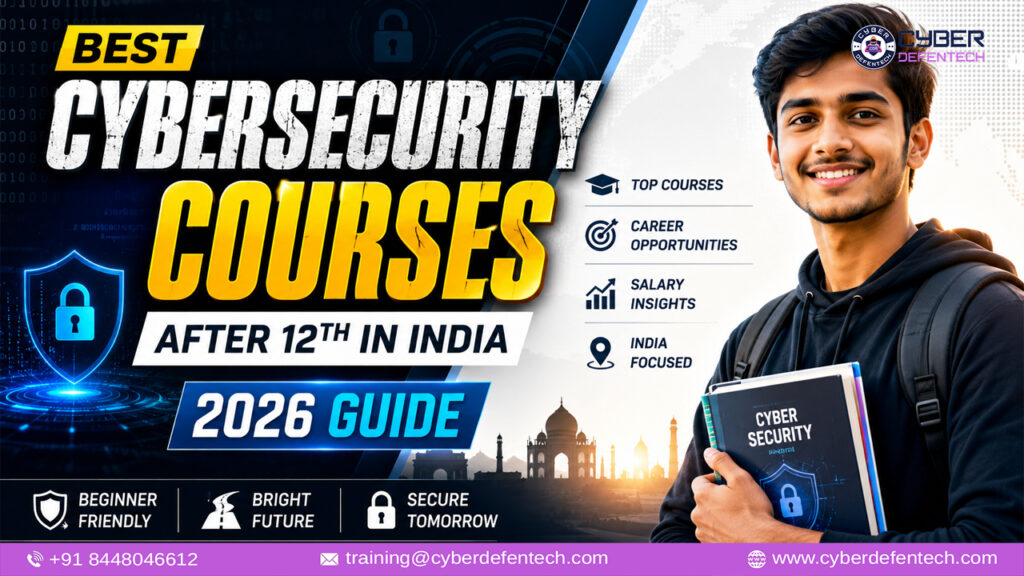
Best Cybersecurity Courses After 12th in India: A Complete Career Guide
Introduction
Every day, news headlines remind us that cyberattacks are no longer rare events. Data breaches, ransomware attacks, UPI frauds, phishing scams, and fake apps affect individuals, startups, banks, hospitals, and even government departments. As India moves rapidly toward digital payments, cloud services, and online governance, the need to protect digital systems has never been greater.
This is why cybersecurity has become one of the most promising career paths for students who have just finished 12th. The industry faces a shortage of skilled professionals, which means demand for trained people continues to grow. The best part is that you don’t need to be a genius hacker from the movies. You need curiosity, discipline, and the right learning path.
But with so many options, such as B.Tech, BCA, B.Sc, diplomas, and online certifications, most students get confused. Which course is right for you? How much does it cost? What jobs can you get? And how do you start if you come from a non-technical background?
In this guide, we break down the best cybersecurity courses after 12th in India, who should choose which option, the skills you need, career roles, salary expectations, and how institutes like CyberDefenTech can support your practical learning journey. By the end, you will have a clear roadmap to start your cybersecurity career with confidence.
What Is Cybersecurity and Why Is It a Great Career Choice?
Cybersecurity is the practice of protecting computers, networks, applications, and data from unauthorized access, attacks, and damage. It covers several areas:
- Network security: protecting company networks and servers
- Application security: finding and fixing flaws in websites and apps
- Ethical hacking and penetration testing: legally attacking systems to find weaknesses
- Digital forensics: investigating cybercrimes and collecting digital evidence
- Cloud security: protecting data on platforms like AWS, Azure, and Google Cloud
- Governance, risk, and compliance (GRC): ensuring organizations follow security laws and standards
Why choose cybersecurity after 12th?
- High demand: Banks, IT companies, e-commerce firms, startups, consulting companies, and government agencies all need security professionals.
- Strong salary growth: Skilled professionals often see rapid salary growth as they gain certifications and experience.
- Multiple career paths: You can become a penetration tester, SOC analyst, forensic investigator, security consultant, or bug bounty hunter.
- Global opportunities: Cybersecurity skills are valued worldwide, so remote and international roles are possible.
- Meaningful work: You help protect people’s money, privacy, and identity.
Eligibility: Who Can Study Cybersecurity After 12th?
Eligibility depends on the course type:
- B.Tech/B.E. (Cyber Security or CSE with specialization):
Usually requires 12th with Physics, Chemistry, and Mathematics (PCM). Admission may be through JEE Main, state entrance exams, or university-specific tests. - B.Sc. (Cyber Security/Computer Science/Digital Forensics): Many universities accept students from the Science stream, and some accept other streams too.
- BCA with Cyber Security specialization:
Often open to students from any stream, though some colleges prefer Maths or Computer Science in 12th. - Diplomas and certifications:
Generally open to any 12th pass student, and many have no strict stream requirement.
Always check the latest eligibility criteria on the official website of the college or institute before applying.
Best Cybersecurity Courses After 12th in India
1. B.Tech in Computer Science with Cyber Security Specialization
This 4-year engineering degree is among the most respected routes into cybersecurity. You study core computer science subjects such as programming, data structures, operating systems, and networking, along with security-focused subjects like cryptography, secure coding, ethical hacking, and digital forensics.
- Duration: 4 years
- Best for: Students with PCM who want a strong technical foundation and broader IT career options
- Career benefits: Eligible for campus placements, higher studies like M.Tech, and government technical roles
- Things to check: College reputation, lab facilities, industry tie-ups, and placement record
2. B.Sc. in Cyber Security or Digital Forensics
A B.Sc. is a 3-year program (some universities offer integrated or 4-year formats) that focuses more on security concepts, forensics, and network defense. Several universities, including specialized forensic and security institutions, offer such programs.
- Duration: 3 to 4 years
- Best for: Students who want a security-focused degree at a lower cost than engineering
- Career options: Security analyst, forensic analyst, cyber crime investigator, IT auditor
3. BCA with Specialization in Cyber Security
BCA (Bachelor of Computer Applications) is a popular choice for students who want an IT career without engineering. Many universities now offer cybersecurity or ethical hacking specializations within BCA.
- Duration: 3 years
- Best for: Students from Commerce or Arts backgrounds who love computers
- Next step: MCA or M.Sc. in Cyber Security, or entry-level jobs with added certifications
4. Integrated B.Tech-M.Tech or B.Sc.-M.Sc. Programs
Some institutes offer 5-year integrated programs in cybersecurity or digital forensics. These give you a bachelor’s and master’s degree together and provide deeper specialization.
- Best for: Students who are certain about cybersecurity and want advanced expertise early
5. Diploma in Cyber Security or Network Security
Diplomas typically last from 6 months to 2 years. They suit students who want faster entry into the field or want to add skills alongside a degree.
- Best for: Students who want hands-on training quickly
- Tip: Choose programs with lab practice, real-world projects, and industry-recognized exam preparation
6. Industry Certifications for Beginners
Certifications are important in cybersecurity because employers value verified skills. Some of the most popular entry-level and mid-level options are:
- CompTIA Security+: A widely recognized foundation certification for security fundamentals
- CompTIA Network+: Builds networking knowledge that every security professional needs
- CEH (Certified Ethical Hacker): Popular in India for ethical hacking and penetration testing roles
- ISC2 Certified in Cybersecurity (CC): An entry-level certification designed for beginners
- Google Cybersecurity Professional Certificate: A beginner-friendly online program
- Cisco CCNA: Strong networking base, useful for security roles
- eJPT and similar practical certifications: Test hands-on penetration testing skills
Advanced certifications like CISSP, OSCP, and CISM are better pursued after gaining experience, since some require years of work history.
Degree vs. Certification: Which One Should You Choose?
This is one of the most common questions students ask.
| Factor | Degree Programs | Certifications and Diplomas |
|---|---|---|
| Duration | 3 to 5 years | A few weeks to 2 years |
| Cost | Higher | Generally lower |
| Recognition | Strong for jobs, government roles, higher studies | Strong for specific skills |
| Depth | Broad and theoretical plus practical | Focused and practical |
| Best for | Long-term career foundation | Skill upgrade and quick entry |
Our recommendation: The strongest approach is to combine both. Complete a degree such as BCA, B.Sc., or B.Tech, and build practical skills through certifications, labs, and projects at the same time. Employers want both academic grounding and proven hands-on ability.
Skills You Need to Build for a Cybersecurity Career
Whichever course you choose, focus on developing these skills:
Technical skills
- Computer networking (TCP/IP, DNS, firewalls, VPNs)
- Linux and Windows administration
- Programming and scripting (Python, Bash, and basic web technologies)
- Understanding of databases and web applications
- Cryptography basics
- Cloud fundamentals
- Security tools such as Wireshark, Nmap, Burp Suite, and Metasploit (used legally in labs)
Soft skills
- Analytical and problem-solving mindset
- Patience and attention to detail
- Clear report writing and communication
- Ethical thinking and responsibility
Career Opportunities After a Cybersecurity Course
Once you complete your education and build practical experience, you can pursue roles such as:
- SOC (Security Operations Center) Analyst: Monitors systems for threats and responds to incidents
- Ethical Hacker/Penetration Tester: Tests systems and applications for vulnerabilities
- Cybersecurity Analyst: Protects networks and manages security tools
- Digital Forensics Investigator: Investigates cybercrimes and recovers digital evidence
- Cloud Security Engineer: Secures cloud infrastructure
- Application Security Engineer: Reviews code and fixes security flaws
- GRC Analyst/IT Auditor: Ensures compliance with security standards and regulations
- Security Consultant: Advises organizations on strengthening defenses
- Bug Bounty Hunter: Earns rewards by responsibly reporting vulnerabilities to companies
Salary expectations in India
Salaries vary widely based on skills, city, company, and certifications. Entry-level roles commonly start in a modest range, and with a few years of experience and strong certifications, salaries can rise significantly. Specialists in penetration testing, cloud security, and security architecture are among the better-paid professionals. Check current job portals and company listings for the latest salary data before making decisions.
How to Choose the Right Cybersecurity Course
Before enrolling, ask yourself and the institute these questions:
- Is the curriculum updated? Cybersecurity changes fast, so outdated syllabi are a red flag.
- Is there hands-on lab training? Theory alone isn’t enough. You should practice on real-world simulations.
- Who are the trainers? Look for instructors with industry experience and certifications.
- Does it prepare you for recognized certifications? This improves your job prospects.
- What support is offered for careers? Resume building, interview preparation, and project guidance matter.
- Are fees transparent? Avoid institutes making unrealistic promises like guaranteed high-paying jobs.
How CyberDefenTech Can Support Your Cybersecurity Journey
Many students struggle because college syllabi cover concepts but give limited real-world exposure. This is where specialized training providers like CyberDefenTech can add value. A good cybersecurity training platform focuses on:
- Practical, lab-based learning that mirrors real attack and defense scenarios
- Industry-aligned content covering ethical hacking, network security, and defensive techniques
- Mentorship and guidance from experienced professionals
- Certification preparation to help you build a recognized profile
- Career-oriented support to prepare you for entry-level cybersecurity roles
If you are a 12th pass student unsure where to begin, exploring beginner-friendly programs at CyberDefenTech alongside your regular degree can help you build real skills early. Visit the CyberDefenTech website or contact their team to understand current course options, duration, and fees.
Step-by-Step Roadmap After 12th
Step 1: Build the basics (Months 0 to 6)
Learn how computers and networks work. Get comfortable with Linux and start basic Python.
Step 2: Choose your main path
Select a degree (B.Tech, B.Sc., BCA) or a diploma or certification based on your stream, budget, and goals.
Step 3: Practice hands-on
Use legal practice platforms such as TryHackMe, Hack The Box, PicoCTF, and OWASP learning resources. Participate in Capture The Flag (CTF) competitions.
Step 4: Earn your first certification
Start with foundational certifications like Security+, Network+, ISC2 CC, or CEH, depending on your level.
Step 5: Build a portfolio
Document your labs, write blogs about what you learn, and create a GitHub profile showing your projects.
Step 6: Do internships
Apply for internships in IT security, SOC teams, or cybersecurity startups. Real exposure matters enormously.
Step 7: Keep learning
Follow security news, vulnerability disclosures, and new tools. In cybersecurity, learning never stops.
Common Mistakes Students Should Avoid
- Chasing “hacking” without fundamentals: Skipping networking and operating systems leads to weak understanding.
- Believing guaranteed placement claims: No honest institute can guarantee a high-paying job.
- Ignoring ethics and law: Hacking without permission is illegal under India’s IT Act. Always practice in authorized environments.
- Collecting certificates without skills: Employers test practical knowledge in interviews.
- Not building a network: Join cybersecurity communities, attend meetups, and connect with professionals.
Frequently Asked Questions (FAQs)
Q1. Can I do cybersecurity after 12th Commerce or Arts?
Yes. Courses like BCA, diplomas, and certifications are often open to students from any stream. You may need to put extra effort into learning technical basics.
Q2. Is cybersecurity a good career in India?
Yes. Demand is growing due to digital adoption, stricter data regulations, and rising cyber threats.
Q3. Which is better after 12th: B.Tech or BCA for cybersecurity?
B.Tech offers a broader engineering foundation, while BCA is more focused on computer applications and is often more affordable. Both can lead to strong careers with the right skills and certifications.
Q4. Is coding necessary for cybersecurity?
Not for every role, but basic scripting skills in Python or Bash are very helpful, especially for penetration testing and automation.
Q5. Can I learn cybersecurity online?
Yes. Many reputed platforms and institutes offer online training. Choose programs with hands-on labs and mentor support.
Q6. How long does it take to get a job in cybersecurity?
It depends on your effort. Many students become job-ready within 1 to 3 years of focused learning, practice, and internships.
Q7. Is ethical hacking legal?
Yes, when performed with proper authorization. It becomes illegal if done without permission.
Conclusion
Cybersecurity is not just a trending field. It is a long-term career with strong demand, diverse roles, and meaningful impact. After 12th, you have multiple routes: a B.Tech for strong engineering depth, a B.Sc. for specialized security knowledge, a BCA for flexible IT entry, or diplomas and certifications for quick skill-building.
The key is to start early, stay consistent, and focus on practical skills rather than only theory. Combine your academic path with hands-on practice, certifications, and real projects. If you want structured guidance and practical training, platforms like CyberDefenTech can help you bridge the gap between classroom learning and industry expectations.
Your digital defense career can begin today. Pick your path, build your skills, and become part of the community protecting India’s digital future.
Ready to take the first step? Explore cybersecurity training options at CyberDefenTech and start building your career in digital defense.
📞 Call/WhatsApp: +91 8448046612
