
Best Cloud Security Certifications in 2026
By Cyber Defentech Team | June 2026 | 11 Mins Read | Beginner to Advanced
Introduction
Somewhere right now, a misconfigured S3 bucket is leaking customer data. A forgotten IAM role is sitting wide open. An AI-powered attacker is scanning thousands of cloud environments per minute, looking for exactly that kind of mistake. This isn’t a hypothetical — it’s the daily reality of cloud security in 2026, where enterprises are migrating faster than they can secure, and attackers are automating faster than defenders can respond.
Cloud adoption didn’t just change how companies build software — it changed the entire attack surface. Every API, every container, every identity, and every misconfigured permission is now a potential entry point. And as organizations across banking, SaaS, healthcare, and e-commerce shift critical workloads to AWS, Azure, and Google Cloud, the demand for skilled cloud security professionals has exploded into one of the most high-demand, future-ready career paths in tech.
This is exactly why cloud security certifications have become the fastest way to prove real-world skill in a market flooded with self-taught claims and outdated resumes. Whether you’re a fresher trying to break into cybersecurity or a working IT professional pivoting into a specialized, high-paying domain, the right certification can be the difference between getting filtered out by an ATS and getting fast-tracked into an interview.
In this guide, Cyber Defentech breaks down the best cloud security certifications in 2026 — what they cover, who they’re for, what they pay, and how to actually build a practical, industry-ready skill set instead of just collecting another exam badge.
What is Cloud Security?
Cloud security is the discipline of protecting cloud-based infrastructure, applications, data, and identities from unauthorized access, misconfiguration, data breaches, and cyberattacks. Unlike traditional network security, which focuses on perimeter defense, cloud security operates on a shared responsibility model — the cloud provider secures the underlying infrastructure, while the organization is responsible for securing its data, identity controls, configurations, and applications running on top of it.
In practical terms, cloud security covers areas like:
- Identity and Access Management (IAM) and least-privilege design
- Data encryption, both at rest and in transit
- Network segmentation and Zero Trust architecture
- Container and Kubernetes security
- Cloud Security Posture Management (CSPM)
- Incident response and threat detection across multi-cloud environments
- Compliance with frameworks like ISO 27001, SOC 2, PCI-DSS, and India’s DPDP Act
A cloud security certification validates that a professional understands these domains deeply enough to design, implement, and audit secure cloud environments — not just talk about them in theory.
Why is Cloud Security Important in 2026?
The simple answer: data has left the building, and the building’s walls don’t matter anymore.
Modern enterprises run on multi-cloud and hybrid environments, often spanning AWS, Azure, and GCP simultaneously. Add in AI-driven workloads, containerized microservices, and remote-first teams accessing systems from anywhere, and you get a sprawling, dynamic attack surface that traditional security models were never built to handle.
A few forces are driving the urgency in 2026:
- AI-powered attacks — Threat actors now use AI to automate reconnaissance, generate phishing content, and identify misconfigurations at scale, compressing the time between exposure and exploitation.
- Multi-cloud complexity — Securing one cloud is hard. Securing three, with different IAM models, logging tools, and compliance requirements, is significantly harder.
- Regulatory pressure — Frameworks like the DPDP Act, GDPR, and sector-specific mandates (RBI, SEBI) are forcing organizations to formalize cloud security practices or face penalties.
- Talent shortage — Demand for skilled cloud security professionals continues to outpace supply, creating a genuine hiring gap that certified professionals are stepping in to fill.
For businesses, a single cloud misconfiguration can mean regulatory fines, reputational damage, and direct financial loss. For professionals, this is exactly why cloud security has become one of the most future-ready and high-demand specializations in the entire cybersecurity industry.
Real-World Cyber Threats & Risks in Cloud Environments
Understanding why certifications matter requires understanding what they’re actually defending against. Some of the most common real-world cloud security risks include:
- Misconfigured storage and IAM roles — Publicly exposed cloud storage buckets and overly permissive access roles remain one of the leading causes of data breaches across industries.
- Insecure APIs — As applications become API-first, poorly secured or unauthenticated APIs become a direct gateway into sensitive backend systems.
- Account hijacking and credential theft — Stolen or weak credentials, especially without multi-factor authentication, continue to be a primary entry point for attackers in cloud environments.
- Container and Kubernetes vulnerabilities — Unpatched container images and exposed Kubernetes dashboards create lateral movement opportunities for attackers.
- Insider threats and shadow IT — Employees spinning up unsanctioned cloud resources outside IT’s visibility create blind spots that security teams can’t monitor or protect.
- Supply chain and third-party risk — Vulnerabilities introduced through SaaS integrations, MCP-style connectors, and third-party APIs are increasingly being exploited as indirect attack vectors.
Major global incidents over the past few years — from cloud storage leaks affecting millions of users to ransomware groups pivoting through cloud backup systems — have made one thing clear: cloud security isn’t optional infrastructure hygiene anymore. It’s a board-level priority.
Why Companies Need Cloud Security Professionals?
Organizations aren’t just hiring “cloud engineers” anymore — they specifically want professionals who understand security-by-design. Here’s why dedicated cloud security talent has become non-negotiable for modern companies:
- Faster, safer cloud migration — Security-trained professionals help avoid the costly mistake of “lift and shift without lockdown.”
- Continuous compliance — Auditors and regulators expect demonstrable, certified expertise behind security controls, not just internal documentation.
- Reduced breach costs — Skilled professionals who can detect and contain incidents early directly reduce the financial and reputational cost of a breach.
- Cross-functional trust — Security-certified engineers bridge the gap between DevOps, compliance, and leadership, making them indispensable in cross-functional teams.
- AI security oversight — As companies deploy AI models and agentic systems on cloud infrastructure, security teams need professionals who understand both cloud-native risks and emerging AI security concerns like prompt injection and model data exposure.
Why It Matters?
A company can have the best cloud architecture in the world — but without the right people watching, configuring, and defending it, that architecture is just a bigger, more expensive target.
Skills You Will Learn
A strong cloud security certification path builds both foundational and advanced, practical skills. Here’s what a well-rounded skill set looks like:
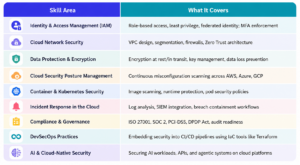
This blend of identity, network, compliance, and DevSecOps skills is exactly what separates a certified cloud security professional from a generalist cloud engineer.
Top Cloud Security Certifications to Pursue in 2026
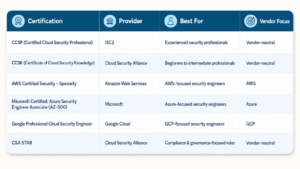
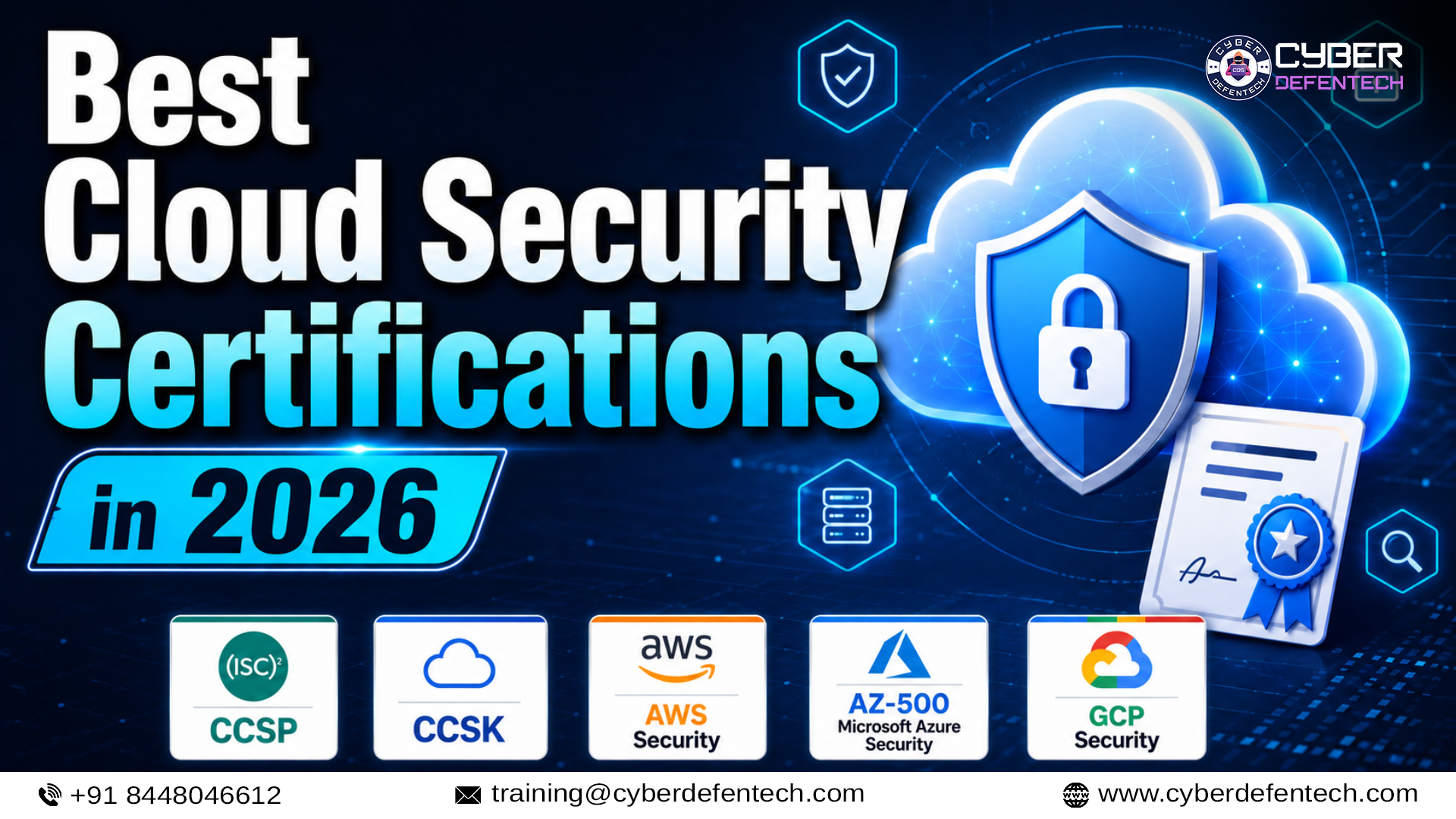
CCSP remains the most established, advanced credential, requiring real-world experience and covering six broad domains from architecture to legal compliance. CCSK is the recommended entry point for beginners — it’s vendor-neutral, foundational, and widely respected as a first certification before pursuing CCSP. The vendor-specific certifications (AWS, Azure, GCP) are essential if you’re targeting roles within a specific cloud ecosystem, which is often where the fastest hiring happens.
Career Opportunities in Cloud Security
A cloud security certification doesn’t lock you into one job title — it opens doors across multiple specialized roles, including:
- Cloud Security Engineer
- Cloud Security Architect
- DevSecOps Engineer
- Security Operations Center (SOC) Analyst – Cloud Focus
- Cloud Compliance & Risk Analyst
- Identity and Access Management (IAM) Specialist
- Penetration Tester – Cloud Infrastructure
- Chief Information Security Officer (CISO) – long-term career trajectory
These roles span industries — BFSI, SaaS, e-commerce, healthcare, and government — meaning your skills remain portable and future-ready regardless of where the next big hiring wave happens.
Salary & Industry Demand
Cloud security has become one of the highest-paying specializations within cybersecurity, and certified professionals consistently out-earn their non-certified peers.

Industry data shows certified professionals with credentials like CISSP, OSCP, or CCSP often earn meaningfully more than non-certified peers in similar roles, and cloud security is widely cited as one of the fastest-growing, highest-paying sub-disciplines within India’s broader cybersecurity job market. Globally, the cybersecurity industry continues to face a significant talent shortage, with cloud-specific roles representing one of the widest supply-demand gaps — which directly translates into stronger job security and negotiating power for certified professionals.
Why It Matters?
Certifications aren’t just resume decoration — in cloud security, they’re directly correlated with higher starting offers, faster interview shortlisting, and stronger long-term salary growth.
Real-World Importance of Cloud Security Certifications
It’s easy to treat certifications as just an exam to pass, but in practice, they serve a much bigger purpose:
- They standardize knowledge — A CCSP-certified professional in Mumbai and one in Dubai have demonstrably learned the same core domains, which builds trust with global employers.
- They accelerate hiring — Recruiters and ATS systems frequently filter for specific certifications, especially for mid-to-senior cloud security roles.
- They build practical credibility — Hands-on certification paths (not just theory-based exams) prove you can actually configure IAM policies, harden a VPC, or respond to a live incident — not just describe one.
- They future-proof your career — As AI security, Zero Trust, and multi-cloud governance become standard expectations, certified professionals are better positioned to adapt without starting from scratch.
Tools & Technologies Used in Cloud Security
A strong cloud security professional doesn’t just know theory — they’re hands-on with the tools that power real enterprise environments, including:
- Cloud Platforms: AWS, Microsoft Azure, Google Cloud Platform
- IAM & Identity Tools: AWS IAM, Azure AD (Entra ID), Okta
- CSPM & Monitoring: Prisma Cloud, Wiz, Microsoft Defender for Cloud
- SIEM & Threat Detection: Splunk, Microsoft Sentinel, AWS GuardDuty
- Container Security: Docker, Kubernetes, Aqua Security, Trivy
- Infrastructure as Code: Terraform, AWS CloudFormation
- Vulnerability Scanning: Nessus, Qualys, AWS Inspector
Practical exposure to these next-generation tools is what separates a certificate holder from a job-ready cloud security professional — and it’s exactly the gap that hands-on, lab-based training is designed to close.
Beginner Roadmap to Cloud Security Career
If you’re starting from scratch, here’s a practical, advanced-but-achievable roadmap:
- Build IT fundamentals — Networking basics, operating systems, and core security concepts.
- Learn one cloud platform deeply — Start with AWS or Azure fundamentals before going broad.
- Earn a foundational certification — CCSK or a cloud platform’s associate-level security certification.
- Practice in real labs — Set up your own cloud environment, configure IAM policies, and simulate misconfigurations and fixes.
- Learn DevSecOps basics — Understand how security integrates into CI/CD pipelines using tools like Terraform.
- Pursue an advanced certification — CCSP, AWS Security Specialty, or AZ-500, depending on your target role.
- Build a portfolio — Document your lab work, incident response simulations, and any bug bounty or CTF participation.
- Apply with confidence — Target SOC, DevSecOps, or junior cloud security engineer roles to gain real-world experience.
This roadmap reflects how the industry actually hires: certifications open the door, but practical, hands-on skill is what gets you through it.
Why Choose Cyber Defentech?
At Cyber Defentech, training is built around one core principle: certifications should reflect real, demonstrable skill — not just exam memorization. Our cloud security training programs are designed to take learners from beginner to industry-ready through:
- Hands-on practical labs simulating real AWS, Azure, and GCP environments
- Industry-focused curriculum aligned with current certification bodies and hiring requirements
- Real-world case studies covering misconfigurations, incident response, and compliance scenarios
- Mentorship from experienced cybersecurity professionals who’ve worked in live SOC and cloud security environments
- Career-oriented guidance to help learners map their certification path to actual job roles
Whether you’re a complete beginner or an IT professional pivoting into cloud security, Cyber Defentech’s training approach is built to make sure your certification translates into genuine, job-ready competence.
Future Scope & Industry Trends
Cloud security isn’t a trend — it’s the foundation that the next decade of technology will be built on. Key trends shaping the field heading into 2027 and beyond include:
- AI-driven security operations — Security teams increasingly rely on AI-assisted threat detection and automated response, making AI literacy a core cloud security skill.
- Zero Trust as the default architecture — “Never trust, always verify” is replacing perimeter-based security models across enterprises.
- Multi-cloud governance — As more companies adopt multi-cloud strategies, professionals who can secure across AWS, Azure, and GCP simultaneously will be especially valuable.
- Securing AI workloads and agentic systems — As organizations deploy AI models and autonomous agents on cloud infrastructure, securing those pipelines is becoming its own specialized skill set.
- Stricter regulatory enforcement — Data protection laws like the DPDP Act will continue driving demand for compliance-literate cloud security professionals.
For anyone evaluating long-term career stability, cloud security checks nearly every box: high demand, strong pay growth, cross-industry relevance, and a skill set that only becomes more valuable as cloud and AI adoption deepens.
Final Thoughts
Cloud security in 2026 isn’t a niche specialization anymore — it’s central to how every modern business operates safely. The organizations winning today are the ones investing in skilled, certified professionals who can secure complex, multi-cloud, AI-integrated environments before attackers find the gaps first.
If you’re serious about building a next-generation cybersecurity career, the path is clear: start with a strong foundational certification, gain real hands-on lab experience, and progress toward advanced, vendor-specific or vendor-neutral credentials based on where you want to specialize. With the right practical, industry-focused training — like what Cyber Defentech offers — that path becomes a lot more achievable, and a lot less overwhelming.
The cloud isn’t slowing down, and neither are the threats targeting it. The only question is whether you’ll be ready to defend it.
FAQs
- What is the best cloud security certification for beginners in 2026?
CCSK (Certificate of Cloud Security Knowledge) is widely recommended as the best starting point, since it’s vendor-neutral, foundational, and doesn’t require extensive prior work experience. - Is CCSP better than AWS Security Specialty?
They serve different purposes. CCSP is vendor-neutral and ideal for broad, advanced cloud security knowledge, while AWS Security Specialty is best if you’re specifically targeting AWS-focused roles. - How long does it take to get certified in cloud security?
Depending on your background, foundational certifications can take 4–8 weeks of focused study, while advanced certifications like CCSP may take 3–6 months due to experience requirements and exam depth. - Do I need coding skills for a cloud security career?
Basic scripting (Python) and Infrastructure as Code knowledge (Terraform) are highly valuable, though not always mandatory for entry-level roles. They become increasingly important as you move into DevSecOps-focused positions. - What is the average salary of a cloud security professional in India?
Salaries typically range from ₹6–12 LPA for entry-level roles up to ₹35 LPA and above for senior architects, with certified professionals generally earning more than non-certified peers. - Which cloud platform should I learn first for security — AWS, Azure, or GCP?
AWS and Azure are generally recommended first due to broader enterprise adoption, but the right choice depends on the industry and region you’re targeting. - Are cloud security certifications worth it without prior IT experience?
Yes, especially foundational ones like CCSK, when paired with hands-on lab practice. Practical experience alongside certification significantly improves job readiness. - Does Cyber Defentech provide hands-on cloud security training?
Yes, Cyber Defentech offers practical, lab-based cloud security training designed to build real-world, job-ready skills alongside certification preparation.
Ready to Build Your Career in Cloud Security?
✅ Hands-on Practical Training
✅ Real-World Cybersecurity Skills
✅ Industry-Focused Learning
✅ Future-Ready Career Path
 Visit Now:
 Call/WhatsApp:
