
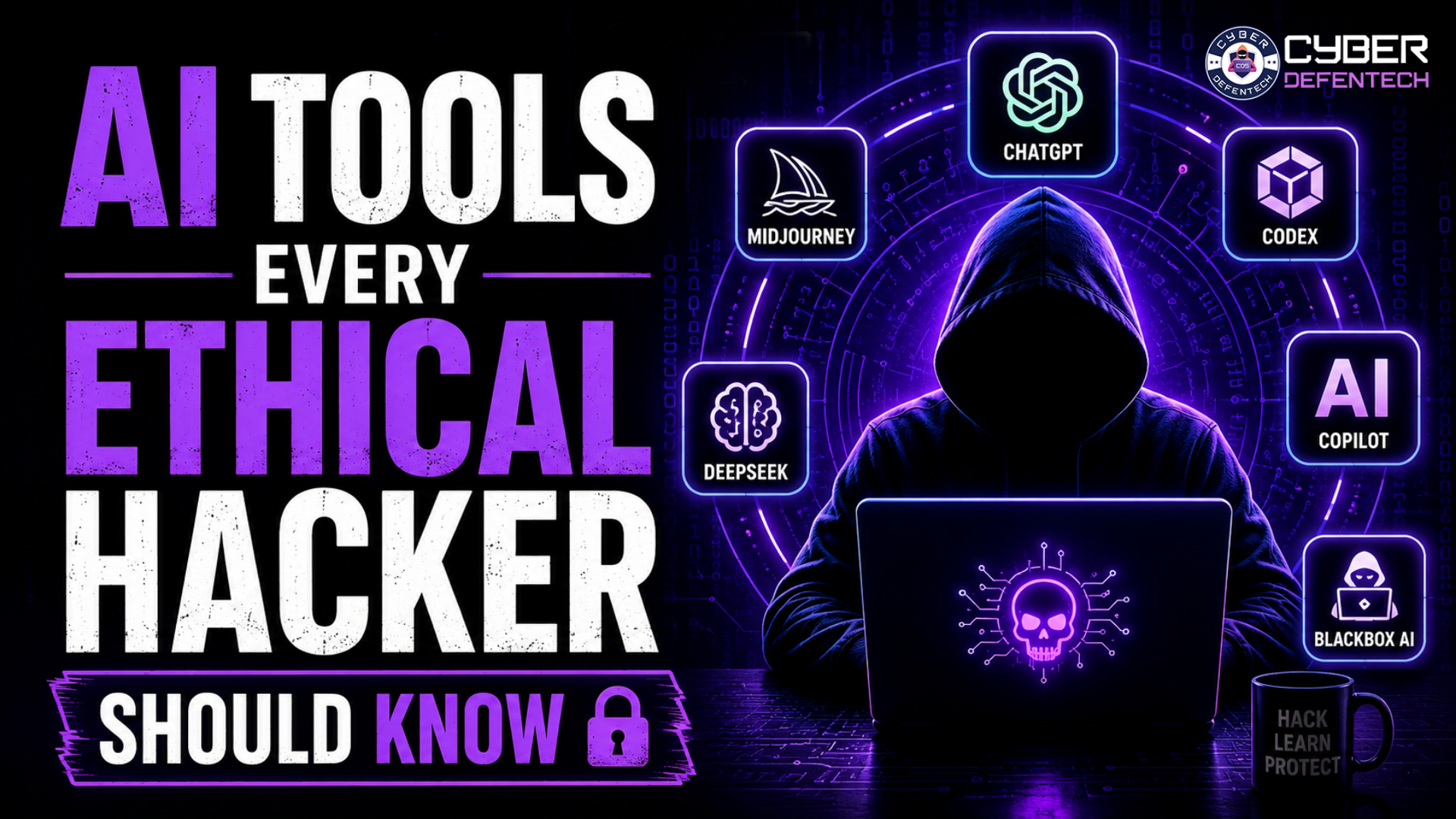
AI Tools Every Ethical Hacker Should Know
By Cyber Defentech Team | May 2026 | 11 Mins Read | Beginner to Advanced
Introduction
A seasoned red team operator recently shared something that stopped the cybersecurity community cold: his AI-powered attack simulation completed in 4 hours what previously took his team 4 days — autonomously mapping the network, identifying vulnerable entry points, crafting custom payloads, and generating a full attack report. And he did it before the organization’s security team even knew a test had begun.
That is not the future of ethical hacking. That is 2026.
Artificial intelligence has not just augmented the ethical hacker’s toolkit — it has completely reinvented it. Today, attackers on both sides of the line — malicious and ethical — are using AI to move faster, think deeper, and operate at a scale that was simply impossible two years ago. The result is a new competitive reality: ethical hackers who do not understand and actively use AI tools are falling behind, while those who master them are being hired at rates and salaries the industry has never seen before.
This guide is your definitive resource for the AI tools every ethical hacker should know in 2026. Whether you are just beginning your penetration testing journey or a seasoned practitioner looking to master ethical hacking with AI, understanding these tools — and the AI concepts behind them — is no longer optional. It is the price of entry into modern offensive security.
What Are AI-Powered Ethical Hacking Tools?
AI-powered ethical hacking tools are next-generation security applications that use machine learning, natural language processing, large language models, and automated reasoning to perform offensive and defensive security tasks that previously required significant manual effort and expertise.
Traditional penetration testing tools like Nmap, Metasploit, and Burp Suite remain foundational. But the AI layer on top of them — and the entirely new AI-native tools emerging alongside them — has created a new class of AI penetration testing tools and machine learning cybersecurity tools that is transforming how authorized security assessments are conducted.
These tools can autonomously conduct reconnaissance on a target, intelligently prioritize vulnerabilities by exploitability and business impact, generate context-aware phishing campaigns, write custom exploit code, identify behavioral anomalies in network traffic, and even adapt their approach when initial attack vectors fail — all with a level of speed and consistency that no human operator can match alone.
For ethical hackers and penetration testers, mastering these AI tools means the ability to deliver more thorough assessments, catch vulnerabilities that manual methods miss, and demonstrate dramatically higher value to the organizations that hire them.
Why Are AI Hacking Tools Important in 2026?
The case is simple: attackers are already using AI. Defenders and ethical hackers must match that capability.
Threat actors are deploying AI-driven tools to automate credential stuffing at industrial scale, generate hyper-personalized spear-phishing lures, discover and exploit zero-day vulnerabilities faster than patch cycles can respond, and evade detection by learning the behavioral patterns of the security tools monitoring them.
If your penetration test is still being conducted entirely with manual techniques and decade-old scripts, you are not accurately simulating what a modern attacker looks like. And an inaccurate simulation means undetected vulnerabilities — which means real risk for your client.
Beyond simulation fidelity, AI hacking tools in 2026 deliver competitive advantages that are reshaping the ethical hacking profession itself. Bug bounty hunters using AI-assisted recon are discovering critical vulnerabilities in hours instead of weeks. Red team operators using AI-powered payload generation are bypassing EDR solutions that previously stopped their work cold. Security researchers leveraging automated vulnerability scanning and large language models are reversing obfuscated malware samples in a fraction of the traditional time.
The professionals who learn to wield these tools effectively are not just better ethical hackers — they are the ethical hackers who get hired, get paid, and get promoted.
Real-World Cyber Threats & Risks That Make This Critical
Understanding why these AI tools exist requires understanding the threat landscape they were built to counter and simulate.
FraudGPT and WormGPT: In 2024 and 2025, cybercriminal communities began selling access to uncensored large language models specifically designed for offensive operations — generating phishing emails, writing exploit code, and crafting social engineering scripts with zero ethical guardrails. These tools lowered the barrier to entry for attackers dramatically.
AI-Augmented Ransomware: Modern ransomware variants like BlackBasta and Akira use machine learning components to scan compromised environments, identify the most valuable data to encrypt, and select the optimal time to execute — maximizing damage and ransom leverage. Their behavior-based evasion techniques defeat signature-based defenses entirely.
Deepfake-Driven Social Engineering: Vishing attacks using AI voice cloning are now sophisticated enough to impersonate executives convincingly in real-time calls. Multiple organizations have suffered seven-figure losses from fraudulent wire transfers authorized on the basis of cloned executive voices.
Autonomous Vulnerability Discovery: Nation-state threat actors and advanced persistent threat (APT) groups are using AI systems to continuously scan internet-facing assets of target organizations, automatically correlating exposed services with known CVEs and custom zero-day research to identify exploitable paths before defenders can remediate them.
Ethical hackers equipped with AI tools can simulate all of these attack patterns during authorized assessments — giving organizations a realistic view of their actual exposure before a malicious actor exploits it.
Why Companies Need AI-Savvy Ethical Hacking Professionals?
Enterprise security teams are under enormous pressure. Attack surfaces have exploded with cloud adoption, remote work infrastructure, IoT device proliferation, and third-party API integrations. Traditional penetration testing, conducted once or twice a year by small teams, cannot keep pace with the rate at which new vulnerabilities are introduced.
AI-powered ethical hackers change this equation. They can conduct continuous, automated reconnaissance across massive attack surfaces. They can perform thorough assessments in compressed timelines, enabling quarterly or monthly testing cycles instead of annual ones. They can generate more comprehensive reports with higher-fidelity risk prioritization — helping security teams focus limited remediation resources where they matter most.
From a business perspective, organizations that retain AI-savvy penetration testers are demonstrably better protected. Their security postures are more accurately assessed, their critical vulnerabilities are found proactively, and their incident response plans are stress-tested against realistic, AI-augmented attack scenarios.
This is why demand for ethical hackers with demonstrated AI tool proficiency has surged. CISOs and security directors are actively seeking professionals who can bring next-generation offensive techniques to their assessment programs — and they are paying significant premiums to find them.
Skills You Will Learn Mastering AI Ethical Hacking Tools
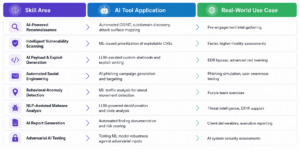
The AI Tools Every Ethical Hacker Should Know in 2026
Nuclei with AI Templates
Nuclei by ProjectDiscovery is already one of the most powerful vulnerability scanners in the ethical hacker’s arsenal. In its AI-enhanced form, Nuclei leverages community-contributed and AI-generated templates to automatically scan for thousands of known vulnerabilities, misconfigurations, and exposed sensitive data across web applications and infrastructure. Its speed and extensibility make it indispensable for modern assessments.
Recon-ng with AI-Enhanced Modules
Recon-ng provides a modular framework for OSINT and reconnaissance operations. When combined with AI-enriched data sources and automated correlation engines, it enables ethical hackers to build comprehensive target profiles — mapping organizational structures, technology stacks, employee information, and third-party relationships — at a scale and depth impossible through manual research.
PentestGPT
Developed specifically for penetration testing workflows, PentestGPT integrates large language model reasoning into the offensive security process. It helps ethical hackers reason through complex attack chains, suggests next steps based on discovered vulnerabilities, assists with payload customization, and generates professional-grade findings documentation. It is essentially an AI co-pilot for the entire penetration testing engagement.
Burp Suite with AI Extensions
Burp Suite Professional remains the gold standard for web application security testing. Its AI-powered extensions — including ML-based scanner enhancements and intelligent fuzzing modules — dramatically increase the detection rate for complex vulnerabilities like business logic flaws, race conditions, and advanced injection variants that traditional scanners routinely miss.
AutoRecon with AI Correlation
AutoRecon is one of the most effective AI-powered recon tools available to penetration testers today. It automates the network reconnaissance phase of penetration testing, running multiple discovery and enumeration tools in parallel and organizing their outputs intelligently. AI correlation layers identify relationships between discovered services, flag anomalous configurations, and highlight the highest-probability attack paths — transforming raw enumeration data into actionable intelligence.
Metasploit with AI-Assisted Modules
Among the most powerful AI red team tools available today, the Metasploit Framework’s AI-assisted development ecosystem now includes modules that intelligently select and configure exploits based on target fingerprinting data, automatically test payload encoding variants against detected defenses, and adapt exploitation strategies when initial attempts trigger defensive responses.
WPScan AI Mode (for WordPress Environments)
For web application assessors who regularly encounter WordPress deployments, WPScan’s AI-augmented scanning capability correlates installed plugin and theme versions against real-time vulnerability intelligence feeds — automatically identifying exploitable configurations and generating tailored attack recommendations.
Darktrace (Purple Team Use)
Darktrace’s AI-powered network detection platform is primarily a defensive tool, but its value for purple team exercises — where red and blue teams collaborate to test and improve defenses — is immense. Ethical hackers who understand how AI-based behavioral detection systems work are better equipped to both evade them during assessments and help organizations tune them effectively afterward.
ChatGPT / Claude (AI Research & Scripting Assistants)
Large language models have become essential research and productivity tools for ethical hackers. They assist with rapid vulnerability research, help write and debug custom scripts and exploits, explain complex attack techniques, assist in crafting realistic social engineering content for authorized simulations, and accelerate the report-writing process that consumes a significant portion of every engagement.
AI-Powered OSINT Platforms (Maltego AI, SpiderFoot HX)
Maltego’s AI-enhanced graph analysis and SpiderFoot HX’s automated intelligence gathering represent the state of the art in offensive OSINT. They transform publicly available information into actionable attack intelligence — mapping organizational relationships, identifying shadow IT, discovering exposed credentials, and flagging the external attack surface elements that organizations often do not even know exist.
Career Opportunities for AI-Skilled Ethical Hackers
Mastering AI tools for ethical hacking positions you for some of the most exciting and financially rewarding roles in the entire cybersecurity industry:
- Penetration Tester / Ethical Hacker — Conducting authorized offensive assessments for enterprises and government agencies
- Red Team Operator — Simulating advanced persistent threats against the world’s most security-conscious organizations
- Bug Bounty Hunter — Independently discovering and reporting vulnerabilities in exchange for significant financial rewards
- Offensive Security Researcher — Developing new attack techniques and tools at the bleeding edge of the field
- AI Security Specialist — Assessing the security of AI and machine learning systems themselves — an emerging high-demand discipline
- Purple Team Analyst — Bridging offensive and defensive teams to continuously improve organizational security posture
- Security Consultant — Delivering expert offensive security engagements and strategic recommendations to enterprise clients
- CISO / Security Director (Long-Term) — Leading organizational security strategy with deep offensive knowledge as your foundation
Salary & Industry Demand
AI-proficient ethical hackers command some of the highest compensation packages in tech:
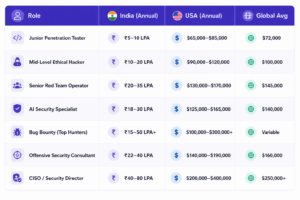
Bug bounty earnings deserve special mention — top performers on platforms like HackerOne and Bugcrowd regularly earn six-figure annual incomes through independent vulnerability research, with some hunters earning over $1 million USD in a single year.
Real-World Importance of AI Tools in Ethical Hacking
Consider what happened when a major European financial institution commissioned an AI-augmented red team engagement in 2025. The red team, using AI-powered reconnaissance and automated attack chaining tools, discovered and demonstrated a complete attack path from an internet-facing marketing subdomain to core banking systems — including access to customer account data and transaction systems — within 72 hours.
The same organization had passed a traditional penetration test six months earlier with no critical findings. The difference was not the skill of the testers — it was the tools they used. AI-powered tooling found what manual testing missed.
This pattern is repeating across industries. Organizations that commission AI-augmented assessments are discovering real vulnerabilities that traditional testing overlooked. Those that do not are finding out about those vulnerabilities from malicious actors instead.
Ethical hackers who can deliver AI-augmented assessments are providing a fundamentally more valuable service. And the market is pricing that value accordingly.
Tools & Technologies Used in AI Ethical Hacking
A comprehensive AI-powered ethical hacker toolkit in 2026 includes the following industry-standard platforms across every phase of the engagement:
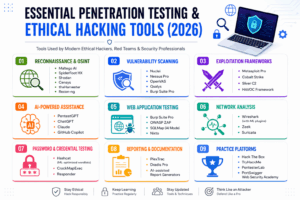
Cyber Defentech’s hands-on labs give students direct access to industry-standard tools in controlled, realistic environments — ensuring you build genuine proficiency, not just theoretical familiarity.
Beginner Roadmap: From Zero to AI Ethical Hacker
Step 1 — Build Your Technical Foundation (1–2 months) Master Linux command line, basic networking (TCP/IP, DNS, HTTP/S, OSI model), and fundamental security concepts. Platforms like TryHackMe’s pre-security path are excellent starting points.
Step 2 — Earn a Foundational Certification (2–3 months) CompTIA Security+ establishes your credibility and demonstrates foundational knowledge. Follow it immediately with eJPT (eLearnSecurity Junior Penetration Tester) for your first hands-on offensive credential.
Step 3 — Learn Core Ethical Hacking Methodology (2–3 months) Study the five phases of penetration testing: reconnaissance, scanning, gaining access, maintaining access, and reporting. Use platforms like Hack The Box and TryHackMe to practice each phase practically.
Step 4 — Introduce AI Tools Into Your Practice (Ongoing) Start with PentestGPT for reasoning assistance, Nuclei for automated scanning, and LLM assistants for script development. Practice using these tools on your lab environments before incorporating them into real assessments.
Step 5 — Earn the CEH v13 Certification (2–4 months) The Certified Ethical Hacker v13 explicitly covers AI-powered attack techniques and is recognized globally by enterprise employers. Cyber Defentech’s CEH preparation program is one of the most comprehensive available, combining structured curriculum with hands-on lab environments.
Step 6 — Pursue Advanced Credentials (6–18 months in) OSCP (Offensive Security Certified Professional) is the industry’s most respected practical penetration testing credential. CRTP (Certified Red Team Professional) is ideal for those moving into Active Directory and red team operations. These certifications separate practitioners from professionals.
Step 7 — Specialize in AI Security (Ongoing) As AI systems proliferate across enterprises, the ability to assess the security of AI models, training pipelines, and inference infrastructure is becoming a standalone specialization. Professionals who develop this expertise early will command the highest premiums in the market.
Why Choose Cyber Defentech?
In a training market crowded with generic online courses and outdated bootcamps, Cyber Defentech ethical hacking training delivers something fundamentally different: real-world, industry-focused instruction built specifically for the AI era.
Hands-On Lab Environments: Every Cyber Defentech program includes access to purpose-built lab infrastructure where students practice real attack and defense scenarios using industry-standard AI tools. You do not just watch demonstrations — you execute techniques yourself, in realistic environments, until they become second nature.
AI-Integrated Curriculum: Cyber Defentech’s ethical hacking curriculum is continuously updated to incorporate the latest AI tools, attack techniques, and industry developments. When a new AI hacking tool gains traction in the professional community, it is in the curriculum within weeks.
Practitioner Instructors: Our trainers are not career educators reading from slides — they are active penetration testers, red team operators, and security researchers who use these tools professionally every day. Their real-world insights transform how students understand and apply what they learn.
Certification-Focused Preparation: From Security+ and CEH v13 to OSCP and beyond, Cyber Defentech’s programs are precision-engineered to prepare students for certification success while building genuine practical capability that persists long after the exam.
Career Development Support: Resume reviews, mock interviews, bug bounty guidance, LinkedIn optimization, and access to Cyber Defentech’s professional network give students the career launch infrastructure they need to convert skills into opportunities.
Mentorship Community: Join a community of ethical hackers, security professionals, and Cyber Defentech alumni who support each other, share knowledge, and collaborate on challenges — because in this field, your network amplifies your capability.
Future Scope & Industry Trends
The convergence of AI and ethical hacking is accelerating, and the professionals who position themselves at that intersection today will define the field tomorrow. AI in cybersecurity is no longer a future concept — it is the operating reality of 2026, and every forward-thinking ethical hacker must understand it deeply.
Continuous Automated Penetration Testing (CAPT) is emerging as a standard enterprise practice — AI systems that continuously probe organizational defenses, simulating real-world attack techniques around the clock. Human ethical hackers who understand and can operate these systems will be in extraordinary demand.
AI Model Security Assessments will become a standard service offering as organizations deploy more AI-powered applications. Adversarial machine learning attacks, model inversion, prompt injection, and training data poisoning are attack vectors that require a new generation of specialized ethical hackers to assess and address.
Regulation-Driven Demand is accelerating. India’s DPDP Act, the EU AI Act, and evolving global cybersecurity frameworks are creating compliance requirements that mandate regular security assessments — directly driving demand for qualified penetration testers and ethical hackers.
Autonomous Red Teams — AI systems that can conduct sophisticated attack simulations with minimal human oversight — will augment (not replace) human ethical hackers. Professionals who can configure, direct, and interpret the outputs of these systems will command significant premiums.
Bug Bounty Market Expansion continues as more organizations launch public and private programs to leverage the global ethical hacker community. AI tools that help hunters discover vulnerabilities more efficiently are directly translating to higher earnings for the professionals who master them.
The window to get ahead of this curve is open right now. The AI-powered ethical hacking professionals entering the market in 2026 are building skills that will pay dividends for their entire careers.
Final Thoughts
The ethical hacking profession has always rewarded the most technically capable practitioners — those who understood tools deeply, thought creatively about attack chains, and stayed relentlessly current with the evolving threat landscape. AI has not changed that formula. It has amplified it.
The AI tools every ethical hacker should know in 2026 are not shortcuts or crutches. They are force multipliers for professionals who already understand offensive security fundamentals — tools that let skilled practitioners operate at a scale, speed, and sophistication level that was simply out of reach before.
If you are serious about building a high-demand, future-ready career in ethical hacking and penetration testing, the time to start mastering these tools is not when everyone else already has. It is now, while the competitive advantage is still there to be seized.
Cyber Defentech exists to give you exactly that advantage — with practical, industry-focused training that puts these tools in your hands and the knowledge in your head to use them like a professional from Day 1.
FAQs
Q1. What are the best AI tools for ethical hackers in 2026?
The most impactful AI tools for ethical hackers in 2026 include PentestGPT for AI-assisted attack reasoning, Nuclei for intelligent vulnerability scanning, Maltego AI and SpiderFoot HX for AI-enhanced OSINT, Burp Suite Pro with AI extensions for web application testing, and large language models like ChatGPT and Claude for research, scripting, and report generation. Cyber Defentech’s training programs provide hands-on exposure to all of these tools.
Q2. Do I need programming knowledge to use AI ethical hacking tools?
Basic scripting knowledge — particularly Python and Bash — is valuable and will significantly enhance your ability to customize and extend AI tools. However, many AI-powered tools are designed to be accessible to practitioners without deep programming backgrounds. Cyber Defentech’s programs include scripting fundamentals as part of the ethical hacking curriculum.
Q3. Is ethical hacking a good career choice in the AI era?
Absolutely. AI has increased both the complexity of cyber threats and the demand for skilled ethical hackers who can simulate them. The global cybersecurity talent shortage remains severe, and AI-proficient penetration testers command some of the highest salaries in tech. It is one of the most financially rewarding and intellectually engaging career paths available in 2026.
Q4. How do AI tools help in penetration testing?
AI tools accelerate and enhance every phase of a penetration test — from intelligent reconnaissance and automated vulnerability discovery to AI-assisted payload generation, behavioral analysis, and professional report writing. They enable ethical hackers to conduct more thorough assessments in less time, finding vulnerabilities that purely manual techniques would miss.
Q5. What certification should I pursue to become an AI-era ethical hacker?
The CEH v13 (Certified Ethical Hacker) is the ideal first major credential, as it explicitly covers AI-powered attack techniques and is globally recognized by enterprise employers. For advanced practitioners, OSCP remains the gold standard for demonstrating real-world penetration testing capability. Cyber Defentech offers preparation programs for both.
Q6. Can beginners learn to use AI ethical hacking tools?
Yes. While foundational networking and security knowledge is important, AI tools are increasingly designed to be accessible to practitioners at all experience levels. Cyber Defentech’s beginner-to-advanced curriculum is specifically structured to build the technical foundation and then systematically introduce AI tools in a practical, hands-on learning environment.
Q7. What is PentestGPT and how is it used?
PentestGPT is an AI assistant specifically designed for penetration testing workflows. It uses large language model reasoning to help ethical hackers think through complex attack chains, suggest next steps based on discovered vulnerabilities, assist with payload customization and exploit research, and generate professional-grade findings documentation. It functions as an AI co-pilot throughout the entire engagement lifecycle.
Q8. How much can I earn as an AI-skilled ethical hacker in India?
Entry-level penetration testers in India typically earn ₹5–10 LPA. Mid-level professionals with CEH and practical experience command ₹10–20 LPA. Senior red team operators and offensive security specialists can earn ₹20–40 LPA or more. Top-performing bug bounty hunters can earn ₹15–50 LPA annually through independent vulnerability research.
Ready to Build Your Career as an AI-Powered Ethical Hacker?
The demand is real. The tools are here. The only question is whether you are going to be the professional who masters them — or the one watching others get hired.
Cyber Defentech’s industry-focused ethical hacking programs are built for 2026 and beyond — combining AI-integrated curriculum, real-world hands-on labs, and expert practitioner instruction to turn motivated learners into job-ready offensive security professionals.
✅ Hands-on Practical Training — Real tools, real labs, real attack scenarios
✅ Real-World Cybersecurity Skills — Go beyond theory into genuine offensive capability
✅ Industry-Focused Learning — Curriculum aligned with what employers and clients actually need
✅ Future-Ready Career Path — AI-era skills that grow with the threat landscape
✅ Expert Mentorship — Learn from active penetration testers and red team operators
✅ Career Support Included — Resume, interview prep, bug bounty guidance, and network access
Your next-generation ethical hacking career starts here.
💬 Have a question about starting your journey?
The attackers are already using AI. It’s time you did too — on the right side of the line.
