
AI Audit vs IT Audit: Which Course Is Better for Your Career in 2026?
Artificial intelligence is changing how organisations approve loans, detect fraud, recommend products, manage healthcare workflows, screen job applications and automate customer support. At the same time, organisations still depend on secure networks, reliable applications, controlled user access, protected databases, tested backups and effective information-security processes. These two realities have created strong interest in AI auditing and information technology auditing.
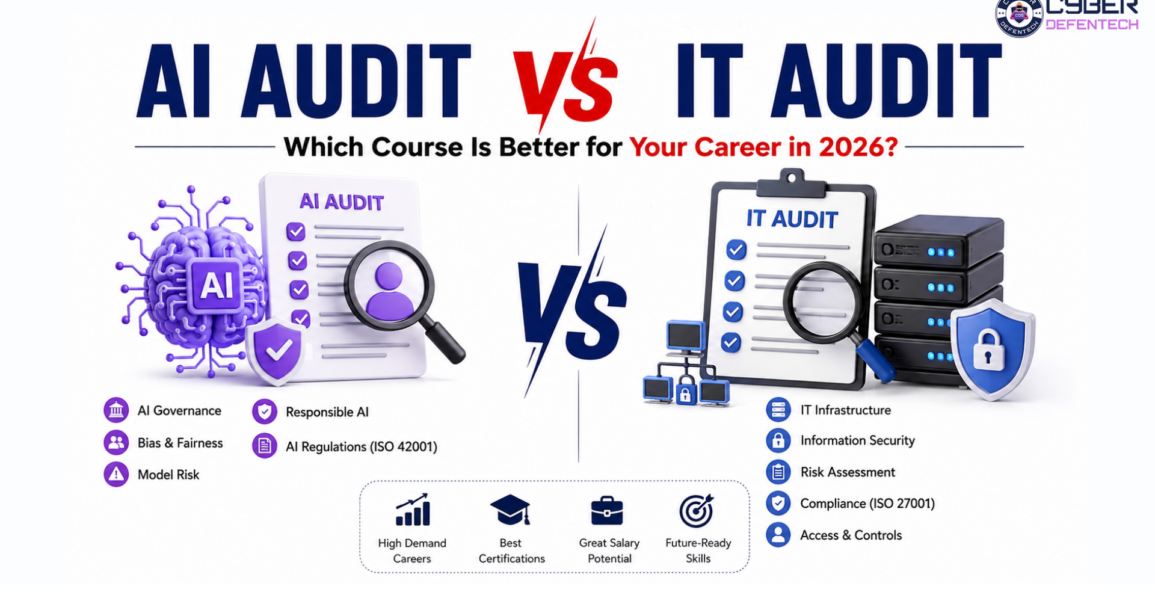
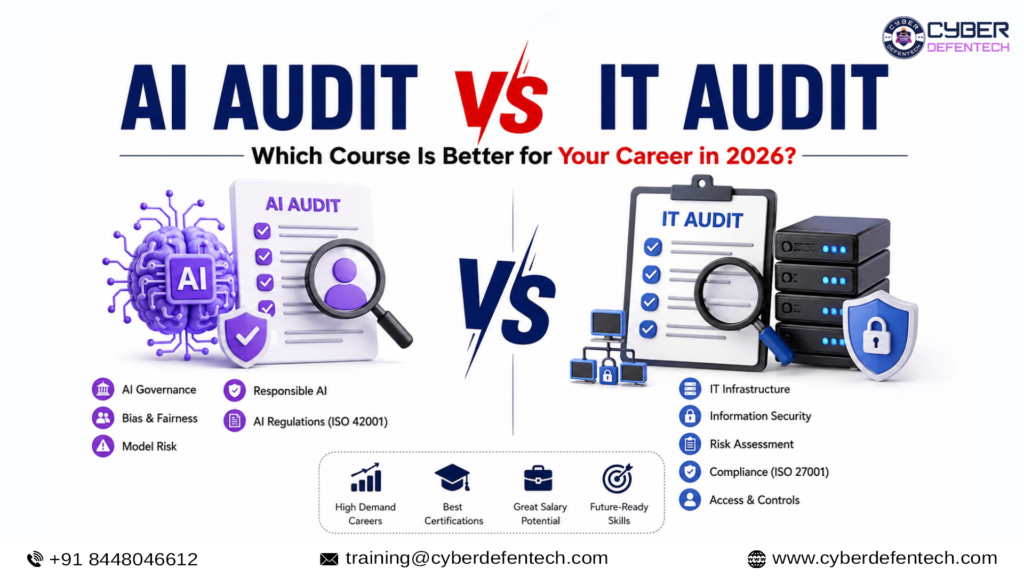
The AI Audit vs IT Audit decision is therefore becoming important for students, graduates, cybersecurity professionals, internal auditors, compliance teams and technology managers. Both fields assess technology-related risk, control effectiveness, governance and compliance. However, they do not examine exactly the same systems or ask exactly the same questions.
An AI auditor focuses on how an artificial-intelligence system is designed, governed, trained, deployed, monitored and used. The auditor may examine data quality, bias, transparency, explainability, human oversight, privacy, security, model performance and regulatory obligations.
An IT auditor focuses on the wider technology environment, including networks, servers, applications, databases, cloud systems, access controls, change management, business continuity and security operations.
This guide develops the original article structure—including definitions, comparison, skills, careers, course selection, learning paths and FAQs—into a complete professional article. It also includes current standards, recognised frameworks, an India-focused section, answer-friendly summaries and practical career guidance.
Quick Answer: Which Is Better in AI Audit vs IT Audit?
The better option depends on your existing knowledge and long-term career objective.
Choose IT Audit when you want a broad foundation in information systems, cybersecurity controls, networks, applications, access management, governance and compliance.
Choose AI Audit when you already understand audit, risk, data or technology and want to specialise in responsible AI, model risk, data governance, transparency and AI regulations.
For most beginners, the practical answer to AI Audit vs IT Audit is to learn IT audit fundamentals first and then add AI governance and AI audit capabilities.
IT audit builds transferable knowledge of controls, evidence, risk assessment, documentation and assurance. AI audit then adds specialised questions about datasets, model behaviour, human oversight, explainability, fairness and AI lifecycle governance.
What Is an AI Audit in the AI Audit vs IT Audit Comparison?
An AI audit is a structured evaluation of an artificial-intelligence system and the governance processes surrounding it. Its purpose is to determine whether the system is being developed, purchased, deployed and monitored responsibly.
An AI auditor does not usually develop the model. Instead, the auditor evaluates whether the organisation has:
- Identified relevant AI risks
- Assigned clear accountability
- Documented the system
- Evaluated its intended use
- Tested its outputs
- Protected sensitive data
- Established human oversight
- Created monitoring procedures
- Developed incident-management processes
- Maintained suitable audit evidence
ISO/IEC 42001 establishes requirements for creating, implementing, maintaining and continually improving an AI management system. It provides an organisational approach to the responsible development, provision and use of AI systems.
The NIST AI Risk Management Framework is another important resource. It is intended for voluntary use and organises AI risk-management activities around four major functions: Govern, Map, Measure and Manage.
In an AI Audit vs IT Audit comparison, the AI audit side examines technical and organisational questions. It may review model documentation, data lineage, intended use, prohibited use, performance metrics, fairness testing, security testing, human-review procedures, incident handling and post-deployment monitoring.
Why AI Audit Matters in AI Audit vs IT Audit
Organisations audit AI because automated decisions can affect customers, employees, patients, citizens and business operations.
A model may perform well during development but produce unreliable, unfair or unsafe results after deployment. Data can change, customer behaviour can change, business processes can evolve and new security threats can emerge.
AI audits help organisations answer questions such as:
- Is the AI system being used for its approved purpose?
- Is the training data appropriate?
- Is operational data accurate and relevant?
- Are outputs reliable enough for the business context?
- Are certain individuals or groups being affected unfairly?
- Can important decisions be explained?
- Is personal or confidential information protected?
- Is meaningful human oversight available?
- Can employees challenge or override an output?
- Are complaints and incidents recorded?
- Does management receive meaningful risk information?
- Are legal and contractual requirements being tracked?
- Is the AI system monitored after deployment?
- Are material changes independently reviewed?
The AI Audit vs IT Audit distinction is clear here. AI auditors are interested not only in whether the technology platform is secure, but also in whether the model’s behaviour is fair, responsible, explainable and aligned with its intended purpose.
Practical AI Audit vs IT Audit Example: A Bank Loan Model
Suppose a bank uses AI to support loan approvals. An AI auditor may check whether the system treats applicants consistently, whether rejected applications can be explained, whether the model uses appropriate data and whether customer information remains protected.
The auditor may also examine whether bank employees can override or escalate questionable results.
The AI auditor could review:
- The approved purpose of the model
- Data sources and data-quality checks
- Features used in decision-making
- Model-development documentation
- Fairness-testing results
- Model-validation reports
- Human-review requirements
- Customer-notification processes
- Access permissions
- Logging and monitoring
- Complaint procedures
- Appeal processes
- Change-control records
- Incident-response plans
- Model-retirement procedures
This example shows why AI Audit vs IT Audit is not simply “new audit versus old audit.” AI audit includes several traditional control questions but extends them to model behaviour, data ethics, transparency, explainability and lifecycle monitoring.
What Is an IT Audit in the AI Audit vs IT Audit Comparison?
An IT audit is a structured examination of an organisation’s information systems, technology processes and controls.
Its purpose is to determine whether systems:
- Protect information
- Support business objectives
- Operate reliably
- Prevent unauthorised activity
- Maintain data accuracy
- Support business continuity
- Follow approved policies
- Comply with relevant requirements
IT auditors commonly review:
- IT governance
- Information-security policies
- Network architecture
- Operating systems
- Databases
- Business applications
- Cloud environments
- Identity and access management
- Privileged access
- Change management
- Backup and recovery
- Incident management
- Vendor controls
- Business continuity
- Vulnerability management
- Security logging
- System monitoring
- Data-retention processes
ISO/IEC 27001 defines requirements for an information security management system. It provides a systematic approach to managing information-security risks through people, processes and technology.
Within AI Audit vs IT Audit, IT audit provides the broader technology foundation. Even an AI platform depends on cloud resources, identity controls, secure software, configuration management, logging, backup and incident response.
These areas remain part of IT audit even when specialised AI assurance is added.
Practical AI Audit vs IT Audit Example: Customer Database and Business Systems
Suppose a company stores customer and employee information in business applications and databases.
An IT auditor may check whether:
- Only authorised users can access the data
- Privileged accounts are properly controlled
- Access rights are periodically reviewed
- Security updates are installed
- Changes are approved and tested
- Backups are completed
- Restore procedures are tested
- Security incidents are recorded
- Vendors follow contractual requirements
- Business-continuity processes are available
The auditor may collect evidence such as:
- User-access lists
- Access-review approvals
- Firewall configurations
- Change tickets
- Backup logs
- Restore-test results
- Vulnerability reports
- Security policies
- Incident records
- Vendor contracts
- Business-continuity test results
- System-monitoring reports
The objective is not merely to find faults. A good IT audit evaluates risk, tests controls, explains the business impact of weaknesses and recommends practical improvements.
AI Audit vs IT Audit Comparison Table
| Feature | AI Audit | IT Audit |
|---|---|---|
| Primary focus | AI systems, models, data and governance | IT infrastructure, applications, processes and security |
| Main objective | Responsible, trustworthy and compliant AI use | Secure, reliable and controlled information systems |
| Major risks | Bias, model drift, unsafe output, opacity and weak oversight | Unauthorised access, outages, insecure changes and data loss |
| Evidence reviewed | Model cards, data lineage, validations and impact assessments | Policies, configurations, tickets, logs and access records |
| Core knowledge | AI governance, machine-learning basics, ethics and data risk | Networking, operating systems, security and audit methods |
| Relevant standards | ISO/IEC 42001, NIST AI RMF and applicable AI rules | ISO/IEC 27001, IT control frameworks and privacy requirements |
| Career roles | AI Auditor, AI Governance Specialist and AI Risk Manager | IT Auditor, Security Auditor and GRC Specialist |
| Coding requirement | Helpful but not compulsory for every position | Helpful but not compulsory for every position |
| Suitable for | People interested in AI, ethics, governance and emerging risks | People interested in cybersecurity, systems and controls |
| Beginner accessibility | Easier after audit or technology fundamentals | Stronger starting point for most beginners |
The table provides a quick AI Audit vs IT Audit answer, but the correct career choice also depends on the type of work you enjoy.
Major Differences in AI Audit vs IT Audit
Although both fields involve risk, controls, evidence and assurance, they differ in scope, technical requirements and expected outcomes.
Technology Scope in AI Audit vs IT Audit
IT audit covers the organisation’s wider information-technology environment. AI audit narrows its attention to AI systems and the controls surrounding their lifecycle.
In AI Audit vs IT Audit, the first major question is scope.
An IT auditor may evaluate the cloud platform hosting an AI model. The auditor could review access management, network configuration, backups, change management and incident monitoring.
An AI auditor evaluates whether the model has:
- An appropriate business purpose
- Reliable data
- Validated performance
- Fairness controls
- Suitable documentation
- Meaningful human oversight
- Post-deployment monitoring
- Defined accountability
Both reviews can be necessary for the same system.
Risk Types in AI Audit vs IT Audit
Traditional IT risks commonly involve:
- Confidentiality
- Integrity
- Availability
- Unauthorised access
- Insecure changes
- Service outages
- Poor recovery
- Weak monitoring
- Regulatory non-compliance
AI risks can additionally include:
- Bias
- Discrimination
- Harmful output
- Hallucinations
- Model drift
- Lack of explainability
- Inappropriate automation
- Poor-quality data
- Model misuse
- Unclear accountability
- Insufficient human oversight
The AI Audit vs IT Audit difference becomes particularly important when an AI system influences important decisions.
A system can be technically secure but still make unreliable or unfair decisions. Security controls alone do not complete an AI audit.
Audit Evidence in AI Audit vs IT Audit
IT auditors commonly work with:
- Security configurations
- Approved policies
- User-access lists
- Change tickets
- System logs
- Backup reports
- Security test results
- Vulnerability reports
- Incident records
AI auditors may require all of the above, along with:
- Model documentation
- AI system inventories
- Data-source records
- Data-lineage documentation
- Validation reports
- Testing datasets
- Fairness metrics
- Model-performance reports
- AI impact assessments
- Human-oversight records
- Monitoring thresholds
- Model-change documentation
Evidence must be sufficient, reliable, relevant and traceable to the audit objective.
Stakeholders in AI Audit vs IT Audit
IT audits commonly involve:
- IT administrators
- Cybersecurity teams
- Application owners
- Process owners
- Risk professionals
- Senior management
AI audits may additionally involve:
- Data scientists
- Machine-learning engineers
- AI product owners
- Data-governance teams
- Legal professionals
- Privacy professionals
- Ethics committees
- Model validators
- Industry specialists
Because AI systems can affect business decisions and individuals, AI auditors often work across several departments.
Regulatory Direction in AI Audit vs IT Audit
AI governance is evolving rapidly. The EU AI Act follows a risk-based regulatory approach, and official implementation guidance continues to clarify requirements and timelines. Organisations should rely on current official information rather than outdated summaries.
India’s official AI ecosystem also places emphasis on safe, inclusive, secure and trustworthy AI through governance initiatives, responsible-AI resources and the IndiaAI Safety Institute.
This regulatory development makes AI Audit vs IT Audit an important strategic career question rather than a temporary trend.
AI Audit vs IT Audit Skills: What AI Auditors Need
AI auditors require a mixture of governance, risk, technology, data and communication abilities.
AI Governance
AI governance defines:
- Who owns an AI system
- Who approves its use
- Which systems are permitted
- Which uses are restricted
- How risks are accepted
- How performance is monitored
- How incidents are escalated
- How management receives reports
In AI Audit vs IT Audit, governance is relevant to both fields. However, AI governance must specifically address model ownership, data responsibility, acceptable use, human oversight and AI accountability.
AI Risk Assessment
An AI auditor should identify risks throughout the complete AI lifecycle:
- Planning
- Data collection
- Development
- Training
- Testing
- Validation
- Deployment
- Monitoring
- Change
- Retirement
The auditor should connect technical weaknesses with customer, legal, financial, operational and reputational consequences.
Machine-Learning Fundamentals
An AI auditor does not necessarily need to become a data scientist. However, the auditor should understand:
- Training data
- Testing data
- Validation data
- Features
- Labels
- Model accuracy
- False positives
- False negatives
- Overfitting
- Underfitting
- Model drift
- Performance thresholds
This knowledge makes the AI Audit vs IT Audit transition easier because the auditor can ask meaningful technical questions without being responsible for developing the model.
AI Ethics and Responsible AI
AI ethics includes:
- Fairness
- Accountability
- Transparency
- Privacy
- Safety
- Security
- Human rights
- Human oversight
- Social impact
Responsible AI converts these principles into policies, controls, testing, documented decisions and monitoring processes.
Bias Detection and Fairness
Bias can enter an AI system through:
- Historical data
- Incomplete data
- Incorrect assumptions
- Inaccurate labels
- Feature selection
- Sampling methods
- Deployment context
- Human feedback
- Feedback loops
An auditor should check whether the organisation has identified relevant groups, selected appropriate fairness measures, investigated differences and documented its decisions.
Transparency and Explainability
Transparency means stakeholders receive suitable information about an AI system, including its purpose, limitations and responsible owner.
Explainability concerns whether important outputs or decisions can be understood at the level required by users, reviewers, regulators or affected individuals.
Data Governance
AI performance depends heavily on data. Auditors should evaluate:
- Data ownership
- Data sources
- Data lineage
- Data quality
- Consent
- Privacy
- Accuracy
- Relevance
- Retention
- Access
- Security
- Deletion
Weak data governance can undermine an otherwise sophisticated AI model.
Documentation and Audit Reporting
AI auditors must translate complex technical findings into clear observations.
A professional audit observation generally explains:
- Condition: What was found?
- Criteria: What should have happened?
- Cause: Why did the issue occur?
- Risk: What could happen?
- Recommendation: What should management do?
Communication Skills
AI auditors communicate with technical and non-technical stakeholders, including data scientists, legal professionals, process owners and senior management.
They must explain complex risks without unnecessary jargon.
ISO/IEC 42001 Knowledge
ISO/IEC 42001 provides a structured, organisation-wide approach to AI management.
ISO/IEC 42006 addresses consistent and credible auditing and certification of AI management systems. ISO/IEC 42005 provides guidance for conducting AI system impact assessments.
For professionals comparing AI Audit vs IT Audit, knowledge of these standards can create a structured route into AI assurance.
AI Audit vs IT Audit Skills: What IT Auditors Need
IT auditors require broad technical, security, governance and audit knowledge.
Networking
An IT auditor should understand:
- IP addressing
- DNS
- Routers
- Switches
- Network segmentation
- Firewalls
- Remote access
- Virtual private networks
- Wireless security
- Common ports
- Network protocols
This knowledge helps auditors evaluate how systems communicate and how network risks are controlled.
Information Security
Important concepts include:
- Confidentiality
- Integrity
- Availability
- Threat
- Vulnerability
- Risk
- Control
- Incident
- Resilience
- Recovery
Auditors must understand the relationship between threats, vulnerabilities, business impact and security controls.
Operating Systems and Databases
IT auditors should understand:
- User accounts
- Permissions
- Security updates
- Patch management
- Secure configuration
- Event logging
- Database access
- Backup
- Recovery
- System monitoring
Identity and Access Management
Access management is central to IT audit.
Auditors commonly test:
- User creation
- Management approval
- Access modification
- Employee termination
- Privileged access
- Password settings
- Multi-factor authentication
- Periodic access reviews
- Segregation of duties
Risk Assessment
An IT auditor evaluates the likelihood and potential impact of technology risks. The auditor then determines whether implemented controls reduce risk to an acceptable level.
Internal Controls
Controls may be:
- Preventive
- Detective
- Corrective
- Manual
- Automated
- Technical
- Administrative
- Physical
Auditors need to understand control design, implementation and operating effectiveness.
ISO/IEC 27001
ISO/IEC 27001 helps organisations establish, implement, maintain and continually improve an information security management system.
Its management-system approach makes it useful for people working in IT audit, cybersecurity, governance, risk and compliance.
Vulnerability and Configuration Assessment
IT auditors should understand:
- Vulnerability reports
- Risk ratings
- Patch status
- Secure configuration
- Remediation
- Exception approval
- Retesting
IT auditors do not always perform penetration tests, but they should be able to interpret findings and evaluate management action.
Security Policies and Procedures
Policies establish organisational expectations. Procedures describe how employees perform specific activities.
Auditors compare actual practice with:
- Approved policies
- Procedures
- Legal requirements
- Contractual requirements
- Standards
- Management expectations
Audit Documentation
Audit working papers should clearly show:
- What was tested
- Who performed the test
- Which evidence was reviewed
- Which sample was selected
- What result was identified
- How the conclusion was supported
When evaluating AI Audit vs IT Audit, remember that IT audit skills remain valuable in AI auditing because AI systems still depend on secure and controlled technology environments.
Is Coding Required for AI Audit vs IT Audit?
Coding is helpful, but it is not compulsory for every audit position.
For AI audit, Python or SQL can help with:
- Data analysis
- Audit sampling
- Fairness testing
- Data-quality checks
- Performance validation
- Evidence analysis
- Audit automation
For IT audit, scripting can help analyse:
- Access lists
- System logs
- Security configurations
- Change records
- Vulnerability reports
- Large evidence files
Many professionals succeed through strong governance, risk, control, process and communication skills.
The key AI Audit vs IT Audit lesson is that technical depth should match the role.
A highly technical model auditor may require programming and statistical skills. An AI-governance auditor may concentrate more on policies, documentation, accountability and compliance.
Beginners can start with:
- Basic Python
- Basic SQL
- Spreadsheet analysis
- Data visualisation
- Audit automation
- System-log interpretation
- Basic API knowledge
Career Opportunities in AI Audit vs IT Audit: AI Roles
AI audit and governance can lead to several emerging career roles.
AI Auditor
An AI Auditor plans and conducts assurance work over AI systems.
Responsibilities may include:
- Reviewing AI governance
- Evaluating data controls
- Examining model validation
- Reviewing monitoring processes
- Assessing human oversight
- Testing documentation
- Evaluating compliance
AI Governance Specialist
An AI Governance Specialist helps create:
- AI policies
- AI committees
- Approval processes
- AI inventories
- Accountability structures
- Risk-reporting procedures
- Responsible-use requirements
Responsible AI Consultant
A Responsible AI Consultant helps organisations convert principles such as fairness, transparency and accountability into practical policies and controls.
AI Compliance Analyst
An AI Compliance Analyst tracks:
- Regulatory requirements
- Contractual obligations
- Internal policies
- Documentation requirements
- Compliance evidence
- Remediation activities
AI Risk Manager
An AI Risk Manager identifies, evaluates, reports and monitors risks across the AI lifecycle.
This professional may maintain an AI risk register and present key risks to management.
AI Ethics Officer
An AI Ethics Officer may support:
- Ethical reviews
- Stakeholder-impact analysis
- Responsible-use decisions
- AI policy development
- Escalation of high-impact cases
Job titles and responsibilities vary between organisations.
The AI Audit vs IT Audit career comparison shows that AI roles are often cross-functional. They connect technology, data, risk, policy, law and business operations.
Career Opportunities in AI Audit vs IT Audit: IT Roles
IT audit offers established career options across industries.
IT Auditor
An IT Auditor evaluates information systems, technology processes and controls.
Work may include:
- Audit planning
- Risk assessment
- Evidence collection
- Control testing
- Report writing
- Management discussions
- Finding follow-up
Information Security Auditor
This role focuses on:
- Security governance
- User access
- Vulnerability management
- Incident response
- System monitoring
- Security standards
- Information-security controls
Internal Auditor with Technology Focus
Internal auditors assess technology risks as part of wider operational, financial and compliance audits.
Cyber Risk Consultant
A Cyber Risk Consultant helps organisations:
- Identify technology risks
- Design controls
- Prepare for audits
- Conduct assessments
- Improve governance
- Manage remediation
Compliance Analyst
A Compliance Analyst maps requirements to controls, gathers evidence, tracks gaps and supports compliance assessments.
Governance, Risk and Compliance Specialist
A GRC Specialist may support:
- Security policies
- Risk registers
- Control frameworks
- Compliance programmes
- Third-party risk
- Audit coordination
- Remediation tracking
In AI Audit vs IT Audit, IT audit generally provides a broader range of entry routes because most established organisations have technology controls requiring assurance.
Certifications and Courses for AI Audit vs IT Audit
Certifications can support structured learning, but they should be combined with practical skills and relevant experience.
CISA for IT Audit
ISACA’s CISA examination contains 150 questions and covers five job-practice domains. Passing the examination is only one step. Full certification also requires relevant professional experience under ISACA’s eligibility requirements.
CISA can be valuable for experienced professionals. Beginners should understand the difference between studying the syllabus, passing the exam and meeting the full certification requirements.
ISO/IEC 27001 Lead Auditor
ISO/IEC 27001 Lead Auditor training can help professionals understand:
- Audit planning
- Opening meetings
- Evidence collection
- Interview techniques
- Audit sampling
- Nonconformity reporting
- Closing meetings
- Audit reporting
- Follow-up activities
Students should verify the training provider, accreditation, examination rules and certificate type before enrolling.
ISO/IEC 42001 Training
ISO/IEC 42001 awareness, implementer and auditor courses can introduce:
- AI management systems
- AI governance
- AI policies
- AI risks
- AI objectives
- Impact assessment
- Monitoring
- Internal audit
- Continual improvement
Course names and certification arrangements can differ by provider, so students should verify all current details.
ISACA Advanced in AI Audit
ISACA’s Advanced in AI Audit certification is designed for experienced auditors. Candidates must hold an active CISA or another qualifying advanced audit credential.
Its exam covers AI governance and risk, AI operations, and AI auditing tools and techniques.
This requirement is important in AI Audit vs IT Audit planning because AAIA is not positioned as an entry-level certification for an absolute beginner.
AI Audit vs IT Audit: Which Course Should You Choose?
The correct course depends on your interests, existing skills and career goals.
Choose AI Audit When:
- You are interested in artificial intelligence and data
- You enjoy governance, ethics and risk
- You want to evaluate model behaviour
- You want to examine AI controls
- You are interested in responsible AI
- You want to work with Generative AI governance
- You can work with technical and legal teams
- You already have audit, compliance, cybersecurity or data experience
Choose IT Audit When:
- You are interested in cybersecurity
- You enjoy networks and infrastructure
- You want a broad audit foundation
- You prefer established assurance practices
- You are interested in information security
- You enjoy risk and compliance
- You want roles in IT audit or GRC
- You are beginning your audit career
The most practical AI Audit vs IT Audit recommendation for beginners is to start with IT fundamentals and audit methodology.
After establishing that foundation, learners can add:
- Machine-learning basics
- AI governance
- AI risk
- Data governance
- Responsible AI
- ISO/IEC 42001
Best Choice for Students
Students should begin with:
- Computer fundamentals
- Networking
- Operating systems
- Information security
- Risk management
- Internal controls
- Audit documentation
They can then explore IT audit through practical exercises, case studies and internships.
After building this foundation, students can study AI concepts, data governance and ISO/IEC 42001. This staged AI Audit vs IT Audit path reduces confusion and makes advanced AI assurance easier.
Best Choice for Cybersecurity Professionals
Cybersecurity professionals already understand threats, vulnerabilities, controls, access and incident response.
IT audit can strengthen their:
- Assurance skills
- Evidence collection
- Risk assessment
- Audit documentation
- Reporting
AI audit can then add model-specific risk and governance knowledge.
Best Choice for Internal Auditors
Internal auditors may already understand:
- Evidence
- Risk
- Controls
- Sampling
- Audit reports
- Management communication
They should strengthen technology fundamentals before learning AI lifecycle concepts and responsible-AI controls.
Best Choice for Data and AI Professionals
Data professionals may understand models and datasets but need to learn:
- Governance
- Audit independence
- Evidence requirements
- Control testing
- Risk assessment
- Reporting
For them, the AI Audit vs IT Audit choice may begin with AI audit, supported by essential information-security and IT-control knowledge.
Recommended AI Audit vs IT Audit Learning Path
A structured roadmap can help beginners avoid random learning.
Stage 1: Technology Fundamentals
Learn:
- Computer hardware
- Software
- Networking
- Windows
- Linux
- Databases
- Cloud fundamentals
- Cybersecurity basics
Stage 2: Risk and Control Fundamentals
Study:
- Risk identification
- Risk analysis
- Control types
- Control design
- Evidence
- Audit sampling
- Audit planning
- Findings
- Recommendations
Stage 3: IT Audit
Practise:
- User-access reviews
- Change-management audits
- Backup and recovery reviews
- Vulnerability-management reviews
- Vendor-risk assessments
- Policy-compliance audits
- Incident-management reviews
Stage 4: AI Fundamentals
Learn:
- Machine-learning lifecycle
- Training data
- Testing data
- Model validation
- Model performance
- Bias
- Explainability
- Model drift
- Generative AI risks
Stage 5: AI Governance and Audit
Study:
- ISO/IEC 42001
- NIST AI RMF
- AI impact assessments
- AI inventories
- Model documentation
- Human oversight
- AI incident management
- Regulatory monitoring
This five-stage AI Audit vs IT Audit pathway is suitable for students and career changers because it develops broad foundations before specialisation.
A 12-Month Beginner Roadmap
Months 1–2: IT and Networking
Learn:
- Operating systems
- IP addressing
- DNS
- Routers
- Switches
- Common ports
- Cloud basics
- Security fundamentals
Months 3–4: Information Security and Controls
Study:
- Access control
- Change management
- Vulnerability management
- Backup
- Incident response
- Business continuity
- Security monitoring
Months 5–6: Audit Methodology
Learn:
- Audit scope
- Audit objectives
- Evidence
- Sampling
- Control testing
- Documentation
- Finding development
- Audit reporting
Months 7–8: Practical IT Audit Projects
Complete projects such as:
- Access-control review
- Backup-control review
- Change-management review
- Policy-gap assessment
- Vendor-risk questionnaire
Months 9–10: AI and Data Fundamentals
Learn:
- AI lifecycle
- Datasets
- Model performance
- Bias
- Explainability
- Privacy
- AI security
Months 11–12: AI Governance Projects
Create:
- AI system inventory
- AI risk assessment
- AI impact assessment
- Model-card checklist
- Human-oversight checklist
- AI audit programme
At the end of the year, compare AI Audit vs IT Audit again based on the activities you enjoyed most. Practical experience will provide a more reliable answer than promotional course advertisements.
AI Audit vs IT Audit in India
India’s technology, digital-services, financial, healthcare, retail and public-sector ecosystems are adopting data and artificial intelligence across different use cases.
Official IndiaAI initiatives emphasise safe, inclusive, secure and trustworthy AI, while responsible-AI resources provide practical governance guidance.
For Indian students and professionals, AI Audit vs IT Audit should not be treated as a choice between a future field and an outdated field.
Organisations require secure infrastructure and dependable IT controls before they can operate AI responsibly.
Potential employers can include:
- IT-service companies
- Consulting organisations
- Banks
- Financial institutions
- Insurance companies
- Technology companies
- Audit firms
- Advisory firms
- Healthcare organisations
- E-commerce businesses
- Telecommunication companies
- Government organisations
- Public-sector organisations
- Large enterprises adopting AI
Candidates should review current job descriptions because titles vary.
Relevant opportunities may be advertised under:
- IT Audit
- Technology Risk
- Cyber Risk
- GRC
- Model Risk
- Responsible AI
- AI Governance
- Data Risk
- Digital Trust
- Information Security Audit
AI Audit and IT Audit Training in Delhi NCR
Students in Delhi, Noida, Gurugram, Ghaziabad, Faridabad and nearby locations can compare classroom, online and hybrid programmes.
Before selecting a course, check:
- Trainer experience
- Official syllabus
- Practical exercises
- Audit case studies
- Standards covered
- Project work
- Examination preparation
- Certificate type
- Eligibility requirements
- Internship support
- Placement-support terms
- Total fees
- Additional charges
- Batch size
- Doubt support
A reliable AI Audit vs IT Audit course should explain the similarities and differences between the two areas.
It should not promise:
- Guaranteed jobs
- Guaranteed salaries
- Instant expertise
- Certification without examination
- Professional status without experience
Cyber Defentech learners can request current details about IT audit, cybersecurity, ISO/IEC 27001, AI governance and ISO/IEC 42001 learning pathways before enrolling.
Salary and Career Growth
Salary depends on:
- Country
- City
- Industry
- Organisation
- Role
- Qualification
- Certification
- Practical skills
- Professional experience
- Communication ability
A certification alone does not determine compensation.
IT audit offers established career levels such as:
- Junior IT Auditor
- IT Auditor
- Senior IT Auditor
- Audit Manager
- Technology Risk Manager
- Head of IT Audit
- Audit Leader
AI audit titles are still evolving. Positions may be located within:
- Internal audit
- Technology risk
- Model risk
- Compliance
- Data governance
- Responsible AI
- Digital trust
The AI Audit vs IT Audit salary decision should focus on relevant capabilities instead of one advertised salary figure.
Professionals who combine audit methodology, cybersecurity, data governance, AI knowledge and communication may be able to work across a wider range of assignments.
Why AI Audit Is Gaining Attention
AI systems are increasingly supporting important business processes. Organisations require assurance that AI risks are identified, controls are documented and systems are continuously monitored.
AI audit is receiving attention because:
- AI adoption is expanding
- Management needs evidence of responsible use
- Customers expect transparency
- Regulators are developing requirements
- Boards need clearer AI-risk reporting
- AI failures can create legal consequences
- AI failures can interrupt operations
- AI failures can harm organisational reputation
- Traditional audits may not fully cover model-specific risks
However, the AI Audit vs IT Audit conclusion should not be that AI audit will replace IT audit.
AI platforms still rely on:
- Secure systems
- Controlled access
- Reliable data
- Approved changes
- Continuous monitoring
- Effective incident response
- Resilient technology operations
Common Mistakes to Avoid
Choosing a Course Only Because AI Is Trending
Interest in AI is valuable, but career decisions should be based on actual work preferences and foundational abilities.
Ignoring IT Fundamentals
AI auditors still need to understand:
- Security
- User access
- Cloud systems
- Databases
- Data
- Change management
- Incident response
Collecting Certificates Without Practice
Certificates cannot replace:
- Evidence collection
- Control testing
- Audit judgement
- Documentation
- Projects
- Professional experience
Expecting Coding to Solve Everything
Coding is helpful, but auditors also require:
- Professional judgement
- Independence
- Communication
- Documentation
- Business understanding
- Ethical decision-making
Using Outdated Regulatory Information
AI requirements continue to evolve. Professionals should regularly verify official sources and updated guidance.
Claiming Expertise Too Early
A short course can provide awareness, but professional competence requires practice, appropriate supervision and experience.
Avoiding these mistakes makes the AI Audit vs IT Audit career decision more realistic and sustainable.
Practical Portfolio Projects
Students can develop projects without accessing confidential organisational systems.
IT Audit Projects
- User-access review checklist
- Change-management audit programme
- Backup and restore review
- Vendor-risk questionnaire
- ISO/IEC 27001 gap assessment
- Vulnerability-remediation tracker
- Incident-management audit checklist
- Business-continuity review
AI Audit Projects
- AI system inventory
- AI risk register
- Model-card review checklist
- AI impact-assessment template
- Bias-testing plan
- Human-oversight checklist
- Generative AI acceptable-use policy
- AI incident-response workflow
- AI vendor-risk questionnaire
- Model-monitoring dashboard concept
A portfolio comparing AI Audit vs IT Audit projects can demonstrate that a candidate understands both assurance areas.
Frequently Asked Questions
1. What Is the Main Difference Between AI Audit and IT Audit?
AI audit evaluates AI systems, data, model behaviour, governance and responsible use.
IT audit evaluates broader information systems, infrastructure, applications, security and technology controls.
2. Which Is Better for Beginners?
For most beginners, the AI Audit vs IT Audit starting point should be IT fundamentals and IT audit.
AI audit becomes easier after learning technology basics, risks, controls, evidence and audit documentation.
3. Do I Need Coding for AI Audit?
Coding is not mandatory for every role.
It can be helpful for data analysis, fairness testing, audit automation and technical validation. Governance and compliance positions may focus more on risk, policies, documentation and communication.
4. Can a Commerce Student Enter AI Audit or IT Audit?
Yes. Commerce students can build technical foundations and use their knowledge of business, risk, finance, internal controls and compliance.
5. Can a Cybersecurity Professional Become an AI Auditor?
Yes. Cybersecurity knowledge is valuable, but professionals should add:
- Machine-learning fundamentals
- Data governance
- Responsible AI
- AI risk assessment
- AI lifecycle governance
6. Can an IT Auditor Move into AI Audit?
Yes. This is one of the most logical AI Audit vs IT Audit career transitions because IT auditors already understand evidence, controls, risk, governance and reporting.
7. Is CISA Suitable for Beginners?
Beginners can study CISA concepts, but full certification includes professional-experience requirements.
Candidates should always verify ISACA’s current eligibility and certification policies.
8. Is ISO/IEC 42001 Only for AI Developers?
No. ISO/IEC 42001 is an organisational management-system standard that applies to organisations developing, providing or using AI systems.
9. Is ISO/IEC 27001 Useful for AI Auditors?
Yes. AI systems depend on information security, access control, risk management and governance.
ISO/IEC 27001 knowledge can strengthen an AI auditor’s IT-control foundation.
10. Which Field Has Better Future Scope?
Both fields have career value.
IT audit remains essential for technology assurance, while AI audit is an emerging specialisation. The strongest AI Audit vs IT Audit strategy may be to combine both areas.
11. Can I Learn Both?
Yes. Begin with technology and IT audit before adding AI fundamentals, AI governance and responsible-AI assurance.
This sequence can create a broad and flexible professional profile.
12. Which Course Should I Join First?
Absolute beginners should begin with:
- IT fundamentals
- Networking
- Cybersecurity
- Risk management
- Internal controls
- Audit basics
Experienced auditors can move more directly into AI governance and AI audit training.
Final Verdict
AI Audit vs IT Audit is not a competition in which one field makes the other unnecessary.
IT audit provides broad assurance over the systems, processes and controls that organisations depend on.
AI audit adds specialised assurance over:
- AI governance
- Data
- Models
- Fairness
- Transparency
- Explainability
- Human oversight
- Responsible use
Choose IT audit when you want a broad and established foundation in technology risk and controls.
Choose AI audit when you already possess relevant foundations and want to specialise in an emerging assurance area.
For beginners, the strongest pathway is generally IT audit first, followed by AI audit.
The best long-term AI Audit vs IT Audit career strategy is to understand both areas. Organisations need professionals who can evaluate secure technology environments and also recognise the unique risks created by artificial-intelligence systems.
About This Guide
This article was developed from the original user-provided draft and expanded using current information from official standards, government and certification sources.
Written by: Cyber Defentech Editorial Team
Reviewed by: Cybersecurity, GRC and AI Governance Training Team
Last Updated: August 2026
Editorial Disclaimer
Certification, course completion and training do not guarantee employment, salary growth or promotion.
Readers should verify current:
- Eligibility requirements
- Course fees
- Examination policies
- Certification requirements
- Applicable laws
- Regulatory guidance
- Standards and frameworks
Verification should be completed through the relevant official organisation or certification provider.
Contact Cyber Defentech
For current information about IT audit, information security, ISO/IEC 27001, AI governance and ISO/IEC 42001 training pathways:
 Call/WhatsApp:

Location: D-12/77, 2nd Floor, Sector 8, Near Rohini East Metro Station Gate No. 2, Rohini, Delhi – 110085
