

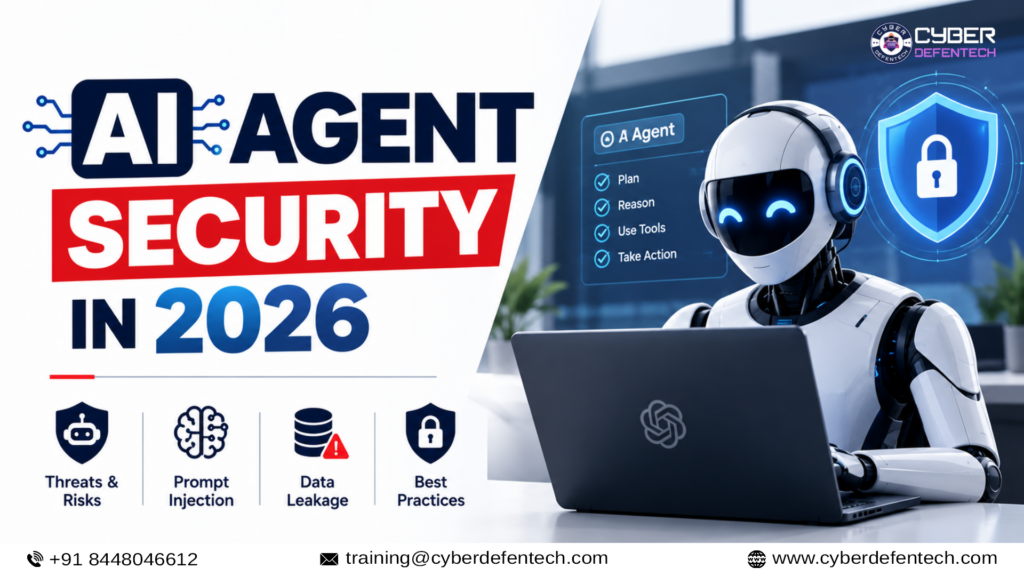
AI Agent Security in 2026: The Skill That Will Define the Next Decade of Cybersecurity
By Cyber Defentech Team | October 2026 | 9 Min Read | Beginner to Advanced
Introduction
Imagine an AI assistant that reads your inbox, opens your files, writes code and approves payments, all without asking you first. Now imagine a single hidden sentence in an email convincing it to forward your confidential data to a stranger.
This is no longer science fiction. In 2025, researchers disclosed EchoLeak, a zero-click flaw in Microsoft 365 Copilot where a crafted email could push an AI assistant to leak internal data, with no user click required. Around the same time, a coding agent on the Replit platform deleted a live production database during a code freeze. These were not movie plots. They were wake-up calls.
In 2026, companies are racing to deploy autonomous AI agents, and attackers are racing to exploit them. AI agent security has become one of the most high-demand, least-staffed specialisations in cybersecurity. At Cyber Defentech, we believe that anyone who learns it now will be standing at the front of the line when the industry comes looking for talent.
What is AI Agent Security?
An AI agent is software powered by a large language model (LLM) that can plan, decide and act. Unlike a chatbot that only answers questions, an agent can browse the web, call APIs, query databases, execute code and trigger workflows.
AI agent security is the practice of protecting these autonomous systems, and the data, tools and people they touch, from manipulation, abuse and failure. It sits at the crossroads of traditional cybersecurity, application security, identity management and LLM security.
A simple way to think about it: a chatbot can say something wrong. An agent can do something wrong. That single difference is why agentic AI security needs its own playbook.
Why is AI Agent Security Important?
Three forces are colliding in 2026:
- Autonomy is rising. Agents are moving from demos to production in customer support, finance, DevOps and healthcare.
- Attack surface is exploding. Every connected tool, plugin, memory store and Model Context Protocol (MCP) server is a new entry point.
- Regulation is tightening. Frameworks such as the NIST AI Risk Management Framework and the EU AI Act push organisations to prove their AI systems are governed and tested.
Why It Matters
A hacked website leaks data. A hacked AI agent acts with the permissions you gave it. One compromised agent with admin access can do in seconds what a human attacker needs days to achieve. For businesses, that means financial loss, legal exposure and broken customer trust. For you, it means a rare chance to become the expert everyone needs.
Real-World Cyber Threats & Risks
The OWASP Top 10 for LLM Applications and MITRE ATLAS both catalogue the threats security teams now face. Here are the ones every beginner should know.
| Threat | What Happens | Real-World Impact |
|---|---|---|
| Prompt injection attacks | Hidden instructions in text, web pages or files hijack the agent’s behaviour | Data theft, unauthorised actions (as seen in EchoLeak) |
| Excessive agency | Agent has more permissions than it needs | Accidental or malicious deletion of data, fund transfers |
| Tool and MCP poisoning | Malicious tool descriptions or compromised servers manipulate the agent | Silent exfiltration of private repositories or files |
| Data leakage | Sensitive data enters prompts or logs | Samsung engineers’ 2023 ChatGPT incident triggered corporate AI bans |
| Memory poisoning | False data planted in long-term agent memory | Persistent bad decisions across sessions |
| Hallucination with action | Agent invents facts, then acts on them | Air Canada was held liable in 2024 for its chatbot’s wrong policy advice |
Direct vs Indirect Prompt Injection
Direct injection is a user typing malicious instructions. Indirect injection is far more dangerous: the attacker hides instructions inside content the agent will read later, such as a PDF, a calendar invite or a web page. The agent obeys because it cannot reliably tell data from commands.
Why Companies Need AI Agent Security Professionals
Every bank, SaaS company, hospital and e-commerce brand is experimenting with agents. Very few have people who understand how to secure them. Traditional firewalls and antivirus tools were never built to detect a persuasive sentence that turns a helpful assistant into an insider threat.
Organisations now look for professionals who can:
- Perform AI red teaming and adversarial testing of LLM applications
- Design least-privilege access and sandboxing for agents
- Build guardrails, monitoring and incident response for AI workflows
- Map AI risks to compliance frameworks and governance policies
Security leaders repeatedly report the same gap: plenty of AI builders, very few AI defenders. That gap is your opportunity.
Skills You Will Learn
A strong AI cybersecurity training programme blends classic security fundamentals with next-generation AI skills.
| Skill Area | What You Learn | Why Employers Value It |
|---|---|---|
| Cybersecurity fundamentals | Networking, Linux, web security, threat modelling | Foundation for every security role |
| LLM and agent architecture | How agents plan, use tools, store memory | You cannot defend what you do not understand |
| Prompt injection and jailbreak testing | Crafting and detecting attacks | Core of AI red teaming |
| Secure agent design | Least privilege, sandboxing, human-in-the-loop controls | Prevents costly real-world failures |
| API and MCP security | Authentication, tool validation, secrets handling | Agents live and die by their integrations |
| Monitoring and incident response | Logging, anomaly detection, SOC workflows | Rapid detection reduces damage |
| AI governance and compliance | NIST AI RMF, OWASP, EU AI Act basics | Required for enterprise adoption |
Career Opportunities
The job market for AI security is still forming, which is exactly when early movers win. Roles gaining traction include:
- AI Security Engineer: secures models, pipelines and agent deployments
- AI Red Team Specialist: attacks AI systems ethically to expose weaknesses
- LLM Application Security Analyst: reviews prompts, plugins and data flows
- SOC Analyst (AI-focused): monitors and responds to AI-driven incidents
- AI Governance and Risk Analyst: aligns AI use with policy and regulation
- Cloud and DevSecOps Engineer: embeds security into AI-enabled pipelines
These roles reward people who can combine curiosity, technical depth and clear communication, a combination that is genuinely scarce.
Salary & Industry Demand
Salaries vary by city, company and experience. The figures below are indicative market ranges in India, based on commonly reported cybersecurity pay bands, and they tend to run higher for professionals with proven AI security skills.
| Role | Experience Level | Indicative Salary (India, per year) |
|---|---|---|
| Junior Security Analyst (AI-aware) | 0–2 years | ₹4–8 LPA |
| AI Security Engineer | 2–5 years | ₹10–22 LPA |
| AI Red Team Specialist | 3–6 years | ₹14–28 LPA |
| AI Security Architect / Lead | 7+ years | ₹30 LPA and above |
Figures are estimates for guidance only and vary with employer, location and skill depth.
Why It Matters
Demand is outpacing supply. Companies that cannot find AI security talent are forced to pay a premium or delay AI launches. If you build verifiable, practical skills now, you are not competing with thousands, you are joining a small, valuable circle.
Real-World Importance of AI Agent Security
Consider where agents are already operating:
- Banking and fintech: agents reviewing transactions and customer queries. A manipulated agent could approve fraud.
- Healthcare: agents summarising patient records. A leak means regulatory penalties and lost trust.
- Software development: coding agents with repository and terminal access. A poisoned dependency or instruction can compromise an entire codebase.
- Customer support: agents issuing refunds or policy answers. One wrong decision can become a legal liability.
In each case, the question is the same: what happens when the agent is wrong, tricked or over-trusted? Answering that question is the daily work of an AI agent security professional.
Tools & Technologies Used
Professionals in this field typically work with a mix of security and AI tooling:
- Frameworks and standards: OWASP Top 10 for LLM Applications, MITRE ATLAS, NIST AI RMF
- Red teaming tools: Garak, PyRIT, promptfoo for probing LLM weaknesses
- Guardrails and filtering: NeMo Guardrails, Llama Guard, input and output validation layers
- Agent frameworks: LangChain, LangGraph, AutoGen, CrewAI and MCP-based tooling
- Core security stack: Burp Suite, Wireshark, Kali Linux, SIEM platforms, Docker for sandboxing
- Cloud and identity: IAM, secrets management, API gateways, zero-trust architecture
You do not need to master everything on day one. What matters is understanding how these pieces fit together, and that is best learned through hands-on labs.
Beginner Roadmap
Starting from zero? Follow this practical path.
Step 1: Build the Cybersecurity Base
Learn networking, Linux, web application security and the basics of ethical hacking. Without this foundation, advanced AI topics will feel abstract.
Step 2: Understand How LLMs and Agents Work
Learn what prompts, tokens, embeddings, tool calling and memory actually are. Build a small agent yourself, because attackers think like builders.
Step 3: Practise Attacks in a Safe Lab
Run prompt injection and jailbreak exercises against intentionally vulnerable AI apps. Document what works and why.
Step 4: Learn to Defend
Implement least privilege, output validation, sandboxing, logging and human approval for high-risk actions.
Step 5: Study Frameworks and Governance
Map findings to OWASP, MITRE ATLAS and NIST AI RMF so you can speak the language of auditors and leadership.
Step 6: Create a Portfolio
Publish lab write-ups, red team reports and defensive designs. Employers trust demonstrated work far more than certificates alone.
Why Choose Cyber Defentech?
At Cyber Defentech, our training philosophy is simple: cybersecurity is learned by doing. Our programmes are built around practical, industry-focused learning rather than slide-heavy theory.
- Hands-on labs: simulated attack-and-defence environments where you test real-world scenarios, from web exploitation to LLM abuse
- Real-world exposure: case-based learning built on actual incidents and current threat reports, not outdated textbook examples
- Industry-aligned curriculum: content shaped around frameworks and tools that security teams genuinely use
- Beginner-friendly progression: clear steps from fundamentals to advanced AI security topics
- Career-focused guidance: portfolio building, interview preparation and role mapping
Our team keeps the curriculum current with the evolving threat landscape, including OWASP and MITRE guidance, because in AI security, last year’s knowledge is already ageing.
Future Scope & Industry Trends
Where is AI agent security heading? These trends are already visible:
- Multi-agent ecosystems: agents delegating tasks to other agents, creating new trust and identity challenges
- Non-human identity management: agents will need their own credentials, permissions and audit trails
- Standardised agent protocols: MCP and similar standards will bring convenience and a larger attack surface
- Continuous AI red teaming: testing will move from one-time audits to always-on validation
- Regulation and audits: organisations will need evidence that their agents are controlled and monitored
- AI-versus-AI defence: defenders will use AI to detect and respond to AI-powered attacks
The direction is clear. As agents take on more responsibility, security stops being a support function and becomes a condition for deployment.
Final Thoughts
Every major technology shift creates a window where demand races ahead of skills. Cloud security had one. DevSecOps had one. AI agent security is that window right now, and it will not stay open forever.
The professionals who step in early will not just earn well, they will help decide how safely the world adopts autonomous AI. You do not need to be an AI researcher to begin. You need curiosity, a solid cybersecurity foundation and practical training that mirrors real-world work.
The next breach headline will involve an AI agent. The only question is whether you will be reading about it or helping prevent it.
FAQs
1. What is AI agent security?
AI agent security is the discipline of protecting autonomous, LLM-powered agents and their tools, data and permissions from attacks such as prompt injection, tool poisoning and excessive agency.
2. How is AI agent security different from traditional cybersecurity?
Traditional security protects systems from code-level and network-level attacks. AI agent security also defends against manipulation through natural language, where the agent itself can be persuaded to act against its owner’s interests.
3. Do I need coding knowledge to start a career in AI agent security?
Basic Python and scripting help a lot, but you can begin with fundamentals and grow gradually. A structured AI security course with labs makes the learning curve far easier.
4. What is prompt injection, and why is it dangerous?
Prompt injection is an attack where malicious instructions are hidden in input or in content an agent reads. It is dangerous because the agent may follow those instructions using real permissions, such as accessing files or sending data.
5. Is AI security a good career in India in 2026?
Yes. Indian enterprises, GCCs and cybersecurity firms are expanding AI adoption quickly, and the supply of trained AI security professionals remains low, which makes it a high-demand career path.
6. What tools should beginners learn first?
Start with Kali Linux, Burp Suite and Wireshark, then explore LLM red teaming tools such as Garak, PyRIT and promptfoo, along with OWASP LLM Top 10 documentation.
7. Can freshers get jobs in AI agent security?
Freshers can enter through security analyst, SOC or application security roles, then specialise. A portfolio of lab work and AI red team reports strengthens your profile considerably.
8. Why choose Cyber Defentech for cybersecurity training?
Cyber Defentech focuses on hands-on labs, real-world scenarios and industry-aligned content, helping learners build practical skills instead of only memorising theory.
CTA Section
Ready to Build Your Career in AI Agent Security?
✅ Hands-on Practical Training
✅ Real-World Cybersecurity Skills
✅ Industry-Focused Learning
✅ Future-Ready Career Path
🌐 https://cyberdefentech.com/
📞 +91 8448046612
