

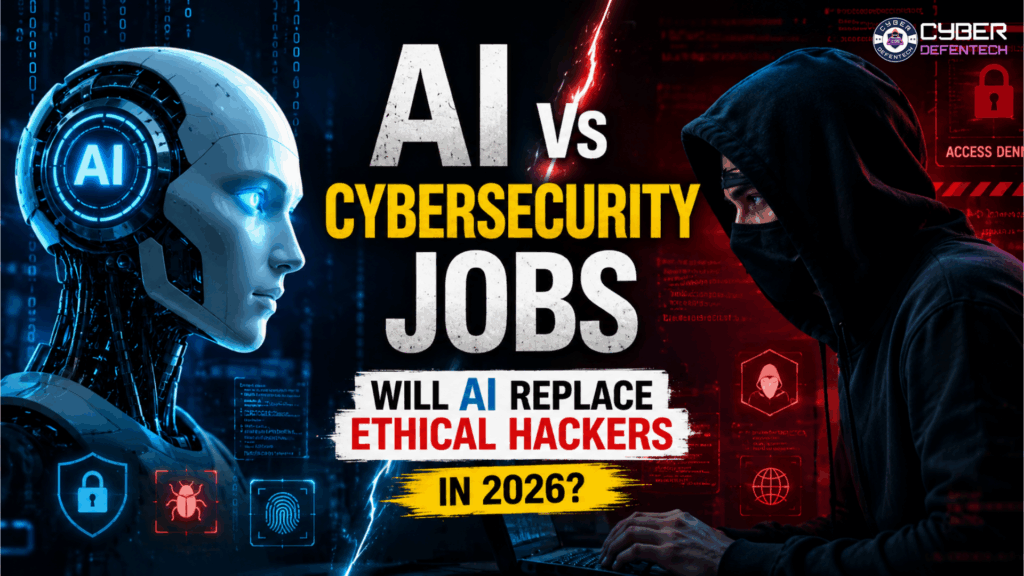
AI vs Cybersecurity Jobs: Will AI Replace Ethical Hackers in 2026?
The Truth About AI, Ethical Hacking, and the Future of Cybersecurity Careers
Introduction
Will AI replace ethical hackers in 2026?
It’s a fair question.
Every few months, a new AI tool appears claiming to automate penetration testing, vulnerability scanning, SOC monitoring, or threat analysis. Companies are integrating AI into security operations faster than ever, and many beginners now worry whether ethical hacking will still be a valuable career in the future.
But here’s the reality most people don’t fully understand:
AI is transforming cybersecurity — not replacing cybersecurity professionals.
In fact, the rise of AI is creating even more demand for skilled ethical hackers, penetration testers, SOC analysts, cloud security engineers, and threat hunters.
The cybersecurity battlefield is evolving. Attackers are using AI. Defenders are using AI. And organizations now need human experts who understand both cybersecurity and AI-driven threats.
This article explores the real future of cybersecurity jobs in 2026, how AI is impacting ethical hacking, what skills will remain irreplaceable, and why human intelligence still matters more than artificial intelligence in cyber defense.
What Is AI in Cybersecurity?
Artificial Intelligence in cybersecurity refers to machine learning systems and intelligent automation tools designed to improve threat detection, security analysis, and response speed.
Today, AI is being used for:
- Malware detection
- Threat intelligence analysis
- Automated SOC monitoring
- Suspicious behavior detection
- Password attack pattern analysis
- Vulnerability scanning
- Email phishing detection
- Incident response automation
- Log analysis
- Risk scoring
Security companies are heavily investing in AI-powered platforms because traditional security systems struggle to keep up with modern cyber threats.
However, AI systems still rely on human guidance, human logic, and human decision-making.
That’s where ethical hackers and cybersecurity professionals remain essential.
Why People Think AI Will Replace Ethical Hackers ?
The fear mainly comes from automation.
Today, AI tools can already:
- Generate exploit code
- Scan networks automatically
- Detect vulnerabilities faster
- Write scripts
- Analyze huge datasets
- Suggest remediation steps
Some AI-powered tools can even perform basic penetration testing tasks automatically.
Because of this, many students assume:
“If AI can hack systems automatically, then ethical hackers won’t be needed anymore.”
But cybersecurity is not just about running tools.
Real ethical hacking involves:
- Critical thinking
- Creativity
- Human psychology
- Business logic understanding
- Decision-making
- Real-world attack simulation
- Risk assessment
- Manual exploitation
- Strategic defense planning
AI can assist with these tasks, but it cannot fully replace human expertise.
The Biggest Limitation of AI in Ethical Hacking
AI is powerful, but it has one major weakness:
AI lacks human intuition.
Cybersecurity is unpredictable.
Attackers constantly change tactics, exploit human behavior, manipulate emotions, and discover creative ways to bypass systems. Ethical hackers must think like real attackers, and that requires human reasoning beyond automation.
For example:
- AI may identify a vulnerability.
- But an ethical hacker understands whether it can actually be exploited in a real business environment.
- AI may flag suspicious activity.
- But a SOC analyst determines whether it is a real attack or a false positive.
- AI may generate phishing detection rules.
- But humans understand evolving social engineering tricks.
Cybersecurity is not only technical — it’s psychological and strategic.
And that’s extremely difficult for AI to fully replicate.
Will AI Replace Ethical Hackers in 2026?
Short Answer: No.
AI will not replace ethical hackers in 2026.
Instead, AI will change how ethical hackers work.
The future belongs to professionals who know:
- Cybersecurity
- AI-assisted security tools
- Automation
- Threat intelligence
- Cloud environments
- Advanced attack simulation
Ethical hackers who adapt to AI will become more valuable, not less.
In fact, organizations now prefer cybersecurity professionals who can work alongside AI systems.
How AI Is Actually Helping Ethical Hackers
Instead of replacing jobs, AI is improving productivity.
Here’s how ethical hackers are benefiting from AI:
Faster Vulnerability Analysis
AI can quickly analyze systems and identify possible weaknesses, saving hours of manual effort.
Better Threat Intelligence
AI processes massive amounts of cyber threat data much faster than humans.
Automated Repetitive Tasks
Tasks like:
- Log monitoring
- Basic scans
- Alert categorization
- Pattern analysis
can now be automated.
This allows ethical hackers to focus on advanced investigations and critical attacks.
Improved Red Team Simulations
AI helps security teams simulate sophisticated attacks more realistically.
Faster Learning for Beginners
Students can now learn scripting, Linux commands, networking concepts, and security basics more efficiently using AI assistants.
The Rise of AI-Powered Cybercrime
One major reason ethical hackers will remain in demand is because cybercriminals are also using AI.
Attackers now use AI for:
- Deepfake scams
- AI-generated phishing emails
- Automated malware creation
- Voice cloning attacks
- Credential stuffing
- Social engineering campaigns
- AI-powered reconnaissance
Cyberattacks are becoming smarter and faster.
This means companies need advanced cybersecurity professionals more than ever before.
The more AI evolves, the more cyber defense becomes necessary.
Cybersecurity Jobs That Will Grow in 2026
Instead of disappearing, many cybersecurity roles are expected to grow rapidly.
Ethical Hacker / Penetration Tester
Organizations constantly need professionals who can test security defenses manually and creatively.
SOC Analyst
Security Operations Centers still rely heavily on human investigation and incident response.
Cloud Security Engineer
As businesses move to AWS, Azure, and Google Cloud, cloud security demand is increasing.
Threat Hunter
Threat hunting requires human intuition and advanced analysis skills that AI alone cannot handle.
AI Security Specialist
A completely new role emerging in the industry.
These professionals secure AI systems themselves.
Digital Forensics Expert
Cybercrime investigations still require deep human expertise and legal understanding.
Skills Ethical Hackers Must Learn to Stay Relevant
The cybersecurity industry is evolving rapidly.
To stay ahead in 2026 and beyond, ethical hackers should learn:
AI Security Fundamentals
Understanding how AI systems work and how attackers misuse them.
Cloud Security
Cloud environments are now a major attack target.
Automation & Scripting
Python, Bash, and PowerShell remain valuable.
Advanced Networking
Networking is still the backbone of cybersecurity.
Web Application Security
Web attacks continue to dominate the threat landscape.
Social Engineering Awareness
Human manipulation attacks are increasing rapidly.
Threat Intelligence
Understanding attacker behavior is critical.
Human Skills AI Cannot Replace
This is where many people underestimate cybersecurity careers.
Technical skills matter, but human skills matter even more.
AI cannot truly replace:
- Creativity
- Leadership
- Communication
- Decision-making
- Ethical judgment
- Strategic thinking
- Negotiation
- Real-world adaptability
Imagine a real ransomware attack happening inside a hospital.
Would companies trust only an AI system to make critical decisions?
No.
They need experienced cybersecurity professionals who can:
- Analyze the situation
- Communicate with teams
- Make fast decisions
- Understand business impact
- Respond under pressure
That human element is irreplaceable.
Ethical Hacking in 2026: Easier or Harder?
Interestingly, ethical hacking may actually become harder.
Why?
Because:
- Systems are becoming more complex
- AI-powered defenses are growing
- Attack surfaces are expanding
- Cloud infrastructure is everywhere
- IoT devices are increasing
- AI-generated malware is evolving rapidly
Future ethical hackers will need broader and deeper knowledge than before.
This means skilled professionals will remain highly valuable.
The Future of AI + Cybersecurity Careers
The future is not:
AI vs Cybersecurity
The real future is:
AI + Cybersecurity
Professionals who combine both skills will dominate the industry.
Companies are now searching for experts who understand:
- AI security risks
- Automated defense systems
- AI-powered threat detection
- Adversarial AI attacks
- Secure AI deployment
Cybersecurity is no longer limited to firewalls and antivirus software.
The field is expanding into:
- AI security
- Cloud security
- Zero Trust architecture
- Threat intelligence
- Red teaming
- Digital forensics
- Security automation
This creates huge career opportunities.
Is Ethical Hacking Still a Good Career in 2026?
Absolutely.
Cybersecurity remains one of the fastest-growing industries globally.
According to multiple industry reports, there is still a massive shortage of skilled cybersecurity professionals worldwide.
Businesses, governments, healthcare organizations, banks, startups, and even AI companies all require cybersecurity experts.
Ethical hacking continues to offer:
- High salaries
- Remote work opportunities
- Global demand
- Freelancing opportunities
- Consulting careers
- Government job options
- Continuous learning
- Strong career growth
The key is adapting to changing technologies instead of fearing them.
How Beginners Should Prepare for the Future?
If you’re starting your cybersecurity journey in 2026, focus on building strong fundamentals first.
Start with:
- Networking
- Linux
- Cybersecurity basics
- Web security
- Python scripting
Then gradually learn:
- AI security
- Cloud security
- SOC operations
- Threat hunting
Avoid relying entirely on AI tools.
Instead, understand:
- Why attacks happen
- How systems work
- How attackers think
- How defenses fail
That deep understanding is what separates real cybersecurity professionals from tool users.
Why Cybersecurity Training Matters More Than Ever?
Because the industry is evolving rapidly, proper training and practical exposure have become extremely important.
Many students learn only theory but struggle during real-world scenarios.
Hands-on labs, live attack simulations, SOC practice, and penetration testing environments help students build practical confidence.
Organizations today prefer candidates who can:
- Work with real tools
- Analyze incidents
- Understand attack chains
- Respond to threats effectively
This is why many learners are now joining advanced cybersecurity training programs to gain practical exposure in ethical hacking, SOC analysis, cloud security, and digital forensics.
As an EC-Council Official Partner, Cyber Defentech provides practical cybersecurity training programs designed to help students build industry-ready skills for modern cyber threats and AI-driven security challenges.
Final Verdict: Will AI Replace Ethical Hackers?
No — AI will not replace ethical hackers in 2026.
But ethical hackers who refuse to learn AI may struggle in the future.
AI is becoming a powerful cybersecurity assistant, not a replacement for human intelligence.
The future belongs to cybersecurity professionals who:
- Adapt quickly
- Learn continuously
- Understand AI tools
- Think creatively
- Solve real-world security problems
Cybersecurity is ultimately about protecting humans, businesses, and digital systems from evolving threats.
And that responsibility still requires human expertise.
So instead of asking:
“Will AI replace ethical hackers?”
The better question is:
“Are ethical hackers ready to evolve with AI?”
Because the cybersecurity professionals who embrace AI will become the strongest defenders of the digital future.
Frequently Asked Questions (FAQs)
1. Will AI completely replace ethical hackers in the future?
No, AI is unlikely to completely replace ethical hackers. AI can automate repetitive cybersecurity tasks, but ethical hacking still requires human creativity, strategic thinking, real-world decision-making, and understanding human behavior. AI works best as a support tool for cybersecurity professionals rather than a replacement.
2. Is ethical hacking still a good career in 2026?
Yes, ethical hacking remains one of the most in-demand cybersecurity careers in 2026. As cyberattacks become more advanced and AI-driven threats increase, organizations need skilled ethical hackers to secure networks, applications, cloud systems, and digital infrastructure.
3. How is AI changing cybersecurity jobs?
AI is transforming cybersecurity by:
- Automating threat detection
- Improving SOC monitoring
- Speeding up vulnerability analysis
- Enhancing malware detection
- Assisting with incident response
However, cybersecurity professionals are still required to investigate attacks, make decisions, and handle complex security challenges.
4. Which cybersecurity jobs are safest from AI automation?
Some of the most future-proof cybersecurity roles include:
- Ethical Hacker
- Penetration Tester
- SOC Analyst
- Threat Hunter
- Cloud Security Engineer
- Digital Forensics Investigator
- AI Security Specialist
These roles require critical thinking and advanced problem-solving that AI cannot fully replicate.
5. Should cybersecurity students learn AI?
Absolutely. Learning AI fundamentals can give cybersecurity professionals a major advantage in the future. Understanding how AI tools work, how attackers misuse AI, and how AI-based security systems operate will become increasingly valuable in modern cybersecurity careers.
6. Can AI tools perform penetration testing automatically?
AI tools can assist with scanning and identifying vulnerabilities, but full penetration testing still requires human expertise. Ethical hackers analyze business logic flaws, chained vulnerabilities, and real-world exploitation scenarios that automated tools often miss.
7. What skills should ethical hackers learn in 2026?
To stay relevant in the future, ethical hackers should focus on:
- Networking
- Linux
- Python scripting
- Cloud security
- Web application security
- AI security concepts
- Threat hunting
- SOC operations
- Digital forensics
Continuous learning is essential in cybersecurity.
Ready to Build a Future in Cybersecurity?
The cybersecurity industry is evolving fast — and this is the perfect time to upgrade your skills in ethical hacking, SOC analysis, cloud security, digital forensics, and AI-powered cybersecurity.
Whether you’re a beginner, college student, IT professional, or someone planning a career switch, practical cybersecurity training can help you stay ahead in the AI-driven future.
Start Your Cybersecurity Journey with Cyber Defentech
As an EC-Council Official Partner, Cyber Defentech offers industry-focused cybersecurity training programs designed for real-world skills and hands-on learning.
📞 Contact Details
- 🌐 Website: www.cyberdefentech.com
- 📧 Email: training@cyberdefentech.com
- 📱 Phone: +91 8448046612
Explore Popular Training Programs
- Ethical Hacking
- SOC Analyst (CSA)
- CEH Certification
- Cloud Security
- Digital Forensics
- Penetration Testing
- Linux & Networking
- Threat Hunting & SIEM
Don’t just watch the future of cybersecurity — become part of it.
