

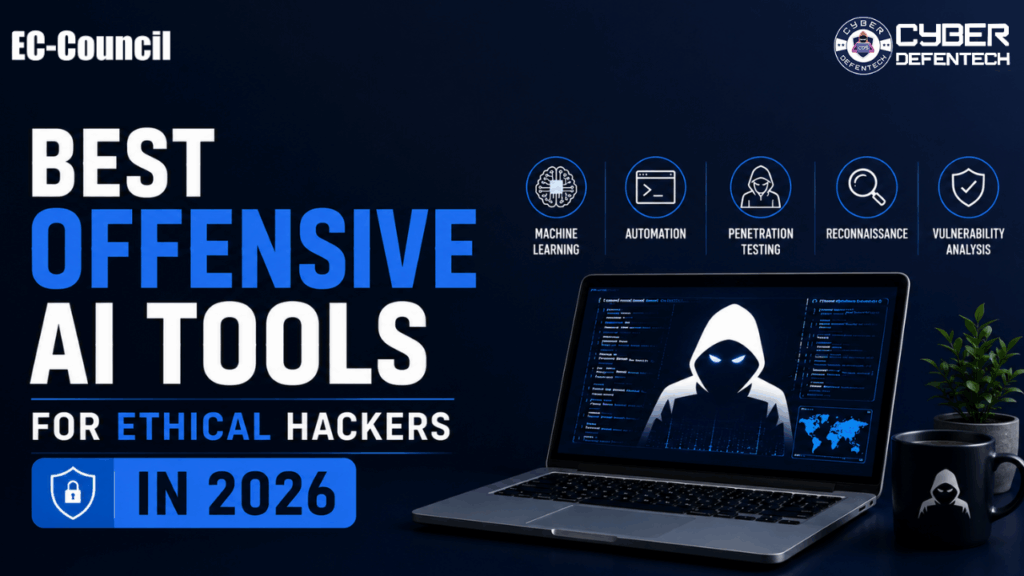
Best Offensive AI Tools for Ethical Hackers in 2026
Published: May 2026
Category: Offensive AI Security / Ethical Hacking / AI Cybersecurity
Reading Time: 12–15 Minutes
Artificial Intelligence is rapidly transforming the cybersecurity industry. From automated penetration testing support to intelligent threat analysis, AI-powered tools are changing how ethical hackers and security professionals work in 2026.
Today, ethical hackers are using Offensive AI tools to automate repetitive tasks, improve reconnaissance, generate scripts, understand malware behavior, analyze vulnerabilities, and increase productivity during security testing.
The rise of AI-powered cybersecurity tools is creating a new domain known as Offensive AI Security — a growing area that combines ethical hacking, artificial intelligence, penetration testing, automation, and threat intelligence.
This ultimate guide will explain:
- What Offensive AI tools are
- How ethical hackers use AI
- The best AI cybersecurity tools in 2026
- Benefits and risks of Offensive AI
- AI security career opportunities
- Essential skills for Offensive AI professionals
- Future trends in AI-powered cybersecurity
If you want to understand the future of AI in ethical hacking and cybersecurity, this pillar guide will help you get started.
Table of Contents
- What Is Offensive AI?
- What Are Offensive AI Tools?
- Why Ethical Hackers Use AI Tools
- Benefits of AI in Cybersecurity
- Best Offensive AI Tools for Ethical Hackers in 2026
- How AI Is Used in Penetration Testing
- AI and OSINT in Cybersecurity
- Risks of Offensive AI
- AI Security Skills Every Ethical Hacker Needs
- Offensive AI Career Opportunities
- Future of AI Security in 2026 and Beyond
- COASP and Offensive AI Security
- Frequently Asked Questions
- Conclusion
What Is Offensive AI?
Offensive AI refers to the use of artificial intelligence technologies in offensive cybersecurity operations such as penetration testing, reconnaissance, threat simulation, vulnerability research, malware analysis, phishing simulation awareness, and security automation.
Offensive AI does not mean illegal hacking.
Instead, ethical hackers and cybersecurity professionals use AI tools to improve efficiency during legal and authorized security testing.
In modern cybersecurity environments, AI can help professionals:
- Analyze vulnerabilities faster
- Automate repetitive security tasks
- Generate scripts and payload explanations
- Improve reconnaissance and OSINT
- Assist with malware analysis
- Speed up report generation
- Improve threat intelligence workflows
As cybersecurity threats continue to evolve, AI-powered cybersecurity is becoming one of the most important future skills in the security industry.
What Are Offensive AI Tools?
Offensive AI tools are artificial intelligence-powered cybersecurity tools designed to help ethical hackers and security professionals perform security testing, automation, analysis, and research more effectively.
These tools often use:
- Machine learning
- Large language models (LLMs)
- Automation systems
- Predictive analysis
- Intelligent threat analysis
- Natural language processing
Modern AI cybersecurity tools are capable of assisting ethical hackers during:
- Web application testing
- Vulnerability analysis
- Malware research
- OSINT investigations
- Script generation
- Security report writing
- Threat hunting
- Reconnaissance
The main goal of these tools is not to replace cybersecurity professionals.
Instead, they help ethical hackers work faster and more efficiently.
Why Ethical Hackers Are Using AI Tools?
Ethical hackers are increasingly using AI-powered tools because cybersecurity environments are becoming more complex every year.
Modern organizations generate huge amounts of security data daily. AI tools can help professionals process and analyze this information more efficiently.
Here are some major reasons ethical hackers use AI tools:
Faster Reconnaissance
AI tools can help automate information gathering and digital footprint analysis.
Script Assistance
AI-powered assistants can help generate Python, Bash, and PowerShell scripts for automation.
Improved Learning
Beginners can use AI tools to understand cybersecurity concepts, Linux commands, and penetration testing methodologies.
Better Threat Analysis
AI can help identify suspicious patterns and anomalies in large datasets.
Faster Reporting
Ethical hackers can use AI to generate structured penetration testing reports.
Improved Productivity
AI tools can automate repetitive tasks and reduce manual effort.
AI is becoming an assistant for cybersecurity professionals rather than a replacement.
Benefits of AI in Cybersecurity
Artificial Intelligence is improving cybersecurity operations in multiple ways.
1. Security Automation
AI can automate repetitive security operations such as log analysis, threat detection, and alert prioritization.
2. Faster Vulnerability Analysis
AI tools can help identify and analyze vulnerabilities more quickly.
3. Threat Intelligence
Machine learning systems can process large amounts of threat data efficiently.
4. Malware Detection
AI can identify suspicious behavior patterns and detect malicious activity.
5. Improved Incident Response
AI-assisted security systems can help security teams respond to incidents faster.
6. Better Productivity
Ethical hackers can use AI tools to automate scripting, reporting, and research tasks.
7. Improved Learning for Beginners
Cybersecurity students can use AI tools to understand concepts and improve technical skills.
Best Offensive AI Tools for Ethical Hackers in 2026
The following AI-powered cybersecurity tools are becoming increasingly popular among ethical hackers and security professionals.
1. ChatGPT
What It Does?
ChatGPT is one of the most widely used AI assistants in cybersecurity.
Ethical hackers use ChatGPT for:
- Python scripting
- Bash scripting
- Regex generation
- Malware analysis explanations
- Report writing
- Learning cybersecurity concepts
- Command explanations
- Security documentation
Common Cybersecurity Use Cases
- Writing automation scripts
- Understanding Linux commands
- Explaining vulnerabilities
- Learning penetration testing concepts
- Improving productivity
Why Ethical Hackers Use It?
ChatGPT can save significant amounts of time during research and scripting.
Important Note
Always verify AI-generated code before use.
2. PentestGPT
What It Does
PentestGPT is designed to assist penetration testers during security assessments.
Main Features
- Pentesting workflow support
- Reconnaissance guidance
- Vulnerability analysis assistance
- Reporting support
- Security testing suggestions
Why It Matters
PentestGPT helps beginners understand penetration testing methodologies and workflows.
3. Kali GPT
What It Does
Kali GPT helps users understand Kali Linux tools and commands.
Common Use Cases
- Learning Kali Linux
- Tool explanations
- Command troubleshooting
- Ethical hacking assistance
- Linux guidance
Best For
Cybersecurity beginners and students.
4. Burp Suite AI Features
What It Does
Burp Suite AI features assist with web application security testing.
Common Use Cases
- Vulnerability analysis
- Security testing support
- Web security assessments
- Faster issue identification
Why It Matters
AI-assisted web testing can improve productivity during penetration testing.
5. AI-Powered OSINT Tools
What They Do
OSINT AI tools help security professionals gather and analyze publicly available information.
Main Use Cases
- Threat intelligence
- Digital footprint analysis
- Social media investigations
- Reconnaissance
- Security investigations
Why Ethical Hackers Use Them?
OSINT is an important part of cybersecurity investigations and penetration testing.
6. AI Threat Intelligence Platforms
What They Do?
These platforms use machine learning to analyze large amounts of threat intelligence data.
Main Use Cases
- Threat monitoring
- Malware analysis
- Security operations
- Incident response
- Suspicious behavior detection
Why They Matter?
AI can process security data much faster than humans.
7. AI Malware Analysis Systems
What They Do
AI-powered malware analysis systems help security researchers analyze suspicious files and behaviors.
Common Use Cases
- Malware classification
- Behavioral analysis
- Threat intelligence
- Security research
Importance
These systems help security professionals respond to threats more efficiently.
How AI Is Used in Penetration Testing?
Artificial Intelligence is changing the way penetration testing works.
Ethical hackers now use AI tools during multiple stages of penetration testing.
Reconnaissance
AI can assist with:
- Information gathering
- OSINT analysis
- Digital footprint analysis
- Domain research
Vulnerability Research
AI tools can help security professionals understand vulnerabilities more efficiently.
Scripting Assistance
AI assistants can help generate automation scripts.
Report Writing
Penetration testing reports can be partially automated with AI.
Learning and Research
AI systems can help beginners understand penetration testing methodologies.
AI and OSINT in Cybersecurity
OSINT (Open Source Intelligence) is becoming more powerful with AI integration.
AI-powered OSINT tools help ethical hackers:
- Analyze publicly available information
- Identify digital footprints
- Improve reconnaissance
- Investigate suspicious activities
- Monitor cyber threats
Modern AI systems can process large amounts of public data much faster than manual methods.
This is why AI-assisted OSINT is becoming increasingly important in cybersecurity.
Risks of Offensive AI
While Offensive AI tools are powerful, they also introduce security risks.
Potential risks include:
AI-Generated Phishing
Cybercriminals can use AI to create convincing phishing messages.
Deepfake Attacks
AI-generated audio and video content can be used for scams.
AI-Assisted Malware
Automation can potentially improve malware development.
Social Engineering Risks
AI tools can help attackers generate more convincing social engineering content.
Misinformation Campaigns
AI systems can generate large amounts of misleading information.
This is why ethical and responsible AI usage is extremely important.
AI Security Skills Every Ethical Hacker Needs
Professionals entering Offensive AI Security should build both cybersecurity and AI-related skills.
Linux Fundamentals
Linux knowledge is essential for ethical hacking and cybersecurity.
Networking Basics
Understanding networking concepts is critical for penetration testing.
Python Scripting
Python is widely used for cybersecurity automation.
Prompt Engineering
AI prompt engineering is becoming an important skill.
OSINT Techniques
Reconnaissance and intelligence gathering remain important.
Threat Analysis
Understanding cyber threats and attack techniques is essential.
Web Security
Knowledge of web vulnerabilities is important for ethical hackers.
Security Automation
Automation skills are becoming increasingly valuable.
Offensive AI Career Opportunities
Offensive AI Security is expected to create multiple career opportunities in the coming years.
Potential roles include:
- AI Security Analyst
- Offensive Security Researcher
- AI Threat Intelligence Analyst
- Security Automation Specialist
- Ethical Hacker
- Penetration Tester
- AI Security Consultant
- SOC Analyst
- Threat Hunter
As organizations continue investing in AI-powered security systems, demand for AI cybersecurity professionals may continue growing.
Future of AI Security in 2026 and Beyond
The future of cybersecurity is becoming increasingly AI-driven.
Organizations are investing heavily in:
- AI-powered threat detection
- Automated security operations
- Intelligent threat intelligence
- AI-assisted penetration testing
- Security automation
- AI governance
- AI risk management
Cybersecurity professionals who understand both AI and security concepts may gain a major advantage in the future job market.
AI is likely to become a core part of cybersecurity operations over the next few years.
COASP and Offensive AI Security
Professionals interested in Offensive AI Security can also explore structured certifications and learning paths such as COASP.
COASP-related learning can help beginners understand:
- Offensive AI concepts
- AI security risks
- Cybersecurity automation
- AI-powered threat analysis
- Ethical AI usage
Recommended related guides:
- COASP Career Guide
- AI Security Skills for Ethical Hackers
- How Hackers Use AI in 2026
These supporting articles can help readers understand the growing field of AI-powered cybersecurity.
Learn Offensive AI Security with Cyber Defentech
As Artificial Intelligence continues transforming cybersecurity, professionals with Offensive AI Security skills are becoming increasingly valuable in the cybersecurity industry.
Learning topics such as:
- AI-powered penetration testing
- AI threat analysis
- Offensive AI concepts
- AI-powered cybersecurity tools
- Security automation
- Ethical AI usage
- AI-assisted threat intelligence
can help cybersecurity professionals prepare for the future of AI-driven security operations.
Professionals interested in Offensive AI Security, Ethical Hacking, AI Cybersecurity, and AI-powered penetration testing can also explore cybersecurity and AI Security learning resources offered by Cyber Defentech.
Cyber Defentech provides training and learning resources covering:
- Ethical Hacking
- Offensive AI Security
- AI Cybersecurity
- Penetration Testing
- SOC Operations
- AI Security Concepts
- Cybersecurity Career Guidance
👉 Explore More:
https://cyberdefentech.com/
Frequently Asked Questions
What is Offensive AI?
Offensive AI refers to the use of artificial intelligence in offensive cybersecurity operations such as penetration testing, reconnaissance, and vulnerability research.
Are AI tools replacing ethical hackers?
No. AI tools are helping ethical hackers automate tasks and improve productivity.
Which AI tool is best for ethical hackers?
Popular tools include ChatGPT, PentestGPT, Kali GPT, and AI-powered OSINT tools.
Is Offensive AI legal?
Yes, when used ethically and legally for cybersecurity testing and security research.
Is Offensive AI Security a good career?
Yes. AI Security is becoming one of the fastest-growing areas in cybersecurity.
What skills are required for AI Security?
Important skills include Linux, networking, Python, cybersecurity fundamentals, OSINT, and AI prompt engineering.
How is AI changing cybersecurity?
AI is improving automation, threat analysis, vulnerability research, and security operations.
Can AI help penetration testers?
Yes. AI tools can assist with scripting, reconnaissance, report writing, and research.
Conclusion
Artificial Intelligence is transforming the cybersecurity industry.
Ethical hackers and security professionals are increasingly using AI-powered tools for automation, vulnerability analysis, reconnaissance, threat intelligence, and security testing.
As Offensive AI Security continues to grow, professionals who understand AI-powered cybersecurity tools may gain a significant advantage in the future job market.
Whether you are a beginner or an experienced ethical hacker, learning Offensive AI concepts and AI security tools is becoming an important cybersecurity skill in 2026.
The future of cybersecurity is likely to be deeply connected with AI, automation, and intelligent security operations.
Professionals who adapt early to AI-powered cybersecurity trends may benefit from growing career opportunities in Offensive AI Security.
💬 Have a question about starting your ethical hacking journey?
Drop it in the comments below — our team and community members respond to every question.
Disclaimer: This article is for educational purposes only. Always practice ethical hacking in legal, authorized environments. Unauthorized access to computer systems is a criminal offense under India’s IT Act 2000. CyberDefenTech does not encourage or condone any illegal activity.
© 2026 CyberDefenTech — India’s Cybersecurity Learning Hub | cyberdefentech.com
