


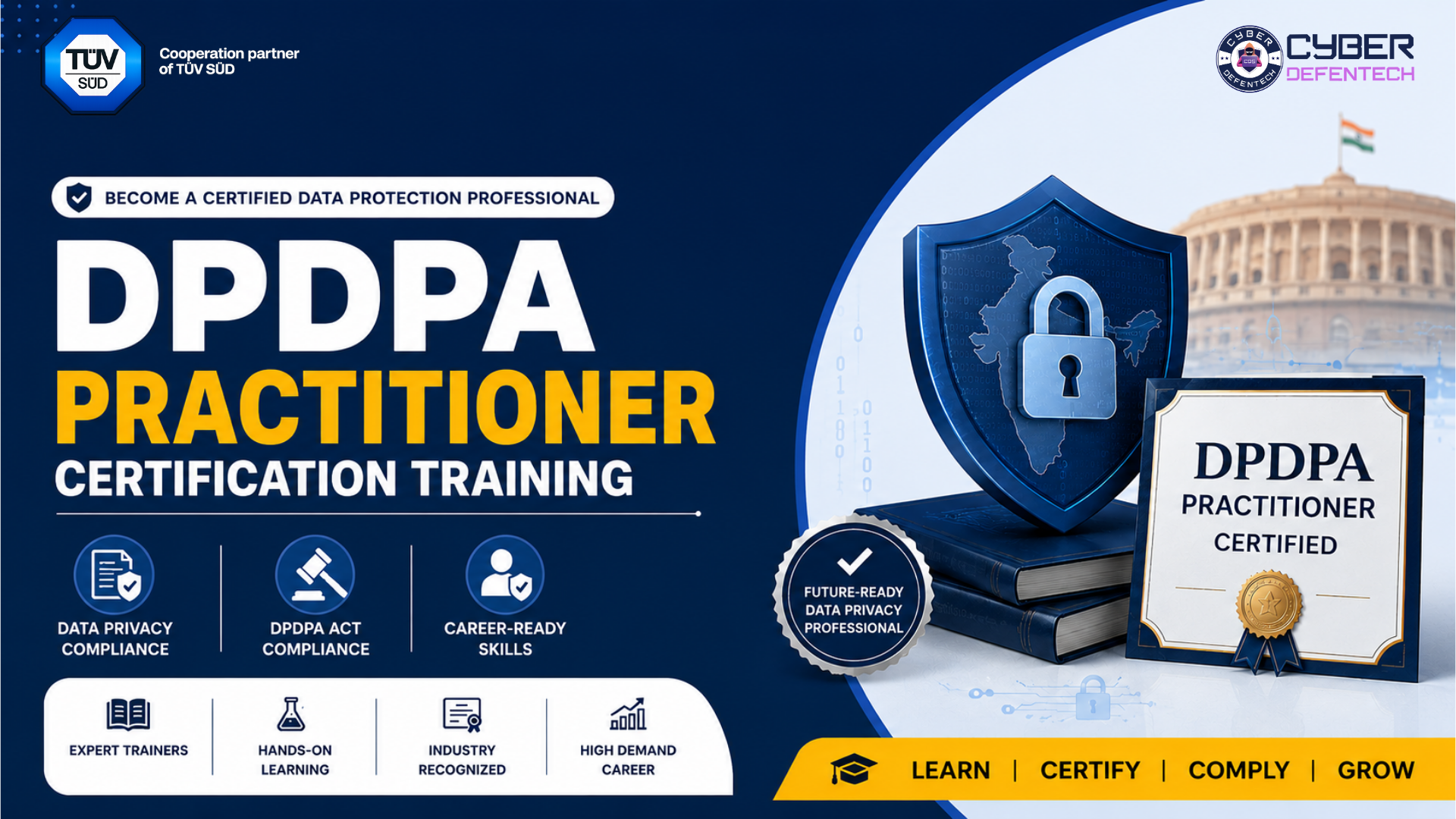
DPDPA Practitioner Certification Training : Career, Course & Exam Guide 2026
By Cyber Defentech | May 2026 | 12 Mins Read | Beginner to Advanced
Introduction
Every 39 seconds, a cyberattack happens somewhere in the world. But in 2026, the most dangerous breach isn’t always a hacker breaking through a firewall — it’s an organization mishandling millions of personal data records without even realizing they’re violating the law.
India’s Digital Personal Data Protection Act (DPDPA), enacted in 2023 and now actively enforced in 2026, has fundamentally transformed how businesses, governments, and institutions must handle personal data. Non-compliance is no longer a technicality — it carries penalties of up to ₹250 crore per violation. Regulatory audits are tightening. Boards are demanding accountability. And organizations are scrambling to find professionals who actually understand this law.
This has created a massive talent gap — and an extraordinary career opportunity for those ready to fill it.
DPDPA Practitioner Certification Training is not just a course. It is a career accelerator, a compliance shield, and a passport into one of the most future-ready domains in India’s technology and legal landscape. Whether you are a cybersecurity professional, legal consultant, HR manager, or IT auditor, this certification equips you with the practical knowledge, legal fluency, and implementation skills that the industry urgently needs.
If you have been waiting for the right moment to pivot your career toward data privacy — this is it.
What is DPDPA Practitioner Certification Training?
The Digital Personal Data Protection Act (DPDPA) is India’s comprehensive data privacy legislation, modeled after global standards like the GDPR (Europe) and CCPA (California). It governs how organizations — called Data Fiduciaries — collect, store, process, and share the personal data of Indian citizens, known as Data Principals.
DPDPA Practitioner Certification Training is a structured, industry-aligned program designed to:
- Build a deep understanding of the DPDPA’s legal framework and compliance architecture
- Develop practical skills to implement data protection policies across organizations
- Prepare professionals for formal certification examinations and real-world job roles
- Train individuals to serve as Data Protection Officers (DPOs), privacy consultants, and compliance leads
The certification validates that a professional can independently manage data protection obligations, conduct privacy impact assessments, handle data principal rights, and build organizational accountability frameworks — making them indispensable to any data-driven enterprise in India.
At Cyber Defentech, this training goes beyond theory. It combines legal interpretation with hands-on simulations, live case studies, and real-world compliance scenarios to ensure every graduate is job-ready from day one.
Why is DPDPA Practitioner Certification Important Training ?
The short answer: because ignorance of the law is no longer a defence — and organizations know it.
Since the DPDPA’s enforcement regulations came into force, India’s data protection landscape has shifted dramatically. Here is why certification is no longer optional:
Regulatory Enforcement Is Real. The Data Protection Board of India (DPBI) has begun issuing notices and fines to non-compliant organizations. Legal exposure for companies without a qualified data privacy professional on board has increased substantially.
Global Business Demands It. Indian companies working with international clients — especially in the EU and US markets — must demonstrate dual compliance with DPDPA and GDPR. Certified practitioners are essential to bridge that gap.
Boards and CXOs Are Accountable. Under the DPDPA, senior leadership can be held personally accountable for data breaches and compliance failures. This has triggered widespread demand for internal DPOs and privacy advisors.
Career Differentiation. In a crowded market of cybersecurity and IT professionals, a DPDPA certification is a powerful differentiator that signals both legal literacy and technical competence.
Real-World Cyber Threats & Data Privacy Risks
The convergence of cybersecurity and data privacy is the defining challenge of 2026. Consider these real-world scenarios that make DPDPA expertise critical:
The Healthcare Breach Problem. In 2024, a major Indian hospital network suffered a ransomware attack that exposed the personal health data of over 3 million patients. Under the DPDPA, this would have triggered mandatory breach notification, an investigation by the DPBI, and potentially hundreds of crores in fines — had the law been fully enforced at the time.
The FinTech Consent Trap. Multiple Indian FinTech platforms were found collecting sensitive financial and biometric data without lawful consent mechanisms. DPDPA mandates explicit, informed, and withdrawable consent — a requirement many platforms are still struggling to implement correctly.
The E-Commerce Data Leak. A top Indian e-commerce platform leaked customer purchase histories, addresses, and payment data through a misconfigured API. The DPDPA’s accountability principle places the responsibility for third-party vendor data handling squarely on the Data Fiduciary.
The Insider Threat Gap. A significant percentage of data breaches originate from within organizations — employees mishandling, selling, or accidentally exposing data. DPDPA Practitioners are trained to design internal access controls, data minimization policies, and employee awareness frameworks to close this gap.
These examples are not hypothetical. They represent the real-world compliance failures that DPDPA Practitioners are trained to prevent, respond to, and remediate.
Why Companies Need DPDPA Practitioner Professionals ?
India’s corporate landscape is undergoing a compliance revolution. Every organization that processes the personal data of Indian citizens — regardless of size, sector, or location — falls under the DPDPA’s jurisdiction.
This includes banks, hospitals, edtech platforms, telecom companies, HR departments, SaaS companies, government agencies, and multinational corporations with Indian operations. The demand for qualified DPDPA practitioners spans every sector.
| Sector | DPDPA Use Case | Urgency Level |
|---|---|---|
| Banking & Finance | Consent management, data retention, breach response | Critical |
| Healthcare | Sensitive data protection, third-party sharing compliance | Critical |
| E-Commerce & Retail | Customer data governance, cross-border transfers | High |
| IT & SaaS | Data processor obligations, contractual compliance | High |
| HR & Staffing | Employee data handling, purpose limitation | High |
| Government & PSUs | Exemption management, data principal rights | Medium-High |
| EdTech & Education | Children’s data protection, parental consent | High |
Organizations are actively hiring professionals who can audit existing data practices, implement DPDPA-compliant frameworks, train internal teams, and serve as the accountable point of contact for regulators. A certified DPDPA Practitioner is no longer a luxury — they are a legal necessity.
Skills You Will Learn
Cyber Defentech’s DPDPA Practitioner Certification Training is architected to build competency across the full spectrum of data privacy practice. Here is what you will master:
| Skill Area | What You’ll Learn |
|---|---|
| DPDPA Legal Framework | Structure of the Act, key definitions, applicability, and exemptions |
| Data Principal Rights | Right to access, correction, erasure, grievance redressal, and nomination |
| Consent Management | Designing lawful consent mechanisms, withdrawal workflows, and records |
| Data Fiduciary Obligations | Accountability, security safeguards, and significant data fiduciary duties |
| Privacy Impact Assessment | Conducting DPIAs, risk mapping, and mitigation planning |
| Breach Management | Detection, notification timelines, DPBI reporting, and remediation |
| Cross-Border Data Transfers | Permitted territories, contractual safeguards, and compliance conditions |
| DPO Role & Responsibilities | Appointment criteria, functions, independence, and reporting structure |
| Vendor & Third-Party Governance | Data processor agreements, due diligence, and audit frameworks |
| Compliance Program Building | Policies, training programs, data inventories, and audit readiness |
Beyond classroom learning, Cyber Defentech’s program integrates live labs, mock audits, real-world compliance scenario exercises, and access to a curated library of DPDPA templates, policy documents, and frameworks used by industry practitioners.
Career Opportunities
A DPDPA Practitioner Certification opens doors across multiple high-demand career paths. The roles available to certified professionals span legal, technical, and leadership functions:
- Data Protection Officer (DPO) – The most high-profile role, now mandatory for Significant Data Fiduciaries under DPDPA
- Privacy Compliance Manager – Overseeing enterprise-wide DPDPA implementation and audit readiness
- Data Privacy Consultant – Advising organizations across sectors on DPDPA gap assessments and remediation
- Legal & Regulatory Analyst – Bridging legal interpretation with operational implementation
- GRC Analyst (Governance, Risk & Compliance) – Integrating privacy into broader enterprise risk management
- Information Security Officer – Managing privacy-by-design principles within cybersecurity programs
- Privacy Engineer – Embedding data minimization, anonymization, and access controls into product development
- Compliance Auditor – Assessing organizational adherence to DPDPA obligations
The cross-functional nature of data privacy makes certified practitioners valuable to legal teams, IT departments, HR functions, and C-suite leadership simultaneously.
Salary & Industry Demand
The salary landscape for data privacy professionals in India has shifted dramatically since the DPDPA’s enforcement. Organizations are paying a premium for certified expertise.
| Job Role | Experience Level | Average Annual Salary (India) |
|---|---|---|
| Data Protection Officer | 5–10 years | ₹18,00,000 – ₹45,00,000 |
| Privacy Compliance Manager | 3–7 years | ₹12,00,000 – ₹28,00,000 |
| DPDPA Consultant | 2–8 years | ₹10,00,000 – ₹30,00,000 |
| GRC / Privacy Analyst | 1–4 years | ₹6,00,000 – ₹16,00,000 |
| Legal Privacy Advisor | 3–6 years | ₹8,00,000 – ₹22,00,000 |
| Privacy Engineer | 2–5 years | ₹10,00,000 – ₹24,00,000 |
According to industry hiring data for 2025–2026, job postings explicitly requiring DPDPA knowledge or data privacy certification have grown by over 240% year-on-year. The supply of qualified professionals remains critically low — creating one of the most favorable job markets in India’s technology and compliance sector.
Real-World Importance of DPDPA Compliance
Why does this matter beyond career growth? Because data privacy is fundamentally about human dignity.
The DPDPA is built on the principle that every Indian citizen has a constitutionally recognized right to privacy — affirmed by the Supreme Court in the landmark Justice K.S. Puttaswamy vs. Union of India judgment. Personal data — your health records, financial history, location data, and communication records — is an extension of your identity.
When organizations fail to protect this data, the consequences extend far beyond regulatory fines. Lives are disrupted. Identities are stolen. Reputations are destroyed. Communities lose trust in the institutions they depend on.
DPDPA Practitioners are not just compliance officers. They are guardians of digital trust — professionals who ensure that the technology powering India’s digital economy treats every person with the respect and protection they deserve.
Tools & Technologies Used
Modern DPDPA practitioners work with a sophisticated toolkit of privacy management, governance, and security technologies. Cyber Defentech’s training introduces you to industry-standard tools used by data protection professionals globally:
- OneTrust / TrustArc – Privacy management and consent governance platforms
- Microsoft Purview – Data classification, governance, and compliance management
- Securiti.ai – AI-powered data intelligence and privacy automation
- BigID – Data discovery, classification, and privacy risk management
- SAP GRC – Enterprise governance, risk, and compliance management
- JIRA / ServiceNow – Breach and incident tracking workflows
- ISO 27001 / NIST Privacy Framework – Foundational security and privacy standards
- DPIA Templates & Data Mapping Tools – Practical assessment and inventory tools
Beginner Roadmap: From Zero to DPDPA Certified
Not a lawyer? Not a technical expert? That is perfectly fine. The DPDPA Practitioner pathway is designed to be accessible to professionals from diverse backgrounds. Here is how Cyber Defentech guides you from foundation to certification:
Phase 1 – Foundation (Weeks 1–2) Understand India’s data protection landscape, the journey from IT Act to DPDPA, key terminology, and the constitutional basis of privacy rights.
Phase 2 – Core Legal Framework (Weeks 3–5) Deep-dive into the DPDPA’s provisions: applicability, exemptions, consent architecture, data principal rights, and obligations of Data Fiduciaries and Data Processors.
Phase 3 – Practical Implementation (Weeks 6–8) Conduct data mapping exercises, build consent management frameworks, draft privacy policies, and perform simulated Privacy Impact Assessments (DPIAs).
Phase 4 – Advanced Compliance (Weeks 9–10) Master breach notification procedures, cross-border data transfer compliance, vendor governance frameworks, and Significant Data Fiduciary obligations.
Phase 5 – Exam Preparation & Mock Tests (Weeks 11–12) Structured revision, exam-pattern mock tests, case study reviews, and final certification readiness assessment with personalized feedback from Cyber Defentech mentors.
Why Choose Cyber Defentech?
In a market flooded with generic online courses, Cyber Defentech stands apart through its commitment to practical, industry-aligned, and career-focused education.
Here is what makes Cyber Defentech the most trusted name in cybersecurity and data privacy training:
Expert-Led Instruction. Our trainers are practicing data privacy professionals, legal experts, and cybersecurity leaders — not just educators. You learn from people who implement DPDPA compliance in the real world, every day.
Hands-On Labs & Live Simulations. Every module includes practical exercises — from drafting privacy policies and conducting mock data audits to simulating breach notification scenarios and DPBI response procedures.
Industry-Recognized Certification. Cyber Defentech’s DPDPA Practitioner Certification is designed in alignment with industry standards and recognized by hiring organizations across sectors.
Career Support & Placement Assistance. Our dedicated career team provides resume building, interview coaching, LinkedIn optimization, and direct connections to our hiring partner network.
Flexible Learning Options. Choose from live online sessions, recorded modules, weekend batches, and corporate group training — designed to fit your professional schedule without compromise.
Community & Mentorship. Join an active community of Cyber Defentech alumni, privacy professionals, and industry mentors who provide ongoing support, insights, and opportunities long after you complete your certification.
Future Scope & Industry Trends
The future of data privacy is not a niche concern — it is the backbone of the digital economy.
AI and Automated Data Processing. As AI systems consume vast volumes of personal data, regulators worldwide — including India’s DPBI — are developing sector-specific guidance on AI-driven data processing. DPDPA Practitioners with AI governance knowledge will be among the most sought-after professionals in the next five years.
India’s Global Data Compliance Role. With India increasingly positioned as a global technology and outsourcing hub, Indian companies are managing data for clients across the EU, UK, US, and APAC. Professionals who understand both DPDPA and international privacy frameworks like GDPR will command extraordinary career premiums.
The DPO Mandate for Large Enterprises. As the DPDPA’s rules on Significant Data Fiduciaries are implemented, the mandatory appointment of qualified DPOs will create hundreds of senior-level openings across India’s top corporations in 2026 and 2027.
Privacy-by-Design Becomes Standard. Forward-thinking organizations are embedding privacy engineering into product development lifecycles. DPDPA Practitioners who bridge legal compliance with technical implementation will lead this transformation.
Sector-Specific Regulations. Supplementary rules for healthcare data, financial data, and children’s data are expected to be notified under the DPDPA in the coming years — expanding the scope of compliance and the demand for specialized practitioners exponentially.
Final Thoughts
India is at a defining inflection point in its digital evolution. The DPDPA is not just a law — it is a signal that India’s data economy has matured to the point where personal data must be treated with the same seriousness as financial assets and physical property.
For professionals who recognize this moment and invest in DPDPA Practitioner Certification Training, the rewards are extraordinary: high-demand careers, premium salaries, cross-sector relevance, and the deep professional satisfaction of protecting what matters most — people’s privacy and dignity.
The question is not whether data privacy expertise will be important. It already is. The question is whether you will be positioned to lead when organizations need you most.
Cyber Defentech is ready to get you there.
Frequently Asked Questions (FAQs)
Q1. What is the DPDPA Practitioner Certification?
The DPDPA Practitioner Certification validates your ability to understand, implement, and manage compliance with India’s Digital Personal Data Protection Act. It is designed for professionals seeking careers as Data Protection Officers, privacy consultants, or compliance managers in any organization handling personal data of Indian citizens.
Q2. Who should enroll in DPDPA Practitioner Certification Training?
This course is ideal for IT professionals, legal consultants, HR managers, compliance officers, cybersecurity analysts, auditors, and anyone responsible for data governance within their organization. No prior legal or technical degree is required — the course is designed for professionals from diverse backgrounds.
Q3. What is the eligibility criteria for the DPDPA exam?
While formal eligibility may vary by certifying body, most DPDPA practitioner examinations are open to graduates and working professionals. Prior experience in IT, law, compliance, or HR is advantageous but not mandatory. Cyber Defentech’s training prepares candidates regardless of their starting point.
Q4. How long does it take to complete the DPDPA Practitioner Training at Cyber Defentech?
Cyber Defentech’s comprehensive DPDPA Practitioner program is structured as a 12-week course with flexible learning options including weekend batches, live online sessions, and self-paced recorded modules.
Q5. What career opportunities are available after DPDPA certification?
Certified DPDPA Practitioners qualify for roles including Data Protection Officer (DPO), Privacy Compliance Manager, Data Privacy Consultant, GRC Analyst, Legal Privacy Advisor, Privacy Engineer, and Compliance Auditor — across sectors including banking, healthcare, IT, e-commerce, and government.
Q6. How is DPDPA different from GDPR?
DPDPA is India’s domestic data protection legislation specifically governing the personal data of Indian citizens and residents. While GDPR (EU) and DPDPA share foundational principles — such as consent, purpose limitation, and data subject rights — they differ in their legal architecture, enforcement mechanisms, and specific obligations. Organizations with Indian and international operations often need to comply with both.
Q7. Is DPDPA compliance mandatory for all companies in India?
The DPDPA applies to all entities — Indian and foreign — that process the personal data of individuals in India in connection with any activity. Certain exemptions apply for specific government functions and personal or domestic use. Any business collecting customer, employee, or user data in India is generally subject to its provisions.
Q8. What is the salary for a DPDPA-certified Data Protection Officer in India?
Experienced DPOs with DPDPA certification in India typically earn between ₹18,00,000 and ₹45,00,000 per annum, depending on organization size, industry sector, and experience level. Demand for qualified DPOs is outpacing supply significantly in 2026, driving salaries upward across all experience levels.
Ready to Build Your Career in Data Privacy?
India’s DPDPA era is here — and the professionals who act now will define the compliance leadership of tomorrow.
Cyber Defentech’s DPDPA Practitioner Certification Training gives you everything you need to step into one of India’s most future-ready, high-demand career paths with confidence, competence, and credential.
✅ Hands-On Practical Training — Real-world labs, mock audits, and live compliance simulations
✅ Real-World Cybersecurity & Privacy Skills — Taught by practicing industry experts
✅Industry-Focused Learning — Curriculum aligned with DPDPA enforcement realities of 2026
✅ Future-Ready Career Path — DPO roles, privacy consulting, GRC, and beyond
✅ Certification & Career Support — Resume building, placement assistance, and alumni network
Don’t wait for the next regulatory penalty to make data privacy a priority. Be the professional who prevents it.
🌐 https://cyberdefentech.com/
📞 +91 8448046612
📧 training@cyberdefentech.com
Cyber Defentech — Empowering India’s Next Generation of Cybersecurity & Data Privacy Leaders.
