

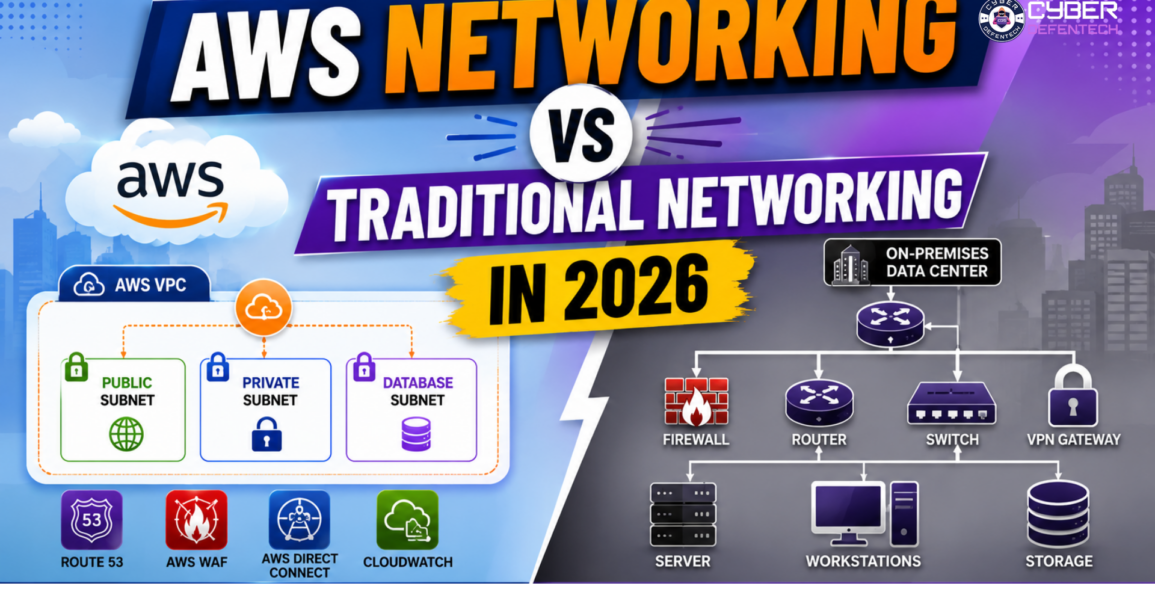
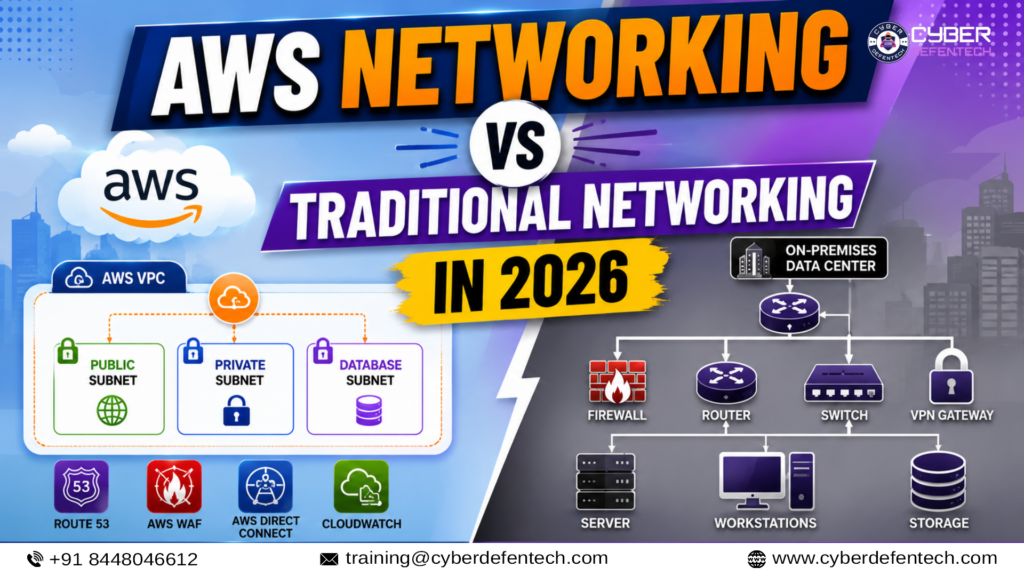
AWS Networking vs Traditional Networking in 2026
By Cyber Defentech Team | June 2026 | 10 Mins Read | Beginner to Advanced
Introduction
Imagine this: a multinational bank suffers a catastrophic data breach — not because a hacker cracked a firewall, but because a misconfigured cloud networking rule left an entire AWS Virtual Private Cloud (VPC) exposed to the public internet. The breach cost the company $4.35 million and erased years of customer trust overnight. This is not a hypothetical. This is the new reality of cybersecurity in the cloud era.
As organisations worldwide accelerate their cloud migration journeys, the line between networking and cybersecurity has permanently blurred. Today, understanding AWS networking vs traditional networking is not optional for security professionals — it is the baseline requirement for entering and thriving in a high-demand, future-ready career in cybersecurity.
Whether you are a fresh graduate, an IT professional pivoting into security, or an experienced network engineer who wants to future-proof your skills, this guide breaks down everything you need to know — with real-world examples, career insights, and a practical roadmap to mastery.
What is AWS Networking vs Traditional Networking?
Traditional Networking — The Foundation
Traditional networking refers to the physical and logical infrastructure used to connect devices, servers, and systems within an organisation. This includes routers, switches, firewalls, load balancers, and cables — all housed within on-premises data centres managed directly by IT teams. Security policies are enforced at the hardware level using tools such as Cisco firewalls, VLAN segmentation, and physical access controls.
While robust and battle-tested, traditional networking is inherently static. Scaling requires purchasing new hardware, configuring devices manually, and often enduring weeks of lead time — a costly bottleneck for modern businesses.
AWS Networking — The Next-Generation Alternative
AWS networking, powered by Amazon Web Services, replaces physical infrastructure with virtualised, software-defined networking services. At its core is the Virtual Private Cloud (VPC) — a logically isolated segment of the AWS cloud where you launch and manage AWS resources. Security and access controls are enforced through Security Groups, Network Access Control Lists (NACLs), AWS Shield, AWS WAF, and advanced services like AWS PrivateLink and AWS Transit Gateway.
Unlike traditional networking, AWS networking is dynamic, elastic, and globally scalable — deployable in minutes through code (Infrastructure as Code) rather than physical hardware.
Why is AWS Networking Important for Cybersecurity Professionals?
The global cloud computing market is projected to surpass $1.2 trillion by 2028. AWS currently commands more than 31% of that market. As companies migrate their critical operations — financial systems, healthcare records, national infrastructure — to AWS, the attack surface has expanded dramatically. The result is a massive, urgent demand for professionals who understand cloud networking security inside and out.
Security teams that cannot distinguish between a Security Group and a NACL, or that fail to understand how AWS route tables affect traffic flow, are leaving organisations critically exposed. Cybersecurity today demands cloud-native fluency — and AWS networking is the gateway to that fluency.
Real-World Cyber Threats & Risks in Cloud Networking
The shift from traditional networking to AWS cloud environments has introduced new and sophisticated cyber threats that security professionals must be equipped to handle:
- S3 Bucket Misconfiguration — One of the most common AWS vulnerabilities. In 2024, a misconfigured S3 bucket at a major healthcare firm exposed over 11 million patient records. Traditional networking perimeter defences are entirely ineffective here.
- VPC Peering Attacks — Improperly configured VPC peering connections allow attackers to move laterally between cloud environments, accessing sensitive workloads that were never intended to be reachable.
- Security Group Sprawl — Overly permissive inbound/outbound rules accumulate over time, creating silent attack vectors that bypass traditional threat models.
- Man-in-the-Middle via Unencrypted Transit — Without TLS enforcement and proper use of AWS Certificate Manager, data in transit across cloud networks is vulnerable to interception.
- DNS Hijacking and Route Table Manipulation — Attackers who gain access to AWS IAM credentials can alter route tables, redirecting network traffic to malicious endpoints.
- AI-Powered Reconnaissance — Modern threat actors now use AI-driven tools to continuously probe cloud infrastructure for misconfigurations, making real-time detection and response skills non-negotiable.
These threats have one thing in common: they cannot be mitigated using traditional networking tools alone. They require cloud-native security expertise — the exact skills taught at Cyber Defentech.
Why Companies Need AWS Networking Professionals?
The cybersecurity talent gap is at a record high — with over 3.5 million unfilled cybersecurity positions globally in 2025. Among the most in-demand specialisations is cloud network security. Here is why organisations are urgently hiring:
- Digital Transformation Mandates — Every enterprise is moving workloads to the cloud, requiring professionals who can secure cloud-native architectures from day one.
- Regulatory Compliance — Frameworks such as PCI-DSS, HIPAA, ISO 27001, and GDPR mandate strict controls over cloud network access and data flows — controls that require specialist knowledge to implement.
- Zero Trust Architecture Adoption — Modern enterprises are adopting Zero Trust principles across their cloud infrastructure, requiring professionals skilled in micro-segmentation, identity-based access, and least-privilege networking.
- AI and Machine Learning Workloads — As organisations deploy AI on AWS, protecting the underlying networking layers that train and serve machine learning models has become a critical security concern.
- Ransomware and Nation-State Threats — Advanced persistent threat (APT) groups specifically target cloud infrastructure. Companies need professionals who can build and defend sophisticated AWS network architectures.
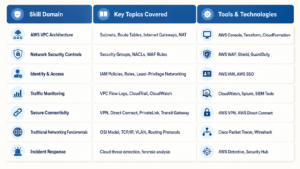
Skills You Will Learn
At Cyber Defentech, our industry-focused AWS networking and cloud security curriculum is designed to deliver practical, job-ready competencies.
Career Opportunities
Professionals with expertise in AWS networking and cloud network security are among the most sought-after in the technology industry. Your career pathways include:
- Cloud Security Engineer
- AWS Network Engineer
- Cloud Infrastructure Architect
- DevSecOps Engineer
- Security Operations Centre (SOC) Analyst — Cloud Specialist
- Network Security Consultant
- Cloud Compliance Analyst
- Penetration Tester — Cloud Environments
These roles exist across all sectors — banking, healthcare, government, retail, defence, and technology — meaning your career is industry-agnostic and extraordinarily future-proof.
Salary & Industry Demand
The financial rewards for cloud networking security professionals reflect the urgency of the talent shortage.

Salary figures are indicative and vary based on experience, certifications, and employer. Senior roles with AWS certifications command premium compensation.
Real-World Importance of AWS Networking
Why It Matters for Every Industry?
Consider these industry-specific scenarios where AWS networking security expertise is mission-critical:
- Financial Services — A leading payment processor routes millions of transactions per day through AWS. A single misconfigured Security Group can expose cardholder data to the internet, triggering immediate PCI-DSS violations and regulatory fines.
- Healthcare — Electronic health record systems hosted on AWS must comply with HIPAA. Misconfigured VPC endpoints can allow unauthorised access to patient records, resulting in regulatory penalties and destroyed public trust.
- Government & Defence — National agencies deploying cloud-based intelligence systems require professionals capable of architecting air-gapped VPCs, enforcing zero-trust network access, and monitoring all east-west traffic for anomalous behaviour.
- E-Commerce — Retail giants on AWS process millions of daily API calls. Understanding how to secure API Gateway configurations, load balancer rules, and CloudFront distributions is the difference between a secure platform and a breach headline.
In each case, the professional who understands both the networking architecture and the cybersecurity implications is invaluable — and irreplaceable.
Tools & Technologies Used
Mastering AWS networking and cloud network security requires hands-on familiarity with an advanced, industry-standard toolset.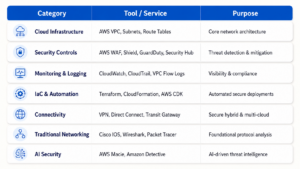
Beginner Roadmap: From Zero to Cloud Security Professional
If you are just starting out, here is a practical, progressive pathway to follow:
Phase 1 — Build the Foundation (Weeks 1–4)
- Understand the OSI Model and TCP/IP protocol stack
- Learn core networking concepts: IP addressing, subnetting, routing, and switching
- Explore traditional networking tools: Wireshark, Cisco Packet Tracer
Phase 2 — Enter the Cloud (Weeks 5–8)
- Set up your AWS Free Tier account and explore the console
- Build and configure your first VPC with public and private subnets
- Understand Security Groups vs NACLs — practical configuration labs
Phase 3 — Security Deep Dive (Weeks 9–12)
- Implement VPC Flow Logs, CloudTrail auditing, and CloudWatch alarms
- Configure AWS WAF, Shield, and GuardDuty for threat detection
- Explore Identity and Access Management (IAM) for network access control
Phase 4 — Advanced & Industry Application (Weeks 13–16)
- Design multi-tier AWS network architectures with Defence-in-Depth
- Implement Zero Trust network access using AWS PrivateLink and IAM Identity Center
- Practice cloud penetration testing and incident response on real-world lab environments at Cyber Defentech
Why Choose Cyber Defentech?
At Cyber Defentech, we do not just teach theory — we build industry-ready professionals through hands-on, practical, real-world training that mirrors what you will encounter in your career from day one.
- Hands-On Lab Environment — Access real AWS environments, not simulations. Build, break, and secure actual cloud infrastructure.
- Industry-Expert Instructors — Learn from certified cybersecurity practitioners with active experience in cloud security, penetration testing, and network defence.
- Structured Curriculum — Our programmes are aligned with globally recognised frameworks including AWS certifications, CEH, CompTIA Security+, and OSCP pathways.
- Career Support — Resume building, interview preparation, and direct connections to our industry hiring network.
- Flexible Learning — Online and offline training options designed to fit working professionals and full-time students alike.
- Community of Professionals — Join a growing network of cybersecurity professionals who continuously collaborate, share threat intelligence, and support each other’s careers.
Cyber Defentech is trusted by hundreds of students and working professionals across India who are building future-ready careers in cybersecurity. Our advanced, practical approach to AWS networking and cloud security training has earned us a reputation as one of India’s premier cybersecurity training providers.
Future Scope & Industry Trends
The convergence of cloud networking, artificial intelligence, and cybersecurity is defining the next decade of IT. Here is where the industry is heading — and why your AWS networking skills will only increase in value:
AI-Driven Network Security
Machine learning models are increasingly embedded in cloud network security tools — from AWS GuardDuty’s threat intelligence feeds to Amazon Detective’s graph-based investigation capabilities. Professionals who understand both the networking layer and AI-driven security tooling will be the most competitive.
Multi-Cloud and Hybrid Architectures
Organisations are no longer running on a single cloud. AWS, Azure, and Google Cloud environments must be interconnected securely. Professionals who can design and secure multi-cloud networking architectures are extraordinarily rare and highly compensated.
Zero Trust Network Access (ZTNA)
Traditional perimeter-based security is being replaced by Zero Trust, where every network request — regardless of origin — is verified. AWS provides the building blocks (PrivateLink, Verified Access, IAM) for implementing ZTNA at scale. This represents the future of enterprise network security.
5G and Edge Computing Security
As 5G networks proliferate and edge computing extends workloads beyond centralised data centres, AWS Outposts and edge networking services are becoming part of enterprise infrastructure. Cloud network security skills transfer directly to this next frontier.
Regulatory Evolution
Governments worldwide are introducing cloud-specific cybersecurity regulations. India’s Digital Personal Data Protection Act, the EU’s NIS2 Directive, and US CISA mandates all require cloud networking security expertise to implement. Compliance professionals with AWS knowledge will be indispensable.
Final Thoughts
The era of on-premises-only networking is over. Every major organisation — from startups to Fortune 500 enterprises and government agencies — now operates in the cloud. The professionals who understand how to architect, secure, and defend AWS network environments are not just valuable; they are essential.
The question is not whether you need AWS networking skills — it is whether you will acquire them before your competition does. Every day you delay is a day your peers advance.
At Cyber Defentech, we are committed to bridging the gap between classroom learning and real-world cybersecurity practice. Our AWS networking and cloud security programmes are designed to transform beginners into industry-ready professionals and experienced IT professionals into high-demand cloud security specialists.
The future belongs to those who prepare for it today. Your journey starts here.
Frequently Asked Questions (FAQs)
Q1: What is the main difference between AWS networking and traditional networking?
Traditional networking relies on physical hardware — routers, switches, and cables — deployed and managed on-premises. AWS networking is software-defined, virtualised, and managed through the AWS cloud console or APIs. AWS networking is significantly more scalable, flexible, and cost-effective for modern organisations, while traditional networking remains relevant for legacy systems and certain on-premises regulatory requirements.
Q2: Do I need prior networking knowledge to learn AWS networking security?
Basic networking knowledge — understanding of IP addressing, subnets, and the OSI model — is beneficial but not strictly required to get started. Cyber Defentech’s programmes are structured to take you from foundational networking concepts through to advanced AWS cloud security, making them accessible to genuine beginners while remaining highly valuable to experienced IT professionals.
Q3: Is AWS networking relevant for cybersecurity professionals?
Absolutely. Cloud misconfigurations are now among the leading causes of data breaches globally. Understanding how AWS networking works — VPCs, Security Groups, NACLs, routing, and connectivity services — is fundamental to identifying, preventing, and responding to cloud-based threats. AWS networking expertise is one of the highest-demand skill sets in cybersecurity today.
Q4: What AWS certifications should I pursue alongside networking skills?
The AWS Certified Solutions Architect – Associate and AWS Certified Security – Specialty certifications are the most recognised and valuable for networking and security professionals. CompTIA Security+, Certified Ethical Hacker (CEH), and OSCP certifications complement AWS credentials exceptionally well. Cyber Defentech’s curriculum is aligned with these certification pathways.
Q5: How long does it take to become job-ready in AWS cloud network security?
With structured, hands-on training through a programme like Cyber Defentech’s, most dedicated students become job-ready within 3 to 6 months. The timeline varies based on your prior IT experience, the intensity of your study schedule, and the depth of hands-on practice you commit to.
Q6: What is the average salary for an AWS cloud security professional in India?
AWS cloud security professionals in India typically earn between 8 LPA and 25 LPA, depending on experience, certifications, and the specific role. Senior cloud security architects and AWS security consultants with 5 or more years of experience regularly command 30 to 40 LPA and above at major enterprises and global technology firms.
Q7: Can traditional network engineers transition into AWS cloud security?
Traditional network engineers are exceptionally well-positioned to transition into AWS cloud security. Your existing understanding of routing, switching, firewall policies, and network design is directly applicable to AWS networking concepts. With targeted upskilling in cloud-native security services and AWS architecture, the transition can be accomplished in a matter of months. Many of Cyber Defentech’s most successful students are experienced network engineers who made this precise transition.
Q8: Why should I choose Cyber Defentech for AWS networking training?
Cyber Defentech combines industry-expert instruction, real-world lab environments, structured certification pathways, and active career support in a single, cohesive programme. Unlike generic online courses, Cyber Defentech provides the mentorship, community, and practical experience necessary to convert knowledge into a thriving cybersecurity career. Our track record of placing students in top-tier security roles speaks for itself.
Ready to Build Your Career in AWS Networking & Cloud Security?
Your next-generation cybersecurity career begins with a single decision. Do not let the cloud security skills gap pass you by.
✅ Hands-On Practical Training in Real AWS Environments
✅ Real-World Cybersecurity Skills That Employers Demand
✅ Industry-Focused Learning Aligned with Global Certifications
✅ Future-Ready Career Path with Active Placement Support
✅ Expert Mentorship from Active Cybersecurity Practitioners
✅ Flexible Online & Offline Learning Options
 Visit Now:
 Call/WhatsApp:
