

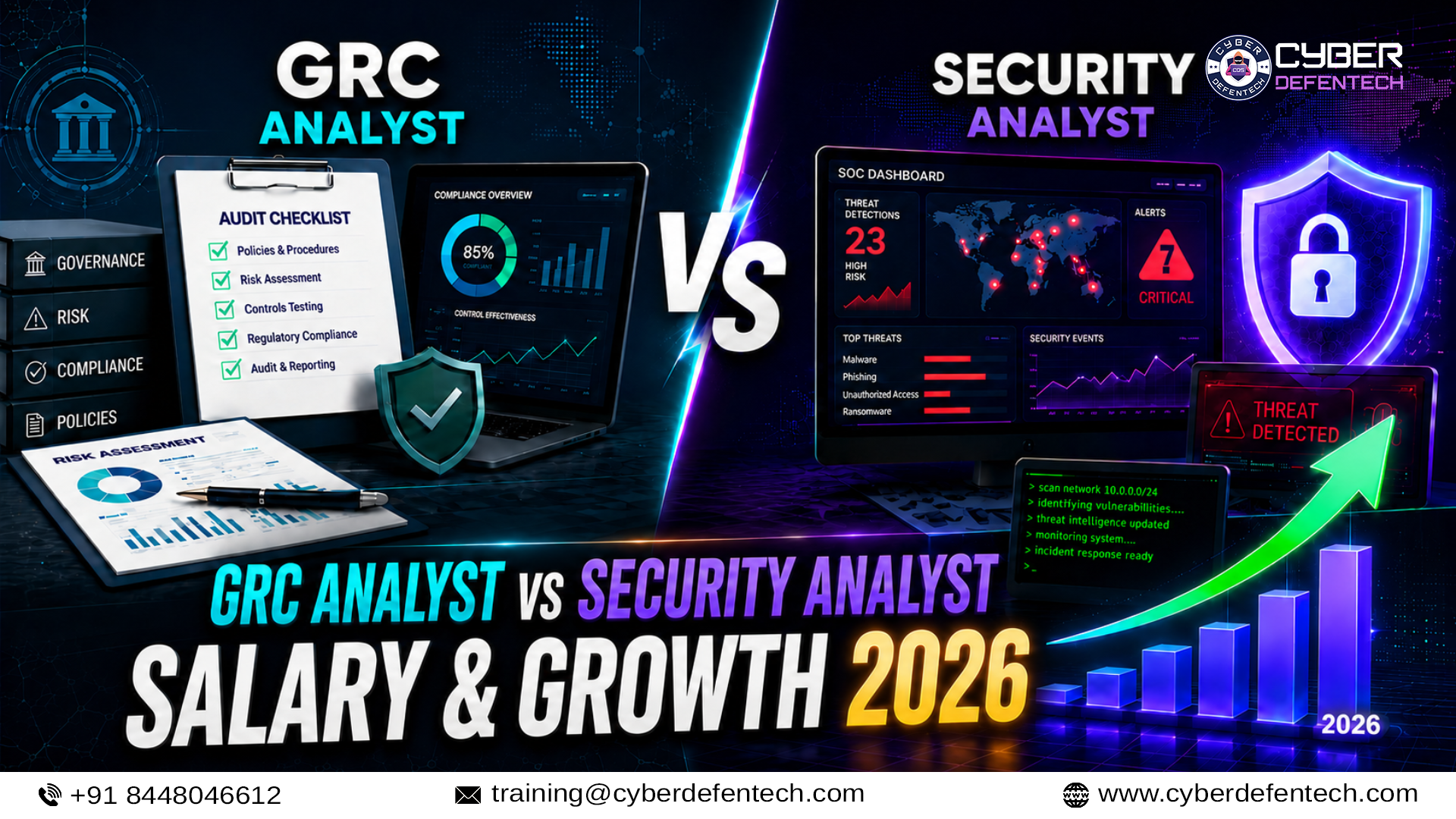
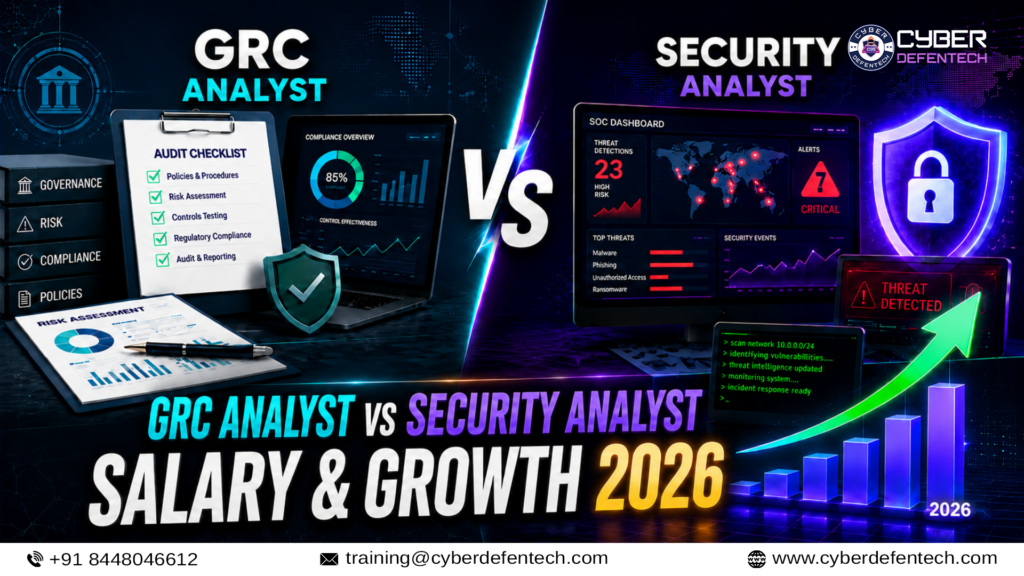
GRC Analyst vs Security Analyst Salary & Growth 2026
By Cyber Defentech Team | June 2026 | 10 Mins Read | Beginner to Advanced
Introduction
E very 39 seconds, a cyberattack happens somewhere in the world. In 2026, that number has only accelerated — ransomware gangs are deploying AI-enhanced payloads, state-sponsored threat actors are targeting critical infrastructure, and enterprise data breaches are costing organizations an average of $4.9 million per incident. The demand for cybersecurity professionals has never been more urgent, more lucrative, or more consequential.
But here’s the dilemma thousands of aspiring cybersecurity professionals face every day:
Should I become a GRC Analyst or a Security Analyst?
Both roles sit at the heart of the modern cybersecurity ecosystem. Both are high-demand, well-compensated, and future-ready. But they serve fundamentally different functions — and choosing the wrong path early can cost you years of momentum.
This article cuts through the noise. Whether you’re a fresh graduate trying to break into cybersecurity, an IT professional planning a career pivot, or a working analyst trying to decide where to level up — this is the definitive, industry-level comparison you’ve been looking for.
What is a GRC Analyst?
GRC stands for Governance, Risk, and Compliance — three interconnected pillars that keep organizations legally protected, strategically aligned, and operationally resilient.
A GRC Analyst is a cybersecurity professional responsible for ensuring that an organization’s information systems and processes comply with regulatory standards, manage risks proactively, and operate within a well-defined governance framework. Think of them as the architects of cybersecurity policy and the guardians of regulatory accountability.
In practical terms, GRC Analysts work with frameworks like ISO 27001, NIST CSF, SOC 2, GDPR, PCI-DSS, HIPAA, and India’s IT Act amendments. They conduct risk assessments, audit internal controls, develop security policies, and report to C-suite stakeholders and regulatory bodies.
What a GRC Analyst Does Day-to-Day:
- Conducting risk assessments and gap analyses
- Developing and maintaining security policies and procedures
- Mapping controls to regulatory frameworks
- Performing internal audits and third-party vendor assessments
- Preparing compliance documentation and audit reports
- Communicating risk posture to leadership and board members
What is a Security Analyst?
A Security Analyst — often called an Information Security Analyst or SOC Analyst — is a hands-on cybersecurity defender who monitors, detects, investigates, and responds to cyber threats in real time.
Where a GRC Analyst works in the domain of policy and risk strategy, a Security Analyst lives in the trenches — analyzing network traffic, hunting threats, responding to incidents, and keeping attackers out of the perimeter. They are the digital first responders of the modern enterprise.
Security Analysts typically work within Security Operations Centers (SOCs), using tools like SIEM platforms (Splunk, Microsoft Sentinel), IDS/IPS systems, endpoint detection and response (EDR) tools, and threat intelligence feeds to maintain 24/7 vigilance over organizational assets.
What a Security Analyst Does Day-to-Day:
- Monitoring SIEM dashboards and security alerts
- Investigating security incidents and anomalies
- Performing vulnerability assessments and penetration testing support
- Conducting threat hunting and malware analysis
- Writing incident reports and forensic documentation
- Collaborating with IT teams to harden systems and patch vulnerabilities
Why This Career Decision Matters More Than Ever in 2026
The cybersecurity talent gap is staggering. According to ISC2’s 2025 Workforce Study, the global cybersecurity workforce shortage stands at 3.5 million unfilled positions — and that number keeps climbing. India alone is projected to need over 1 million cybersecurity professionals by 2027.
Here’s what makes this particularly urgent: organizations are no longer just looking for technical defenders. Boards of directors, regulators, and investors now demand governance, accountability, and risk visibility — creating an unprecedented surge in GRC roles that many traditional cybersecurity programs simply don’t prepare students for.
Both career paths are future-ready, AI-adjacent, and positioned for explosive growth. But they demand different mindsets, different skill sets, and lead to very different career trajectories.
Let’s break them down with precision.
Real-World Cyber Threats Fueling Demand for Both Roles
Understanding why both roles are critical requires appreciating the scale of modern cyber risk:
For Security Analysts:
- In 2025, AI-generated phishing attacks bypassed traditional email filters at a 76% success rate in targeted campaigns
- Ransomware-as-a-Service (RaaS) groups like LockBit and its successors launched over 4,000 attacks globally in a single quarter
- Zero-day exploits are now being weaponized within 48 hours of public disclosure
- Cloud misconfigurations remain the #1 cause of enterprise data breaches, creating constant monitoring demand
For GRC Analysts:
- The EU AI Act (2025) introduced sweeping compliance obligations for AI-integrated businesses
- India’s Digital Personal Data Protection (DPDP) Act 2023 is now in active enforcement mode, creating massive compliance workloads
- Companies failing SOC 2 audits are being dropped by enterprise clients and insurance providers
- Third-party vendor risk management has become a boardroom-level priority after multiple supply chain attacks
Bottom line: The threat landscape of 2026 creates high-demand conditions for both roles simultaneously — but for very different reasons.
Why Companies Need Both GRC and Security Analysts?
The most resilient cybersecurity organizations in the world operate with both functions running in parallel. Here’s how they interact:
Security Analysts detect the threats. GRC Analysts build the frameworks that prevent and document them. Security Analysts respond to incidents. GRC Analysts ensure those responses comply with regulatory requirements and are reported correctly to authorities.
In financial services, healthcare, government, and tech — sectors that collectively employ millions in India and globally — both roles are not optional. They are mandated. A hospital that suffers a ransomware attack without a proper incident response plan (Security Analyst territory) and without HIPAA-compliant documentation procedures (GRC Analyst territory) faces regulatory fines, lawsuits, and reputational collapse simultaneously.
The modern cybersecurity department is not a choice between technical defense and governance. It’s a fusion of both.
Skills You Will Learn: A Side-by-Side Comparison
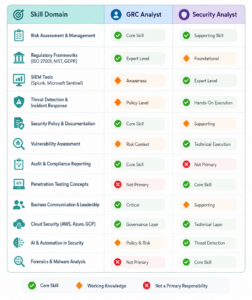
At Cyber Defentech, both learning tracks are structured to include practical, hands-on labs — not just theoretical frameworks. GRC students work with real audit templates and risk registers, while Security Analyst students work inside live SOC simulation environments and real SIEM dashboards.
Career Opportunities in 2026
GRC Analyst Career Ladder:
- Junior GRC Analyst → GRC Analyst → Senior GRC Analyst → GRC Manager → Chief Risk Officer (CRO) / CISO
Security Analyst Career Ladder:
- Tier 1 SOC Analyst → Tier 2/3 Security Analyst → Threat Intelligence Analyst → Security Engineer → Penetration Tester → Security Architect → CISO
Both paths lead to senior leadership. The GRC track moves faster toward executive and consulting roles. The Security Analyst track opens doors to highly specialized, premium technical positions.
Industries actively hiring both roles in India (2026):
- Banking, Financial Services & Insurance (BFSI)
- Healthcare & Pharma
- IT & Product Companies
- Government & Defence (under CERT-In mandates)
- E-commerce & Fintech
- Manufacturing (OT/ICS security)
- Legal & Consulting Firms
Salary & Industry Demand
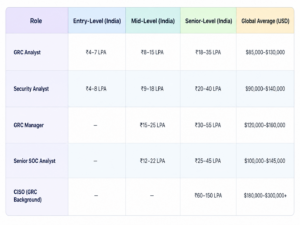
Salaries based on 2025–2026 industry data from Naukri, LinkedIn, Glassdoor, and PayScale India.
Verdict on Salary: Security Analysts may edge out slightly higher at mid-senior levels due to specialized technical premiums. However, GRC professionals who move into managerial and consulting roles — especially those with Big 4 experience — regularly outpace technical peers at the C-suite level.
Real-World Importance: Industry Case Studies
Case Study 1 — GRC Analyst: When India’s DPDP Act came into enforcement, a major e-commerce platform with 50 million users needed to audit its data processing pipelines, update 200+ vendor contracts, and implement a new consent management framework — all within 90 days. GRC Analysts led the entire project, saving the company from potential fines exceeding ₹250 crore.
Case Study 2 — Security Analyst: A global bank’s SOC team detected unusual lateral movement within their network at 2:47 AM. Within 19 minutes, Tier 2 Security Analysts had isolated the compromised endpoint, identified a novel fileless malware strain, and initiated containment. The attack — attributed to a state-sponsored APT group — was neutralized before any customer data was exfiltrated.
Both scenarios are not hypothetical. They are the daily reality of 2026’s cybersecurity landscape — and both require trained, certified professionals who know what they’re doing under pressure.
Tools & Technologies Used
GRC Analyst Tools:
- GRC Platforms: ServiceNow GRC, RSA Archer, MetricStream, OneTrust
- Audit & Compliance: Vanta, Drata, Tugboat Logic
- Risk Frameworks: NIST RMF, ISO 27005, COBIT 2019, FAIR Model
- Documentation: Confluence, SharePoint, Power BI (risk dashboards)
- AI Tools: AI-assisted risk scoring platforms, automated compliance monitoring
Security Analyst Tools:
- SIEM: Splunk, Microsoft Sentinel, IBM QRadar, Elastic SIEM
- EDR/XDR: CrowdStrike Falcon, SentinelOne, Microsoft Defender XDR
- Threat Intelligence: MITRE ATT&CK, VirusTotal, Recorded Future
- Forensics: Autopsy, Volatility, Wireshark, FTK
- Vulnerability Management: Nessus, Qualys, OpenVAS
- SOAR & Automation: Palo Alto XSOAR, Splunk SOAR
Beginner Roadmap: How to Get Started?
For Aspiring GRC Analysts:
- Build foundational IT and network knowledge (CompTIA A+, Network+)
- Study ISO 27001, NIST CSF, and GDPR fundamentals
- Learn risk assessment methodologies (FAIR, OCTAVE)
- Pursue certifications: CISA, CRISC, ISO 27001 Lead Auditor, CompTIA Security+
- Get hands-on practice with audit templates and GRC platforms
- Enroll in a structured GRC training program at Cyber Defentech
For Aspiring Security Analysts:
- Master networking fundamentals (TCP/IP, DNS, HTTP, firewalls)
- Learn Linux command line and basic scripting (Python, Bash)
- Set up a home lab — practice with Kali Linux, Wireshark, Splunk
- Study the MITRE ATT&CK framework and common attack TTPs
- Pursue certifications: CompTIA Security+, CEH, SOC Analyst (CSA+), eJPT
- Practice in SOC simulation environments — available through Cyber Defentech’s hands-on labs
Why Choose Cyber Defentech?
In a market flooded with generic online courses and outdated video tutorials, Cyber Defentech stands apart as a next-generation cybersecurity training institute built for the real world of 2026.
Here’s what makes Cyber Defentech the smarter choice:
✅ Industry-Focused Curriculum — Designed in collaboration with active cybersecurity practitioners, CISOs, and compliance experts. Not textbook theory — real tools, real scenarios, real skills.
✅ Hands-On Lab Environment — Students work inside live SOC simulations, real SIEM dashboards, and actual GRC platforms. You graduate with experience, not just a certificate.
✅ Dual-Track Training — Whether you’re heading toward GRC or Security Analysis, Cyber Defentech offers specialized, structured pathways that take you from beginner to industry-ready.
✅ Mentorship from Active Professionals — Learn from trainers who work in the field every day — not instructors who stopped practicing years ago.
✅ Career Support & Placement Assistance — Resume reviews, mock interviews, LinkedIn optimization, and direct industry connections to help you land your first — or next — cybersecurity role.
✅ Certifications Aligned to Industry Demand — Training structured around globally recognized certifications that employers actually care about.
Thousands of cybersecurity professionals across India have launched and accelerated their careers through Cyber Defentech’s practical, results-driven programs.
Future Scope & Industry Trends
The cybersecurity landscape of 2026 and beyond is being reshaped by forces that make both GRC and Security Analyst roles even more critical:
AI-Augmented Security Operations: AI is not replacing Security Analysts — it’s supercharging them. Analysts who can work alongside AI-powered detection platforms and tune machine learning models will command premium salaries. GRC Analysts who understand AI governance and the EU AI Act will be indispensable.
Cloud-Native Security: As organizations go all-in on multi-cloud architectures, both GRC professionals (cloud compliance, shared responsibility models) and Security Analysts (CNAPP, CSPM tools) face exploding demand.
Zero Trust Architecture: The death of perimeter security means every organization needs both the technical implementation (Security Analysts) and the governance framework (GRC Analysts) to operationalize Zero Trust.
India’s Regulatory Surge: DPDP Act enforcement, RBI cybersecurity directives, SEBI’s new cybersecurity framework, and CERT-In’s 6-hour breach reporting mandate are creating enormous demand for GRC professionals specifically in India’s domestic market.
Supply Chain & Third-Party Risk: After high-profile supply chain attacks devastated enterprises globally, third-party risk management — a core GRC function — has become a boardroom priority with dedicated budget.
Both roles are not just growing. They are becoming foundational infrastructure roles within every serious enterprise — as essential as finance or legal departments.
Final Thoughts
The question isn’t really “GRC Analyst or Security Analyst?” The real question is: Which role matches your strengths, your ambitions, and the impact you want to make?
If you think in frameworks, love strategy, enjoy communicating with leadership, and want to shape how organizations manage risk at the highest level — GRC is your path.
If you thrive under pressure, love solving technical puzzles, want to be the person who stops the attacker at the gate, and enjoy working with cutting-edge security tools — Security Analysis is your calling.
Both careers offer strong salaries, extraordinary growth potential, and the rare privilege of doing work that genuinely matters. In a world where data is the new oil and attackers are growing more sophisticated every quarter, the professionals who protect digital assets are not just well-paid — they are essential.
The only wrong decision is choosing neither.
Frequently Asked Questions (FAQs)
Q1. Which is better for freshers in 2026 — GRC Analyst or Security Analyst?
Both are excellent entry points. Security Analyst roles (especially Tier 1 SOC) often have more entry-level openings and require slightly more technical depth. GRC roles are ideal for graduates from IT, law, management, or business backgrounds who want a cybersecurity career with a governance focus. At Cyber Defentech, both tracks are designed to be accessible to freshers with structured, step-by-step learning paths.
Q2. Do I need coding skills to become a GRC Analyst?
Not necessarily. GRC Analysts benefit from basic scripting knowledge (Python for automation, Excel for data analysis), but it is not a hard requirement. Strong analytical thinking, communication skills, and deep knowledge of compliance frameworks matter far more.
Q3. Can a Security Analyst transition into a GRC role?
Absolutely — and this is one of the most powerful career moves in cybersecurity. Security Analysts who transition to GRC bring invaluable technical context that makes them exceptional risk assessors and auditors. Many senior GRC professionals and CISOs have technical security backgrounds.
Q4. What certifications should I pursue for GRC in 2026?
The most recognized GRC certifications in 2026 are: CISA (Certified Information Systems Auditor), CRISC (Certified in Risk and Information Systems Control), ISO 27001 Lead Auditor, CGRC (formerly CAP), and CompTIA Security+ as a foundation. Cyber Defentech’s GRC training is aligned to these globally recognized credentials.
Q5. Is there a demand for GRC Analysts in India specifically?
Yes — and it’s surging. India’s DPDP Act, RBI cybersecurity guidelines, SEBI’s cybersecurity framework, and CERT-In compliance mandates are creating massive domestic demand for GRC professionals. BFSI, healthcare, and IT sectors in India are actively hiring.
Q6. How long does it take to become job-ready as a Security Analyst?
With a focused, structured program like the one offered at Cyber Defentech, most students become job-ready in 4–6 months. This includes completing foundational training, earning a baseline certification (Security+, CEH, or equivalent), and building portfolio projects in a hands-on lab environment.
Q7. What is the average salary for a GRC Analyst fresher in India?
Entry-level GRC Analyst roles in India typically start between ₹4–7 LPA depending on the organization, city, and certifications held. With 2–3 years of experience and relevant certifications, this quickly scales to ₹10–15 LPA and beyond.
Q8. Can I do both GRC and Security Analyst work in the same role?
In smaller organizations and startups, hybrid roles do exist. However, as organizations scale, the two functions typically specialize. Learning both — which Cyber Defentech encourages through cross-functional curriculum — makes you an exceptionally versatile and valuable cybersecurity professional.
🚀 Ready to Launch Your Cybersecurity Career?
Whether you’re drawn to the strategic world of GRC or the technical frontlines of Security Analysis — Cyber Defentech will get you there.
Our programs are built for the real world of 2026: hands-on, practical, industry-focused, and designed to make you genuinely job-ready — not just certified on paper.
✅ Hands-On Practical Training
✅ Real-World Cybersecurity Skills
✅ Industry-Focused Learning
✅ Future-Ready Career Path
✅ Expert Mentorship from Active Professionals
✅ Placement Support & Career Guidance
Don’t wait for the perfect moment. The cybersecurity talent gap means employers need you now — and every month you delay is a month someone else gets the role, the salary, and the career you deserve.
Take the first step today.
 Visit Now:
 Call/WhatsApp:
Your cybersecurity career starts with one decision. Make it count.
© 2026 Cyber Defentech. All rights reserved. | Information Security Training | GRC | Ethical Hacking | SOC Analyst Programs
