
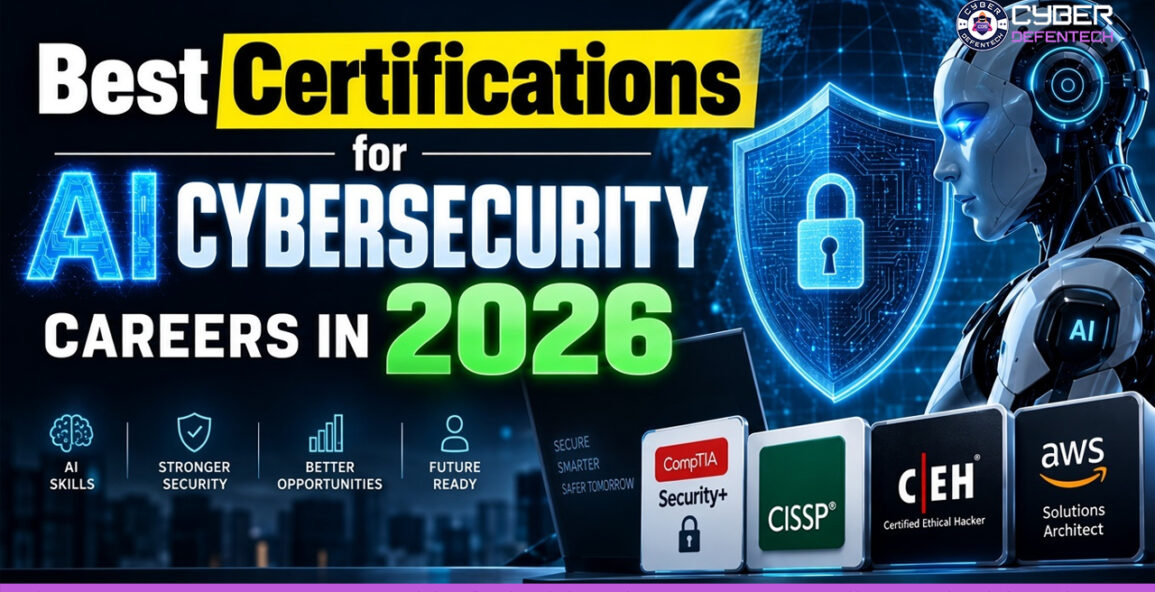
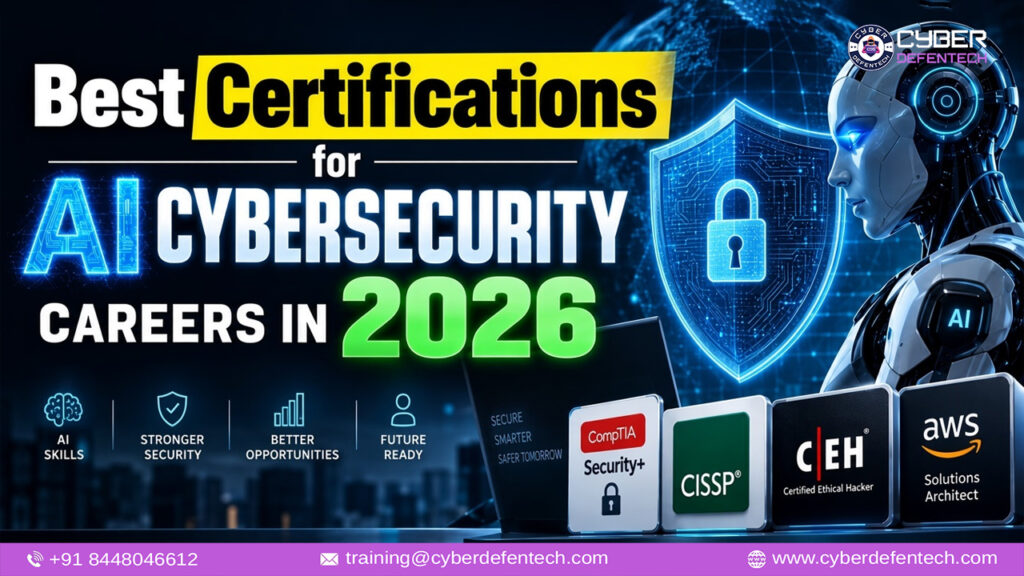
Best Certifications for AI Cybersecurity Careers in 2026
Introduction
Artificial intelligence has changed the cyber security landscape faster than almost anyone predicted. Attackers now use AI to write convincing phishing emails, clone voices, automate reconnaissance and generate malware variants in minutes. Defenders, in turn, rely on machine learning to detect anomalies, triage alerts and respond to incidents at a speed no human team could match. In the middle of this shift, a new type of professional is in demand: someone who understands both cyber security fundamentals and AI systems.
If you are wondering which credentials will actually help you land these roles, you are in the right place. This guide covers the best certifications for AI cybersecurity careers, explains who each one is for, and shows you how to build a practical learning path, whether you are a fresher, a working IT professional or an experienced security leader.
At CyberDefentech, we see this question from learners every day: “Which certification should I do first?” The honest answer is that it depends on your starting point and your target role. Let us break it down.
Why AI Cybersecurity Is One of the Fastest-Growing Career Paths
Organizations are adopting AI everywhere: chatbots, code assistants, fraud detection, customer analytics and internal copilots. Every one of these systems creates a new attack surface. Cyber security teams now need to handle risks such as:
- Prompt injection and jailbreaking of large language models
- Data poisoning and model theft
- Deepfake-based fraud and social engineering
- Sensitive data leakage through AI tools
- Shadow AI, where employees use unapproved AI apps
- AI-powered attacks that scale faster than traditional threats
At the same time, security operations centers (SOCs) use AI to reduce alert fatigue, hunt threats and automate response. That means employers want people who can secure AI, use AI for defense, and govern AI responsibly. Certifications help prove you can do these things, especially when you are changing roles or entering the field.
Do Certifications Really Matter for AI Security Jobs?
Yes, but with a caveat. Certifications alone do not make you job-ready; hands-on skills do. However, a good certification does three valuable things:
- Validates your knowledge to recruiters who screen hundreds of resumes.
- Gives you a structured learning path instead of random YouTube hopping.
- Opens doors to compliance-driven roles, since many government and enterprise jobs list specific certifications as requirements.
The best approach is to combine certifications with labs, home projects and real practice. Think of the certificate as the proof and the practical skill as the substance.
How to Choose the Right Certification
Before picking any credential, ask yourself these questions:
- Where am I today? Beginner, intermediate or senior?
- What role do I want? SOC analyst, penetration tester, cloud security engineer, AI security engineer or AI governance and risk specialist?
- What is my budget and timeline? Some exams need months of preparation.
- Does my target employer prefer any particular one? Check 10 to 15 job postings and note the repeated requirements.
Now let us look at the certifications themselves.
1. CompTIA Security+ (Best Foundation for Beginners)
If you are new to cyber security, Security+ is the most common starting point. It covers core topics such as threats, vulnerabilities, network security, cryptography, identity and access management, and risk management. It is vendor-neutral and widely recognized.
Why it matters for AI careers: You cannot secure an AI system without understanding basic security principles. Security+ builds the foundation that every advanced AI security skill sits on.
Best for: Freshers, career switchers, help desk and IT support professionals.
2. CompTIA CySA+ (Best for AI-Assisted SOC and Threat Detection)
Cybersecurity Analyst (CySA+) focuses on threat detection, log analysis, vulnerability management and incident response. These are exactly the areas where AI and machine learning tools are used most heavily today.
Why it matters: SOC analysts increasingly work alongside AI-driven detection platforms. CySA+ teaches you to interpret alerts, validate findings and respond, skills that AI cannot fully replace.
Best for: Aspiring SOC analysts, threat hunters and blue team professionals.
3. Certified Ethical Hacker (CEH) (Best for Offensive Security Awareness)
CEH introduces the attacker’s mindset: reconnaissance, scanning, exploitation, social engineering and more. Recent versions of the program place strong emphasis on using AI tools in both attack and defense scenarios.
Why it matters: To protect AI systems, you must understand how they can be attacked. CEH is a recognized name that many recruiters and government organizations look for.
Best for: Penetration testers, red team beginners and security consultants.
4. Offensive Security Certified Professional (OSCP) (Best for Hands-On Pen Testers)
OSCP is known for its tough, practical exam, where you must compromise machines in a timed lab environment. It does not focus on AI directly, but the deep hands-on skill it builds is highly respected.
Why it matters: Professionals who can test AI-enabled applications, APIs and infrastructure need strong exploitation skills. OSCP proves you have them.
Best for: Intermediate to advanced penetration testers who want to move into AI application security testing.
5. CISSP (Best for Senior and Leadership Roles)
Certified Information Systems Security Professional (CISSP) from ISC2 is among the most recognized cyber security credentials in the world. It covers eight domains, including security architecture, risk management, identity management and software development security. It requires several years of professional experience.
Why it matters: AI security at the enterprise level is about architecture, policy and risk. CISSP prepares you to make those decisions and communicate them to executives.
Best for: Security managers, architects, consultants and anyone targeting leadership.
6. ISACA AAISM (Advanced in AI Security Management)
ISACA introduced the AAISM credential specifically to address AI security. It focuses on AI governance, AI risk management and AI security program management. It is aimed at experienced professionals, and ISACA generally expects candidates to already hold a credential such as CISM or CISSP.
Why it matters: This is one of the few certifications built specifically around securing and governing AI in an organization. It signals that you can lead AI security strategy, not just operate tools.
Best for: Experienced security managers, risk professionals and auditors.
7. ISACA CISM and CRISC (Best for Risk and Governance Paths)
CISM (Certified Information Security Manager) focuses on security governance, program development and incident management. CRISC (Certified in Risk and Information Systems Control) focuses on IT risk identification and control.
Why they matter: AI introduces new risks such as bias, privacy violations, model failures and regulatory exposure. Professionals who can assess and manage those risks are in demand.
Best for: Risk analysts, compliance officers and security managers.
8. IAPP AIGP (Artificial Intelligence Governance Professional)
AIGP focuses on responsible AI, covering AI laws, ethics, risk management and governance frameworks. It is less technical and more policy-oriented.
Why it matters: With AI regulations emerging worldwide, organizations need people who understand compliance and ethical AI deployment alongside cyber security.
Best for: Privacy professionals, legal and compliance teams, and security leaders working on AI policy.
9. ISO/IEC 42001 Lead Implementer or Lead Auditor
ISO/IEC 42001 is the international standard for AI management systems. Training programs for this standard teach you how to build, implement or audit an AI management system inside an organization.
Why it matters: As more companies seek formal compliance for their AI use, professionals who understand this standard become very valuable.
Best for: Auditors, compliance consultants and governance specialists.
10. GIAC Certifications (GCIH, GMLE and Others)
GIAC offers highly respected, practical certifications. Two worth noting for AI-focused careers:
- GCIH (Certified Incident Handler): Strong for incident response and handling modern attacks.
- GMLE (Machine Learning Engineer): Focused on machine learning skills, useful if you want to build or analyze ML-based security tools.
Why they matter: GIAC credentials are known for technical depth. They are especially valued in mature SOC, DFIR and engineering teams.
Best for: Technical practitioners who want deep, specialized skills. (Note that GIAC exams are often linked to expensive training, so plan your budget.)
11. Cloud Security and Cloud AI Certifications
Most AI workloads run in the cloud, so cloud security knowledge is essential. Consider:
- Microsoft SC-200 (Security Operations Analyst): Covers threat protection and security operations in the Microsoft ecosystem, including AI-assisted tools.
- Microsoft AI-900 (Azure AI Fundamentals): A gentle introduction to AI concepts and services.
- AWS Certified Security – Specialty: Deep coverage of securing workloads on AWS.
- AWS Certified AI Practitioner: Foundational understanding of AI and machine learning on the AWS platform.
- Google Professional Cloud Security Engineer: Focused on designing and implementing secure solutions on Google Cloud.
Why they matter: AI security is often cloud security in practice. Knowing how to secure data pipelines, storage, identities and model endpoints in the cloud sets you apart.
Best for: Cloud engineers, DevSecOps professionals and anyone securing AI workloads on public cloud platforms.
12. Practical DevSecOps CAISP (Certified AI Security Professional)
The Certified AI Security Professional program is a hands-on credential built around attacking and defending AI systems, with topics like LLM threats, model security and the OWASP-style risk categories for AI applications.
Why it matters: It is one of the more specialized, practical AI security certifications available, which makes it a strong resume differentiator.
Best for: Security engineers, DevSecOps professionals and application security specialists.
Quick Comparison: Which Certification for Which Role?
| Career Goal | Recommended Certifications |
|---|---|
| Beginner / Career Switcher | Security+, AI-900 |
| SOC Analyst (AI-assisted) | Security+, CySA+, SC-200 |
| Penetration Tester / Red Team | CEH, OSCP |
| AI Application Security Engineer | CAISP, cloud security certifications |
| Cloud AI Security | AWS Security Specialty, Google Cloud Security, SC-200 |
| Security Manager / Architect | CISSP, CISM, AAISM |
| AI Governance and Risk | AIGP, CRISC, ISO/IEC 42001, AAISM |
A Practical Roadmap You Can Follow
Stage 1: Foundation (0 to 6 months)
Learn networking, Linux, basic scripting in Python and core security concepts. Earn Security+ and, if you are new to AI, a fundamentals-level AI certificate.
Stage 2: Specialization (6 to 18 months)
Choose your lane. Defensive path: CySA+ and SC-200. Offensive path: CEH, then OSCP. Cloud path: AWS or Google Cloud security certifications.
Stage 3: AI Security Focus (18 to 36 months)
Add AI-specific skills through CAISP, GIAC machine learning content or ISO/IEC 42001 training. Build projects such as testing an LLM application for prompt injection in a safe lab.
Stage 4: Leadership (3 years and beyond)
Pursue CISSP, CISM and AAISM to move into architecture, governance and management.
Skills to Build Alongside Your Certifications
Certifications open the door, but these skills help you walk through it:
- Python programming for automation and working with ML libraries
- Understanding of machine learning basics, including how models are trained and where they can fail
- LLM security concepts, such as prompt injection, insecure output handling and data leakage
- Cloud security fundamentals
- Threat modeling for AI systems
- Incident response and digital forensics
- Regulatory awareness, such as privacy laws and emerging AI regulations
Build a small home lab, practice on legal training platforms, write about what you learn, and document your projects. Recruiters love evidence of curiosity.
Common Mistakes to Avoid
- Collecting certificates without practice. Ten certificates with no hands-on skill will not impress a technical interviewer.
- Starting with an advanced exam too early. Respect prerequisites and experience requirements.
- Ignoring fundamentals. AI security still depends on networking, operating systems and identity basics.
- Chasing trends blindly. Pick certifications that match your actual career goal.
- Skipping soft skills. Communication and reporting matter enormously in cyber security roles.
Frequently Asked Questions (FAQs)
1. Which certification is best for beginners in AI cybersecurity?
CompTIA Security+ is the best starting point, since it builds core security knowledge. Adding an AI fundamentals course helps you understand how AI systems work.
2. Is there a certification specifically for AI security?
Yes. ISACA’s AAISM focuses on AI security management, and CAISP from Practical DevSecOps focuses on hands-on AI security. Others, like AIGP and ISO/IEC 42001 programs, cover AI governance.
3. Do I need coding skills for AI cybersecurity?
Basic Python is highly recommended. You do not need to be a software developer, but scripting helps you automate tasks and understand ML tools.
4. Is CISSP worth it for AI security careers?
Yes, if you are targeting senior, architecture or management roles. It requires professional experience, so beginners should start with entry-level certifications first.
5. How long does it take to build an AI cybersecurity career?
With consistent effort, many learners reach an entry-level role in 6 to 12 months and move into specialized AI security roles within 2 to 4 years.
6. Are certifications enough to get a job?
Certifications help, but employers also want hands-on skills, projects and clear communication. Combine both for the best results.
conclusion
AI is not replacing cyber security professionals; it is changing what they do. The people who thrive will be those who can secure AI systems, use AI for smarter defense and guide organizations through new risks. The best certifications for AI cybersecurity careers depend on your starting point: Security+ and CySA+ for foundations, CEH and OSCP for offensive skills, CISSP, CISM and AAISM for leadership, and AIGP or ISO/IEC 42001 for governance.
Start with one certification that matches your current level, pair it with hands-on practice, and build step by step. If you want guided learning and practical cyber security training, explore what CyberDefentech offers and take the next step in your journey.
📞 Call/WhatsApp: +91 8448046612
