
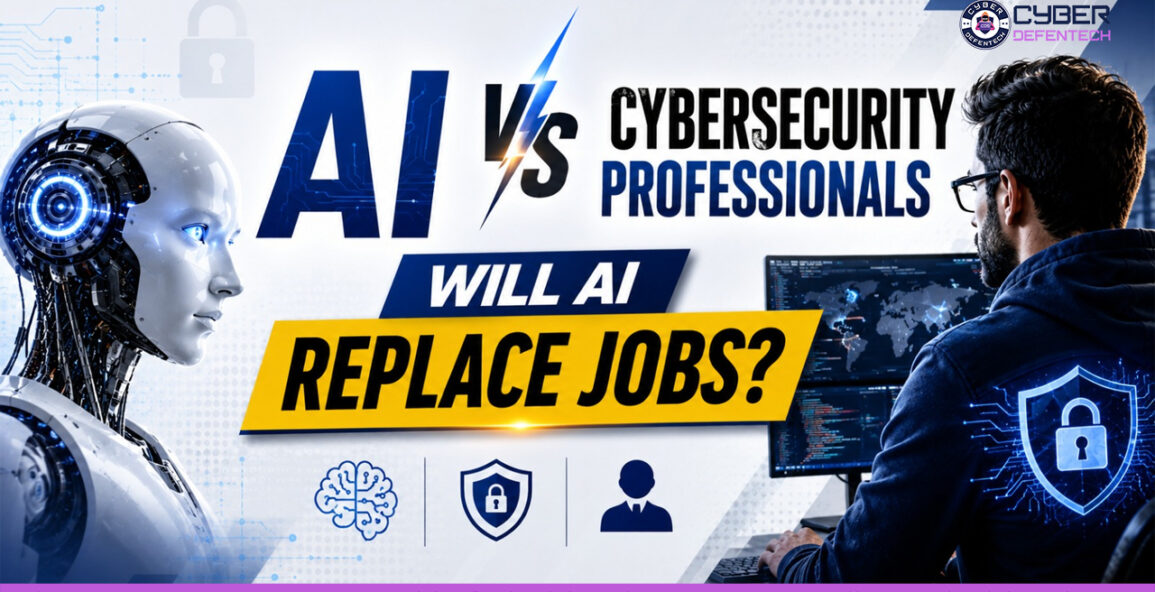
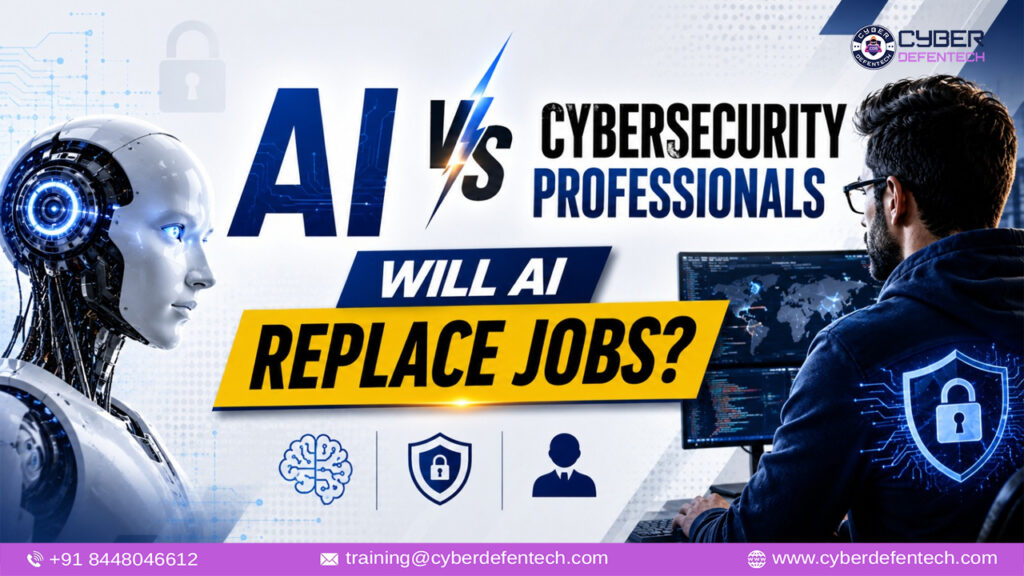
AI vs Cybersecurity Professionals: Will AI Replace Security Jobs?
Introduction
Artificial intelligence is changing almost every industry, and cybersecurity is no exception. Security tools can now scan millions of logs in seconds, flag suspicious behavior, and even respond to incidents automatically. Naturally, a big question is on everyone’s mind: will AI replace cybersecurity professionals?
If you are a student planning a security career, a SOC analyst worried about automation, or a business owner wondering whether AI alone can protect your company, this question matters to you. The short answer is that AI will not replace cybersecurity professionals, but it will change what they do every day. Professionals who learn to work with AI will become more valuable, and those who ignore it may struggle to keep up.
In this blog, we will look at where AI is strong, where it fails, how attackers are using it, which jobs are changing, and how you can prepare. We will also share how CyberDefenTech views the balance between human expertise and machine intelligence. This guide breaks down the AI vs cybersecurity professionals question with practical insights.
How AI Is Being Used in the AI vs Cybersecurity Professionals Debate
AI is already a regular part of modern security operations. Machine learning models help detect malware, identify phishing emails, spot unusual login behavior, and prioritize alerts. Security platforms use behavioral analytics to learn what “normal” looks like for a network or user, then flag anything that deviates from it.
Tasks that used to take analysts hours, such as correlating logs from different systems, enriching alerts with threat intelligence, or checking whether an IP address is malicious, can now be done in seconds. Generative AI assistants are also being used to summarize incidents, draft reports, explain suspicious scripts, and suggest response steps.
At CyberDefenTech, the focus is on using this technology as a force multiplier. AI handles the volume, and people handle the judgment.
Why Security Professionals Feel Worried
The fear is understandable. Headlines often claim that AI will take over jobs, and cybersecurity looks like a natural target because so much of it involves data, patterns, and repetitive tasks. Entry-level work like alert triage, basic vulnerability scanning, and routine compliance checks is increasingly automated.
There is also the pressure of constant change. New AI tools appear every month, and many professionals feel they must learn everything at once. This creates anxiety, especially for people early in their careers. But fear of change is different from actual replacement. History shows that technology usually changes the nature of a job before it eliminates it, and cybersecurity has a particular feature that makes full replacement unlikely: it is a contest against thinking human adversaries.
Where AI Outperforms Humans
In the AI vs cybersecurity professionals comparison, AI clearly wins on speed and scale. To be honest about the debate, we must admit that AI is better than humans at certain things.
Speed is the biggest advantage. An AI system can analyze enormous volumes of logs, network traffic, and endpoint events without getting tired. Humans simply cannot match that scale.
Pattern recognition is another strength. Models can detect subtle anomalies, such as a user logging in at an unusual hour from an unfamiliar device and then accessing files they never touch, that would be buried in the noise for a human analyst.
AI also never suffers from alert fatigue. Security teams often receive thousands of alerts daily, and tired analysts can miss real threats. Automation keeps the same consistency at 3 a.m. as at 3 p.m.
Finally, AI can automate first-level response, such as isolating an infected endpoint, blocking a malicious domain, or resetting compromised credentials, which reduces the time attackers have to cause damage.
Where AI Still Falls Short
In the AI vs cybersecurity professionals contest, humans still lead on context and judgment. Despite these strengths, AI has serious limitations that keep humans essential.
First, AI lacks real context. A model may flag unusual activity, but it does not understand your business. It does not know that the finance team runs a large data export every quarter, or that a sudden spike in traffic is due to a product launch. Humans bring that business understanding.
Second, AI makes mistakes. False positives waste time, and false negatives let real attacks through. AI models can also “hallucinate,” presenting wrong information with confidence. Without a human to verify, a bad decision can be automated at scale.
Third, AI struggles with novel attacks. Models learn from past data, so brand-new techniques with no historical pattern can slip past them. Skilled human threat hunters think creatively, form hypotheses, and investigate things that “feel wrong” before any tool raises an alarm.
Fourth, AI cannot take accountability. When a breach happens, regulators, customers, and boards want a responsible human who can explain decisions, communicate with stakeholders, and make ethical calls. A machine cannot stand in front of a board or negotiate during a crisis.
How Attackers Are Using AI Too
One reason cybersecurity jobs are safe is that attackers are adopting AI as well. Cybercriminals use AI to write more convincing phishing emails without grammar mistakes, personalize scams at scale, clone voices for fraud, and speed up the discovery of vulnerabilities.
This creates an arms race. When attackers use AI to move faster, defenders need AI to keep up, but they also need skilled people who understand how these attacks work and can anticipate what comes next. If one side uses AI and the other relies on AI alone, the contest is decided by human creativity and strategy.
This is a key point in how CyberDefenTech approaches security: defense must evolve as fast as offense, and that means investing in both smart tools and smart people. The AI vs cybersecurity professionals race is now a race on both sides.
Which Cybersecurity Jobs Are Most Likely to Change
Not every role will be affected equally. Here is a realistic picture.
Roles with highly repetitive, rule-based work are changing the fastest. Tier-1 SOC analysts who mostly sort and close alerts are seeing automation take over much of that workload. Basic vulnerability scanning, simple compliance reporting, and routine log review are also being automated.
This does not necessarily mean these people lose their jobs. In many organizations, the role is shifting from “clicking through alerts” to “supervising automated systems, investigating complex cases, and tuning detection rules.” The job title may remain, but the daily work becomes more analytical.
The risk is highest for professionals who rely only on a narrow set of repetitive skills and do not upgrade them.
Which Cybersecurity Roles Are Safe and Growing
The AI vs cybersecurity professionals shift affects roles differently. Several areas of cybersecurity depend heavily on human judgment, creativity, and communication, and are likely to grow.
Threat hunters and incident responders need intuition and deep investigation skills. Penetration testers and red teamers must think like attackers and find creative ways around defenses, which AI can assist with but not fully replace. Security architects design systems based on business needs, risk tolerance, and regulation. Governance, risk, and compliance experts interpret laws and policies and advise leadership. Security leaders such as CISOs make strategic decisions that balance risk, budget, and business goals.
Digital forensics and cybercrime investigation also require careful human reasoning, since evidence must be interpreted and defended in legal settings.
New Jobs Created by AI in Cybersecurity
Every technological shift creates new roles, and AI is no different. We are already seeing demand for AI security engineers who protect machine learning models from attacks such as data poisoning and prompt injection. There is also growing need for AI governance and risk specialists, who ensure AI tools are used safely, ethically, and legally.
Other emerging roles include security automation engineers, detection engineers who build and tune AI-assisted detection logic, and AI red teamers who test how models can be manipulated. As companies adopt AI everywhere, the AI systems themselves become new targets, which expands the attack surface and creates more work for security teams, not less.
Skills Cybersecurity Professionals Should Build Now
If you want to stay valuable, focus on skills that complement AI rather than compete with it.
Start with strong fundamentals: networking, operating systems, cloud security, identity and access management, and incident response. AI is a tool, and tools work best in the hands of people who understand the basics deeply.
Next, learn automation and scripting, especially Python, along with security orchestration concepts. Being able to build playbooks and connect tools makes you the person who controls the automation rather than the person replaced by it.
Develop AI literacy. Understand how machine learning models work, where they fail, how to write good prompts, and how to validate AI output. Learn about AI-specific risks like adversarial inputs and data leakage.
Finally, invest in soft skills. Communication, critical thinking, risk assessment, and the ability to explain technical issues to non-technical leaders are skills AI cannot easily replicate. Continuous learning through labs, certifications, and real-world practice is the best long-term career insurance, and platforms like CyberDefenTech can be a useful part of that learning journey.
AI vs Cybersecurity Professionals: Why the Human + AI Model Wins
The strongest security programs do not choose between humans and machines. They combine them.
In this model, AI does the heavy lifting: collecting data, filtering noise, spotting anomalies, and handling routine responses. Humans do the thinking: validating findings, investigating complex incidents, understanding business impact, and making final decisions. Over time, human feedback also improves the AI, creating a loop where each makes the other better.
Think of it like a pilot and an autopilot. The autopilot handles routine flying, but nobody removes the pilot, because when something unexpected happens, a trained human must take control. Cybersecurity works the same way. This balanced philosophy is at the heart of how CyberDefenTech looks at modern defense: automation for speed, people for wisdom.
Common Myths About AI and Security Jobs
Many myths surround the AI vs cybersecurity professionals topic Myth 1: AI will completely take over cybersecurity. In reality, AI lacks context, accountability, and creativity, so full automation of security is unrealistic.
Myth 2: Only technical experts are affected. AI changes work at every level, but the shift is toward higher-value tasks rather than just job loss.
Myth 3: You must become an AI scientist to survive. You do not. You need to understand how to use and question AI tools, not necessarily build them from scratch.
Myth 4: Entry-level security careers are dead. Entry paths are changing, not disappearing. Beginners who learn automation and hands-on skills early can actually progress faster than before.
What Businesses Should Do
For organizations, the lesson is not to cut security staff and rely on AI. Companies that do this risk blind spots, poor decisions, and weak incident response.
Instead, businesses should use AI to reduce analyst burnout, free skilled people for higher-value work, and shorten detection and response times. They should invest in training so teams can use AI tools effectively, set clear policies for how AI is used, and always keep humans in the loop for critical decisions.
Partnering with security-focused providers like CyberDefenTech can help organizations adopt AI responsibly while maintaining strong human oversight, so technology strengthens the security posture instead of creating false confidence.
The Future of Cybersecurity Careers
Looking ahead, cybersecurity will likely become more strategic and less repetitive. Routine tasks will be automated, and professionals will spend more time on threat hunting, risk analysis, architecture, and strategy. The demand for skilled security talent remains high worldwide, and AI adoption is likely to increase that demand by creating new systems to protect and new threats to manage.
The professionals who thrive will be those who adapt: curious learners who see AI as a partner. The ones who struggle will be those who resist change or depend only on tasks that machines can do better.
Frequently Asked Questions (FAQs)
1. Will AI replace cybersecurity professionals completely? In the AI vs cybersecurity professionals debate, AI supports humans but cannot replace them. AI can automate repetitive tasks, but it cannot replace human judgment, creativity, accountability, and business understanding.
2. Which cybersecurity jobs are most at risk from AI? Highly repetitive roles, such as basic alert triage and routine scanning, are most affected, though these roles are evolving rather than disappearing.
3. Which cybersecurity jobs are safe from AI? Threat hunting, incident response, penetration testing, security architecture, governance and risk, and security leadership are considered more resilient.
4. Is cybersecurity still a good career in the AI era? Yes. Demand for skilled professionals remains strong, and AI is creating new roles and new attack surfaces to defend.
5. What skills should I learn to stay relevant? Focus on security fundamentals, cloud security, Python and automation, AI literacy, and communication and critical thinking.
conclusion
AI will not replace cybersecurity professionals, but it will replace parts of what they do. Repetitive, low-value tasks are being automated, while demand grows for people who can think critically, understand context, and manage both technology and risk.
The real competition is not AI versus humans. It is humans who use AI versus humans who do not. If you build strong fundamentals, learn automation, understand AI’s strengths and limits, and keep sharpening your human skills, you will not just survive this shift, you will lead it.
Cybersecurity has always been about staying one step ahead of attackers, and AI is simply the newest tool in that fight. With the right mindset and guidance from resources like CyberDefenTech, the future of security careers looks challenging, but also full of opportunity. That is the real lesson of AI vs cybersecurity professionals.
 Call/WhatsApp: +91 8448046612


