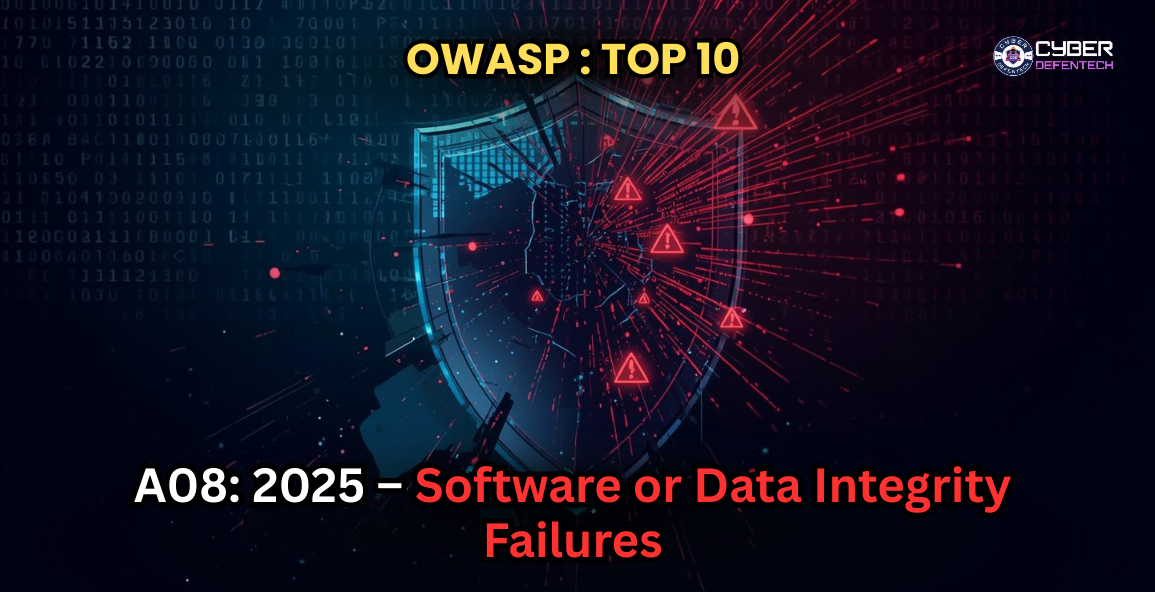
OWASP A08:2025 – Software or Data Integrity Failures refer to weaknesses that occur when applications do not properly protect the integrity of software updates, critical data, or CI/CD pipelines. These failures arise when systems rely on untrusted sources, lack digital signatures, or allow unauthorized changes to code and data. As a result, attackers can inject malicious updates, tamper with sensitive information, or compromise the software supply chain, leading to severe security risks.
Definition: Software and Data Integrity Failures, listed in the OWASP Top 10 (A08:2025), occur when applications don’t properly protect their software or critical data from unauthorized changes.
This allows attackers to secretly modify code, configurations, or data—leading to breaches, malware insertion, or corrupted systems. Think of it like someone quietly altering a bank ledger or injecting malicious instructions into a payment system; the integrity is broken, and the system can no longer be trusted.
Why is A08:2025 – Software or Data Integrity Failures Important ?
Modern applications increasingly rely on automated software updates, package managers, and CI/CD pipelines. If attackers compromise these, they can inject malicious code into thousands of systems at once.
- Famous example: SolarWinds Attack (2020) – Hackers inserted malicious code into legitimate software updates, impacting thousands of companies and government agencies.
- Example in data: Ransomware attacks often encrypt or modify files, breaking data integrity.
So, this is about trust. Can you trust that the software and data in your systems are exactly what they should be? Integrity failures break that trust.
Common Scenarios Leading to Integrity Failures:
1. Tampered Software Updates
o Attackers manipulate software updates to include malicious code.
o Happens when update mechanisms lack proper verification.
2. Unverified or Malicious Dependencies
o Applications often rely on third-party libraries.
o If these libraries are compromised, the entire application can be affected.
3. Insufficient Signing/Validation
o Code or data isn’t digitally signed or signatures are ignored.
o Leads to easy injections or modification by attackers.
4. CI/CD Pipeline Exploitation
o Continuous Integration/Continuous Deployment pipelines automate builds.
o If an attacker gains access, they can inject malicious code at the build stage.
5. Unauthorized Configuration Changes
o Config files or environment variables altered to weaken security or leak data.
Where This Usually Happens ?
- Software Updates without verification – Example: App auto-update le rahi hai bina signature verify kiye.
- CI/CD pipelines insecure – Developer tools hacked ho jaye, attacker malicious code add kar de.
- Untrusted plugins, libraries – Jaise npm, pip, composer packages bina verify kiye use karna.
- Critical data directly trusted – Jaise sensitive config files tamper ho jayein.
- Insufficient digital signatures – Code signing, file integrity checks, hashing missing.
How to Prevent Software or Data Integrity Failures ?
1. Use Strong Integrity Controls
Make sure the software or data you use has not been changed by attackers.
- Use hashing (SHA-256, SHA-512)
- Use digital signatures
- Verify the checksum of files
- Apply code-signing for applications and scripts
2. Secure Software Updates
Software should never install updates blindly.
- Use sign updates
- Only download updates from trusted sources
- Enable automatic signature verification
- Block any update that fails integrity checks
3. Protect CI/CD Pipelines
Your build and deployment pipeline must be secure.
- Use multi-factor authentication (MFA)
- Protect secrets and API keys
- Limit access to pipeline tools
- Scan build artifacts for malware
- Audit and monitor pipeline activities
4. Use Secure and Trusted Dependencies
Most apps use external libraries; ensure they’re safe.
- Use only trusted libraries/packages
- Avoid unknown or suspicious open-source packages
- Maintain an SBOM (Software Bill of Materials)
- Scan dependencies regularly for vulnerabilities
- Prefer packages with verified signatures
5. Protect Data from Tampering
Ensure sensitive data cannot be changed silently.
- Use encryption at rest and in transit
- Implement access controls
- Use file integrity monitoring (FIM)
- Log and audit every change to critical files
6. Disable or Limit Unsafe Deserialization
Many integrity failures come from untrusted data.
- Avoid using binary serialization formats
- Use safe formats like JSON or YAML
- Validate all input data before processing
- Use strict deserialization policies
7. Implement Zero-Trust Principles
Never trust software, data, or components by default.
- Verify everything
- Restrict privileges
- Use least privilege access controls
- Monitor behavior continuously
8. Monitor and Detect Integrity Issues
Use tools to keep track of any tampering.
- File integrity monitoring (Tripwire, OSSEC)
- Runtime protection solutions
- SIEM alerts for suspicious changes
- Version control monitoring
Example Attack Scenarios (Easy to Understand)
1️⃣ Malicious Software Update (Fake or Tampered Update)
Scenario: A company’s software automatically downloads updates from a server. The update file is not digitally signed or verified.
What attacker does:
- Hacker compromises the update server
- Replaces real update with a malicious update
- When users install it, malware gets installed instead
Impact:
- Remote code execution
- Backdoor in the system
- Spread of malware to thousands of users
2️⃣ CI/CD Pipeline Compromise
Scenario: Developers use a CI/CD (build) pipeline to create software packages. The pipeline has weak access control.
What attacker does:
- Attackers steal a developer account
- Inserts malicious code into the build pipeline
- Final software shipped to customers already contains malware
Impact:
- Complete compromise of trusted software
- Customers unknowingly install infected apps
3️⃣ Dependency / Library Tampering (Supply Chain Attack)
Scenario: An application uses third-party open-source libraries (npm/pip packages). The system does not validate package integrity.
What attacker does:
- Uploads a library with the same name (typosquatting)
- Developer accidentally installs the fake package
- Malicious package executes harmful code
Impact:
- Credential stealing
- Data exfiltration
- Remote access to servers
4️⃣ Untrusted Deserialization Attack
Scenario: App receives serialized objects from clients (Java/PHP/.NET). The app trusts the data blindly.
What attacker does:
- Sends a specially crafted malicious object
- During deserialization, code execution happens
Impact:
- Remote Code Execution (RCE)
- Full server takeover
5️⃣ Configuration File Tampering
Scenario: Config files (like YAML, JSON, or ENV) are stored without integrity controls. No hashing or validation is done.
What attacker does:
- Modifies the configuration file
- Changes in security settings
- Injects harmful parameters
Impact:
- Application misbehaves
- Security controls disabled
- Attackers gain persistence
6️⃣ Database or Data Integrity Attack
Scenario: A system stores critical data (like user roles or balances) without checks.
What attacker does:
- Directly modifying records
- Changes “role=user” to “role=admin”
- OR changes financial amounts
Impact:
- Unauthorized privileges
- Fraud
- Corrupted system state
7️⃣ Docker Image or Container Registry Tampering
Scenario: Company pull Docker images from a registry without signature validation.
What attacker does:
- Uploads a malicious version of an image
- Organization deploys it thinking it’s safe
Impact:
- Malware inside production containers
- Backdoors included in image layers
Conclusion:
OWASP A08:2025 – Software or Data Integrity Failures emphasizes the growing risk of untrusted software, updates, and data. With increasing reliance on automated updates, third-party libraries, and CI/CD pipelines, even a small integrity lapse can impact thousands of systems. Ensuring trusted components, validating changes, securing build pipelines, and monitoring for tampering are essential to maintaining control and preventing large-scale compromise.
Stay informed and stay secure — follow Cyber Defentech for more cybersecurity insights and updates.
