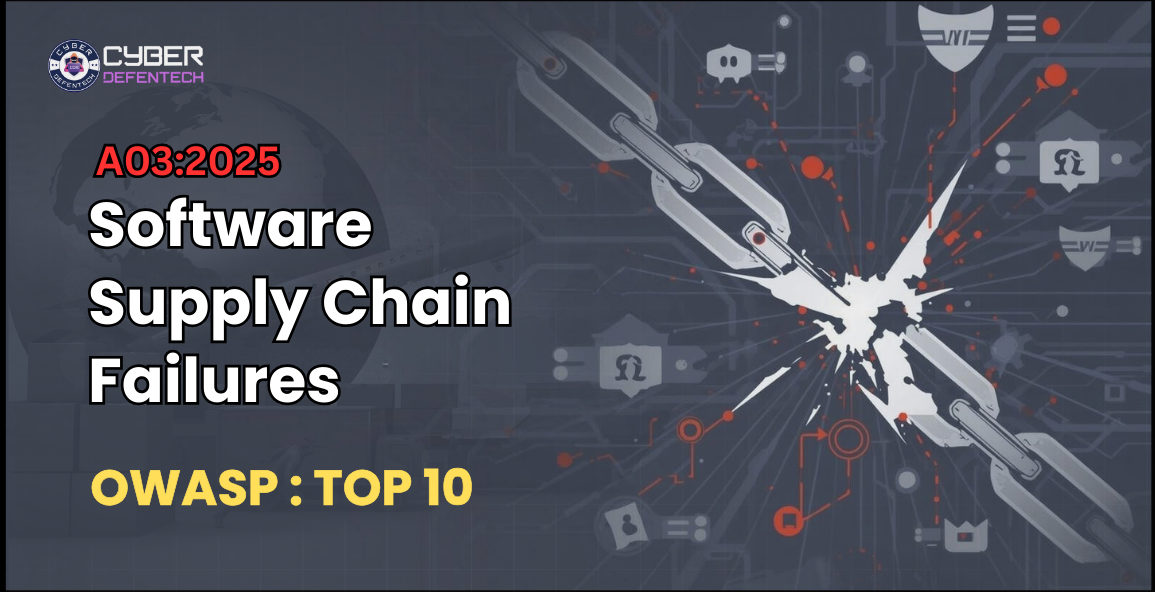
OWASP A03:2025 – Software Supply Chain Failures refers to security risks that occur when the software you use depends on unsafe, unverified, or compromised third-party components. These failures happen when attackers exploit weaknesses in libraries, dependencies, packages, or update processes to inject malicious code. In simple words, if one part of the supply chain is weak, the entire application becomes vulnerable.
Background of A03:2025 – Software Supply Chain Failures
This category received the highest number of votes in the Top 10 community survey, with exactly 50% of participants placing it in the #1 position. Originally introduced in the 2013 OWASP Top 10 as “A9 – Using Components with Known Vulnerabilities,” its scope has significantly expanded over the years. It no longer focuses only on vulnerable components but now includes all types of software supply chain failures.
Even with this broader coverage, supply chain weaknesses remain difficult to detect, as only 11 CVEs have been mapped to the related CWEs. However, based on contributed testing data, this category shows the highest average occurrence rate — 5.19%, indicating how frequently these issues are found in real-world applications.
Description.
Software and data supply chain failures occur when applications rely on third-party components, libraries, services, or tools that are outdated, untrustworthy, or compromised. Modern software heavily depends on open-source ecosystems, package managers, and external vendors. If any part of this chain becomes malicious, vulnerable, or improperly maintained, it can allow attackers to infiltrate systems without directly attacking the main application.
This risk includes issues such as using unmaintained libraries, components with known or unknown vulnerabilities, tampered software updates, dependency confusion, compromised CI/CD pipelines, and insecure package sources. Since developers often trust these external components by default, such weaknesses can silently spread across multiple applications.
Software supply chain failures are considered highly critical because a single compromised dependency can impact thousands of organizations simultaneously, making detection extremely challenging and the consequences severe.
How to prevent ?
- Maintain an SBOM (Software Bill of Materials) : Keep a complete list of all third-party libraries, dependencies, versions, and sources to track risks easily.
- Use Trusted and Verified Sources Only : Download packages, libraries, and tools only from official and reputable repositories. Avoid random GitHub code or unknown package authors.
- Perform Regular Dependency Scanning : Use automated tools to detect outdated, vulnerable, or risky components. Tools: Snyk, Dependabot, Trivy, OWASP Dependency-Check.
- Keep All Components Updated : Always patch and upgrade third-party libraries to the latest secure versions.
- Verify Cryptographic Signatures : Use digitally signed packages and verify checksums to ensure components are not tampered with.
- Secure the CI/CD Pipeline : Enable MFA• Protect build servers• Encrypt secrets• Avoid hard-coded credentials• Restrict access to build tools
- Implement Zero-Trust for Dependencies : Never blindly trust any third-party component. Assume every dependency could be compromised and validate before use.
- Monitor for Malicious or Fake Packages : Watch dependency confusion, typosquatting, and malicious package uploads on npm, PyPI, etc.
- Isolate Third-Party Code Execution : Run external components in sandboxes or isolated environments to limit impact.
- Conduct Supply Chain Risk Assessments : Evaluate vendors, APIs, cloud platforms, and libraries for: • Security posture • Maintenance status • Update frequency • Known vulnerabilities
- Use Runtime Protection & Integrity Checks : Implement integrity verification, monitoring, and runtime security tools to detect unauthorized modifications.
- Adopt Secure Development Practices : Follow secure coding guidelines, review third-party code when possible, and enforce security policies for all components. Example Attack Scenarios :
Scenario 1: Compromised Open-Source Library (Log4j-style Attack)
A company uses an open-source logging library in its application. The library has a hidden vulnerability that the attacker discovers first. The attacker exploits this flaw remotely and gains full control over the company’s servers— even though the company’s own code was secure. The failure happened because the third-party component was vulnerable.
Scenario 2: Malicious Software Update (SolarWinds Attack Style)
The attacker breaches the vendor’s build system and inserts malware into a legitimate software update. Thousands of customers download the update thinking it’s safe. The malware silently creates backdoors in all their systems. Here, the supply chain was attacked through the vendor’s update infrastructure.
Scenario 3: Dependency Confusion Attack
A company has internal packages named company-auth and company-utils. An attacker uploads a package with the same name but higher version to the public registry (npm/PyPI). The developer’s build system automatically downloads the attacker’s package instead of the internal one. This installs malware into the app without anyone noticing. This happens due to trusting public repositories blindly.
Scenario 4: Fake Package / Typosquatting Attack
A developer accidentally installs reqeusts instead of requests (Python). The fake package steals API keys and sends data to the attacker. Because the package name looked similar, the developer did not notice. This is a typosquatting / malicious package attack.
Scenario 5: Compromised CI/CD Pipeline
The attacker gains access to the company’s CI/CD server using a stolen credential. They modify the build pipeline to inject malicious code into the final compiled software. Customers receive the infected version through the normal update process. Here, the building process itself was compromised.
Scenario 6: Using Unmaintained or Old Components
The company uses a library that hasn’t been updated for 5 years. The component contains several known CVEs that the vendor never patched. Attackers exploit these vulnerabilities to break into the system. The failure occurs because the organization relied on outdated third-party code.
Scenario 7: Trusted Vendor Gets Breached
A cloud storage provider used by the company suffers security breach. Attackers alter stored data and inject malicious configuration files. Although the company’s internal system was secure, the external vendor compromised the supply chain.
Conclusion
OWASP A03:2025 – Software Supply Chain Failures highlights one of the most dangerous and rapidly growing threats in modern application security. As organizations increasingly rely on third-party libraries, open-source tools, cloud services, and automated pipelines, attackers have shifted their focus toward these indirect but powerful entry points. A single vulnerable or compromised component can expose thousands of systems, making supply chain security not just a technical concern but a critical business priority.
Strengthening the software supply chain requires a proactive, multi-layered approach — from maintaining an SBOM and scanning dependencies to securing CI/CD pipelines, enforcing zero-trust, and continuously monitoring vendor risks. When companies build with trusted components, verify integrity, and adopt secure development practices, they significantly reduce the chances of large-scale compromise.
In today’s interconnected ecosystem, supply chain security is no longer optional — it is essential. Organizations that prioritize it will not only protect their applications but also build long-term resilience against evolving cyber threats.
Stay informed and stay secure — follow Cyber Defentech for more cybersecurity insights and updates.
