

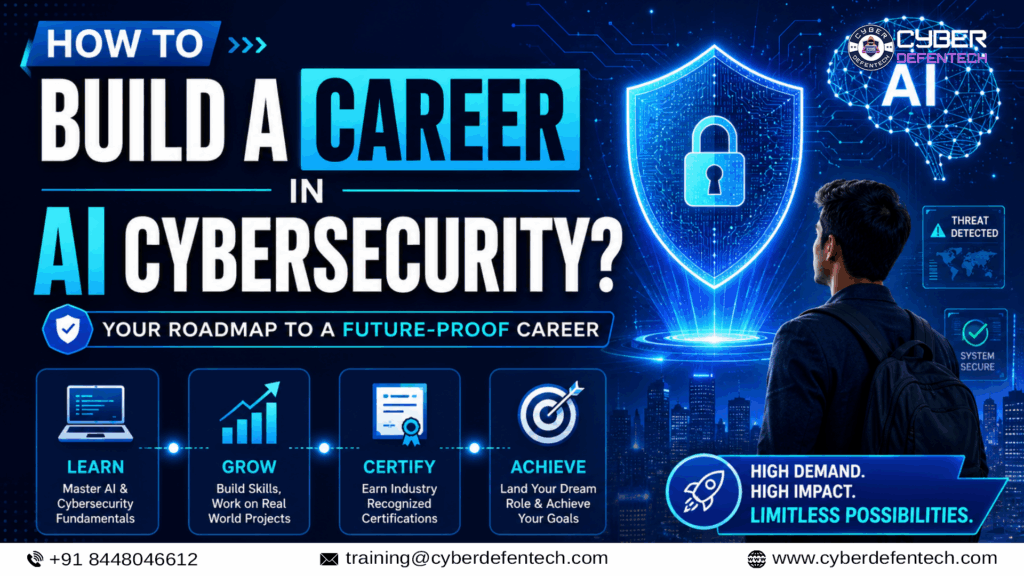
How to Build a Career in AI Cybersecurity ?
By Cyber Defentech Team | June 2026 | 12 Mins Read | Beginner to Advanced
Introduction
“In 2024 alone, global cybercrime damages exceeded $9.5 trillion. By 2029, that number is projected to surpass $15 trillion — and AI is both the weapon and the shield in this digital war. The question isn’t whether AI will transform cybersecurity. It already has. The real question is: will you be on the front lines, or watching from the sidelines?”
A career in AI cybersecurity is the most urgent and high-demand professional opportunity of this decade — and if you are reading this, you are already ahead of millions who haven’t realized it yet. The world is experiencing an unprecedented surge in cyber threats: nation-state hackers, ransomware gangs, AI-powered phishing campaigns, and deepfake social engineering attacks are striking organizations at a scale that traditional security teams simply cannot handle alone.
Building a career in AI cybersecurity means stepping into the frontline of this global digital war. Organizations across banking, healthcare, government, defense, and tech are desperately seeking professionals who can deploy AI-driven threat detection, machine learning-based anomaly analysis, and next-generation security architectures — and they are willing to pay premium salaries to find them.
This guide — crafted by active practitioners at Cyber Defentech — is your definitive, industry-level roadmap to launching and advancing your career in AI cybersecurity. Whether you are a complete beginner or an IT professional pivoting into security, the path forward starts right here.
Key Stats at a Glance:
- 3.5M+ Unfilled Cybersecurity Jobs Globally (2026)
- $15T Projected Cybercrime Cost by 2029
- 35% YoY Growth in AI Security Roles
- ₹25L+ Avg Senior AI Security Salary in India
What Is AI Cybersecurity?
Before mapping out your career in AI cybersecurity, it is essential to understand what the field actually means. AI cybersecurity is the integration of artificial intelligence, machine learning (ML), deep learning, and natural language processing (NLP) into the design, deployment, and management of cyber defense systems. It represents the next evolutionary leap beyond traditional, rule-based security tools.
Where legacy systems depend on known signatures and static rule sets to detect threats, AI-powered security platforms can identify unknown threats, predict attack patterns, and respond autonomously — all at machine speed. This is critical in an era where attacks happen in milliseconds and human analysts simply cannot keep pace.
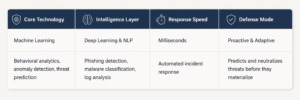
AI cybersecurity spans multiple disciplines: threat intelligence automation, AI-powered SIEM platforms, zero-trust architecture enforcement, autonomous SOC operations, and adversarial machine learning defense. Professionals in this field must be fluent in both the offensive and defensive dimensions of security — understanding how attackers use AI just as well as how defenders do.
Why Is a Career in AI Cybersecurity Important in 2026?
Why It Matters — Right Now
- Cyberattacks now occur every 39 seconds globally, targeting individuals, businesses, and critical infrastructure
- AI is enabling attackers to automate hacking, generate convincing deepfakes, and craft hyper-personalized phishing at industrial scale
- The global cybersecurity talent gap has reached 3.5 million unfilled positions — organizations are in crisis mode
- AI security professionals command some of the highest starting salaries in the entire tech industry
- Regulatory frameworks (GDPR, India’s DPDP Act, ISO 27001) are creating legal mandates for advanced security postures
- The shift to cloud, IoT, and hybrid work has exponentially expanded the attack surface for every organization
The convergence of AI and cybersecurity is not a trend — it is an irreversible paradigm shift. Every major enterprise — from BFSI institutions and healthcare networks to defense agencies and e-commerce giants — is actively rebuilding their security stack around AI-native platforms. This has created a skills gap so severe that companies are offering premium packages to attract qualified talent.
Building a career in AI cybersecurity today means positioning yourself at the intersection of two of the most critical forces shaping the next decade of technology and global commerce.
Real-World Cyber Threats & Risks
Understanding the threat landscape is not just academic — it is the foundation of effective AI security work. Here are the advanced threats that AI cybersecurity professionals are actively combating today:
Critical Threat Alert: In 2024, security researchers documented the first confirmed use of large language models to autonomously discover and exploit zero-day vulnerabilities. The attacker-defender AI arms race is now fully underway.
Advanced Persistent Threats (APTs) with AI
Nation-state actors now augment their APT campaigns with ML algorithms that adapt to evasion techniques in real time. The SolarWinds and MOVEit attacks demonstrated how sophisticated, patient, and technologically advanced modern adversaries have become. AI-assisted APTs can lie dormant in networks for months, learning normal behavior before striking.
AI-Generated Phishing & Social Engineering
Generative AI allows attackers to craft perfectly personalized phishing emails, generate fake voice calls (vishing), and produce deepfake video messages — all at scale. Traditional email security filters are largely blind to these next-generation lures. AI security professionals build detection models trained on behavioral signals rather than content alone.
Ransomware-as-a-Service (RaaS) Evolution
The LockBit, BlackCat, and Cl0p ransomware groups have industrialized cybercrime. Their operations leverage AI to identify high-value targets, negotiate ransoms, and maximize extraction. In 2023, the MOVEit breach alone impacted over 2,600 organizations and exposed data belonging to more than 77 million individuals.
Adversarial Machine Learning Attacks
When organizations deploy AI security models, sophisticated attackers attempt to poison training data, craft adversarial inputs that fool classifiers, or extract sensitive model information through inference attacks. Defending against these requires deep expertise in adversarial ML — a cutting-edge skill that very few professionals possess today.
Cloud & Supply Chain Vulnerabilities
The migration to multi-cloud environments has created sprawling, complex attack surfaces. Misconfigured S3 buckets, over-permissioned IAM roles, and vulnerable third-party software dependencies continue to result in catastrophic breaches. AI-driven cloud security posture management (CSPM) tools are now essential for monitoring these environments continuously.
Why Companies Need AI Cybersecurity Professionals
The business case for hiring AI security talent has never been more urgent or financially compelling.
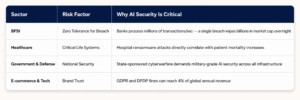
Security Operations Centers (SOCs) that once required dozens of analysts to manage alerts are now rebuilding around AI-augmented platforms — but they need skilled human professionals to design, train, tune, and govern these systems. The role of the AI security professional is not to be replaced by automation — it is to be the architect of that automation.
Industry Reality: For every four open AI cybersecurity positions in India, there is currently less than one qualified candidate. This talent shortage is projected to worsen through 2030, making now the single best time to enter this field.
Skills You Will Learn in AI Cybersecurity
To build a successful career in AI cybersecurity, you need a hybrid skill set spanning traditional security fundamentals, advanced AI/ML techniques, and hands-on technical execution. Here is a comprehensive breakdown of what you need to master:
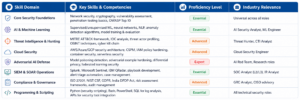
At Cyber Defentech, our curriculum is designed to build exactly this skill stack — through structured theory, hands-on labs, real-world simulations, and mentorship from active industry practitioners. You don’t just learn concepts; you apply them in environments that mirror real enterprise security operations.
Career Opportunities in AI Cybersecurity
One of the greatest strengths of building a career in AI cybersecurity is the sheer breadth of paths available. Whether you prefer offensive security, defensive operations, research, leadership, or consulting, there is a high-demand role designed for your strengths.
Offensive AI Security (Red Team)
AI Red Teamers simulate sophisticated adversary attacks to identify vulnerabilities before real attackers do. This includes AI-augmented penetration testing, adversarial ML attack simulation, social engineering campaigns, and advanced evasion technique research. These professionals are among the most sought-after — and highest paid — in the industry.
Defensive AI Security (Blue Team & SOC)
The modern AI-powered SOC analyst works with machine learning-driven SIEM platforms, behavioral analytics engines, and automated response playbooks to detect and neutralize threats at machine speed. Roles include AI Threat Hunter, SOC Analyst (L2/L3), Incident Response Analyst, and Cyber Threat Intelligence (CTI) Analyst.
AI Security Engineering
Security engineers build the AI-powered systems and infrastructure that protect organizations. This includes developing ML models for threat detection, integrating AI into DevSecOps pipelines, designing zero-trust architectures, and building cloud-native security platforms. Strong programming skills combined with deep security knowledge define this track.
Governance, Risk & Compliance (GRC) with AI
As organizations adopt AI systems, they face new and complex governance challenges. AI GRC professionals ensure that artificial intelligence deployments are secure, ethical, compliant with regulations, and aligned with organizational risk tolerance. This fast-growing role bridges technical understanding with policy expertise.
Research & Academia
The frontiers of adversarial machine learning, AI privacy, and secure federated learning are being shaped by researchers in industry labs and academic institutions. For those with deep technical curiosity, research roles at organizations like DRDO, IITs, CERT-In, and global security vendors offer the opportunity to define the future of the field.
Salary & Industry Demand
Financial rewards in AI cybersecurity reflect the criticality of the skill and the severity of the talent shortage.
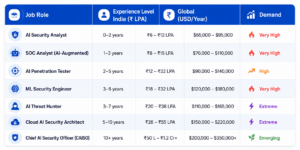
Salary Accelerator Tip: Certifications like OSCP, CEH, CISSP, AWS Security Specialty, and Google Professional Cloud Security Engineer can add ₹4–10 LPA to base compensation. Bug bounty track records and open-source security contributions are also highly valued.
Real-World Importance of AI Cybersecurity
Case Study: AIIMS Delhi Ransomware Attack (2022)
In November 2022, India’s premier medical institution — AIIMS Delhi — suffered a devastating ransomware attack that crippled hospital operations for weeks. Patient records for approximately 40 million individuals were compromised. The attackers exploited a combination of unpatched systems and the absence of AI-driven behavioral monitoring. An AI-powered SIEM would have detected the lateral movement pattern within minutes rather than days.
Case Study: AI-Assisted Fraud Detection in Banking
India’s largest private banks now process over 10 million UPI transactions daily. Traditional rule-based fraud detection was generating unacceptably high false-positive rates. Deployment of gradient-boosted ML models for real-time transaction scoring reduced fraud losses by 62% while simultaneously cutting false positives by 74%. This represents AI cybersecurity delivering measurable, massive business value.
The Deepfake CEO Attack Pattern
In 2024, a multinational company in Hong Kong lost $25 million after attackers used AI deepfake video technology to impersonate the CEO in a fake video conference, convincing a finance employee to authorize a series of fraudulent transfers. AI-powered identity verification and behavioral biometrics are now the primary defense against these attacks.
Tools & Technologies Used in AI Cybersecurity
AI & ML Platforms
TensorFlow · PyTorch · Scikit-learn · Keras · Hugging Face · Apache Spark MLlib · Jupyter Notebooks
SIEM, SOAR & Threat Detection
Splunk Enterprise Security · Microsoft Sentinel · IBM QRadar · Palo Alto Cortex XSOAR · Elastic SIEM · CrowdStrike Falcon · Darktrace
Offensive Security & Red Team
Metasploit Framework · Burp Suite Pro · Nmap / Nessus · Cobalt Strike · BloodHound · Kali Linux · OWASP ZAP
Cloud & Container Security
AWS Security Hub · Microsoft Defender for Cloud · Prisma Cloud · Wiz · Aqua Security · Trivy
Beginner Roadmap: How to Build a Career in AI Cybersecurity Step by Step ?
Building a career in AI cybersecurity is a deliberate, progressive journey — not a shortcut. Here is the exact step-by-step roadmap followed by successful Cyber Defentech graduates who are now working in top organizations:
Step 01 — Build Core IT & Networking Foundations
(4–8 Weeks) Understand TCP/IP, OSI model, DNS, HTTP/HTTPS, firewalls, and basic Linux administration. Earn CompTIA Network+ or equivalent as a confidence anchor.
Step 02 — Learn Cybersecurity Fundamentals
(6–10 Weeks) Study vulnerability assessment, ethical hacking basics, OWASP Top 10, cryptography, and security frameworks. CompTIA Security+ or CEH (foundational) recommended.
Step 03 — Master Python for Security
(6–8 Weeks) Learn Python scripting for security automation, log parsing, API interaction, and basic data manipulation. Work through security-focused projects and CTF challenges.
Step 04 — Study Machine Learning for Security Applications
(8–12 Weeks) Learn supervised/unsupervised ML, anomaly detection, clustering, and classification using Scikit-learn and TensorFlow. Apply to security use cases: malware classification, intrusion detection.
Step 05 — Gain Hands-On SOC & SIEM Experience
(6–10 Weeks) Work with Splunk, Microsoft Sentinel, or Elastic SIEM in lab environments. Practice log analysis, alert triage, and incident response workflows using real threat scenarios.
Step 06 — Specialize: Choose Your Track
(10–16 Weeks) Deep dive into your chosen specialization — AI Red Teaming, Cloud Security, ML Engineering for Security, or Threat Intelligence. Build portfolio projects that demonstrate real-world capability.
Step 07 — Certify, Build Portfolio & Enter the Industry
(8–16 Weeks + Ongoing) Earn industry-recognized certifications (OSCP, CISSP, AWS Security, CEH Advanced). Contribute to bug bounty programs, publish research, and build a public GitHub profile showcasing your security projects.
Why Choose Cyber Defentech?
What Makes Cyber Defentech Different?
- Industry-Practitioner Instructors: Every instructor is an active security professional with real-world enterprise experience — not just academic credentials
- Hands-On Lab Environment: Train in purpose-built cyber ranges that simulate real enterprise networks, cloud environments, and attack scenarios
- AI-Integrated Curriculum: Our syllabus is continuously updated to reflect the latest developments in AI security, adversarial ML, and emerging threat landscapes
- Placement-Focused Approach: Career guidance, resume building, mock interviews, and employer connections are embedded into every program
- Practical Certification Preparation: Structured preparation for CEH, OSCP, CompTIA Security+, CISSP, and cloud security credentials
- Real-World Project Portfolio: Graduate with documented security projects, threat models, and lab reports that demonstrate ability to employers
- Small Cohort Mentorship: Personalized attention, one-on-one mentorship sessions, and continuous feedback — not anonymous online courses
Cyber Defentech students have gone on to work at leading organizations in banking, consulting, government agencies, and global tech companies. Our alumni network provides ongoing career support, referrals, and professional community for every graduate.
Future Scope: Why a Career in AI Cybersecurity Will Only Grow Stronger ?
Autonomous Security Operations
The SOC of 2030 will be largely autonomous — AI systems handling first-line detection, triage, and response, with human analysts focusing on complex strategic decisions. Professionals who can design, govern, and optimize these autonomous systems will be invaluable.
Quantum-Safe Cryptography
As quantum computing approaches practical capability, all current encryption standards face existential risk. The migration to post-quantum cryptographic algorithms (NIST PQC standards are now finalized) will require a global security overhaul — creating massive demand for professionals with expertise in quantum-safe security architectures.
AI Governance & Responsible AI Security
Governments worldwide are enacting AI regulation (EU AI Act, India’s emerging AI policy). Organizations need professionals who can navigate the intersection of AI ethics, security, privacy, and regulatory compliance — a brand-new discipline with virtually no qualified practitioners today.
5G & IoT Security at Scale
India’s 5G rollout is connecting billions of new devices to enterprise and consumer networks. Each connected device is a potential attack vector. AI-powered IoT security platforms capable of monitoring and protecting millions of endpoints simultaneously represent the next major growth area in the field.
Cyber Threat Intelligence Automation
NLP and large language models are transforming threat intelligence — automatically ingesting, correlating, and acting on dark web data, threat feeds, and vulnerability databases. CTI professionals who can build and operationalize these systems will command premium compensation.
Final Thoughts: Your Career in AI Cybersecurity Starts Today
The fusion of artificial intelligence and cybersecurity is not a future possibility — it is the present reality reshaping every organization on the planet. Professionals who master a career in AI cybersecurity will be the architects of digital trust, the guardians of critical infrastructure, and among the most valued contributors to the global economy.
A career in AI cybersecurity demands commitment, structured learning, and real-world practice — but the rewards are extraordinary: job security, premium compensation, intellectual challenge, and the knowledge that your work directly protects lives and economies. Few career paths offer this combination.
The talent shortage is real, the opportunity is immense, and the time to act is now. With the right training, mentorship, and determination, you can transition into this field — regardless of your current background — and build a career that is truly future-ready.
Cyber Defentech exists precisely to bridge the gap between where you are today and where the industry needs you to be. The journey begins with a single decision: to start.
Frequently Asked Questions (FAQs)
Q1. What qualifications do I need to start a career in AI cybersecurity?
Starting a career in AI cybersecurity does not require a specific degree. A background in IT, computer science, engineering, or mathematics provides a strong starting foundation. What matters most is building the right skill stack: networking fundamentals, security concepts, Python programming, and ML basics. Cyber Defentech’s programs are designed to take you from foundational knowledge to industry-ready competence through structured, practical training — regardless of your current background.
Q2. Is AI cybersecurity a good career choice in India?
Absolutely. India is one of the fastest-growing markets for cybersecurity talent globally. With the expansion of digital infrastructure, the UPI ecosystem, government digitization initiatives, and India’s DPDP Act creating compliance mandates, demand for AI security professionals is growing at 35%+ year over year. Entry-level positions start at ₹6–12 LPA, while experienced professionals earn ₹25–55 LPA and above.
Q3. How long does it take to become an AI cybersecurity professional?
With dedicated, structured training, most students pursuing a career in AI cybersecurity are industry-ready within 6–12 months. Cyber Defentech’s intensive programs are designed to maximize learning efficiency, combining theoretical instruction with hands-on lab work and real-world project experience. Your prior experience level will influence the timeline — those with IT backgrounds often progress faster.
Q4. What certifications are most valuable in AI cybersecurity?
The most valued certifications vary by specialization. For offensive security: OSCP is the gold standard. For comprehensive security knowledge: CISSP and CEH (Advanced). For cloud security: AWS Security Specialty, Google Professional Cloud Security Engineer, and AZ-500. For AI-specific roles: Google Professional Machine Learning Engineer combined with security specialization is increasingly recognized.
Q5. Do I need to know programming to work in AI cybersecurity?
For most AI cybersecurity roles, Python proficiency is essential. It is used for security scripting, ML model development, log analysis, and tool automation. Some roles (particularly SOC analyst and GRC positions) require lighter programming knowledge, while ML Security Engineering roles require deeper software development skills. Cyber Defentech’s curriculum includes Python for Security as a core module.
Q6. What is the difference between traditional cybersecurity and AI cybersecurity?
Traditional cybersecurity relies on rule-based, signature-driven tools that can only detect known threats. AI cybersecurity uses machine learning and behavioral analytics to detect novel, unknown threats by identifying anomalous patterns. AI systems can process and correlate millions of security events per second — far beyond human or traditional automated capability.
Q7. What industries hire the most AI cybersecurity professionals?
Banking, Financial Services and Insurance (BFSI) are the largest hirers. Healthcare, government and defense, e-commerce, telecom, and technology consulting firms are also major employers. Public sector organizations including CERT-In, NCIIPC, and defense agencies are increasingly hiring AI security talent in India.
Q8. How does Cyber Defentech prepare students for real-world AI security jobs?
Cyber Defentech combines structured curriculum with hands-on cyber range labs, real-world attack and defense simulations, project-based learning, industry certification preparation, and career placement support. Students work with the same tools used by enterprise security teams — Splunk, Microsoft Sentinel, AWS security services, Kali Linux, and ML frameworks — so they enter their first role with practical, immediately applicable skills.
🚀 Ready to Launch Your Career in AI Cybersecurity?
Join India’s most industry-focused AI cybersecurity training program. Gain practical skills, real-world exposure, and the credentials that employers demand — all with expert mentorship from active security practitioners.
✅ Hands-on Practical Training
✅ Real-World Cybersecurity Skills
✅ Industry-Focused Curriculum
✅ Future-Ready Career Path
✅ Certification-Ready Preparation
✅ Placement & Career Support
