
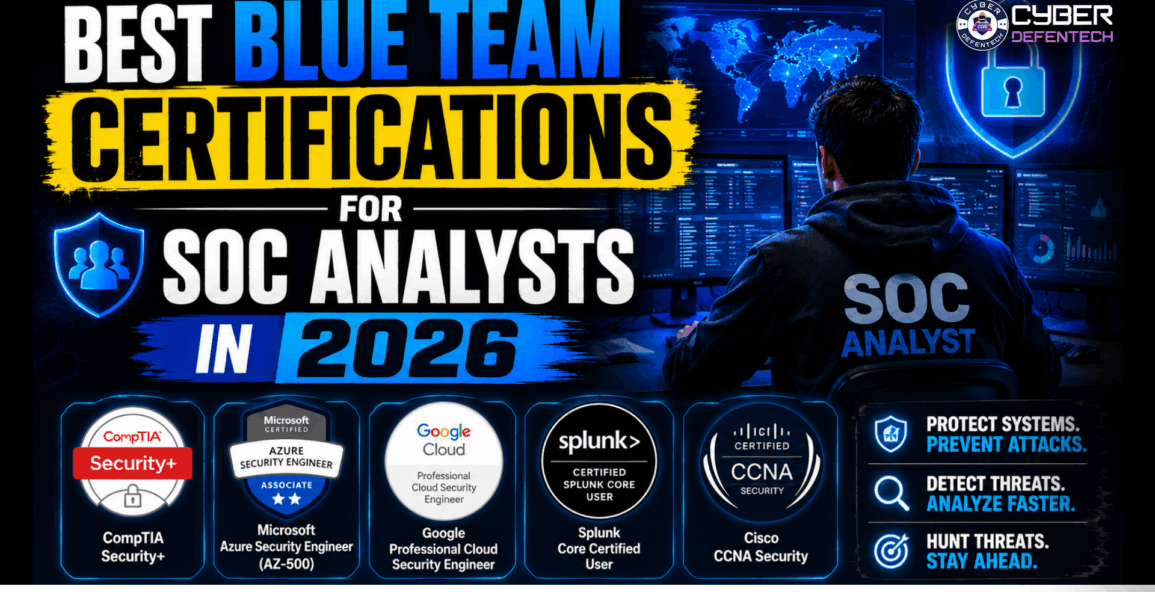
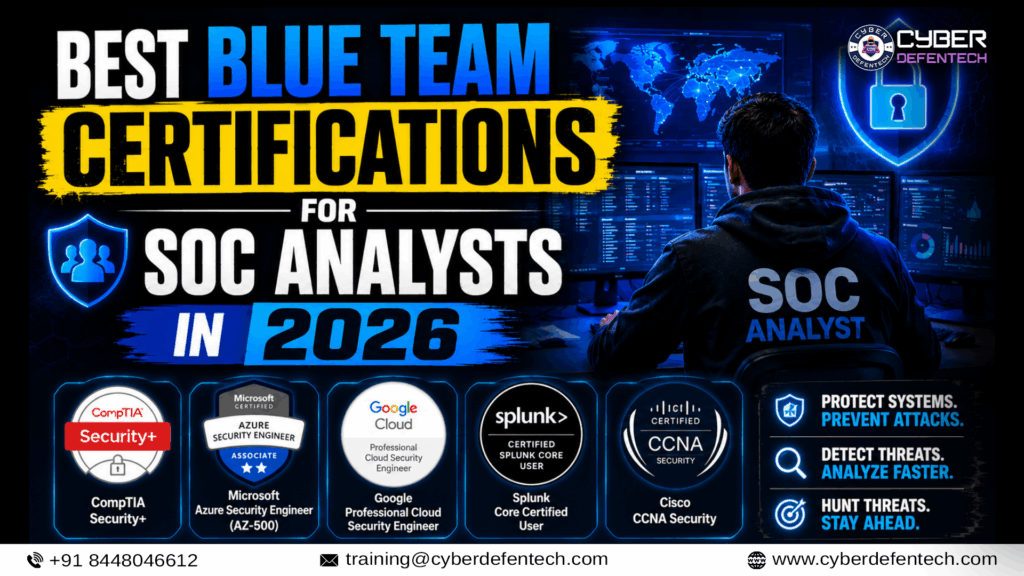
Best Blue Team Certifications for SOC Analysts in 2026
By Cyber Defentech Team | June 2026 | 12 Mins Read | Beginner to Advanced
Introduction
Every 39 seconds, a cyber attack strikes somewhere in the world. In 2026, that pace has not slowed — it has accelerated. AI-powered malware, deepfake phishing campaigns, and next-generation ransomware are reshaping the global threat landscape faster than most organizations can adapt. The average cost of a data breach now exceeds $5.4 million USD in 2026, and attackers are exploiting gaps in security operations faster than teams can detect them.
Behind every breached headline is an uncomfortable truth: there were not enough trained Blue Team defenders in the room.
Blue Team professionals — the cyber defenders who monitor, detect, analyze, and respond to threats — have never been more critical. SOC Analysts are the first line of defense in modern enterprises, and companies worldwide are scrambling to hire qualified professionals who hold the right certifications and hands-on skills.
Whether you are a student stepping into cybersecurity for the first time, an IT professional looking to pivot into security, or a working SOC analyst seeking your next certification milestone, this guide is built for you. At Cyber Defentech, we have helped hundreds of professionals launch and advance their Blue Team careers — and in this article, we are breaking down everything you need to know about the best Blue Team certifications for SOC Analysts in 2026.
What Are Blue Team Certifications?
Blue Team certifications are professional credentials that validate your ability to defend, monitor, and protect an organization’s digital infrastructure against cyber threats. Unlike Red Team certifications — which focus on offensive penetration testing and ethical hacking — Blue Team certifications equip you with the defensive arsenal: threat detection, incident response, SIEM operations, log analysis, threat intelligence, and forensic investigation.
In a Security Operations Center (SOC), Blue Team analysts are the heartbeat of an organization’s cyber defense. They operate 24/7 monitoring systems, correlate alerts from thousands of log sources, investigate suspicious behavior, and coordinate real-time responses to active threats. SOC Analyst certifications formalize and validate that these critical skills meet industry standards.
In 2026, with AI being weaponized by threat actors and attack surfaces expanding into multi-cloud, OT/IoT, and hybrid work environments, Blue Team certifications have shifted from “nice to have” to an absolute career prerequisite.
Why Are Blue Team Certifications Important in 2026?
The cybersecurity industry is experiencing an unprecedented talent crisis. According to ISC² 2026 research, the global cybersecurity workforce gap has now crossed 5 million unfilled positions. As organizations digitally transform and threats grow more sophisticated, the demand for skilled Blue Team professionals is outpacing supply at an alarming rate.
Blue Team certifications serve multiple critical functions in your career:
- Proof of competency — employers use certifications as the primary filter in SOC hiring in 2026
- Standardized skill validation — certifications ensure analysts understand industry-accepted frameworks like MITRE ATT&CK and NIST
- Career advancement — certified professionals consistently earn 20–40% more than non-certified peers
- Global portability — top certifications like CompTIA, EC-Council, and BTL1 are recognized across 150+ countries
- Faster onboarding — certified analysts require significantly less ramp-up time in new SOC environments
Real-World Cyber Threats Driving Blue Team Demand in 2026
Understanding the modern threat landscape is not just context — it is the reason Blue Team professionals exist. In 2026, these are the threats SOC Analysts face daily:
AI-Augmented Phishing & Social Engineering
In 2026, attackers are deploying large language models to craft hyper-personalized phishing emails at scale. AI-generated spear-phishing attacks have increased click-through rates by over 70% compared to traditional phishing methods. SOC Analysts must be trained to detect behavioral anomalies, not just signature-based threats.
Ransomware-as-a-Service (RaaS) Ecosystems
In 2026, RaaS groups operate like professional businesses — providing ransomware toolkits to affiliates in exchange for a revenue cut. The healthcare and critical infrastructure sectors continue to face record ransomware incidents, with average ransom demands now exceeding $3 million. Blue Team incident response skills are the primary line of defense.
Cloud Misconfiguration Exploits
As organizations deepen their multi-cloud deployments across AWS, Azure, and GCP in 2026, misconfigured storage buckets, over-privileged IAM roles, and exposed APIs continue to create massive attack surfaces. Cloud-native threat detection is now a mandatory SOC skill — not optional.
Living-off-the-Land (LotL) Attacks
Advanced attackers in 2026 are increasingly using legitimate system tools — PowerShell, WMI, and LOLBins — to evade traditional antivirus detection. This requires Blue Team analysts to develop advanced behavioral analytics and threat hunting capabilities well beyond rule-based SIEM alerting.
Why Companies Need Certified Blue Team Professionals?
From startups to Fortune 500 enterprises, from government agencies to healthcare systems — every organization with a digital footprint needs Blue Team professionals in 2026. Here is what the hiring landscape looks like:
- Regulatory compliance mandates: GDPR, HIPAA, SOC 2 Type II, DPDP Act India 2026 — all require demonstrable incident response capabilities
- Cyber insurance requirements: Insurers in 2026 now mandate certified SOC personnel as a standard condition of coverage
- Board-level accountability: Post-breach regulatory scrutiny makes trained security teams a legal and financial necessity
- AI security operations: AI-driven SOC platforms require human analysts who understand when and how AI alerts should be escalated
- Remote workforce expansion: Hybrid work environments in 2026 have dramatically expanded the attack surface, requiring more sophisticated monitoring
The bottom line: a certified Blue Team analyst is not a cost center — they are the last line of financial defense for any organization.
Skills You Will Learn with Blue Team Certifications
The following table outlines the core competencies covered across leading Blue Team certification programs in 2026, along with the industry tools associated with each skill domain:
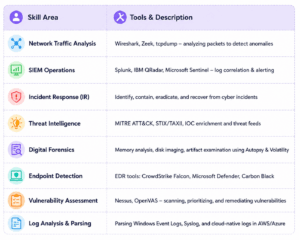
At Cyber Defentech, every skill area above is covered through structured theory modules, guided lab exercises, and real-world simulation environments — not just slides and videos.
Top Blue Team Certifications for SOC Analysts in 2026
Choosing the right certification depends on your current experience level, target role, and career goals. Here is a curated breakdown of the most respected and employer-valued Blue Team certifications in 2026:
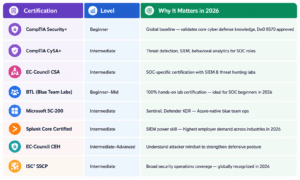
Why CompTIA Security+ Still Dominates Entry-Level Hiring in 2026?
Security+ remains the most widely recognized cybersecurity baseline certification globally in 2026, and it is the only certification approved by the US Department of Defense under Directive 8570. For Indian professionals targeting global roles or BFSI sector positions, Security+ remains the non-negotiable first credential.
Why BTL1 Is the Most Practical SOC Certification for Beginners in 2026?
Blue Team Labs Online Level 1 (BTL1) has gained enormous traction in 2026 because it is built entirely around hands-on labs — not multiple-choice theory. Candidates investigate real phishing attacks, perform memory forensics, and respond to simulated breaches in a live environment. For hiring managers in 2026, BTL1 on a resume signals practical readiness, not just textbook knowledge.
Why EC-Council CSA Is the Top SOC-Specific Certification in 2026?
The EC-Council Certified SOC Analyst (CSA) is purpose-built for SOC operations. It covers threat detection, SIEM management, log analysis, and incident escalation — all skills directly applicable to a Tier 1 and Tier 2 SOC role. In 2026, EC-Council CSA is among the most sought-after certifications by MSSP and enterprise SOC hiring managers across India and the Middle East.
Career Opportunities in Blue Team & SOC Operations in 2026
A Blue Team certification opens doors across a diverse range of roles in both the public and private sectors. Here are the primary career pathways in 2026:
- SOC Analyst L1 / L2 / L3 — the core of enterprise security operations
- Incident Response Analyst — specializing in breach investigation and containment
- Threat Intelligence Analyst — tracking adversaries, IOCs, and emerging attack campaigns
- Threat Hunter — proactively searching networks for undetected intrusions
- Digital Forensics Investigator — examining compromised systems for evidence
- Cloud Security Analyst — defending AWS, Azure, GCP environments in 2026
- Security Engineer — designing and maintaining defensive controls and architectures
- Blue Team Lead / Security Operations Manager — leading SOC teams and strategy
- CISO (with progression) — executive leadership of enterprise security posture
High-growth sectors hiring Blue Team professionals in India in 2026 include Banking & Financial Services (BFSI), healthcare, government & defense, e-commerce, telecom, Big 4 consulting firms, boutique MSSPs, and technology companies operating in cloud-native environments.
Salary & Industry Demand in 2026
Compensation for Blue Team professionals has grown significantly in 2026 as demand outstrips supply. Here is a realistic salary overview based on role and experience level:
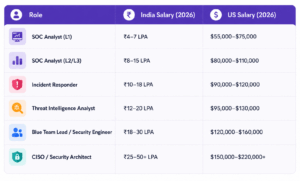
These figures reflect 2026 base compensation only. Performance bonuses, remote work premiums, and ESOP components in startups routinely push total compensation 20–35% higher. Certified professionals in cloud security or threat intelligence command the upper end of these ranges in 2026.
Real-World Importance: Why This Matters Beyond the Certificate?
A certificate is a starting point — not the destination. The real value of Blue Team training emerges when you are in a live SOC in 2026, watching 50,000 daily alerts flood into a Splunk dashboard, trying to distinguish a genuine intrusion from a noisy false positive at 2:47 AM.
Consider the 2024 Change Healthcare ransomware attack that disrupted US healthcare payments for months, causing over $870 million in losses. Or the 2025 wave of AI-crafted phishing attacks that compromised major financial institutions across Southeast Asia. In each case, the absence of skilled Blue Team responders with hands-on experience in rapid containment and forensic investigation compounded the damage exponentially.
This is why Cyber Defentech’s curriculum in 2026 is intentionally built around simulation-first learning — because real-world cybersecurity decisions happen under pressure, with incomplete information, in milliseconds. No slideshow can prepare you for that. Only practice does.
Tools & Technologies Used by Blue Team Professionals in 2026
Modern Blue Team work is tool-intensive. The following represent the core technology stack SOC Analysts operate daily in 2026:
- SIEM Platforms: Splunk Enterprise Security, IBM QRadar, Microsoft Sentinel, Elastic SIEM
- Endpoint Detection & Response (EDR): CrowdStrike Falcon, Microsoft Defender for Endpoint, SentinelOne, Carbon Black
- Network Analysis: Wireshark, Zeek (Bro), Suricata IDS, NetFlow analyzers
- Threat Intelligence Platforms (TIP): MISP, ThreatConnect, Anomali, OpenCTI
- Digital Forensics: Autopsy, Volatility 3, FTK Imager, KAPE
- Vulnerability Management: Tenable Nessus, OpenVAS, Qualys, Rapid7 InsightVM
- SOAR Platforms: Palo Alto XSOAR, Splunk SOAR, IBM Resilient
- Cloud Security: AWS Security Hub, Azure Defender, GCP Security Command Center
- Ticketing & Case Management: ServiceNow, TheHive, Jira Service Management
At Cyber Defentech, students in 2026 receive hands-on access to these tools through cloud-based lab environments — replicating the exact stack found in enterprise SOCs across India, the Middle East, and globally.
Beginner Roadmap: From Zero to Certified SOC Analyst in 2026
If you are starting from scratch in 2026, here is the practical path Cyber Defentech recommends:
- Build the Foundation (Month 1–2):
Networking fundamentals (TCP/IP, OSI model, DNS, HTTP/S), operating systems (Windows & Linux), and basic cybersecurity concepts via CompTIA IT Fundamentals or Network+. - Get Baseline Certified (Month 2–4):
Target CompTIA Security+ for your first globally recognized credential in 2026. This validates foundational Blue Team knowledge and opens doors to entry-level SOC roles. - Add Hands-On Skills (Month 3–5):
Pursue BTL1 simultaneously or immediately after Security+. Lab practice on phishing analysis, memory forensics, SIEM investigation, and log analysis — the exact skills SOC hiring managers look for in 2026. - Specialize (Month 5–8):
Choose a specialization path — Splunk Core Certified for SIEM mastery, EC-Council CSA for SOC operations, or Microsoft SC-200 for cloud-native environments dominant in 2026. - Go Advanced (Month 8–14):
Pursue EC-Council CEH or ISC² SSCP for senior-level credibility. Build a portfolio of real-world forensics and IR projects. Begin active job applications with Cyber Defentech’s 2026 placement support program.
Why Choose Cyber Defentech for Your Blue Team Training in 2026?
Cyber Defentech is not a passive online course platform. We are a specialized cybersecurity training academy built by practitioners for practitioners — and our 2026 results speak for themselves.
Industry-Focused Curriculum
Every module in our 2026 Blue Team program is designed around real SOC workflows, not theoretical textbooks. Our instructors are active cybersecurity professionals who bring current threat intelligence, live incident case studies, and industry best practices directly into the classroom.
Hands-On Lab Environments
Students receive access to our dedicated cyber range — a cloud-based, enterprise-grade lab environment where you investigate real malware samples, respond to simulated breaches, analyze actual phishing campaigns, and operate SIEM platforms under realistic load conditions. You will not just learn about SOC work. You will do SOC work.
Certification-Aligned Learning Paths for 2026
Our curriculum is mapped directly to the exam objectives of CompTIA Security+, CompTIA CySA+, EC-Council CSA, BTL1, Microsoft SC-200, and Splunk Core Certified — the most in-demand certifications of 2026. You prepare for your certification and build practical skills simultaneously — not as separate activities.
Placement Support & Industry Network
Cyber Defentech maintains an active network of hiring partners across BFSI, IT, consulting, and MSSP sectors in 2026. Our placement support includes mock SOC interviews, resume and LinkedIn optimization, and direct referrals to employer partners. Our goal is not just certification — it is employment.
Future Scope & Industry Trends for Blue Team Professionals Beyond 2026
The next five years will fundamentally reshape the SOC analyst role, and the professionals who stay ahead of these trends will command the highest career trajectories:
AI-Augmented SOC Operations
In 2026 and beyond, AI and machine learning are deeply integrated into SIEM and SOAR platforms to automate Tier-1 alert triage. This does not eliminate the need for analysts — it elevates it. Future SOC analysts will oversee AI decision-making, investigate complex anomalies that AI cannot contextualize, and tune detection models. Human judgment remains irreplaceable at the highest levels of threat analysis.
Autonomous Threat Response
Next-generation SOAR platforms are evolving toward semi-autonomous incident response — automatically isolating endpoints, blocking IP addresses, and initiating forensic collection without human intervention. Blue Team professionals who understand how to design, govern, and audit these automated workflows will become exceptionally valuable beyond 2026.
Cloud-Native & Zero Trust Security
As organizations fully migrate to cloud-first architectures and implement Zero Trust Network Access (ZTNA) in 2026, the SOC analyst role is expanding to encompass cloud security posture management, identity threat detection, and cross-cloud telemetry analysis. This intersection of traditional SOC skills with cloud security expertise represents one of the highest-growth niches in the industry.
OT/ICS & Critical Infrastructure Security
The convergence of IT and Operational Technology (OT) environments — power grids, manufacturing, healthcare systems — is creating urgent demand for Blue Team professionals with cross-domain expertise in 2026. Governments globally are mandating increased security monitoring for critical infrastructure, opening an entire new career vertical for forward-thinking analysts.
Final Thoughts
The world needs more defenders. In 2026, with AI-enhanced threats evolving faster than ever before, the certified Blue Team professional stands as one of the most vital and future-proof career choices in the technology sector.
Blue Team certifications in 2026 are more than credentials on a resume — they are proof that you have the knowledge, the skills, and the hands-on experience to protect the systems that businesses, governments, and individuals depend on every day.
The question is not whether cybersecurity is a good career in 2026. The question is whether you will be ready when the call comes. At Cyber Defentech, we are committed to making sure the answer is yes.
Your future in cyber defense starts with a single step. Take it today.
Frequently Asked Questions (FAQs)
- What is the best Blue Team certification for beginners in 2026?
For complete beginners in 2026, CompTIA Security+ and BTL1 (Blue Team Labs Online Level 1) are the most recommended starting points. Security+ gives you the foundational knowledge, while BTL1 puts you directly inside hands-on labs — simulating real SOC environments without prior experience. Cyber Defentech’s beginner track combines both to fast-track your entry into the security operations field in 2026. - Is Blue Team a good career choice in 2026?
Absolutely. The global cybersecurity workforce gap has crossed 5 million unfilled positions in 2026, with Blue Team and SOC roles being among the most critically understaffed. As AI-powered attacks become more sophisticated, demand for trained defenders is accelerating — making Blue Team one of the most future-proof, recession-resistant, and high-paying career paths of 2026. - How long does it take to become a certified SOC Analyst in 2026? With focused, practical training, most learners can achieve their first Blue Team certification (like Security+ or BTL1) within 3 to 6 months. The Cyber Defentech 2026 SOC Analyst program is structured as an intensive 4–6 month course combining certification prep, live labs, and industry-level simulation to prepare you for real-world SOC environments quickly.
- Do I need a degree to become a SOC Analyst in 2026?
No, a degree is not mandatory in the 2026 cybersecurity hiring market. Hiring managers increasingly prioritize relevant certifications, hands-on lab experience, and demonstrated skills over traditional degrees. Certifications like CompTIA CySA+, EC-Council CSA, or ISC² SSCP carry significant credibility, especially when combined with a strong portfolio of practical projects. - What is the difference between Blue Team and Red Team in 2026?
Red Teams are the offensive arm — ethical hackers who simulate real-world attacks to expose vulnerabilities. Blue Teams are the defenders who detect, investigate, and respond to those attacks. Both are essential in modern cybersecurity. Most advanced professionals in 2026 learn both sides through Purple Team exercises, but Blue Team skills — especially in SIEM, threat hunting, and incident response — form the critical foundation of any enterprise security operation. - Which SIEM tool should I learn first in 2026?
Splunk remains the gold standard for enterprise SIEM in 2026 and has the highest job-market demand. Microsoft Sentinel is rapidly growing due to the dominance of Azure cloud environments. IBM QRadar is still widely used in large enterprises and government sectors. Cyber Defentech’s 2026 curriculum covers all three, but we recommend starting with Splunk and Sentinel for maximum employability. - How much can I earn as a Blue Team professional in India in 2026?
Entry-level SOC Analysts in India earn between ₹4–7 LPA in 2026, while mid-level professionals with 2–4 years of experience and advanced certifications can expect ₹12–20 LPA. Senior roles like Blue Team Lead or Security Engineer command ₹25–40+ LPA. With global remote opportunities in 2026, certified Indian professionals are landing roles in the ₹60–100+ LPA range. - Does Cyber Defentech provide placement assistance in 2026?
Yes. Cyber Defentech offers dedicated 2026 placement support including resume building, LinkedIn profile optimization, mock SOC interviews, and direct referrals to its hiring partner network. The program is designed not just to get you certified, but to get you hired — with real-world project portfolios and interview readiness baked into the curriculum.
🚀 Ready to Build Your Blue Team Career in 2026?
✅ Hands-On Practical Training
✅ Real-World Cybersecurity Skills
✅ Industry-Focused Learning
✅ Future-Ready Career Path
✅ Placement Assistance Included
Cyber Defentech — India’s Premier Cyber Defense Training Academy 2026
