

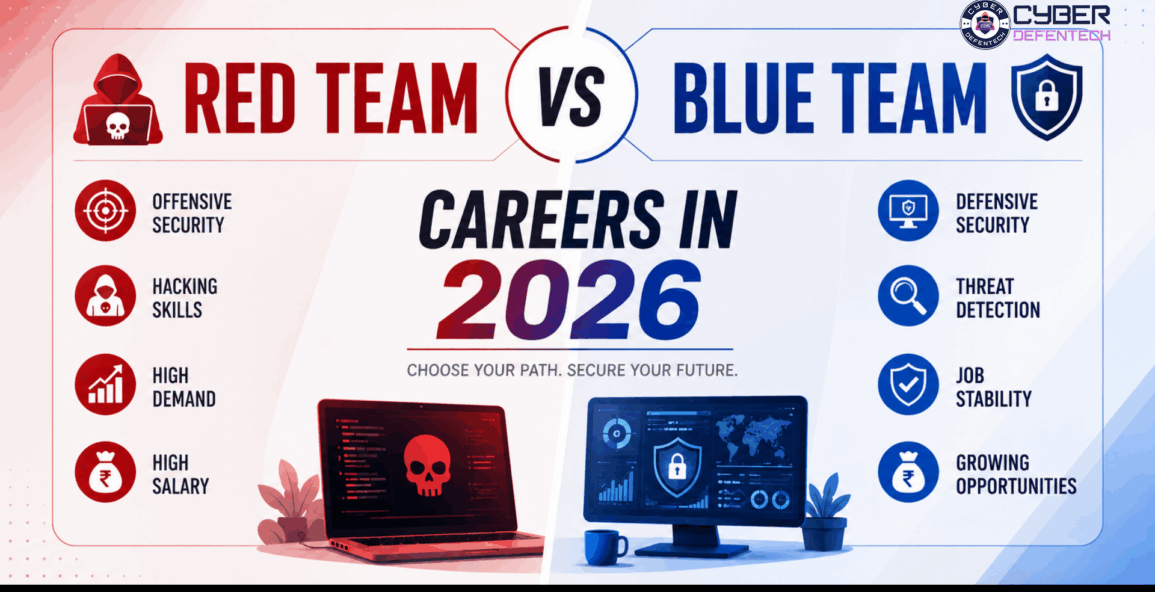
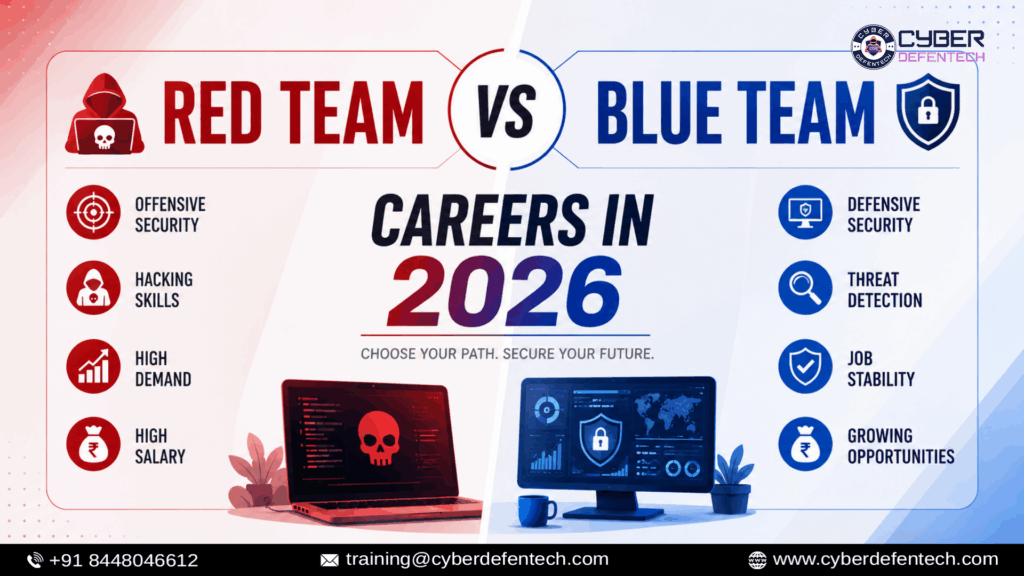
Red Team vs Blue Team Careers in 2026
Introduction
The demand for Red Team vs Blue Team Careers is growing faster than ever as organizations worldwide battle increasingly advanced cyber threats. From AI-powered phishing attacks and ransomware campaigns to cloud breaches and deepfake fraud, businesses now require highly skilled cybersecurity professionals who can both attack and defend digital systems ethically.
In 2026, cybersecurity is no longer just an IT department responsibility — it has become a business survival strategy. Companies are investing heavily in offensive security specialists, ethical hackers, SOC analysts, penetration testers, and cyber defense professionals to secure sensitive data and critical infrastructure.
If you’re planning a future-ready cybersecurity career, understanding the difference between Red Team vs Blue Team Careers can help you choose the right specialization based on your interests, technical strengths, and long-term career goals.
Whether you want to become an ethical hacker who simulates attacks or a cyber defender who detects and stops threats in real time, both paths offer high-demand job opportunities, excellent salaries, and strong global career growth.
What is Red Team vs Blue Team?
In cybersecurity, Red Team and Blue Team represent two different but equally important security functions.
- The Red Team acts as ethical attackers.
- The Blue Team acts as defenders and security responders.
The goal is not competition — it is strengthening organizational security through realistic attack-and-defense simulations.
What is a Red Team?
A Red Team is responsible for simulating real-world cyberattacks to identify weaknesses before malicious hackers exploit them.
Red Team professionals often work in:
- Ethical Hacking
- Penetration Testing
- Vulnerability Assessment
- Exploit Development
- Social Engineering
- Advanced Adversary Simulation
Their mission is to think like attackers and break security systems ethically.
What is a Blue Team?
The Blue Team focuses on defending systems, detecting threats, monitoring networks, and responding to cyber incidents.
Blue Team professionals work in:
- SOC Operations
- Incident Response
- Threat Hunting
- SIEM Monitoring
- Malware Analysis
- Security Operations
Their role is to detect, prevent, investigate, and recover from attacks.
Why is Red Team vs Blue Team Important?
Modern cyberattacks are highly sophisticated. Attackers use AI-driven malware, phishing automation, cloud exploits, and zero-day vulnerabilities to bypass traditional defenses.
Organizations need both offensive and defensive security professionals to stay protected.
Why It Matters?
Without Red Teams:
- Companies may never discover hidden vulnerabilities.
- Security gaps remain untested.
- Attack simulations become unrealistic.
Without Blue Teams:
- Threat detection becomes weak.
- Incident response slows down.
- Data breaches become more damaging.
Together, Red Team and Blue Team operations create a stronger, more resilient cybersecurity infrastructure.
Real-World Cyber Threats & Risks
The cybersecurity industry in 2026 is facing next-generation threats such as:
- AI-generated phishing emails
- Deepfake identity fraud
- Cloud infrastructure attacks
- Ransomware-as-a-Service (RaaS)
- Supply chain compromises
- IoT vulnerabilities
- Advanced Persistent Threats (APT)
Major companies, healthcare organizations, banks, and government agencies are investing heavily in cybersecurity talent because a single breach can cause millions in financial and reputational losses.
Recent real-world incidents have shown how attackers exploit weak passwords, unsecured APIs, cloud misconfigurations, and employee errors to compromise organizations.
This is why trained Red Team and Blue Team professionals are now considered mission-critical assets.
Why Companies Need Red Team & Blue Team Professionals?
Organizations today operate in highly connected digital ecosystems. Cybersecurity is no longer optional.
Companies Need Red Teams To:
- Test real-world attack scenarios
- Discover hidden vulnerabilities
- Improve security posture
- Validate defensive capabilities
- Conduct ethical hacking assessments
Companies Need Blue Teams To:
- Monitor security systems 24/7
- Detect suspicious activity
- Respond to incidents quickly
- Reduce attack impact
- Protect customer and business data
Industries hiring aggressively include:
- Banking & Finance
- Healthcare
- IT & Cloud Services
- Government Agencies
- Telecom
- E-Commerce
- Defense & Aerospace
Skills You Will Learn
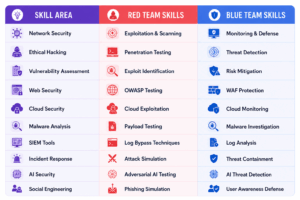
These practical skills are highly valuable in modern cybersecurity careers.
Career Opportunities
Both Red Team and Blue Team professionals have strong career opportunities globally.
Popular Red Team Job Roles
- Ethical Hacker
- Penetration Tester
- Red Team Operator
- Security Consultant
- Exploit Researcher
- Web Application Tester
- Cloud Security Tester
Popular Blue Team Job Roles
- SOC Analyst
- Incident Responder
- Threat Hunter
- Security Analyst
- DFIR Specialist
- Security Engineer
- Cyber Defense Analyst
As cybersecurity becomes more advanced, hybrid professionals with both offensive and defensive skills are becoming highly valuable.
Salary & Industry Demand
Cybersecurity remains one of the highest-paying IT industries in 2026.
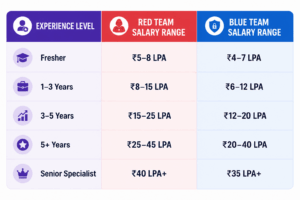
Global Demand is Rising
The shortage of skilled cybersecurity professionals continues to grow worldwide. Companies urgently need professionals who understand:
- Offensive security
- Defensive operations
- Cloud security
- AI threat detection
- Zero Trust security models
This demand makes cybersecurity one of the most stable and future-proof career options.
Real-World Importance of Red Team vs Blue Team
Imagine a financial company facing an AI-powered phishing campaign.
- The Red Team simulates phishing attacks to test employee awareness.
- The Blue Team monitors suspicious login attempts and prevents account compromise.
Another example:
- Red Team professionals identify a cloud vulnerability during testing.
- Blue Team professionals patch the issue and improve monitoring before attackers exploit it.
This real-world collaboration helps organizations stay secure against modern threats.
Tools & Technologies Used
Common Red Team Tools
- Kali Linux
- Metasploit
- Burp Suite
- Nmap
- Wireshark
- John the Ripper
- Cobalt Strike
- SQLmap
Common Blue Team Tools
- Splunk
- IBM QRadar
- Microsoft Sentinel
- CrowdStrike
- Snort
- Suricata
- ELK Stack
- Nessus
Modern cybersecurity professionals also work with:
- AI-based security systems
- Cloud security platforms
- Endpoint Detection & Response (EDR)
- Threat intelligence platforms
Hands-on lab experience with these tools is extremely important for job readiness.
Beginner Roadmap
Starting a cybersecurity career can feel overwhelming, but a structured roadmap makes the journey easier.
Step 1: Learn Networking Fundamentals
Understand:
- IP addressing
- Protocols
- DNS
- Firewalls
- TCP/IP
Step 2: Learn Operating Systems
Focus on:
- Linux
- Windows Security
- Command-line operations
Step 3: Learn Cybersecurity Basics
Study:
- Ethical hacking
- Threat detection
- Web security
- Malware basics
Step 4: Choose Your Path
- Offensive Security → Red Team
- Defensive Security → Blue Team
Step 5: Practice in Labs
Use:
- TryHackMe
- Hack The Box
- CTF platforms
- Security labs
Step 6: Earn Certifications
Recommended certifications:
- CEH v13 AI
- CompTIA Security+
- CHFI
- CSA
- CISSP
- OSCP
Step 7: Build Real-World Experience
Work on:
- Projects
- Internships
- Bug bounty programs
- Simulated environments
Why Choose Cyber Defentech?
Choosing the right training institute can significantly impact your cybersecurity career.
Cyber Defentech focuses on:
- Practical cybersecurity training
- Industry-focused learning
- Live attack simulations
- Hands-on labs
- Real-world projects
- Internship opportunities
- Career guidance
Students gain exposure to:
- Ethical hacking
- SOC operations
- AI security concepts
- Threat intelligence
- Cloud security
- Incident response
As an industry-focused cybersecurity training provider, Cyber Defentech helps learners build future-ready skills aligned with real-world industry requirements.
Future Scope & Industry Trends
Cybersecurity in 2026 is evolving rapidly because of:
- Artificial Intelligence
- Quantum computing risks
- Cloud-first infrastructure
- Remote work security
- Zero Trust Architecture
- AI-driven threat detection
Future Trends to Watch
AI Security
AI is now used by both attackers and defenders. Professionals who understand AI security will have massive career advantages.
Cloud Security
Cloud environments continue expanding rapidly, increasing demand for cloud-focused Red Team and Blue Team experts.
Threat Hunting
Organizations are investing heavily in proactive defense strategies.
Purple Teaming
Many companies are combining Red Team and Blue Team operations into collaborative Purple Team exercises.
Automation & SOC Evolution
Security automation and AI-driven detection systems are reshaping Blue Team operations.
The future of cybersecurity belongs to professionals who combine technical expertise, practical experience, and adaptive learning.
Final Thoughts
The debate between Red Team vs Blue Team careers is not about which role is better — it is about choosing the path that matches your strengths and interests.
If you enjoy:
- Ethical hacking
- Offensive security
- Attack simulation
- Breaking systems ethically
Then Red Teaming may be ideal for you.
If you enjoy:
- Threat monitoring
- Incident response
- Cyber defense
- Security analysis
Then Blue Teaming could be the right fit.
Both career paths are high-demand, future-ready, and financially rewarding in 2026.
As cyber threats continue evolving, organizations worldwide will continue searching for skilled professionals who can secure digital systems against next-generation attacks.
With the right practical training, certifications, and hands-on experience, you can build a successful long-term career in cybersecurity.
FAQs
1. Which is better: Red Team or Blue Team?
Both are excellent career paths. Red Team focuses on ethical hacking, while Blue Team focuses on defense and monitoring.
2. Is Red Teaming difficult for beginners?
It requires technical skills and practice, but beginners can start with networking, Linux, and ethical hacking basics.
3. What certifications are best for Red Team careers?
CEH, OSCP, eJPT, and GPEN are popular certifications for offensive security careers.
4. What certifications are best for Blue Team careers?
CompTIA Security+, CSA, CHFI, CISSP, and CySA+ are valuable for defensive security roles.
5. Are cybersecurity jobs in demand in 2026?
Yes. Cybersecurity jobs remain among the fastest-growing and highest-paying technology careers globally.
6. Do I need coding for Red Team or Blue Team?
Basic scripting knowledge in Python, Bash, or PowerShell is highly beneficial for both roles.
7. Can AI replace cybersecurity professionals?
No. AI assists security teams, but skilled professionals are still essential for analysis, strategy, and incident response.
8. How can I start a cybersecurity career?
Start with networking fundamentals, cybersecurity basics, hands-on labs, and industry-recognized certifications.
Ready to Build Your Career in Red Team & Blue Team Cybersecurity?
✅ Hands-on Practical Training
✅ Real-World Cybersecurity Skills
✅ Industry-Focused Learning
✅ Advanced Ethical Hacking Labs
✅ Future-Ready Career Path
✅ Internship & Career Guidance
