

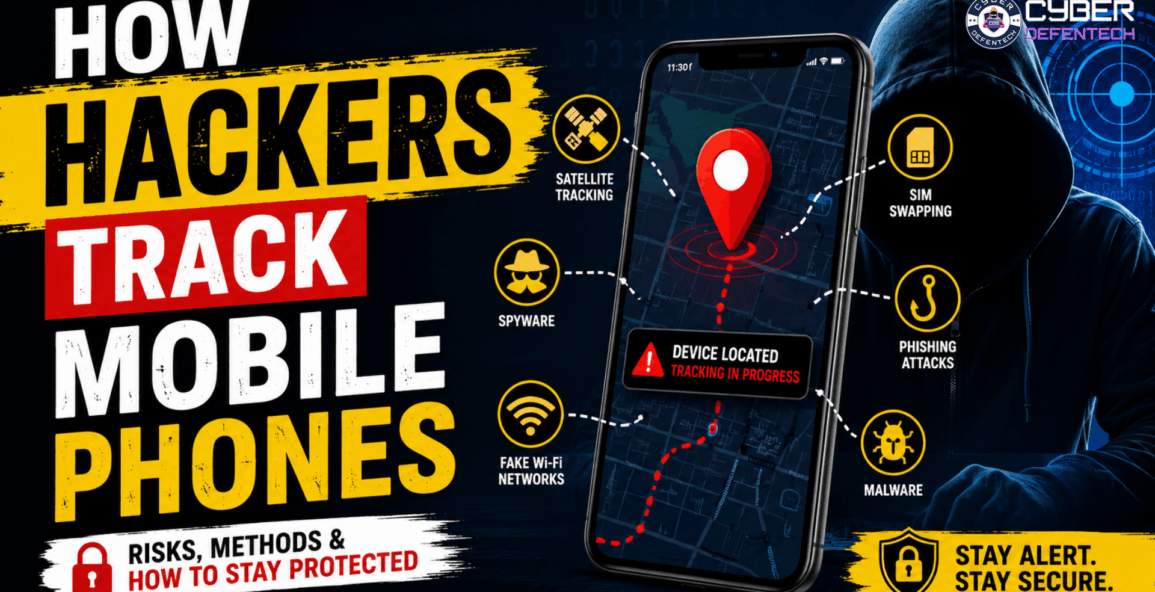
How Hackers Track Mobile Phones ?
By Cyber Defentech Team | May 2026 | 12 Mins Read | Beginner to Advanced
Introduction
Your smartphone knows almost everything about you.
It knows where you live, where you work, who you talk to, what websites you visit, what you buy online, and even where you travel every day. In many ways, your phone has become a digital extension of your identity.
Now imagine if a cybercriminal gained access to that information.
In today’s hyper-connected world, mobile devices have become one of the most attractive targets for hackers. Cybercriminals are constantly developing advanced techniques to track mobile phones, monitor user behavior, steal sensitive data, and conduct surveillance without the victim’s knowledge.
The rise of AI-powered cyberattacks, sophisticated spyware, social engineering campaigns, and mobile malware has transformed smartphone tracking into a major cybersecurity concern for individuals and organizations alike.
Understanding how hackers track mobile phones is no longer optional—it is an essential digital survival skill.
In this guide, we’ll explore the techniques hackers use, real-world risks, prevention strategies, career opportunities in mobile security, and why mobile cybersecurity expertise is becoming one of the most valuable skills in the modern cyber landscape.
What is Mobile Phone Tracking?
Mobile phone tracking refers to the process of identifying and monitoring a smartphone’s location, activities, communications, or behavior through technical methods.
While legitimate tracking technologies help users locate lost devices, support navigation systems, and improve emergency response services, cybercriminals often misuse similar technologies for malicious purposes.
Hackers may attempt to track:
- Physical location
- Internet activity
- Calls and messages
- Social media usage
- Device identifiers
- Browsing behavior
- Contact lists
- Camera and microphone access
- Banking activities
- Authentication credentials
Modern tracking attacks can occur remotely without the victim realizing anything unusual.
The average smartphone contains:
- Personal photographs
- Financial applications
- Banking credentials
- Corporate emails
- Authentication tokens
- Social media accounts
- Business documents
- Location history
A compromised smartphone can provide attackers with enough information to conduct:
- Identity theft
- Financial fraud
- Corporate espionage
- Social engineering attacks
- Account takeovers
- Surveillance operations
Why it Matters ?
Cybersecurity experts increasingly describe smartphones as the “new endpoint battlefield.”
As remote work, digital banking, cloud services, and AI-powered applications continue expanding, mobile devices have become prime targets for advanced cyber threats.
Understanding mobile tracking risks helps individuals:
- Protect privacy
- Prevent financial losses
- Secure personal information
- Reduce attack exposure
- Improve cyber awareness
How Hackers Track Mobile Phones?
Spyware Applications
Spyware remains one of the most dangerous mobile tracking tools used by cybercriminals.
Once installed, spyware can secretly monitor:
- GPS location
- Messages
- Emails
- Call logs
- Photos
- Microphone activity
- Camera access
Some advanced spyware platforms operate silently for months while transmitting information to remote servers.
Examples include:
- Pegasus-style spyware
- Commercial surveillance tools
- Remote administration trojans (RATs)
Phishing Attacks
Many mobile tracking attacks begin with a simple phishing message.
Victims receive:
- Fake delivery notifications
- Banking alerts
- Social media verification requests
- Security warnings
Clicking a malicious link may install malware or redirect users to credential-harvesting websites.
Modern AI-generated phishing campaigns are becoming increasingly convincing and difficult to detect.
Fake Public Wi-Fi Networks
Cybercriminals frequently create fake Wi-Fi hotspots in:
- Airports
- Hotels
- Cafes
- Shopping malls
- Public transportation hubs
When users connect, attackers may intercept:
- Login credentials
- Session cookies
- Browsing activity
- Personal information
This technique is commonly known as an Evil Twin Attack.
GPS Exploitation
Hackers can manipulate or access GPS-related information through:
- Malicious applications
- Compromised permissions
- Location-sharing abuse
- Malware infections
Location intelligence can reveal:
- Home address
- Daily routines
- Workplace locations
- Travel patterns
Such information is highly valuable for targeted attacks.
Bluetooth-Based Tracking
Unsecured Bluetooth connections can expose devices to:
- Data theft
- Device discovery
- Unauthorized access
- Tracking attempts
Attackers within range may exploit vulnerabilities to gather device information.
Cell Tower Simulation (IMSI Catchers)
Advanced attackers may use fake cellular towers, often called:
- Stingrays
- IMSI Catchers
These devices trick nearby phones into connecting through rogue infrastructure.
Potential risks include:
- Location tracking
- Call interception
- SMS monitoring
- Metadata collection
Although typically associated with advanced surveillance operations, the underlying techniques demonstrate the importance of secure communications.
Real-World Cyber Threats & Risks
Several major cyber incidents have highlighted the growing danger of smartphone surveillance.
Example 1: Executive Surveillance
Corporate executives have been targeted through mobile spyware campaigns designed to obtain sensitive business intelligence.
Example 2: Financial Fraud
Attackers use malicious apps to monitor SMS-based OTP messages and banking activities, enabling unauthorized financial transactions.
Example 3: Social Engineering Operations
Location information gathered from smartphones can be used to create highly convincing phishing attacks targeting specific individuals.
Example 4: AI-Powered Mobile Threats
Modern malware increasingly incorporates AI capabilities for:
- Behavioral analysis
- Adaptive evasion
- Automated phishing
- Intelligent targeting
These developments are creating next-generation mobile security challenges.
Why Companies Need Mobile Security Professionals?
Organizations today manage thousands of mobile endpoints.
These include:
- Employee smartphones
- Corporate tablets
- BYOD devices
- Remote workforce endpoints
Businesses require specialists capable of:
- Mobile threat detection
- Mobile application security testing
- Endpoint protection
- Vulnerability assessments
- Incident response
- Threat intelligence
As mobile attacks continue rising, mobile security expertise has become a high-demand cybersecurity specialization.
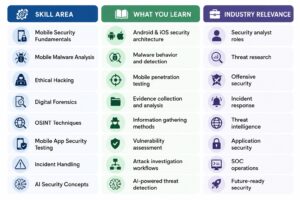
Skills You Will Learn
Career Opportunities
Professionals with mobile security expertise can pursue roles such as:
- Mobile Security Analyst
- Ethical Hacker
- Penetration Tester
- SOC Analyst
- Threat Hunter
- Digital Forensics Investigator
- Security Consultant
- Malware Researcher
- Incident Response Specialist
- Mobile Application Security Tester
These roles are increasingly important as organizations expand their mobile infrastructure and digital services.
Salary & Industry Demand
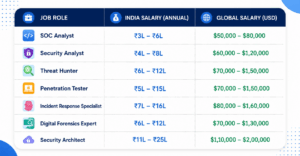
Growing digital transformation initiatives continue driving demand for cybersecurity professionals worldwide.
Real-World Importance of Mobile Security
Modern businesses rely heavily on mobile technology.
Industries including:
- Banking
- Healthcare
- Government
- E-commerce
- Manufacturing
- Education
all depend on smartphones for critical operations.
A compromised mobile device can become an entry point into larger enterprise environments.
Why It Matters?
One vulnerable smartphone can expose:
- Customer information
- Corporate credentials
- Intellectual property
- Financial records
- Internal communications
Mobile security is no longer just an IT concern—it is a business continuity requirement.
Tools & Technologies Used
Mobile security professionals commonly use:
- Burp Suite
- OWASP Mobile Security Testing Guide
- MobSF (Mobile Security Framework)
- Frida
- Wireshark
- Metasploit Framework
- Android Studio Security Tools
- Cellebrite Forensics Platforms
- Splunk
- Microsoft Defender for Endpoint
- CrowdStrike Falcon
- OSINT Framework
- Kali Linux
These tools provide practical exposure to real-world mobile security testing and analysis.
Beginner Roadmap
If you want to learn how mobile tracking attacks work and how security professionals defend against them, follow this roadmap:
Step 1: Learn Networking Fundamentals
Understand:
- IP addresses
- DNS
- TCP/IP
- Wireless networks
Step 2: Study Mobile Operating Systems
Learn Android and iOS architecture.
Step 3: Understand Cybersecurity Basics
Focus on:
- Threats
- Malware
- Authentication
- Encryption
Step 4: Learn Ethical Hacking
Practice:
- Vulnerability assessment
- Penetration testing
- Security testing
Step 5: Explore Mobile Application Security
Study:
- Secure coding
- API security
- Mobile vulnerabilities
Step 6: Build Hands-On Skills
Use labs and virtual environments to practice:
- Malware analysis
- Mobile forensics
- Threat hunting
Why Choose Cyber Defentech?
Learning cybersecurity requires far more than theory.
At Cyber Defentech, students gain exposure to:
- Hands-on practical labs
- Real-world attack simulations
- Ethical hacking environments
- Security monitoring exercises
- Industry-focused learning
- Career guidance and mentorship
- Certification-oriented training
- Live project experience
The focus remains on practical cybersecurity skills that align with current industry requirements and emerging threat landscapes.
Whether you are a beginner or an experienced professional, structured hands-on learning can significantly accelerate your cybersecurity career growth.
Future Scope & Industry Trends
The future of mobile cybersecurity is being shaped by:
- Artificial Intelligence Security
- Mobile Threat Defense Platforms
- Zero Trust Security Models
- Behavioral Analytics
- AI-Powered Threat Hunting
- Quantum-Resistant Cryptography
- Cloud-Mobile Security Integration
- Extended Detection & Response (XDR)
Experts predict continued growth in mobile attack sophistication, creating strong demand for professionals capable of protecting mobile ecosystems.
Organizations increasingly seek future-ready cybersecurity professionals who understand both traditional security principles and emerging AI-driven threats.
Final Thoughts
Understanding How Hackers Track Mobile Phones is essential in today’s digital-first world.
From spyware and phishing attacks to GPS exploitation and AI-powered surveillance, cybercriminals continue developing advanced methods for monitoring mobile users. Smartphones contain an enormous amount of sensitive personal and professional information, making them attractive targets for attackers.
The good news is that awareness, secure practices, modern security technologies, and professional cybersecurity expertise can dramatically reduce risk.
As mobile security threats continue evolving, the need for skilled cybersecurity professionals will only increase. For students, IT professionals, and career changers, learning mobile security represents a valuable opportunity to enter one of the fastest-growing areas of cybersecurity.
FAQs
1. Can hackers track my phone without installing an app?
Yes. Attackers may use phishing attacks, network interception, compromised accounts, or advanced surveillance techniques to collect information without directly installing visible applications.
2. How do I know if my phone is being tracked?
Common signs include unusual battery drain, increased data usage, device overheating, unexpected permissions, and unfamiliar applications.
3. Are Android phones easier to track than iPhones?
Both platforms face risks. Security depends more on user behavior, updates, permissions, and application sources than the operating system alone.
4. Can public Wi-Fi expose my phone to tracking?
Yes. Unsecured or fake Wi-Fi networks can allow attackers to monitor traffic and collect sensitive information.
5. What is mobile spyware?
Mobile spyware is malicious software designed to secretly monitor device activity, location, communications, and user behavior.
6. How can I protect my smartphone from tracking?
Keep software updated, avoid suspicious links, use strong authentication, review permissions regularly, and install applications only from trusted sources.
7. Is mobile security a good career in 2026?
Absolutely. Mobile security remains one of the fastest-growing cybersecurity specializations due to increasing smartphone usage and evolving mobile threats.
8. Which cybersecurity certification is useful for mobile security?
Foundational certifications such as Security+, CEH, and mobile application security training programs provide a strong starting point.
CTA Section
Ready to Build Your Career in Mobile Security & Ethical Hacking?
✅ Hands-on Practical Training
✅ Real-World Cybersecurity Skills
✅ Mobile Security & Ethical Hacking Labs
✅ Industry-Focused Learning Environment
✅ Future-Ready Career Path
✅ Expert Mentorship & Guidance
Cyber Defentech helps aspiring cybersecurity professionals gain practical experience through real-world scenarios, ethical hacking exercises, and industry-focused cybersecurity training.
🌐 Visit us: https://cyberdefentech.com
📞 Call / WhatsApp: +91 8448046612
📍 Enroll Now and Start Your Cybersecurity Journey Today.
Start building the skills needed to secure the next generation of mobile technologies and become part of the cybersecurity workforce shaping the future.
