


How to Start a Career in Ethical Hacking After College ?
Every 39 seconds, a cyberattack hits somewhere in the world. Banks are breached, hospitals are held hostage by ransomware, and government databases are infiltrated by state-sponsored hackers. The digital world is under siege — and the organisations defending it are desperately short-handed.
Here is the stark reality: there are millions of unfilled cybersecurity positions globally, and that gap is widening every single year. Artificial intelligence has supercharged both attackers and defenders, making the battlefield more complex and the demand for skilled professionals more urgent than ever before.
If you have just graduated from college and are wondering which career path offers stability, excitement, purpose, and exceptional earning potential — a career in ethical hacking after college is your answer. This is not just another tech job. Ethical hackers are the cyber-guardians of our digital civilisation, and the world desperately needs more of them.
This guide will show you exactly how to break into this high-demand field, what skills you need, which certifications matter, how much you can earn, and how Cyber Defentech can accelerate your journey from graduate to certified professional.
What is Ethical Hacking?
Ethical hacking — also known as penetration testing or white-hat hacking — is the authorised, systematic practice of attempting to breach computer systems, networks, and applications to identify vulnerabilities before malicious actors can exploit them.
Unlike criminal hackers who operate in the shadows, ethical hackers work with full legal permission from organisations. Their mission is to think like an attacker, act like an attacker, but report like a defender. The intelligence they gather enables organisations to patch weaknesses and fortify their digital infrastructure.
The Core Principle: Hack to Protect
Ethical hacking is a structured, methodology-driven discipline. It follows frameworks like the EC-Council’s Certified Ethical Hacker (CEH) process, OWASP guidelines, PTES (Penetration Testing Execution Standard), and MITRE ATT&CK — the globally recognised adversary behaviour knowledge base used by next-generation security operations centres worldwide.
With AI security threats evolving at machine speed, ethical hackers today must also understand adversarial machine learning, AI-powered attack automation, and advanced persistent threat (APT) methodologies — making this one of the most intellectually demanding and future-ready careers in technology.
Why is Career in Ethical Hacking Important?
The importance of ethical hacking cannot be overstated in today’s threat landscape. Consider these realities:
- Ransomware attacks cost global organisations billions in damages and downtime annually.
- Critical infrastructure — power grids, hospitals, water treatment plants — faces targeted cyberattacks daily.
- The average cost of a data breach continues to rise year over year.
- Zero-day vulnerabilities are being discovered at an accelerating pace as software complexity grows.
- AI-generated phishing attacks, deepfake social engineering, and automated exploitation tools have lowered the barrier for attackers significantly.
In this environment, organisations simply cannot afford to operate without ethical hackers. Every company that holds sensitive data — which is virtually every company on earth — needs professionals who can think like adversaries and neutralise threats before they materialise.
Choosing a career in ethical hacking after college is not just a smart financial decision. It is a choice to stand on the right side of one of the most consequential battles of our generation.
Real-World Cyber Threats & Risks
The Evolving Threat Landscape
The cybersecurity threats that ethical hackers combat today are sophisticated, multi-vector, and increasingly AI-driven. Understanding these threats gives you clarity on why your future role as an ethical hacker is so critical.
- Advanced Persistent Threats (APTs): Nation-state sponsored hacking groups that infiltrate networks and remain undetected for months, exfiltrating sensitive data silently.
- Ransomware-as-a-Service (RaaS): Organised criminal enterprises selling ransomware toolkits to unskilled attackers, democratising high-impact attacks.
- Supply Chain Attacks: Compromising trusted software vendors to distribute malware to thousands of downstream organisations simultaneously.
- AI-Powered Phishing: Machine learning models generating hyper-personalised phishing emails that bypass traditional detection systems.
- Zero-Day Exploits: Vulnerabilities in software that are unknown to developers, giving attackers an invisible window of opportunity.
- Cloud Misconfigurations: Misconfigured cloud storage and IAM policies that expose sensitive data to the public internet.
These are not hypothetical scenarios — they are daily realities that ethical hackers are hired to simulate, detect, and prevent. Each attack vector represents a specialisation area and a career opportunity for trained professionals.
Why Companies Need Ethical Hacking Professionals ?
The business case for hiring ethical hackers has never been stronger. Across every sector — banking, healthcare, e-commerce, government, defence, and telecommunications — organisations are investing heavily in offensive security capabilities.
Regulatory Pressure Driving Demand
Compliance frameworks like ISO 27001, PCI-DSS, HIPAA, GDPR, and India’s DPDP Act mandate regular security assessments, vulnerability testing, and penetration testing as a condition of operation. This regulatory requirement has transformed ethical hacking from a nice-to-have into a business necessity.
The Bug Bounty Economy
Companies like Google, Microsoft, Meta, and Apple run multi-million-dollar bug bounty programmes that reward ethical hackers for discovering and responsibly disclosing vulnerabilities. A skilled ethical hacker can earn significant income purely through bug bounty hunting — creating a powerful freelance career path alongside traditional employment.
Red Team Culture is Mainstream
Enterprise organisations now maintain full-time red teams — groups of ethical hackers who continuously simulate attacks against their own infrastructure. These internal adversarial teams represent some of the highest-paying and most intellectually stimulating roles in the entire cybersecurity industry.
Skills You Will Learn as an Ethical Hacker
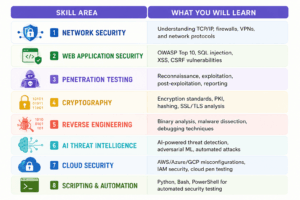
At Cyber Defentech, every skill listed above is taught through hands-on labs, real-world attack simulations, and industry-standard environments — not just theoretical lectures. Practical exposure is at the core of every training programme.
Career Opportunities in Ethical Hacking
One of the most compelling aspects of a career in ethical hacking after college is the sheer diversity of roles available across industries. Your skill set is universally applicable — every sector with a digital presence needs you.
Core Ethical Hacking Roles
- Penetration Tester (Ethical Hacker): Conducts authorised security assessments of networks, applications, and systems.
- Red Team Specialist: Simulates full-scale adversarial attacks against enterprise organisations.
- Vulnerability Researcher: Discovers and analyses new vulnerabilities in software and hardware.
- Bug Bounty Hunter: Independently identifies and reports vulnerabilities through official bug bounty programmes.
- Application Security Engineer: Integrates security into the software development lifecycle (DevSecOps).
- Cloud Security Analyst: Specialises in identifying and remediating cloud infrastructure vulnerabilities.
- Digital Forensics Investigator: Analyses breached systems to reconstruct attack timelines and gather evidence.
- Threat Intelligence Analyst: Tracks adversary groups, tactics, techniques, and procedures (TTPs) using advanced intelligence tools.
Each of these roles represents a distinct and growing specialisation. Starting as a penetration tester, you can carve a highly focused career path based on your strengths and interests — from mobile application security to industrial control system (ICS) security and AI threat modelling.
Salary & Industry Demand
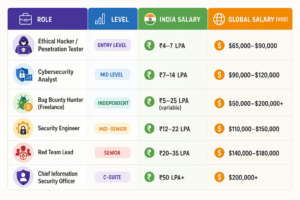
Beyond base salaries, ethical hackers often earn additional income through bug bounty programmes, freelance penetration testing contracts, speaking engagements, and security consulting. The profession rewards skill, continuous learning, and demonstrated expertise generously.
Real-World Importance of Ethical Hacking
Why It Matters: The Human Cost of Cybercrime
Cybercrime is not an abstract technical problem. It has profound real-world consequences for ordinary people. Healthcare data breaches expose patients’ most sensitive medical information. Financial fraud steals life savings from families. Ransomware attacks on hospitals have delayed critical patient care, with tragic consequences.
Ethical hackers stand between these outcomes and the organisations responsible for protecting people. Every vulnerability you discover and report, every penetration test you conduct, every security assessment you complete — it all translates into tangible protection for real people.
This is the emotional weight and the professional privilege of being an ethical hacker. Your work matters in ways that few careers can claim. You are not just writing code or managing servers. You are actively defending the digital infrastructure that society depends upon every day.
India’s Cybersecurity Imperative
India has emerged as a major target for cyberattacks as its digital economy expands rapidly. With the Digital India initiative, UPI payment infrastructure, Aadhaar identity systems, and a booming startup ecosystem, the attack surface has grown enormously. India’s cybersecurity professionals are now on the frontlines of protecting one of the world’s largest and fastest-growing digital economies — making a career in ethical hacking after college in India particularly impactful and strategically important.
Tools & Technologies Used in Ethical Hacking
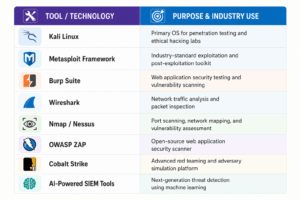
Cyber Defentech’s training environment provides hands-on access to these tools in realistic lab scenarios, ensuring you graduate with genuine practical proficiency — not just theoretical familiarity.
Why Choose Cyber Defentech?
In a market saturated with generic online courses and passive video lectures, Cyber Defentech stands apart as a premium, industry-focused cybersecurity training provider committed to producing job-ready ethical hacking professionals.
What Makes Cyber Defentech Different?
✅ Hands-On Practical Training in real cybersecurity lab environments.
✅ Industry-Expert Instructors — active professionals with genuine field experience.
✅ Certification-Aligned Curriculum — CEH, OSCP, CompTIA Security+, eJPT.
✅ Real-World Exposure through simulated enterprise attack and defence scenarios.
✅ Career Support from training to placement.
✅ Future-Ready Curriculum including AI security and cloud penetration testing.
✅ Beginner-Friendly Pathways — no prior hacking experience required.
Cyber Defentech is not just a training provider. It is a launchpad for the next generation of cybersecurity professionals who will defend India’s — and the world’s — digital future.
Future Scope & Industry Trends
The cybersecurity industry is not just growing — it is transforming. Understanding where the industry is headed positions you to build a career that remains relevant, high-demand, and exceptionally rewarding for decades to come.
Key Trends Shaping the Future of Ethical Hacking
- AI-Powered Offensive Security: Ethical hackers will increasingly use AI tools to automate reconnaissance, identify vulnerabilities at scale, and simulate sophisticated attack patterns.
- Zero Trust Architecture: As organisations adopt Zero Trust security models, ethical hackers specialised in testing these architectures will see explosive demand.
- IoT and OT Security: The proliferation of Internet of Things devices and operational technology systems creates vast new attack surfaces requiring specialised penetration testers.
- Quantum Computing Threats: The approaching quantum computing era threatens current encryption standards, creating urgent demand for cryptography specialists.
- Automotive and Medical Device Security: Connected vehicles and internet-enabled medical devices represent high-stakes, high-demand specialisation areas.
- Bug Bounty Programme Expansion: More organisations launching bug bounty programmes means more income opportunities for independent ethical hackers globally.
The future belongs to professionals who combine deep technical expertise with adaptability, continuous learning, and genuine passion for the field.
Final Thoughts
A career in ethical hacking after college is not just viable — it is one of the smartest, most future-ready decisions a technology graduate can make today. The combination of exceptional salary potential, universal industry demand, intellectual stimulation, and genuine societal impact makes this career path truly exceptional.
The digital world needs defenders who think like attackers. It needs professionals with the technical depth to navigate complex vulnerabilities, the strategic mind to anticipate emerging threats, and the ethical commitment to use their skills for protection rather than destruction.
That professional could be you. The path starts with the right training, the right mentorship, and the commitment to continuous learning. Cyber Defentech is ready to walk that path with you — from your first lab session to your first job offer and beyond.
Do not wait for the perfect moment. In cybersecurity, the threat landscape does not pause, and neither should your career preparation. Start today. Your future as a certified ethical hacker begins now.
Frequently Asked Questions (FAQs)
1. Can I start a career in ethical hacking after college without a CS degree?
Absolutely. While a Computer Science degree provides a useful foundation, many successful ethical hackers come from diverse educational backgrounds. What matters most is practical skill, demonstrated competency through certifications like CEH or OSCP, and a portfolio of real-world experience. Cyber Defentech’s structured training programmes are specifically designed to onboard students from any academic background.
2. Which certifications should I pursue first as a beginner?
For beginners, the recommended starting certifications are CompTIA Security+ (foundational security knowledge), followed by eJPT or CEH. As you advance, OSCP is widely regarded as the gold standard for penetration testers. Cyber Defentech provides training aligned with all of these certification pathways.
3. How long does it take to become a professional ethical hacker?
With dedicated, structured training, most beginners can achieve entry-level competency within 3 to 6 months. Reaching a mid-level professional standard typically requires 1 to 2 years of continuous learning and real-world exposure. Cyber Defentech’s accelerated, practical programmes are designed to compress this learning curve significantly.
4. Is ethical hacking legal in India?
Yes — ethical hacking conducted with proper written authorisation from the target organisation is entirely legal in India, governed by the Information Technology Act. Practising on dedicated lab environments, personal test systems, and authorised bug bounty platforms is completely legal and strongly encouraged.
5. What is the starting salary for an ethical hacker in India?
Entry-level ethical hackers in India typically earn between ₹4 to ₹7 LPA, depending on the employer and role. With 2 to 4 years of experience and recognised certifications, salaries commonly rise to ₹10 to ₹18 LPA or higher. Senior professionals can command ₹25 LPA and above.
6. Do I need to know programming to become an ethical hacker?
Programming knowledge is highly beneficial but not an absolute prerequisite for starting. Understanding Python and Bash scripting significantly enhances your capabilities. Cyber Defentech’s curriculum includes scripting and automation modules that bring students up to the required proficiency level as part of the core programme.
7. What is bug bounty hunting and can I earn from it as a student?
Bug bounty hunting involves finding and responsibly disclosing security vulnerabilities to organisations through official programmes on platforms like HackerOne and Bugcrowd. Rewards range from a few hundred to tens of thousands of dollars per valid report. Many ethical hackers begin earning through bug bounties while still in training.
8. How does Cyber Defentech prepare students for real-world ethical hacking careers?
Cyber Defentech prepares students through hands-on lab environments, real-world attack simulation scenarios, certification preparation, and dedicated career support. Students work in simulated enterprise networks, practise with industry-standard tools, and receive mentorship from active cybersecurity professionals — graduating genuinely job-ready.
Ready to Build Your Career in Ethical Hacking after College ?
The cybersecurity industry is waiting for skilled, passionate, and future-ready ethical hackers. At Cyber Defentech, we transform graduates into certified cybersecurity professionals through hands-on, practical, industry-focused training that delivers real results.
✅ Hands-On Practical Training in real cybersecurity lab environments
✅ Real-World Cybersecurity Skills aligned with active industry demands
✅ Industry-Focused Learning from experienced, practising professionals
✅ Future-Ready Career Path with global certification alignment
✅ Career Support from training to placement
🌐 Visit Us: https://cyberdefentech.com/
📞 Call / WhatsApp: +91 8448046612
Your ethical hacking career starts with a single step. Take it today with Cyber Defentech.
