

Why DPDPA and ISO 27001 Will Dominate Cybersecurity Compliance in 2026 ?
By Cyber Defentech Team | May 2026 | 10 Mins Read | Beginner to Advanced
Introduction
In 2024, a leading Indian fintech company suffered a data breach exposing 7.4 million customer records. The fallout? Not just regulatory fines — complete erosion of customer trust, a 30% drop in share value, and a two-year legal battle. The uncomfortable truth? The breach was entirely preventable with the right compliance framework in place.
Welcome to 2026 — the year cybersecurity compliance stopped being a checkbox exercise and became an existential business imperative. Across boardrooms in Mumbai, Bengaluru, Hyderabad, and beyond, two acronyms have risen to dominate every cybersecurity conversation: DPDPA (Digital Personal Data Protection Act) and ISO 27001.
India’s DPDPA 2023 is now in full enforcement mode, and global organisations operating in India must align or face penalties of up to ₹250 crore per violation. Simultaneously, ISO 27001:2022 — the gold-standard international framework for Information Security Management Systems (ISMS) — has updated its controls to address AI threats, cloud security, and next-generation attack vectors that simply didn’t exist a decade ago.
Together, these two frameworks are rewriting the rules of cybersecurity governance. And for professionals who master both, the career opportunities are extraordinary. This guide from Cyber Defentech breaks down everything you need to know — from foundational concepts to advanced compliance strategies, real-world risks, salary benchmarks, and a future-ready roadmap.
What Is DPDPA and ISO 27001?
DPDPA — India’s Digital Personal Data Protection Act 2023
The Digital Personal Data Protection Act (DPDPA) is India’s landmark data privacy legislation, enacted in August 2023 and modelled on global frameworks like the EU’s GDPR. It governs how organisations collect, process, store, and share the personal data of Indian residents — both within India and from outside its borders when Indian data principals are involved.
Unlike previous IT Act provisions that were ambiguous and under-enforced, the DPDPA 2023 is precise, punitive, and operationally demanding. It introduces concepts like data fiduciaries, data processors, consent managers, and the Data Protection Board of India (DPBI) — a powerful regulatory body with real enforcement teeth.
ISO 27001:2022 — The International Standard for Information Security
ISO/IEC 27001 is the world’s most recognised international standard for establishing, implementing, maintaining, and continually improving an Information Security Management System (ISMS). The 2022 revision brought sweeping updates: 11 new controls addressing cloud security, threat intelligence, data masking, physical security monitoring, and — critically — information security for the use of cloud services and supplier relationships in the AI era.
ISO 27001 certification is increasingly demanded by enterprise clients, government procurement bodies, and international trade partners as a baseline proof of security maturity. In 2026, it is no longer a competitive differentiator — it is a market entry requirement.
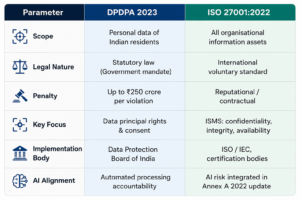
Think of DPDPA as the legal “what you must do” and ISO 27001 as the technical “how you do it.” Together, they form an unbreakable compliance shield.
DPDPA vs ISO 27001 — Framework Comparison
Why Is DPDPA and ISO 27001 Compliance Important in 2026?
The cybersecurity threat landscape has fundamentally transformed. AI-powered attacks, deepfake-enabled social engineering, ransomware-as-a-service (RaaS) ecosystems, and supply chain compromises have made legacy security approaches dangerously obsolete. Here is why these frameworks are more important now than ever:
- India has 900 million+ internet users — the world’s second-largest digital economy — making personal data a high-value target.
- The average cost of a data breach in India reached ₹17.9 crore in 2024 (IBM Cost of a Data Breach Report).
- Non-compliance with DPDPA now carries penalties up to ₹250 crore per incident — enough to bankrupt mid-sized organisations.
- ISO 27001 certification is now a mandatory prerequisite for government contracts, BFSI sector partnerships, and MNC vendor onboarding.
- Global enterprises operating in India face dual compliance obligations under both DPDPA and international frameworks like GDPR and CCPA.
- The rise of AI-generated attacks demands structured, policy-driven defences that only a formal ISMS can provide.
“Compliance is not a one-time project. It is a continuous security posture — and in 2026, organisations that treat it as less are one breach away from irrelevance.” — Cyber Defentech Training Team
Real-World Cyber Threats Driving Compliance Urgency
AI-Powered Phishing & Social Engineering
Generative AI has democratised sophisticated phishing. In 2025, threat actors used large language models to craft hyper-personalised spear-phishing emails with zero grammatical errors, bypassing traditional email filters. DPDPA’s breach notification requirements and ISO 27001’s A.6.3 awareness training controls are the first line of defence.
Ransomware Targeting Indian BFSI & Healthcare
India’s financial and healthcare sectors suffered 38% more ransomware attacks in 2025 compared to 2024 (CERT-In Annual Report). Attackers specifically exploit organisations without formal ISMS, knowing they lack incident response plans, backup protocols, and recovery time objectives (RTOs).
Third-Party & Supply Chain Compromise
Over 60% of data breaches now originate from third-party vendors (Ponemon Institute). ISO 27001’s Annex A.5.19 to A.5.23 controls — covering supplier relationships and cloud service security — directly address this vulnerability. DPDPA additionally mandates that data fiduciaries conduct due diligence on all data processors they engage.
Insider Threats in the Remote-Work Era
With India’s hybrid workforce now exceeding 45 million knowledge workers, insider threats — both malicious and accidental — have surged. ISO 27001’s human resource security controls (A.6.1–A.6.5) combined with DPDPA’s data minimisation and purpose limitation principles create a robust defence architecture.
Why Companies Are Desperately Seeking DPDPA & ISO 27001 Professionals?
The compliance skills gap is real, severe, and widening. According to NASSCOM’s 2025 Cybersecurity Skills Report, India alone needs 1.5 million additional cybersecurity professionals by 2027 — with compliance, GRC (Governance, Risk & Compliance), and data privacy specialists topping the most-wanted list.
Here is the business reality driving this demand:
- Every company processing personal data of Indian citizens must appoint a Data Protection Officer (DPO) — creating thousands of new C-level roles overnight.
- Multinational corporations are establishing dedicated India Compliance Centres, requiring teams of 10–50 specialists per organisation.
- The Data Protection Board of India is actively investigating complaints, making compliance a board-level priority, not an IT afterthought.
- ISO 27001 auditors and lead implementers are commanding 40–60% salary premiums over general IT security professionals.
- Insurers are now making ISO 27001 certification a prerequisite for cybersecurity insurance underwriting — pushing even SMEs to comply.
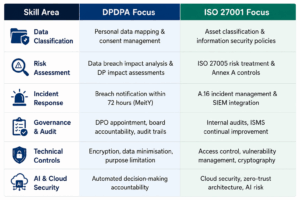
Skills You Will Learn :
DPDPA & ISO 27001 Training — Skills Overview
Career Opportunities in DPDPA & ISO 27001 Compliance
Mastering DPDPA and ISO 27001 opens doors across every industry vertical — from banking and fintech to healthcare, e-commerce, manufacturing, and government. The roles are high-impact, well-compensated, and increasingly senior in organisational hierarchy.
High-Demand Career Paths
- Data Protection Officer (DPO) — Statutory role mandated by DPDPA for significant data fiduciaries.
- ISO 27001 Lead Auditor — Conducts third-party certification audits; globally portable credential.
- GRC Analyst / Manager — Governs organisational risk, compliance frameworks, and control testing.
- Privacy Engineer — Embeds privacy-by-design principles into software development lifecycles.
- AI Governance Specialist — Emerging role addressing algorithmic accountability under DPDPA and global AI regulations.
- CISO (Chief Information Security Officer) — Apex security leadership; commands the highest compensation in the field.
- Cybersecurity Compliance Consultant — Advises organisations on regulatory alignment; high demand in Big 4 and boutique advisory firms.
Salary & Industry Demand
Salary Benchmarks — DPDPA & ISO 27001 Professionals (2026)
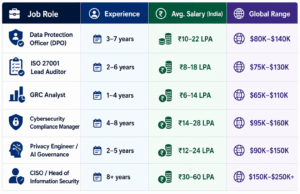
Note: Salary figures are indicative market ranges based on LinkedIn Salary Insights, Glassdoor India, and AmbitionBox (2025–2026).
Real-World Importance of DPDPA & ISO 27001
The DPDPA Enforcement Reality
The Data Protection Board of India became operational in late 2024. Unlike regulatory bodies of the past that moved slowly, the DPBI has fast-track adjudication procedures, can impose penalties without prior warning, and has already issued notices to several major e-commerce and financial services companies. This is not theoretical risk — it is an active enforcement environment.
ISO 27001 as a Market Access Credential
In 2026, organisations without ISO 27001 certification are being excluded from RFPs (Request for Proposals) by global enterprises. This is happening in sectors as diverse as IT/ITES, pharmaceuticals, automotive, and aerospace. The certification has crossed the threshold from “preferred” to “required” — and professionals who can implement and maintain ISMS are consequently in extreme demand.
The Convergence with AI Regulation
India is drafting an AI governance framework that explicitly references DPDPA obligations for AI systems processing personal data. ISO 27001:2022’s updated Annex A already includes controls for AI and machine learning systems. Professionals who understand how these frameworks interact with emerging AI regulation will be the cybersecurity leaders of the next decade.
Tools & Technologies Used
Key Tools in DPDPA & ISO 27001 Compliance Practice
| Category | DPDPA Tools | ISO 27001 Tools |
|---|---|---|
| GRC Platforms | OneTrust, TrustArc, BigID | Archer, ServiceNow GRC, Egnyte |
| SIEM / SOC | Splunk, IBM QRadar, Microsoft Sentinel | Splunk ES, Elastic SIEM, Wazuh |
| Risk & Audit | LogicGate, Vanta, Sprinto | Qualys, Nessus, Drata |
| AI Security | Privado.ai, Securiti.ai, DataGrail | Darktrace, CrowdStrike Falcon, SentinelOne |
At Cyber Defentech, training goes beyond theory. Students gain hands-on lab experience with enterprise-grade GRC platforms, SIEM dashboards, vulnerability management tools, and data discovery engines — the exact toolkit used by compliance professionals in the real world.
Why Choose Cyber Defentech?
At Cyber Defentech, we are not just a training institute — we are a career transformation partner. Our curriculum is built by active industry practitioners, not academic theorists. Every course is designed to deliver practical, hands-on learning that translates directly to workplace performance from day one.
- Industry-Focused Curriculum: Aligned with DPDPA 2023, ISO 27001:2022, CERT-In guidelines, and emerging AI governance frameworks.
- Real-World Lab Environment: Practice with enterprise-grade GRC tools, SIEM platforms, and compliance management software used by Fortune 500 companies.
- Expert Trainers: Learn from certified DPOs, ISO 27001 Lead Auditors, and CISO-level practitioners with decades of industry experience.
- Placement Support: Dedicated career services team with partnerships across BFSI, IT/ITES, healthcare, and consulting sectors.
- Flexible Learning: Online, offline, and hybrid batches to fit every schedule — from fresh graduates to senior professionals upskilling for leadership roles.
- Certification Preparation: Structured preparation tracks for globally recognised credentials that accelerate career progression.
Cyber Defentech alumni are currently working as DPOs, Lead Auditors, GRC Managers, and Privacy Engineers across top-tier organisations in India and internationally.
Future Scope & Industry Trends
AI-Driven Compliance Automation
Machine learning is transforming compliance monitoring. AI tools can now continuously scan organisational data flows, flag DPDPA violations in real time, and auto-generate audit evidence for ISO 27001 assessments. Professionals who understand both the regulatory requirements and the AI tools that enforce them will command a significant premium.
Cross-Border Data Transfer Regulations
DPDPA introduces strict rules on cross-border personal data transfers, with an approved-country whitelist mechanism. As India’s digital economy deepens its global integration, managing compliant data flows will become a specialised sub-discipline within privacy law and technology.
Sector-Specific Compliance Overlaps
India’s IRDAI (insurance), RBI (banking), and SEBI (securities) regulators are aligning their sector-specific cybersecurity guidelines with DPDPA and ISO 27001. This creates layered compliance obligations that require professionals with both domain expertise and cross-framework fluency.
The Compliance-as-a-Service Economy
Small and medium enterprises that cannot afford full-time compliance teams are outsourcing to virtual DPOs and compliance consultancies. This creates a thriving freelance and boutique-advisory market for certified professionals — a genuinely future-ready career path with entrepreneurial potential.
Final Thoughts
In 2026, DPDPA and ISO 27001 are not compliance options — they are non-negotiable business requirements. Every organisation that processes personal data, manages digital assets, or operates in India’s dynamic regulatory environment must build compliance competency. And that competency starts with people.
The professionals who master these frameworks today will not just be protecting organisations from regulatory risk — they will be shaping the future of India’s digital economy, earning exceptional salaries, and building careers with true longevity and global relevance.
Your compliance journey starts with a single, decisive step. Cyber Defentech is here to guide every stride that follows.
Frequently Asked Questions (FAQs)
Q1. What is the DPDPA and when did it come into effect?
The Digital Personal Data Protection Act (DPDPA) is India’s comprehensive data privacy legislation enacted in August 2023. The Data Protection Board of India became operational in late 2024, and enforcement of key provisions began progressively through 2025. In 2026, full enforcement is active, including penalty provisions of up to ₹250 crore per violation.
Q2. Is ISO 27001 certification mandatory for Indian companies?
ISO 27001 is technically a voluntary international standard, but it has become functionally mandatory in practice. Government tenders, enterprise RFPs, banking regulations, and cybersecurity insurance underwriting increasingly require ISO 27001 certification. Companies in BFSI, healthcare, IT/ITES, and defence sectors face the strongest pressure.
Q3. Can beginners with no IT background pursue a career in DPDPA/ISO 27001 compliance?
Absolutely. DPDPA and ISO 27001 compliance is a multidisciplinary field that welcomes professionals from law, business, management, and technology backgrounds. While foundational IT literacy helps, many of the most effective DPOs and compliance managers come from legal, finance, or risk management backgrounds. Cyber Defentech’s programmes are designed for both beginners and experienced professionals.
Q4. How long does it take to get ISO 27001 certified?
ISO 27001 Lead Implementer and Lead Auditor certifications typically require 5-day intensive training programmes plus a written examination. However, building the practical skills to implement an ISMS end-to-end — including internal audit, risk assessment, and management review — typically requires 3–6 months of focused study and practical exposure, which Cyber Defentech’s structured programmes provide.
Q5. What salary can I expect as a DPDPA compliance professional in India?
Entry-level GRC Analysts and Privacy Specialists typically earn ₹6–10 LPA. Mid-level Data Protection Officers and ISO 27001 Lead Auditors command ₹10–22 LPA. Senior Compliance Managers and CISOs earn ₹25–60+ LPA depending on organisation size, industry, and certification profile. Globally, the figures translate to $65,000–$250,000+ annually.
Q6. How does DPDPA relate to AI governance in India?
DPDPA directly governs AI systems that process personal data of Indian residents. Obligations around automated decision-making, data minimisation, purpose limitation, and consent apply to AI/ML systems just as they do to traditional data processing. India’s forthcoming AI governance framework is expected to build upon DPDPA provisions, making AI governance expertise a natural extension of DPDPA compliance skill sets.
Q7. What industries have the highest demand for DPDPA and ISO 27001 professionals?
BFSI (banking, financial services, insurance) leads demand, followed by IT/ITES, healthcare, e-commerce, pharmaceuticals, telecom, and government/public sector. Any organisation processing personal data of Indian residents — which in practice includes virtually all significant businesses — needs DPDPA compliance expertise. ISO 27001 demand spans all industries operating digitally.
Q8. Why should I choose Cyber Defentech over other training providers?
Cyber Defentech offers industry-led, practical training that goes beyond theory. Our programmes include real-world lab simulations, mock audits, case study-based learning, and certification preparation tracks. Our trainers are active industry practitioners — certified DPOs, ISO 27001 Lead Auditors, and CISOs — not just educators. Our placement support network and alumni community provide ongoing career development support long after course completion.
Ready to Build Your Career in DPDPA & ISO 27001 Compliance?
Join India’s Most Advanced Cybersecurity Compliance Training Program
✅ Hands-on Practical Training with Real-World Lab Simulations
✅ Real-World Cybersecurity & Compliance Skills
✅ Industry-Focused Curriculum — DPDPA, ISO 27001, GRC, AI Governance
✅ Certification Preparation & Career Placement Support
✅ Future-Ready Career Path in the World’s Fastest-Growing Compliance Sector
🌐 cyberdefentech.com
📞 +91 8448046612
📧 Enroll today and secure your place in the compliance-driven future of cybersecurity.
