
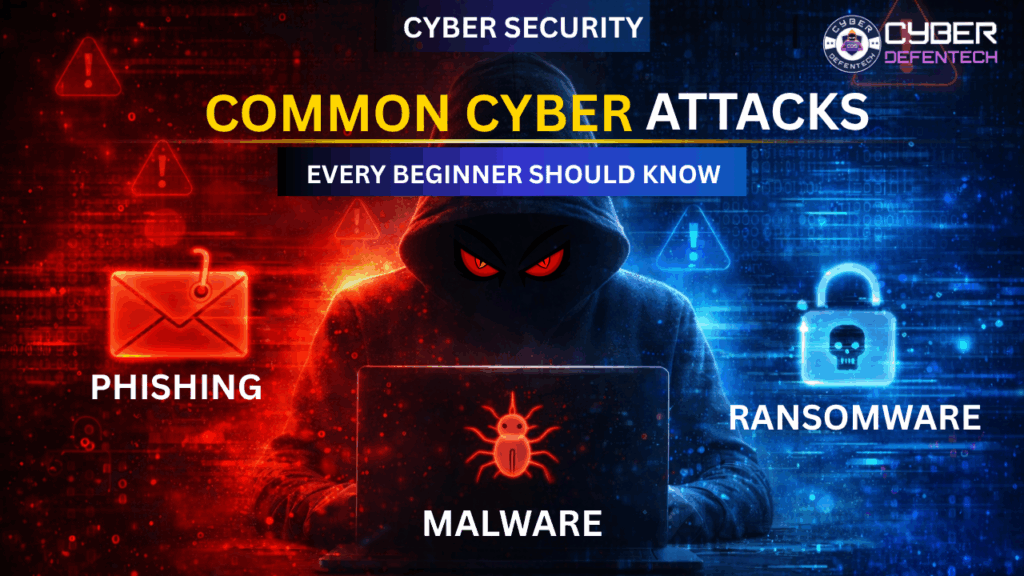
Types of cyber attacks are not something most people think about in daily life.
To be honest…
In today’s world, everyone uses a smartphone. The moment we wake up, we check WhatsApp, Instagram, and YouTube. Later, we use online payments, shopping, emails—everything has become digital.
And in the coming time, this will only increase.
But there is one thing most people ignore — security.
Most people think:
“I don’t have anything important. Who will hack me?”
This is the biggest mistake.
Because in reality, hackers do not care whether you are rich or normal, or which device you use.
They only look for easy targets.
And normal users are the easiest targets.
That is why, if you want to stay safe or start learning cybersecurity, you must first understand how these attacks actually work.
Types of Cyber Attacks Explained
These types of cyber attacks are very common in today’s digital world, and every beginner should understand them.
1. Phishing Attack (Most Common)
This is the most common cyberattack; almost everyone has seen it.
A hacker sends a fake message or email.
The link looks real. The website looks original.
You click without thinking, and that’s where the problem starts.
Real example:
“Your bank account will be blocked. Verify now.”
You panic, click the link, enter your login details…
And within seconds, your account access is gone.
What’s happening?
- The link is fake (small difference you don’t notice)
- The website is a copy
- You unknowingly give your data to the hacker
2. Password Attack (Weak Password Risk)
Be honest…
Many people still use passwords like:
123456
password
name123
This is very risky.
Hackers don’t guess passwords manually.
They use tools that try thousands of combinations in seconds.
Result:
- Instagram hacked
- Gmail hacked
- Full account access lost
Simple rule:
Weak password = Open gate
Strong password = Locked system
3. Malware Attack (Hidden Danger)
Malware means harmful software.
It doesn’t attack directly—it hides.
You install:
- Cracked apps
- Unknown files
- Free downloads
And malware enters your device.
What happens next?
- Data gets stolen
- Phone becomes slow
- Activity is tracked
- Camera/mic can be accessed
Example:
You download a free movie or a cracked app.
It works fine… but your data is leaking in the background.
4. Social Engineering (Mind Game)
This is not a technical attack—it’s a human attack.
Hackers target your trust.
Example:
“Hello, sir, I’m calling from your bank. Share your OTP for verification.”
If you trust them and share it… Your account is gone.
Important:
Systems can be secure, but human mistakes are easy to exploit.
5. Public WiFi Attack (Free WiFi Risk)
Free WiFi in malls, cafes, or stations may feel convenient—but it’s risky.
Hackers on the same network can monitor your activity.
That means:
- What you type
- What you log into
- Your personal data
Rule:
Avoid banking and password login on public WiFi.
6. Ransomware Attack (High Danger)
In this attack, your system gets locked.
You cannot access your files.
A message appears:
“Pay money to unlock your data.”
If you don’t have a backup, your data is lost.
This mostly targets companies, but individuals can also be affected.
7. Fake Apps Attack
Downloading apps from unknown sources is dangerous.
Fake apps look exactly like the original ones.
Same name. Same icon.
But inside, they are harmful.
What they do:
- Steal data
- Spy on activity
Example:
Fake WhatsApp-like app → Full data leak
Most Important Point
These types of cyber attacks are not very complex.
Most people get trapped because of small mistakes.
These types of cyber attacks can be prevented if you follow basic safety practices.
- Do not click on unknown links
- Use strong passwords (letters + numbers + symbols)
- Never share OTP
- Avoid unknown apps
- Do not use public WiFi for sensitive work
For Students
If you want to enter cybersecurity, this is your first step.
Understanding real-world types of cyber attacks helps you think like a security expert.
The more you understand, the stronger you become.
Final Thought
You don’t need to be rich to get hacked.
Being careless is enough.
Learning about these types of cyber attacks is the first step to becoming cyber aware.
If you seriously want to learn cybersecurity:
- Beginner-friendly training
- Practical hands-on learning
- Step-by-step guidance
📞 Call / WhatsApp: +91 8448046612
📧 Email: training@cyberdefentech.com
🌐 Website: cyberdefentech.com
